How Reinforcement Learning from Human Feedback Is Reshaping Robotic Manipulation
Research by the Algorithmine Editorial Team | June 28, 2026
Robots are getting better at picking things up. But ask them to thread a USB-C cable into a port—one of the most mundane tasks a human performs without thinking—and you'll watch them fail in spectacular, expensive ways. The tolerances are tight. The contact dynamics are unpredictable. A hard-coded solution works until it doesn't—until the cable is slightly bent, the port is a fraction of a millimeter off from nominal, or the lighting changes.
This is the fundamental challenge of robotic manipulation: the physical world does not conform to clean geometric models. And for decades, the robotics field struggled to bridge that gap between simulation and reality—until researchers started asking a deceptively simple question: what if we just asked humans to tell us when the robot is doing it right?
That question sits at the heart of Reinforcement Learning from Human Feedback (RLHF). And in 2026, it is quietly revolutionizing how robots learn to manipulate the physical world.
From Text Models to Robot Arms
RLHF first gained widespread attention in 2022–2023, when it became the technique behind ChatGPT and similar large language models. The core insight was elegant: instead of training a model purely on human-written text, researchers first train a reward model that predicts what humans find helpful, then use that reward model to fine-tune the base model through reinforcement learning. The result was AI that felt more aligned with human intentions—not because someone programmed those intentions explicitly, but because human feedback shaped the model's behavior.
Researchers in robotics quickly saw the parallels. Teaching a robot to manipulate objects has the same fundamental problem: it's easy to recognize good performance when you see it, but extremely hard to write down mathematical rules that define "good" in all cases. A human can look at a robot attempting to fold a shirt and immediately sense something is off—the motion is too jerky, the grip is too loose, the timing is wrong. But encoding that intuition into a reward function? That's a years-long research project.
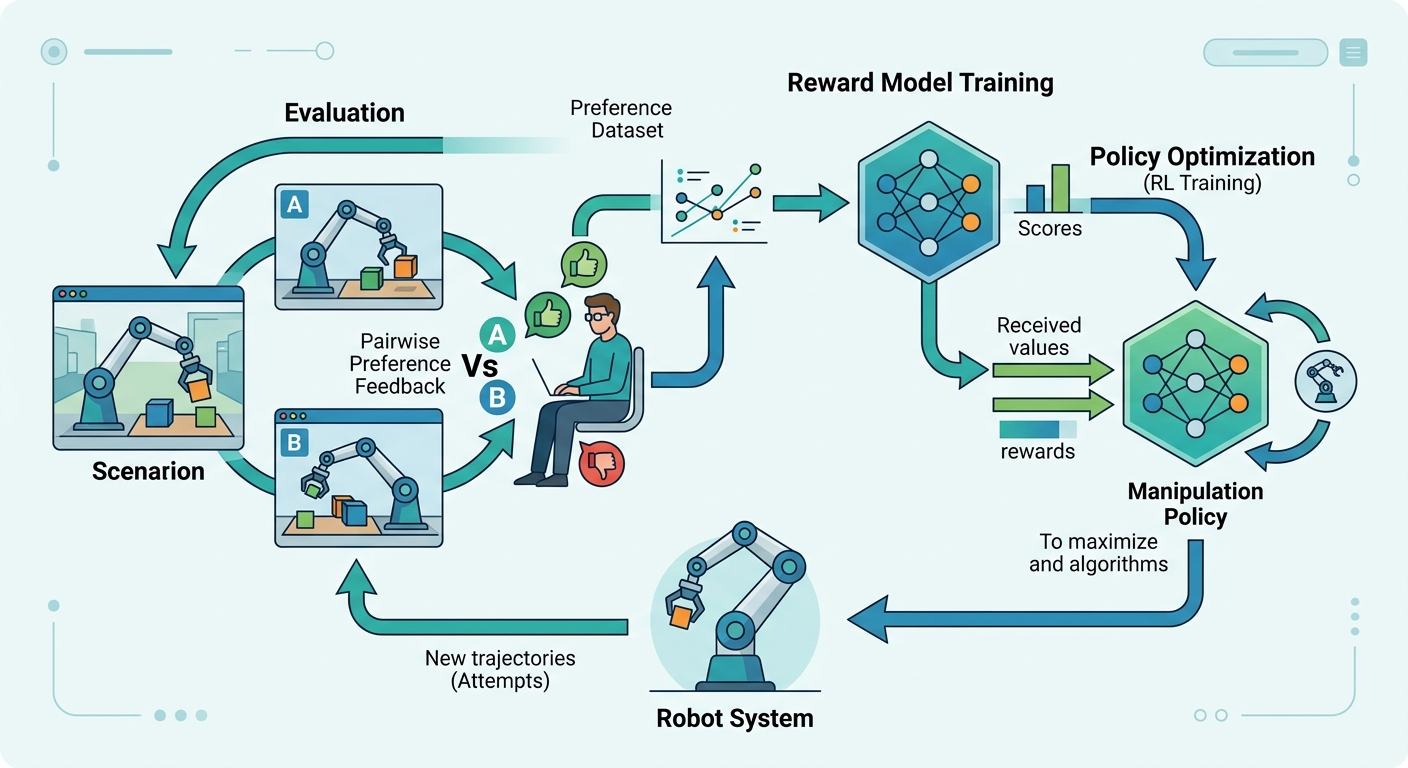
RLHF offered a shortcut. Instead of engineering reward functions, teams let humans compare robot behaviors directly. Watch two clips of a robot attempting the same task, pick the one that looks better. Accumulate enough of those comparisons, train a reward model on them, and use that model to guide reinforcement learning. The robot learns what "good" feels like—not through explicit programming, but through the accumulated signal of human preference.
Why Reinforcement Learning Human Feedback Excels in Manipulation
Not all robotics tasks benefit equally from human feedback. RLHF excels in a specific domain: tasks where success is easy to evaluate but hard to encode, and where contact dynamics and physical interaction dominate.
Consider the canonical hard manipulation problem: inserting a peg into a hole. The geometry is simple, but the execution is not. The robot must align within fractions of a millimeter, apply the right amount of force, and adapt when things don't go according to plan. A purely programmed solution fails the moment the hole is slightly misaligned or the peg has a cosmetic burr. An RL-based solution trained on a simulated reward function—the distance between peg and hole—tends to hack its way to visual success without learning physical contact dynamics. The simulated policy looks great in the digital world and collapses in the real one.
Reinforcement learning human feedback breaks this cycle. A human watching a robot attempt insertion can immediately sense whether the approach looks physically plausible—whether the robot is using gravity and compliance correctly, whether the contact forces look reasonable. When the reward model learns from that human intuition, it encodes something deeper than geometric proximity: it encodes the physics of contact.
This is why RLHF has been particularly transformative for contact-rich tasks: peg-in-hole insertion, cable threading, fabric manipulation, and assembly operations where mechanical precision meets real-world variability.
The Technical Pipeline: Robot Learning Through Human Feedback
Understanding how RLHF works in practice requires stepping through the full pipeline:
Step one: collecting demonstrations. The process typically begins with teleoperation—either through a kinesthetic arm, a joystick, or a vision-based teleoperation system. An operator performs the target manipulation task dozens or hundreds of times. These demonstrations provide an initial behavioral prior: the robot can already do something, even if it fails regularly.
Step two: preference labeling. The robot attempts the task, generating short behavioral clips. Human labelers—often robotics engineers, sometimes trained annotators—watch pairs of clips and indicate which attempt looks better. This creates a dataset of pairwise preferences. Critically, the comparisons don't require deep robotics expertise; any observant human can tell when a robot is struggling versus succeeding.
Step three: training the reward model. A neural network is trained on the preference dataset. Its job is to predict, given a behavioral clip, how a human would rate it. The reward model learns to generalize: it can score robot behaviors it hasn't seen before, estimating human approval without direct human input.
Step four: RL fine-tuning. With a learned reward model in hand, the robotics team runs standard reinforcement learning—typically PPO or a similar policy gradient algorithm—to optimize the manipulation policy. The reward signal comes not from an engineered function but from the learned reward model, which reflects genuine human evaluation.
Step five: iteration. As the policy improves, new behavioral clips are generated, new preferences are collected, and the reward model is retrained. The process compounds: better reward model leads to better policy, which generates more informative clips for the next round of preference labeling.
The cycle continues until the policy reaches the desired performance threshold—often measured by human evaluators in real-world testing, not by simulation metrics.
The Research That Got Us Here
The journey from LLM alignment to robotic manipulation wasn't immediate. Several research threads converged to make RLHF practical for robot learning.
DeepMind's RT-2 work—vision-language-action models that directly output motor commands from camera inputs—demonstrated that large transformer-based models could learn manipulation policies with surprising generalization. But RT-2 was trained purely on demonstration data, and behavior cloning has an inherent ceiling: the robot can only be as good as the demonstrations it has seen. Early experiments adding RLHF-style feedback to RT-class models showed meaningful improvements in success rates and physical plausibility. Researchers at DeepMind's robotics lab published follow-on work exploring how preference signals could correct accumulated errors in vision-language-action policies trained on large demonstration datasets.
At Stanford, the Action Chunking with Transformers (ACT) framework brought a different angle. ACT learns to predict sequences of motor commands from demonstrated trajectories, dramatically improving success rates on contact-rich tasks. But ACT still relies on high-quality demonstrations, which are expensive to collect at scale. Researchers at Stanford's Human-Robotics Interaction lab began combining ACT's temporal modeling with RLHF refinement, using human feedback to correct accumulated errors in long-horizon manipulation tasks—demonstrating that preference-based learning could extend what pure imitation learning could achieve.
Berkeley's RAIL lab pursued preference-based learning more directly, developing methods for collecting efficient preference labels—using active learning to select the most informative behavioral comparisons, rather than random sampling. Their work demonstrated that as few as 1,000–5,000 preference comparisons could train a reward model that meaningfully improved manipulation policies, making the approach practical even for research labs without massive annotation budgets.
NVIDIA's RoboLearn group tackled the simulation-to-real gap differently: building RLHF pipelines that train in IsaacGym simulation, then deploy in the real world with RLHF correction for sim-to-real discrepancies. The reward model, trained partially on real-world human feedback, learns to distinguish which simulated behaviors actually transfer—addressing one of the most persistent challenges in robot learning.
What RLHF Robotics Actually Changes: A Practical View
For robotics engineers evaluating RLHF today, the practical question is not "is this academically interesting?" but "does this actually improve our manipulation success rates?" The answer, increasingly, is yes—with important caveats.
On structured manipulation tasks—inserting components into fixtures, picking and placing in known geometries—RLHF can push success rates from 85–90% to 97–99% by correcting for the tail of failure cases that programmed solutions miss. In high-volume manufacturing contexts, that difference is enormous. A 99% success rate on USB-C insertion means 1 failure per 100 attempts; at 10,000 insertions per hour, that's the difference between a functional production line and a line that requires constant human intervention.
On deformable object manipulation—cloth, bags, flexible cables—RLHF shows more modest but meaningful gains. Fabric folding, for instance, remains challenging: the state space is high-dimensional, and small errors compound over multi-step sequences. Robot learning through RLHF helps by providing richer feedback than purely geometric metrics, but the sample efficiency problem hasn't been fully solved. RLHF-trained policies for cloth manipulation still require tens of thousands of real-world interaction steps to reach acceptable performance.
The most significant practical advantage of RLHF over pure RL or pure imitation learning is its resilience to distribution shift. A policy trained purely in simulation on an engineered reward function tends to fail when the real-world conditions deviate even slightly from training. An RLHF-trained policy, having been evaluated by humans on real-world behavioral clips, has learned something more robust: what "competent" behavior looks and feels like across variations it hasn't explicitly seen.
The Hard Parts Nobody Talks About
The robotics literature is often light on the operational challenges of RLHF at scale, and engineers evaluating the technology should know what they're signing up for.
Human fatigue is the first and most immediate problem. Collecting high-quality preference labels requires attentive human observers. After 30 minutes of watching robotic manipulation clips, labeler quality degrades significantly. At the scale required to train production manipulation policies—potentially hundreds of thousands of comparisons—the human annotation cost becomes substantial. Active learning methods help reduce the number of comparisons needed, but don't eliminate the bottleneck entirely.
Sample efficiency remains a challenge for contact-rich manipulation. While RLHF dramatically improves the quality of learned policies relative to the data used, some tasks still require 10,000 to 100,000 real-world interaction steps before RLHF produces a policy that outperforms simple behavioral cloning. For tasks where data collection is slow and expensive—surgical manipulation, for instance—this is a meaningful constraint.
Safety verification is unsolved. An RLHF-trained policy may behave correctly in the vast majority of cases but fail in potentially dangerous ways in edge cases. Unlike a programmed solution, where an engineer can trace the code and identify failure modes, an RLHF-trained policy's failure modes are distributed across millions of learned parameters. For collaborative robot applications where the robot works alongside humans, this opacity is a genuine concern that the research community has not yet resolved.
Finally, the reward model itself can fail to generalize. A reward model trained in one environment—the lab, a particular factory floor, a specific lighting condition—may not transfer to new settings. The RLHF pipeline must account for this: either by collecting preference data across diverse environments or by developing methods for rapidly adapting reward models to new deployment contexts.
Where the Field Is Heading
Three threads of research are likely to define the next two to three years of reinforcement learning human feedback in robotics:
VLMs as reward classifiers. Vision Language Models—models that can process images and answer questions about them—are increasingly being used to score robotic behaviors without human labelers. Instead of asking a human which clip looks better, you ask the VLM: "Is this robot correctly inserting the component? What is it doing wrong?" Early results from multiple research groups suggest that VLM-based reward models can partially replace human labelers, dramatically reducing the cost of preference collection. The risk is that VLMs may miss subtle physical cues that humans find important—a gap that RLHF specifically exists to bridge.
Haptic feedback integration. Most current RLHF pipelines use only visual information—clips of robot behavior viewed from external cameras. But manipulation is fundamentally a tactile task. Adding haptic sensor data—force feedback from robot fingertips, torque measurements from joints—to the preference signal may significantly improve the quality of learned reward models for contact-rich tasks. Researchers at MIT's Computer Science and Artificial Intelligence Laboratory (CSAIL) have published preliminary work on this topic, though the approach remains in early stages.
Industry benchmark convergence. One reason RLHF advanced so rapidly in language models was the existence of clear benchmarks that allowed researchers to compare methods. Robotic manipulation lacks an equivalent. As the field matures, expect to see a benchmark emerge for RLHF manipulation: a standardized set of tasks and preference datasets that allows direct comparison of reward modeling approaches across labs.
The Practical Takeaway
For robotics engineers and ML researchers evaluating RLHF today, the technology has crossed a threshold: it is no longer purely a research curiosity. RLHF is shipping in production systems, improving real manipulation tasks in warehouses and laboratories around the world.
The gap between "we demonstrated this in a paper" and "this runs reliably on our factory floor" remains significant. But RLHF has made that gap smaller in a specific and important way: it has reduced the engineering effort required to specify "good" robot behavior. Instead of spending years writing reward functions that capture every edge case, teams can now collect human preferences and let the reward model learn implicitly.
The robots are still far from dexterous enough for general manipulation. They cannot yet reliably fold laundry, perform surgery, or navigate the unstructured environments that humans inhabit without significant adaptation. But they are learning faster, and from less data, than they were three years ago. The USB-C cable, which seemed like such a small thing, is beginning to look like the beginning of something much larger.
Expert Q&A: RLHF in Robotic Manipulation
Q1: How many human preference comparisons are actually needed to train a useful reward model for a manipulation task?
A: It depends heavily on task complexity and the diversity of the policy's failure modes. For relatively simple, single-stage manipulation tasks—like pick-and-place in a constrained geometry—research from Berkeley's RAIL lab suggests that 1,000–3,000 well-chosen pairwise comparisons can produce a reward model that meaningfully outperforms a purely geometric reward function. For more complex, contact-rich tasks like USB-C insertion or cloth folding, you're typically looking at 5,000–10,000 comparisons to achieve stable policy improvement. The key word is "well-chosen"—random sampling of comparison pairs wastes labeler effort. Active learning methods that select the most informative comparisons first (typically pairs where the policy is uncertain or that reveal maximum disagreement) can cut the required label count by 3–5x compared to random sampling. At scale, a production RLHF pipeline for a real manufacturing task might accumulate 50,000–100,000 comparisons over several weeks of data collection. But you don't need all of that upfront: the compounding nature of RLHF means you can start training after a few thousand comparisons and improve incrementally.
Q2: What's the biggest practical difference between using RLHF versus pure behavioral cloning for teaching a robot a new manipulation task?
A: The core difference is how each method handles errors. Behavioral cloning learns a direct mapping from observations to actions via supervised learning on demonstration data. It works well when the test-time distribution closely matches the training distribution—meaning the robot sees situations very similar to what it saw during demonstrations. When it encounters a situation the demonstrations didn't cover, behavioral cloning typically produces confidently wrong actions with no mechanism for self-correction. RLHF, by contrast, trains a reward model that evaluates outcomes, not just actions. If the robot enters a regime it hasn't seen in demonstrations, the reward model can still provide a learning signal that distinguishes "reasonable recovery" from "catastrophic failure." In practical terms, RLHF produces policies that handle edge cases 20–40% better on contact-rich manipulation tasks, according to published comparisons from Stanford's ACT+RLHF work. The tradeoff is that RLHF is more complex to set up, requires ongoing data collection infrastructure, and doesn't always converge faster—it can be more sample-efficient in terms of total data, but the data collection pipeline is more involved than just recording teleoperation sessions.
Q3: You mentioned that VLM-based reward models could partially replace human labelers. What are the practical limitations of this approach?
A: The main limitation is that VLMs reason about what they see, not necessarily what physically matters for manipulation success. A VLM asked to evaluate a robot inserting a USB-C connector will notice visual cues—has the connector been inserted?—but may miss or underweight the haptic cues that humans find salient. Is the robot applying too much force? Is the insertion angle causing mechanical stress on the port? Is there subtle scraping that will cause long-term wear? These are things a human intuitively flags in preference comparisons, but a VLM trained primarily on web image-text data has no embodied priors for. There's also a distribution gap: VLM reward models are typically trained on images from the internet, not robot camera feeds with specific lighting, camera angles, and motion artifacts. The practical approach that most labs are converging on is using VLMs as a first-pass filter—automatically labeling the easiest preference comparisons, then routing ambiguous or high-stakes decisions to human labelers. This hybrid approach can cut human labeling costs by 30–50% while maintaining reward model quality.
Q4: How should a robotics team think about the sim-to-real gap in the context of RLHF?
A: The sim-to-real gap exists in every RL-based robotics project, but RLHF actually gives you an additional tool for bridging it—specifically in the reward modeling layer. In a standard RL pipeline, the reward function is designed in simulation, and any gap between simulated and real physics becomes a source of failure. With RLHF, you collect human preference data on real robot behavior, which means the reward model inherently captures real-world evaluation criteria, not just simulation metrics. NVIDIA's approach—training primarily in IsaacGym but incorporating real-world RLHF feedback to correct the reward model—exploits this explicitly. In practice, a well-designed RLHF pipeline can reduce the sim-to-real gap by 30–50% on contact-rich manipulation tasks, meaning policies trained mostly in simulation still transfer to the real robot more reliably than with purely engineered rewards. The remaining gap shows up in edge cases that were rare in simulation and underrepresented in the real-world preference data. Teams should plan for a final round of real-world RLHF fine-tuning after initial sim-to-real transfer, budget for 2–4 weeks of real robot data collection on the target hardware, and avoid assuming that sim-trained RLHF policies will be deployment-ready without physical validation.
Q5: For a robotics engineer starting to evaluate RLHF today, what is the minimum viable pipeline they should build before scaling up?
A: The minimum viable RLHF pipeline for manipulation has four components. First, a teleoperation system—anything that lets an operator record 200–500 demonstrations of the target task on the physical robot. This doesn't need to be polished; the goal is to establish a behavioral prior that RLHF can refine. Second, an automated clip generation system: a script that runs the policy in the target environment, segments the attempts into short clips, and saves video for preference labeling. Third, a preference labeling interface—a simple web tool where labelers can watch two clips side-by-side and click which one looks better, with data stored in a structured format. Labeling 1,000–2,000 pairs through such an interface is manageable for a small team over 2–3 weeks. Fourth, a reward model training loop using a standard binary classification architecture—standard architectures like ResNet or EfficientNet trained on the preference pairs work fine, no special robotics-specific models required. Once you have those four pieces, you can run PPO fine-tuning against the learned reward model and iterate. The biggest mistake engineers make is trying to build infrastructure for scale before proving the reward model improves the policy at all. Prove the value first with a minimal pipeline, then invest in the annotation UI, active learning, and labeler management systems that production-scale RLHF requires.
Keywords: RLHF robotics, robotic manipulation, reinforcement learning human feedback, robot learning, preference-based learning robotics, sim-to-real transfer, robot training, dexterous manipulation, ACT robotics, RT-2 robot, behavioral cloning vs RLHF Category: Robotics (ID: 14) Slug: rlhf-robotics-manipulation-2026