Sim-to-Real Without the Simulation Team: Synthetic Data Comes to Mid-Size Robotics
Mid-size robotics teams can now use managed simulation and synthetic data to close the sim-to-real gap without hiring a full simulation engineering group.
The Real Bottleneck Isn't Physics — It's Headcount
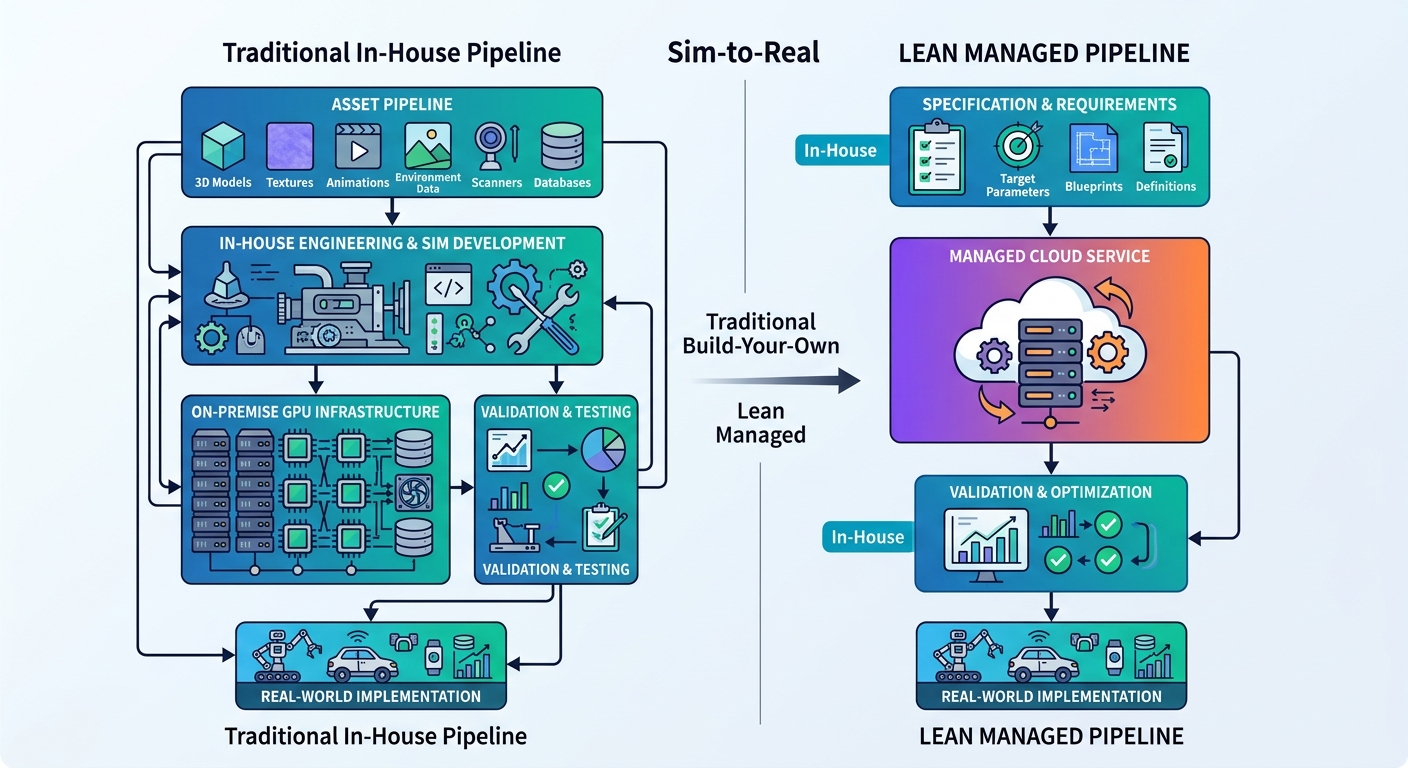
Mid-size robotics companies are caught in an awkward spot. Their customers want learned behaviors — adaptive grasping, robust perception, flexible navigation — but the standard path to those capabilities assumes a simulation engineering group that most firms below a few hundred people simply don't have. Building a credible sim-to-real pipeline has historically meant hiring specialists, curating 3D assets, and standing up GPU infrastructure, all before a single policy ships to a customer.
That constraint is loosening. Managed simulation platforms, synthetic data services, and foundation models are lowering the barrier that once made sim-to-real a big-company game. The question for engineering leaders is no longer whether they can afford a simulation team, but which parts of the pipeline to rent, which to keep, and how to validate that any of it transfers to real hardware.
This article maps the shift, defines what synthetic data actually means for robot learning, and gives lean teams a practical workflow — plus an honest account of where the approach still breaks down.
The Sim-to-Real Gap Was Never Really a Physics Problem
The industry narrative says sim-to-real is hard because simulators don't model contact, friction, and deformation accurately enough. That's true, but it's not the whole story — and treating it as the whole story leads teams to over-invest in fidelity while under-investing in the workflow around it.
Why sim-to-real historically required a dedicated team
A production-grade sim-to-real pipeline is really four jobs wearing one title. Someone has to build and maintain the simulation environment — scenes, sensors, physics parameters, and the glue code that connects them to the training loop. Someone has to run an asset pipeline: sourcing or authoring 3D models, cleaning meshes, tuning materials, and keeping everything versioned. Someone has to own GPU infrastructure and training orchestration. And someone has to own validation — the unglamorous work of running policies on real robots, instrumenting failures, and feeding corrections back into the loop.
Each of those is a specialization. Bundled together, they justify a team of roughly five to fifteen people at a large robotics firm. That's the real moat, and it's why sim-to-real has historically correlated with company size more than with problem difficulty.
What mid-size robotics teams actually lack
Most mid-size teams aren't missing ideas or even ML talent. They're missing simulation engineers who understand both robotics and rendering, a maintained library of validated 3D assets, and burst GPU capacity for large-scale generation and training runs. They also typically lack a formal validation harness — the tooling that turns real-world test runs into structured data about where the policy fails.
The gap that stalls most mid-size teams isn't simulator fidelity. It's the absence of a repeatable loop connecting synthetic generation, training, and real-world validation.
What "Synthetic Data" Actually Means for Robot Learning
The phrase gets used loosely, and that looseness causes bad purchasing decisions. Synthetic data for robotics is not just rendered images. It spans at least four categories:
- Rendered perception data — photorealistic or stylized images with automatically generated labels (bounding boxes, segmentation masks, depth, pose).
- Physics-generated trajectories — motion and control data produced by simulating a robot interacting with a scene.
- Simulated sensor streams — LiDAR, depth, IMU, and force/torque data generated with modeled noise characteristics.
- Labeled data at scale — the combinatorial explosion of variations (lighting, pose, occlusion, material) that would be prohibitively expensive to capture physically.
Photorealistic rendering vs. physics-first generation
Rendering-first pipelines optimize for visual realism — useful for perception models like object detection and segmentation, where the model learns from appearance. The value here comes from material and lighting diversity and plausible BRDFs as much as from ray tracing specifically. Physics-first pipelines optimize for dynamics fidelity — useful for control policies, where what matters is how contacts, friction, and mass behave, not how pretty the scene looks.
Confusing the two is a common and expensive mistake. A team training a grasping policy doesn't primarily need ray-traced materials; it needs accurate contact models and enough variation to cover the real distribution. Conversely, a perception team may get most of its value from rendering diversity with modest physics.
Domain randomization as the workhorse technique
Domain randomization (DR) is conceptually simple: instead of trying to make the simulation perfectly match reality, deliberately vary simulation parameters across a wide range — lighting, textures, friction coefficients, mass, sensor noise, camera pose — so the trained policy learns to be robust to the variation it will encounter in the real world.
In plain terms for engineering leaders: you stop chasing a single "correct" simulation and start training across a distribution wide enough to contain reality. It works remarkably well for perception and locomotion, and a large share of what's sold as "synthetic data" is really DR wrapped in tooling that automates the randomization schedule and manages the resulting datasets. (Generative, diffusion-based data and licensed photoreal asset libraries are distinct product categories — evaluate them on different criteria.)
Two practical failure modes matter. Randomize too widely and the policy learns to ignore the very signal it needs — it becomes invariant to everything, including things that matter. Randomize too narrowly and you've simulated a world that doesn't exist. The discipline is to randomize the parameters that genuinely vary between your sim and your deployment fleet, and to set ranges from measured real-world statistics where you have them.
Domain randomization trades a single precise simulation for a distribution that must contain reality. The art is choosing a range wide enough to generalize but grounded enough that the policy still learns a useful signal.
The other direction: real-to-sim calibration
DR is only half the loop. Credible pipelines also do system identification — measuring real-world parameters (link masses, friction coefficients, motor compliance, sensor noise spectra, latency) and fitting the simulator to them. In practice you calibrate the parameters you can measure, then randomize over the residual uncertainty you can't. Teams that skip sys-ID and lean entirely on DR tend to discover that their randomization ranges were calibrated to a guess, not to their robot.
The Tooling Shift: From Build-Your-Own Sim to Managed Pipelines
The market has stratified into a few recognizable categories. Naming categories rather than endorsing brands is deliberate — the landscape moves fast, and the right choice depends on your robot stack.
Cloud simulation and asset libraries
Managed simulation environments (hosted Isaac Sim, MuJoCo-based services, and vendor-specific stacks) remove the infrastructure and scene-authoring burden. Asset libraries remove the mesh-cleaning tax. The tradeoff is lock-in and provenance: confirm that assets are licensed for commercial use in trained models, and that your policies aren't contractually tied to a vendor's runtime.
Synthetic data generation services
These sell the output rather than the tool — labeled datasets, randomized scene batches, or sensor streams tailored to your task. Useful when you have no sim team but do have a clear task definition and a way to evaluate the data. The risk is buying volume instead of coverage; insist on evaluation against your real validation set, not the vendor's benchmark.
Foundation models as a shortcut
Pretrained perception and manipulation models reduce the amount of task-specific data you need, and vision-language-action models are increasingly usable as initialization for fine-tuning. They lower the representation cost of the pipeline. They do not remove the validation burden — if anything, a large pretrained policy is harder to debug when it fails on your hardware, which makes the validation harness more important, not less.
The procurement question nobody asks
For B2B buyers, the contract matters as much as the tech. Ask: Can I export my trained weights and deploy them without a runtime license? Are the 3D assets and any generative model outputs cleared for commercial use? What happens to my data and models if the vendor pivots? These questions have sunk more pilots than technical shortcomings have.
A Lean Workflow for Teams Without a Sim Group
The workflow below assumes a small team — a couple of ML engineers, a robotics engineer, and someone who owns evaluation — and a task where synthetic data is plausibly the right lever (perception, locomotion, or structured manipulation).
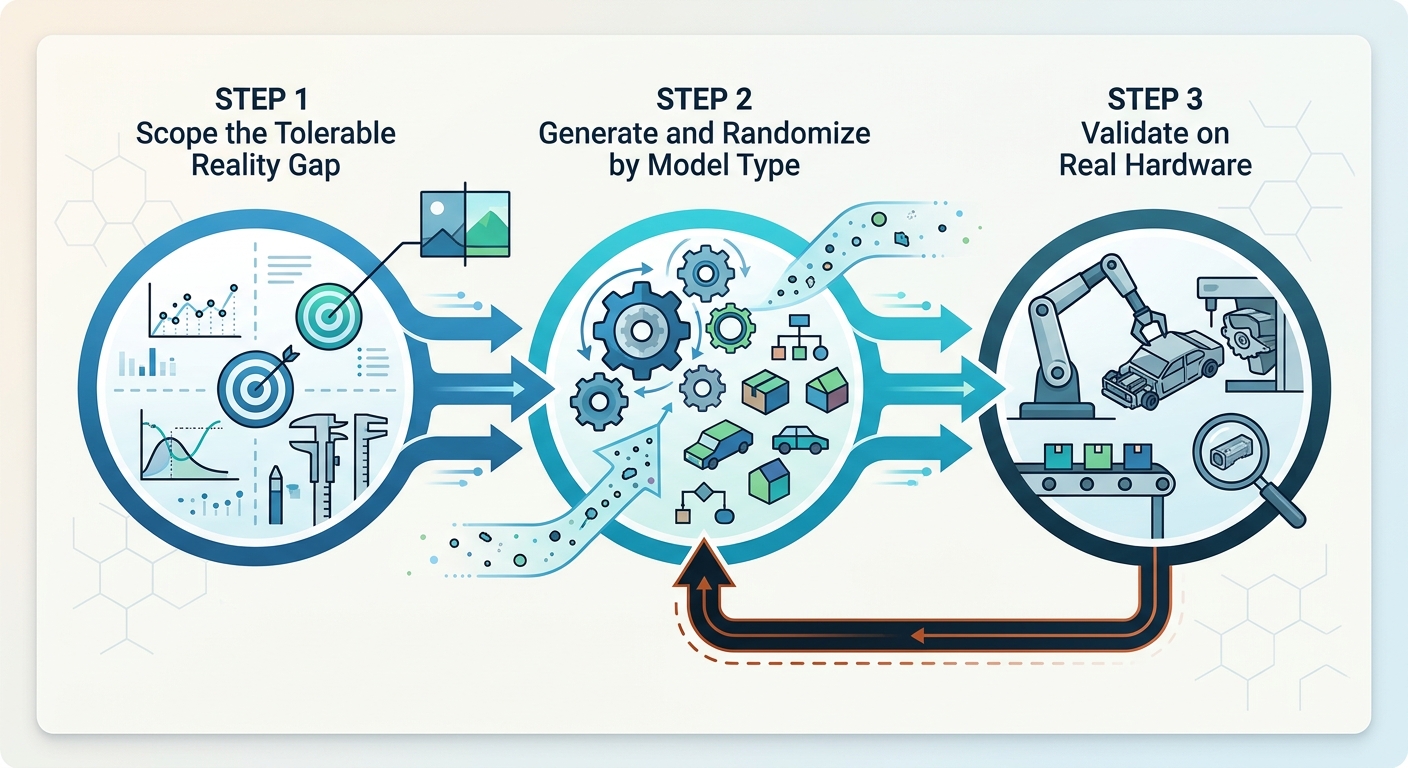
1. Define the task and the real evaluation set first. Before generating anything, collect a small, honest real-world test set and a scoring rubric. This is the anchor for every later decision. Teams that generate first and evaluate later cannot tell whether synthetic data helped.
2. Characterize the sim-to-real gap on a baseline. Train a small policy or detector on real data only, measure real-world performance, then train the same model in sim and measure again. The delta is your gap — and it tells you whether you need better rendering, better dynamics, or better coverage.
3. Calibrate, then randomize. Run system identification on the parameters you can measure. Set DR ranges from measured statistics plus a margin for residual uncertainty. Start narrow; widen only when validation shows the policy is brittle to a specific variation.
4. Build the failure taxonomy early. As real-robot runs fail, log them into structured categories (perception miss, contact slip, occlusion, latency). This turns validation from a pass/fail gate into a data source that tells you what to randomize next.
5. Use shadow deployment before promotion. Run the candidate policy alongside the incumbent on real hardware in a non-actuating or gated mode, and compare action distributions and success rates. This catches the "works in the lab, fails in the field" class of errors cheaply.
6. Track the gap as a first-class metric. Success-rate delta between sim and real, and divergence between simulated and real action distributions, should be reported every iteration — not just at the end. If the gap widens, stop and diagnose.
Where This Still Breaks Down
An honest account, because the tooling is real but not magic:
- Contact-rich manipulation with deformables. Cables, cloth, food, and soft grippers remain hard. Physics engines approximate these poorly, and DR can't randomize its way around a fundamentally wrong contact model.
- Safety-critical certification. If your deployment requires demonstrated reliability bounds, synthetic data alone rarely satisfies a regulator or a customer's safety review. You need real-world evidence, and synthetic data at best reduces how much of it you need.
- The evaluation-distribution gap. A policy can pass every sim and lab test and still fail on a customer's floor because the real distribution differs from both. This is the failure mode that a validation harness is built to catch, and it's the one most likely to bite a lean team that skipped step 1.
- Foundation models raise the debugging bar. A large pretrained policy that fails on your hardware is harder to diagnose than a small one you trained yourself. The shortcut on the front end can become a liability on the back end.
None of these is a reason to skip the approach. They're the reasons to invest in the validation loop before the generation pipeline — and to be honest with your customers about which capabilities are sim-trained and which are not.
The Takeaway for Engineering Leaders
The barrier to sim-to-real has shifted from can we build a simulation team to can we build a validation loop. Managed platforms and foundation models have commoditized much of the generation and infrastructure work. What they haven't commoditized is knowing whether your synthetic data actually transfers — and that knowledge lives in a disciplined, instrumented evaluation process that a lean team can absolutely own.
The teams that win the next few years won't be the ones with the biggest simulation clusters. They'll be the ones that can measure their sim-to-real gap, close it iteratively, and prove to a customer that the policy works on their floor, not just in the lab.