Vision-Language-Action Models Leave the Lab: Deploying VLA Policies in Real Warehouses
A practitioner's guide to deploying vision-language-action (VLA) models in real warehouses — sim-to-real gaps, pilot scoping, and vendor questions for 2026.
The Warehouse Is Becoming the Proving Ground for Embodied AI
For most of the past three years, vision-language-action models were a research curiosity — impressive videos of robots folding laundry or assembling sandwiches, followed by the quiet caveat that none of it would survive a real fulfillment center. That caveat is expiring, but more slowly and more narrowly than the demo reels suggest. In 2026, VLA models are moving from demo reels into paid pilots and a small number of supervised production cells, and the question for operations and engineering leaders is no longer whether the technology works in principle, but whether it works in your warehouse, at your cycle times, with your SKU mix — and under your safety and exception-handling constraints.
This article is a practitioner's briefing on deploying VLA policies in real warehouses. It covers what a VLA policy actually does on the floor, why the sim-to-real gap remains the central engineering challenge, how to scope and instrument a first deployment, what the safety and latency architecture must look like, and what to demand from vendors before you sign. The framing throughout is deliberately unromantic: embodied AI is now a procurement and architecture decision, and it deserves the same scrutiny you'd apply to any capital equipment. (Related: How to Evaluate Warehouse Automation Vendors)
Why 2026 Is a Plausible Inflection Point — With Caveats
Three curves are converging, though none has fully crossed.
First, inference is moving onto the robot. Policies that in 2023 needed a workstation-class GPU can now run on embedded modules inside a robot's control enclosure using quantized (INT8/FP8) inference at control rates in the roughly 5–20 Hz range — enough for pick-and-place decisions, not enough to replace the low-level controller running at hundreds of hertz. Second, manipulation datasets got larger and more diverse — a mix of teleoperation corpora, synthetic data, and, critically, real deployment logs from early adopters. Third, foundation-model tooling matured: pretrained vision-language backbones, more standardized policy architectures, and simulation stacks that integrate with standard robot middleware.
The commercial signal matters as much as the technical one. Fulfillment operators and third-party logistics providers are running paid pilots with defined success criteria, not just innovation-lab experiments. A narrow set of cells has moved into supervised production. That shift — from "interesting" to "budgeted" — is the real signal. It is also a forecast, not a guarantee: deployment remains exception-heavy, human-supervised, and concentrated in high-mix cells where classical automation was never economical.
"The question is no longer whether a VLA can pick a novel SKU. It's whether it can do it several hundred times an hour, shift after shift, without a human resetting it every twenty minutes — and fail safely when it can't."
For a B2B audience, the practical implication is straightforward: VLA evaluation belongs in your 2026–2027 automation roadmap, alongside AMRs, goods-to-person systems, and classical robotic arms. Treat it as an architecture question with real tradeoffs, not a watch-this-space topic. (See also: Building a Warehouse Automation Roadmap)
What a VLA Policy Actually Does on the Warehouse Floor
From Perception to Action in One Model
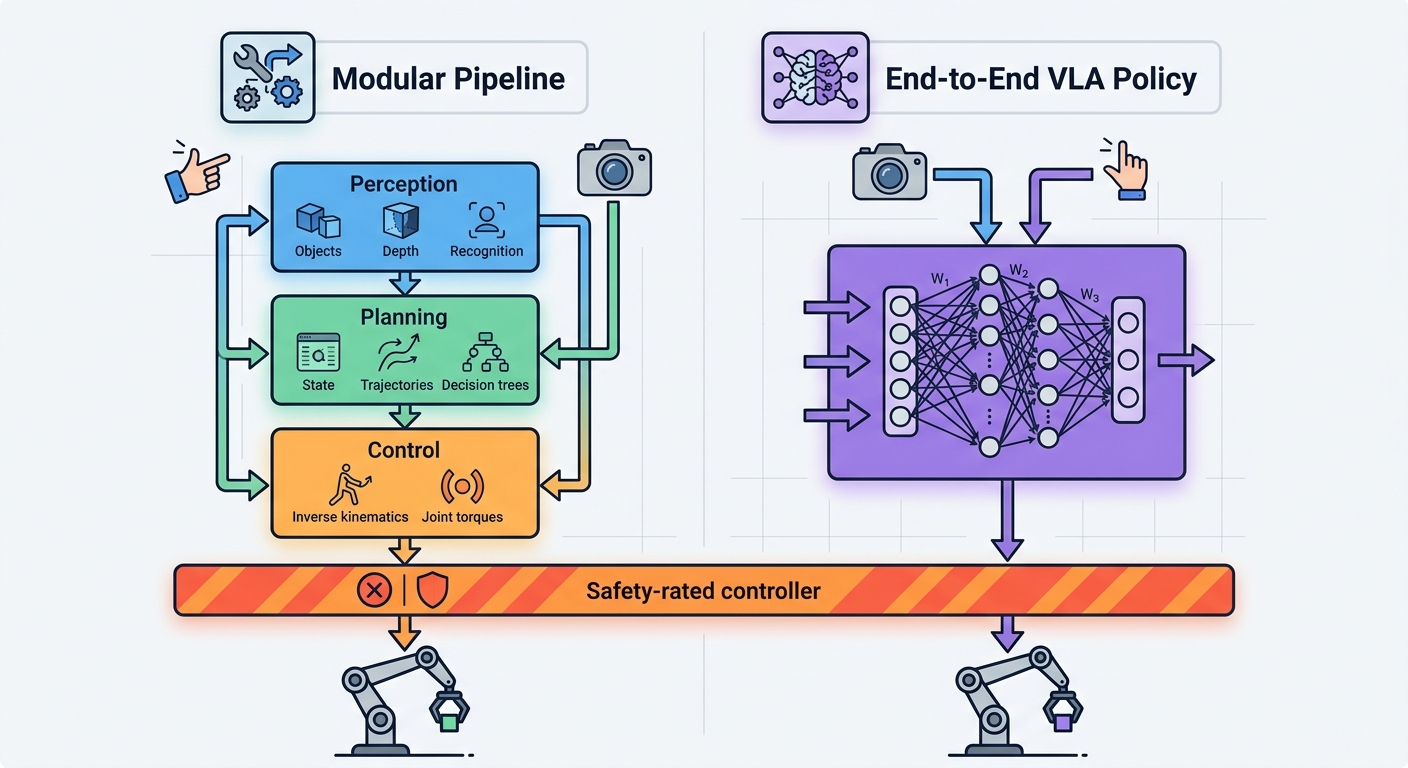
A classical picking stack is a pipeline: a perception module segments the scene, a planner selects a grasp, a motion controller executes it, and a separate error-recovery layer handles failures. Each stage is engineered, tuned, and debugged independently — which is powerful but expensive, because every new task or SKU class can require bespoke work at one or more stages.
A VLA policy collapses much of that into a single learned model. Camera images plus a task instruction — "pick the small blue box and place it in tote B" — go in; motor commands come out. The model has learned, from large-scale data, the mapping from visual scene and language goal to action. There is still classical control underneath: a safety-rated controller enforces limits and e-stops, and a low-level servo loop executes the policy's setpoints. The perception-to-action decision is learned end to end; the safety envelope is not, and must not be.
Where VLAs Beat Classical Picking Stacks
The advantages are real and specific:
- Broader coverage of novel SKUs. A VLA trained across diverse objects degrades more gracefully than a fixed grasp library when a new package shape appears — it attempts items outside its training set rather than failing immediately into an exception queue. This is graceful degradation, not guaranteed success, and the failure modes differ (see below).
- Natural-language task specification. Operators can describe tasks in plain language instead of reprogramming grasp planners — a meaningful reduction in engineering per task.
- Less bespoke integration. One policy can cover a family of related tasks, shrinking the integration surface for high-mix environments.
The limits are equally real. Cycle time and precision ceilings still favor classical systems for high-volume, fixed-SKU picking. And there is an operational trap: a VLA can fail confidently — producing a plausible but wrong action — which is worse than a clean exception. Exception handling, confidence thresholds, and a fallback to classical behavior must be designed in from day one. VLAs shine in high-mix, lower-volume, exception-heavy cells — the places where classical automation was never economical to deploy in the first place. (More: Choosing the Right Picking Automation for High-Mix Operations)
The Safety and Latency Architecture You Actually Need
Two engineering constraints determine whether a VLA cell is deployable:
Latency. VLA inference runs at roughly 5–20 Hz; the underlying servo loop runs at hundreds of hertz. The policy issues setpoints; a real-time controller interpolates and enforces them. Budget for inference jitter, and never let the policy sit in the safety path.
Certification. Learned policies are not certifiable under current robot safety standards (ISO 10218, ISO/TS 15066 for collaborative operation, ANSI/RIA R15.06 in the US). The workable architecture is a safety-rated classical layer — force/torque limits, speed-and-separation monitoring, e-stop — with the VLA confined to the non-safety-rated decision layer. Any vendor claiming a "certified VLA" is either mislabeling the architecture or overstating it. Ask which standard the cell is certified to and which layer the policy occupies.
The Sim-to-Real Gap Is Still the Hard Part
What Breaks When Policies Leave Simulation
Every VLA deployment story eventually becomes a sim-to-real story. Policies that perform beautifully in simulation degrade in predictable ways on the floor:
- Lighting variation. Overhead LEDs, skylights, and shadow patterns shift throughout the day. Simulated lighting rarely captures the full range.
- Reflective and wrapped packaging. Shrink wrap, poly bags, and foil laminate create specular highlights and depth-sensor artifacts that break perception.
- Sensor noise and calibration drift. Real cameras and depth sensors drift; simulated ones don't.
- Contact-rich manipulation. Deformable bags, stacked items, and tight clearances are where physics simulation is weakest and real-world variance is highest.
- Distribution shift from new SKUs. The catalog changes weekly. A policy's competence is a moving target.
The honest summary: sim-to-real is a data problem more than a rendering problem. Photorealistic simulation helps, but the deployments that hold up are the ones that close the loop with real deployment logs — capturing failures, labeling them, and retraining on a defined cadence. Budget for that flywheel (data capture, labeling, retraining, revalidation) as a recurring operating cost, not a one-time integration.
What to Instrument on Day One
A first deployment is an experiment. Instrument it like one:
- Per-SKU-class success rate, not aggregate — aggregate numbers hide the classes that will dominate your exception queue.
- Failure taxonomy — perception miss vs. grasp slip vs. placement error vs. policy timeout — so retraining targets the right failures.
- Latency histograms for inference and end-to-end cycle, to catch jitter before it becomes throughput loss.
- Intervention rate and reason codes for every human reset, which is the truest measure of whether the cell is ready to scale.
- Confidence calibration — does the policy's stated confidence predict success? If not, you cannot safely automate the escalation decision.
Scoping a First Deployment
Start where the economics are defensible and the blast radius is small:
- Pick an exception-heavy, high-mix cell — the one classical automation couldn't justify. Do not start with your highest-throughput line.
- Define success criteria up front — target success rate per SKU class, maximum intervention rate, cycle-time ceiling, and a safety sign-off gate.
- Run shadow mode first — the policy observes and proposes while a human or classical system acts, so you can measure performance without operational risk.
- Stage the autonomy — supervised → human-on-the-loop → limited autonomous, with a documented rollback at each stage.
- Model total cost of ownership — inference hardware, retraining cadence, labeling labor, and the human oversight headcount the cell requires at steady state.
What to Demand From Vendors
Before you sign, require falsifiable answers:
- Which safety standard is the cell certified to, and which layer does the learned policy occupy? (Reject "certified VLA.")
- What is your measured success rate per SKU class on our catalog, and how was it measured? Ask for the evaluation protocol, not a headline number.
- What is the retraining cadence and who pays for it? Get the data flywheel cost in writing.
- What is the inference latency budget and the fallback behavior when the policy is uncertain?
- Show the failure taxonomy and intervention rate from a reference deployment of comparable SKU mix.
- What is the exit path? If the pilot fails, what do you own, and what does decommissioning cost?
What This Is Not
VLAs are not a drop-in replacement for fixed automation, and they will not make high-volume, fixed-SKU picking cheaper in the near term. They are a way to bring automation to the long tail of high-mix, exception-heavy work that classical systems never reached — provided you architect for safety, latency, and the retraining flywheel from the start. The 2026 inflection is real but narrow: budget for a supervised pilot, instrument it rigorously, and let the per-SKU data — not the demo reel — decide whether it scales.