Sim-to-Real Transfer in 2026: Why Embodiment Still Breaks the Best Policies
Sim-to-real transfer still breaks in 2026. See why the embodiment gap defeats domain randomization and the four failure modes sinking robot policies on hardware.
The Policy That Couldn't Pick Up a Cup
A pattern we see repeatedly in warehouse robotics: a team spends months training a manipulation policy in simulation, hits high-90s success on the pick-and-place eval suite, then deploys to the physical arm and drops a meaningful fraction of objects—worse than the scripted baseline it was meant to replace. The policy learned the simulator's physics, not the world's.
The numbers behind that pattern are sobering. It is routine for a policy that scores 95 percent in simulation to land between 60 and 75 percent on hardware for contact-rich tasks, and the drop is not evenly distributed: the failures cluster on the hardest 10 percent of grasps—compliant packaging, glossy or wet surfaces, parts presented at awkward angles. The scripted baseline, for all its brittleness, was tuned against the real arm and does not suffer this cliff.
This is the defining frustration of robot learning in 2026. Reinforcement learning pipelines can now produce policies that look solved in sim and fall apart on hardware. The embodiment gap—the mismatch between a simulated body and a physical one—remains the binding constraint on sim-to-real transfer and deployment. It is not primarily a data problem or a model architecture problem. It is a hardware-and-physics problem, and it does not yield to more compute alone.
The compute story is worth stating plainly because it is the most common misdiagnosis. Teams that double training hours, widen GPU clusters, or scale model parameters often see sim success climb while hardware success stays flat. That is the signature of an embodiment gap: the policy is optimizing against a world model that is wrong in the regimes that determine real-world success, and more optimization against a wrong model produces a more confident wrong policy.
This article breaks down why the embodiment gap persists, which failure modes dominate in 2026, the mitigations that actually move the needle, and what engineering leaders should demand before trusting a sim-to-real claim.
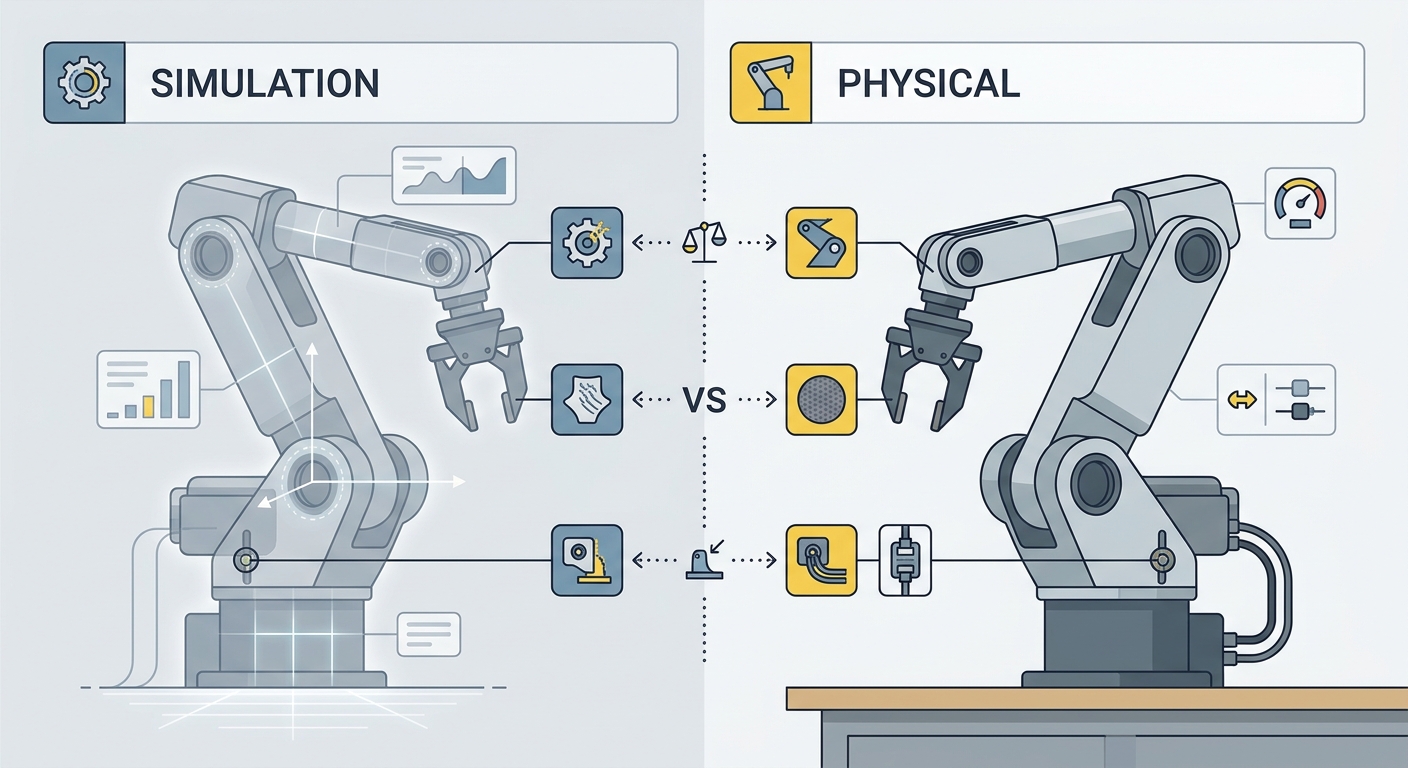
The Embodiment Gap, Defined
The reality gap is the broad divergence between simulation and the real world: lighting, textures, object variety, background clutter. The embodiment gap is narrower and harder: the divergence between the robot itself in sim and the robot itself in the lab. Mass distribution, joint compliance, actuator response curves, sensor placement, cable routing, thermal drift—the physical facts of a specific machine.
The distinction matters because the two gaps fail differently. Visual transfer is largely a perception problem, and modern rendering plus domain randomization has made real progress there. Dynamics and contact transfer is an embodiment problem, and it is where most sim-to-real deployment failures originate. A useful diagnostic: if a policy fails on objects it has never seen but succeeds on familiar objects, suspect the reality gap and invest in perception. If it fails on familiar objects under slightly different contact conditions—a wet surface, a heavier payload, a warm arm after two hours of operation—suspect the embodiment gap.
What Actually Transfers vs. What Doesn't
High-level task structure transfers well. A policy that learns when to approach, grasp, and lift generally carries over. Low-level control—the torque commands, contact forces, and timing that execute those decisions—transfers poorly. Vision backbones trained on randomized renders often generalize; the control layer beneath them rarely does without explicit correction. Teams that treat sim-to-real as one problem tend to over-invest in perception and under-invest in the actuator and contact modeling that actually determines success rates.
A concrete illustration: a policy that learns to approach a bin, center on a part, and close the gripper will usually execute those phases in the right order on hardware. What breaks is the millisecond-scale detail—how hard to close, how fast to lift, when to release. Those are exactly the quantities governed by friction coefficients, actuator response curves, and control-loop timing, and those are exactly the quantities a rigid-body simulator approximates most crudely.
Why Domain Randomization Hit Its Ceiling
Domain randomization (DR) was the workhorse of the last sim-to-real era, and it earned its reputation. By randomizing friction, mass, latency, and visual properties during training, DR forces policies to be robust across a distribution of simulated worlds. For grasping and locomotion, it delivered real gains, and our coverage of domain randomization techniques documents how far the approach can go.
But DR has diminishing returns, and 2026 teams are running into them.
The Cost of Over-Randomization
Push the randomization ranges wide enough to cover real-world variation, and you get a policy that is robust to everything and excellent at nothing. Over-randomized agents learn conservative, sluggish behavior—slow approaches, weak grasps, hesitant motion—because the training distribution punishes any aggressive action that might fail under an unlucky parameter draw. The policy passes sim evals across the board and underperforms on the one physical robot it will actually run on.
The mechanism is a form of distributional hedging. If friction is randomized across a range spanning 0.2 to 1.2, the policy learns a grasp force that works at the low end of that range, which means it over-grips at the high end—crushing soft parts, wasting cycle time, and wearing grippers faster. Teams often observe this as a policy that is "safe but slow," and the fix is not more randomization but better calibration of the range around the true hardware values.
Where the Simulator Itself Is the Bottleneck
DR can only randomize what the simulator models. If the physics engine mishandles contact impulses or omits actuator backlash, no amount of randomization recovers the unmodeled physics. Randomization can partially compensate for a solver bias when that bias is captured as a parameter—but it cannot invent stick-slip, micro-deformation, or backlash that the model has no term for. The simulator's fidelity is the upstream constraint, and many teams are now tuning a randomization strategy on top of a physics model that is simply wrong in the regimes that matter.
This is the trap that consumes the most engineering time in 2026. A team spends weeks sweeping randomization ranges, sees sim robustness improve, deploys, and watches hardware performance stall—because the dominant error term was never in the randomization space. The productive move is to measure where the simulator diverges from hardware first, then decide whether to fix the model, randomize around it, or learn a correction.
The Four Embodiment Failure Modes in 2026
Across manipulation and mobile platforms, four failure modes account for most sim-to-real breakdowns. For contact-rich manipulation, contact and friction dominates; for locomotion, actuator and terrain modeling tend to lead.
Contact and Friction Modeling
Rigid-body simulators approximate contact with simplified models that diverge sharply from reality at the moment of grasp. Real grippers experience stick-slip, micro-deformation, and friction that varies with surface finish, humidity, and contact geometry. A policy trained on a nominal friction coefficient can slip on a polished or wet part where the real coefficient drops well below the simulated value—rubber-on-metal pairs, for instance, can fall below 0.3 when wet. Contact modeling is the largest single cause of contact-rich manipulation transfer failure, and it is worst exactly where manipulation is hardest: compliant, irregular, or slippery objects.
The failure is also asymmetric in a way that hides it during testing. A policy that slips on 5 percent of grasps still succeeds on 95 percent, so aggregate eval numbers look acceptable while the failure mode—systematic slip on a specific material class—goes undiagnosed until a customer complaint surfaces. Teams that instrument contact events during deployment, rather than only measuring end-to-end success, catch this class of failure far earlier.
Actuator Dynamics and Latency
Simulated actuators respond instantly and linearly. Real ones have backlash, dead zones, thermal derating, and control-loop latency that compound under load. The failure is rarely the raw latency number—it is the mismatch and jitter between the timing the policy was trained on and the timing it runs at. A high-frequency torque policy trained against a fixed 1 ms step can oscillate or overshoot when the real loop runs slower or with variable jitter; a low-rate policy trained at 10 Hz can miss the contact transient entirely. Either way, the timing assumptions baked into training do not hold on hardware.
Thermal derating deserves separate mention because it changes actuator behavior over the course of a shift. A motor that produces full torque when cold may derate by 10 to 20 percent after an hour of continuous operation, shifting the effective response curve the policy learned. Policies trained on a single actuator model see this as unexplained degradation over time—the same drift pattern that sensor calibration produces, arriving through a different channel.
Sensor Noise and Calibration Drift
Simulated sensors are clean and stationary. Real encoders, IMUs, and force-torque sensors carry correlated noise, and their calibration drifts over hours and days as components warm and wear. A policy that works on a freshly calibrated arm can degrade over a shift. This is the failure mode teams most often discover in production rather than in the lab.
Correlated noise is the subtle part. Simulated noise is typically independent and zero-mean, which policies learn to average out. Real noise has structure—a force-torque sensor's bias wanders slowly, an encoder's error is periodic with joint position—and policies can mistake that structure for signal. A drift of a few tenths of a degree in a joint encoder is invisible in isolation but can shift a grasp point by millimeters at the end effector.
Morphological Mismatch
The simulated robot is rarely the exact robot on the floor. Payloads, end-effector swaps, cable harnesses, and manufacturing tolerances between units all shift the effective morphology. Unit-to-unit variation from a single production line is usually small; the larger drivers are tooling changes and payload differences. But for precision-sensitive tasks—tight insertion, thin-part grasping—even small geometric shifts can break a policy trained on one arm geometry. Morphological mismatch is why single-unit demos rarely survive fleet deployment without retuning or adaptation.
What Actually Closes the Gap
The teams that ship sim-to-real successfully in 2026 do not pick one trick. They stack mitigations, and they invest where the physics is weakest.
System Identification
System identification (sysID) fits the simulator's actuator and contact parameters to real rollouts—measuring motor response curves, backlash, friction, and latency on the actual hardware rather than assuming spec-sheet values. A simulator calibrated by sysID is worth more than a broader randomization range over an uncalibrated one. This is the highest-ROI investment most teams under-fund.
In practice, a sysID pass means running a scripted excitation sequence on the real arm—sweeps, step responses, controlled collisions—and fitting parameters until simulated rollouts match measured ones. The output is not a perfect model but a model whose residual error is known and bounded, which is what makes the next two mitigations tractable.
Residual and Learned Dynamics Models
Rather than replacing the simulator, residual approaches learn the difference between simulated and real dynamics from a modest amount of real data and layer it on top of the physics model. This keeps the simulator's structure while correcting the regimes it gets wrong—contact transients, actuator nonlinearity—and is often more sample-efficient than end-to-end real-world RL.
The appeal is that the physics model carries the generalization and the learned residual carries the correction. A residual model trained on a few hundred real grasps can correct the contact bias that domain randomization could never reach, because it is learning the specific error of a specific simulator on a specific robot.
Online Adaptation
Policies that estimate and adapt to current conditions at runtime—payload, friction, calibration state—recover performance that static policies lose as the hardware drifts. Adaptation does not eliminate the gap; it keeps the gap from widening over a shift.
The simplest form is online parameter estimation: the policy observes force and position feedback during execution and updates its internal estimate of payload or friction before committing to a grasp. More sophisticated variants adjust control gains in response to measured tracking error. Either way, the goal is to keep the deployed policy operating near the conditions it was calibrated for, rather than drifting away from them.
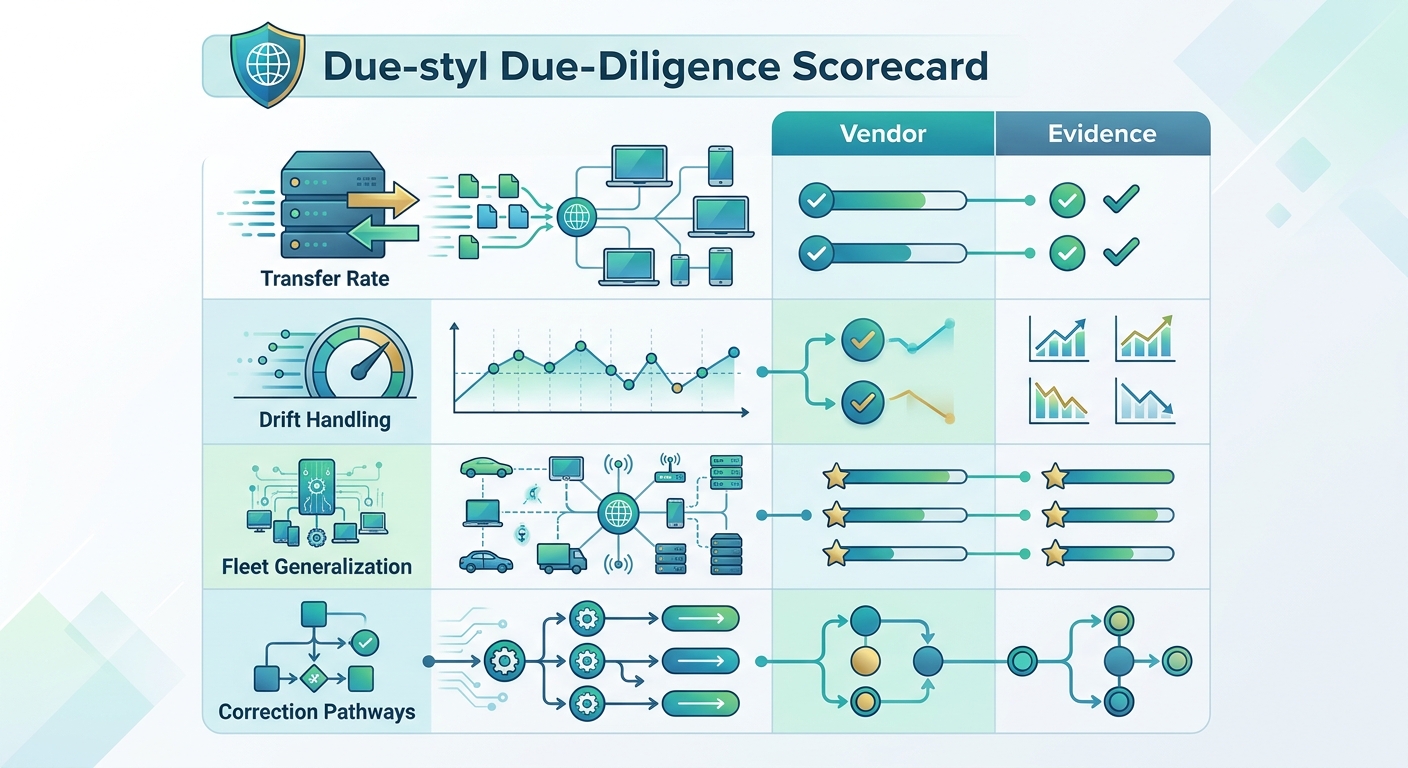
What Engineering Leaders Should Demand
Before trusting a sim-to-real claim, ask for:
- SysID evidence. Were actuator and contact parameters fit to real hardware, or assumed? What was the residual error?
- Failure-mode breakdown. Which of the four failure modes was tested for, and how? A single "it works" demo is not a transfer result.
- Held-out hardware. Was the policy evaluated on units it was not tuned on, and under drift (warm, worn, recalibrated)?
- Contact regimes. What object materials and surface conditions were covered—especially the slippery and compliant cases where contact modeling fails?
- Latency and jitter profile. What control rate did the policy train at, and what does it run at on hardware? How was jitter handled?
The embodiment gap is not closing on its