Foundation Models for Robot Manipulation: A 2026 Progress Report
A 2026 progress report on foundation models for robot manipulation—VLA architectures, open-weight vs. proprietary stacks, sim-to-real, and what buyers should know.
Scope note: this report reflects the state of the field as of early 2026. Claims about deployments are based on vendor reporting and public materials unless otherwise noted; treat success rates as directional.
Robot foundation models made measurable progress in 2026. After two years of viral demo reels—folding laundry, stacking dishes, sorting groceries—vision-language-action (VLA) systems are now in supervised pilots and limited production cells at some logistics operators, electronics assemblers, and lab-automation vendors. The gap between the demo and the deployment is narrowing, but it has not closed. Robot manipulation remains one of the hardest unsolved problems in embodied AI: contact-rich physics, long task horizons, and tight error tolerances make it a far cry from the text tasks that foundation models first conquered.
The distance is easy to underestimate. A language model that is wrong 3% of the time reads as fluent; a manipulator that drops a part 3% of the time is a line-down event. Manipulation compounds error across every step of a task: a ten-step pick-and-place sequence at 97% per-step reliability succeeds only about 74% of the time end to end. That arithmetic—not model quality alone—explains why deployment stays gated behind supervision, cell instrumentation, and human fallback. It also explains why the most credible 2026 deployments are narrow: kitting and tote induction in logistics, connector insertion and screwdriving in electronics, and vial handling in lab automation, where parts are fixtured, lighting is controlled, and a human sits within arm's reach of the cell.
This report covers manipulation specifically—grasping, placing, assembly, and tool use—not locomotion or navigation, which have their own trajectory. The verdict: 2026 delivered real progress in cross-embodiment transfer, data tooling, and on-robot inference, while evaluation methodology, out-of-distribution generalization, and safety verification remain genuinely unresolved. Buyers should treat current systems as powerful accelerators for constrained, well-instrumented tasks—not as general-purpose robotic labor.
What "Foundation Model for Manipulation" Means in 2026
The term gets used loosely, so it's worth being precise. A manipulation foundation model is a pretrained network that maps perception and a natural-language instruction to motor actions, and that can be adapted to new tasks or embodiments through fine-tuning, prompting, or lightweight conditioning rather than training from scratch. That adaptability—not raw scale—is the defining property.
From single-task policies to generalist pretraining
Classical robot learning built one policy per task: collect hundreds of demonstrations, train, deploy, and redeploy when anything changes. These pipelines were data-hungry and brittle. A typical bin-picking policy might need 200–500 teleoperated demonstrations per object family, plus re-collection whenever the gripper, camera mount, or part geometry changed. The foundation-model shift borrows the pretraining playbook from language: train on large, heterogeneous corpora of robot experience (plus video and simulation), then specialize cheaply. In practice, "foundation" is still aspirational—most production systems require meaningful task-specific data—but the pretraining step has collapsed the cost of each new skill. Teams commonly report that fine-tuning a pretrained VLA on a new pick-and-place task takes tens to low hundreds of demonstrations rather than the thousands a from-scratch policy would demand, and that most of the remaining effort goes into data quality and cell setup rather than model training. (See our primer on robot learning pipelines and data collection.)
The VLA architecture pattern
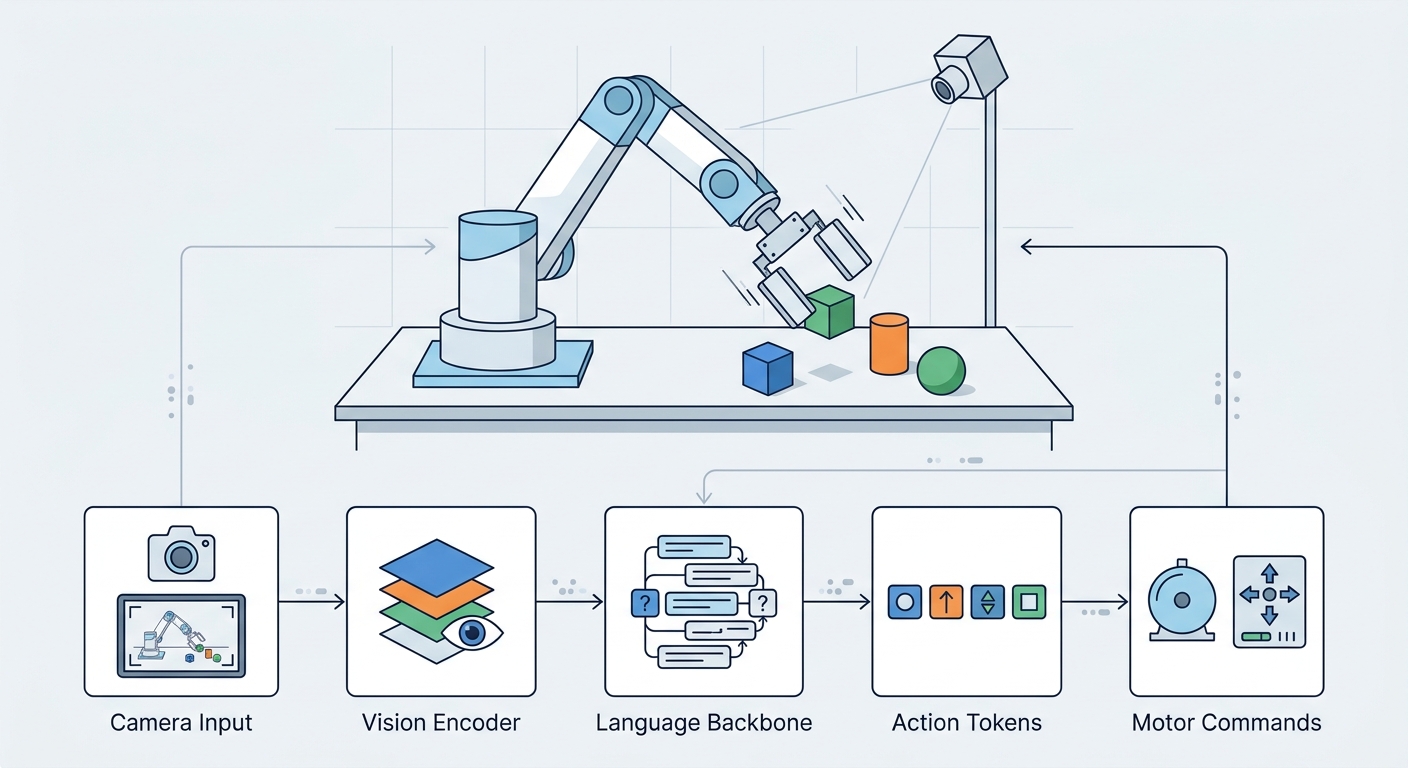
Most 2026 systems follow a common template: a vision encoder processes camera streams, a language backbone (often initialized from an LLM or VLM) fuses instruction and scene context, and an action head emits motor commands. Two design choices dominate the literature.
- Action tokenization discretizes continuous control into tokens the language model predicts, integrating cleanly with existing LLM infrastructure but often capping output rate and smoothness.
- Diffusion- and flow-based action decoding generates smooth action chunks in continuous space. These typically produce better contact-rich behavior at higher compute cost.
Note that chunking (emitting a short horizon of actions per inference) and tokenization (discretizing each action) are distinct and often combined. Either way, the VLA is not the whole controller: production systems run the policy at roughly 1–10 Hz and hand action chunks to a low-level impedance, force, or MPC controller that executes at hundreds of Hz. That two-tier stack—slow learned policy, fast deterministic controller—is what makes contact tasks work at all. A representative configuration runs the VLA on an onboard or edge GPU at 3–5 Hz, emits chunks of 16–50 actions, and relies on a 500 Hz–1 kHz joint-level controller to track them; when the policy stalls or emits an anomalous chunk, the controller's force limits and the cell's safety monitors catch the failure before it becomes a collision. (Related: how VLA action heads differ from LLM token prediction.)
The 2026 Manipulation Model Landscape
The field has stratified into three camps: open-weight VLA families, vertically integrated proprietary stacks, and data-engine providers selling into both.
Open-weight VLA families and their tradeoffs
Open-weight lines have become the default starting point for teams building custom manipulation. Representative exemplars include OpenVLA (2024, openly released weights) and its community successors, and the π-series from Physical Intelligence (released checkpoints with published fine-tuning recipes). Note that Google's RT-1/RT-2 research results were never released as usable weights, so "RT-lineage" is a conceptual ancestor, not a deployable baseline. The practical consequence: any vendor marketing an "RT-based" product is describing an architectural lineage, not a redistributable model, and buyers should ask what weights they can actually inspect and fine-tune.
The appeal of open weights is transparency and fine-tuning headroom: you can inspect the architecture, adapt it to your gripper, and run it on your own hardware. The tradeoff is integration burden. Open weights shift cost from licensing to engineering, and practitioners commonly estimate the gap between a research checkpoint and a production-grade policy at several months of data collection and tuning. A realistic open-weight project plan includes a data-collection rig, a teleoperation or kinesthetic-teaching workflow, a training and evaluation loop, and an on-robot latency budget—none of which ships with the checkpoint. Benchmark claims across these families are hard to compare directly (more below), so treat published success rates as directional. (Compare options in our open-weight VLA model roundup.)
Proprietary and vertically integrated stacks
The proprietary camp bundles hardware, model, and data flywheel into a single offering. These vendors argue—credibly—that manipulation performance depends on tight coupling between arm dynamics, gripper design, and policy training, and that a closed loop produces faster iteration than an open ecosystem can match. A vendor that controls both the arm and the policy can tune compliance, payload limits, and camera placement together, and can push field failures straight back into retraining data. The risk for buyers is lock-in: switching costs are high, and roadmap visibility is limited. The honest framing is a trade: integration convenience for strategic dependency. Before signing, ask what happens to your trained skills if you change hardware vendors, whether your task data is exportable, and how much of the stack is contractual versus merely customary. (Read our vendor evaluation checklist for robotic manipulation systems.)
Sim-to-real and data-engine differentiation
The real moat in 2026 isn't architecture—it's data. Three engines matter: teleoperation fleets generating high-quality human demonstrations, simulation producing cheap but domain-gapped experience, and video pretraining extracting manipulation priors from internet footage without action labels. Vendors with proprietary teleoperation fleets and mature sim-to-real pipelines report better transfer than those relying on public datasets alone—though this is vendor-reported and rarely independently audited. Note also embodiment coupling: many "cross-embodiment" models are in fact tuned to specific gripper morphologies, and performance degrades noticeably when transferred to different end-effectors. A policy trained on a two-finger parallel jaw gripper frequently fails outright on a suction cup or a three-finger adaptive hand, because the action space, contact geometry, and failure modes all change; the practical fix is a modest fine-tuning set on the target end-effector, not zero-shot transfer. (Background: sim-to-real transfer techniques for robot manipulation.)
"The model architecture is becoming commoditized. What separates vendors now is who owns the data engine and how fast they can close the loop between deployment and retrain." — paraphrased industry view, not a direct quote from a named source.
Why Evaluation Is Still the Weak Link
Published success rates are not yet a reliable basis for procurement. The main reasons:
- Inconsistent success criteria. "Success" ranges from "object moved" to "task completed to spec" with no shared definition across papers and vendors.
- Uncontrolled splits. Object sets, lighting, and scene layouts differ, so a high number on one benchmark says little about your warehouse.
- Small trial counts. At n=20 trials, a 90% vs. 85% success gap is within noise. Demand confidence intervals and trial counts, not point estimates.
- Sim-to-real gaps. Simulation numbers routinely overstate real-world performance; ask for real-robot results on held-out objects.
The statistics deserve emphasis because they are routinely ignored. With 20 trials, a 90% observed success rate has a 95% confidence interval spanning roughly 68% to 99%; the same trial count cannot distinguish a strong policy from a mediocre one. Even at 50 trials the interval is wide enough that a 5-point gap between two vendors is not meaningful. And because failures in manipulation are correlated—the same shiny part, the same glare, the same slightly warped bin—averaging over a mixed object set can hide a policy that fails deterministically on one class of part.
Actionable: require vendors to report per-task trial counts, held-out object/scene sets, and variance. A pilot on your parts, in your cell, is the only benchmark that counts. Structure the pilot to include an adversarial subset: the parts that are hardest to grasp, the lighting conditions your cell actually has, and the degraded cases (scuffed parts, partial occlusion) that a curated demo set omits. Track failure modes, not just success rate—a policy that fails safely and recoverably is worth more than one with a marginally higher success rate that occasionally drops parts into the mechanism.
Safety and Verification: Keep the Learned Policy Out of the Safety Loop
VLA policies are not certifiable under current functional-safety frameworks (e.g., ISO 10218 and ISO/TS 15066 for collaborative cells). They are stochastic, hard to formally verify, and can fail in novel ways. The workable pattern in 2026 is a deterministic safety layer independent of the learned policy: hardware force/torque limits, guarded/speed-and-separation-monitored motion, workspace fencing, and runtime monitors that halt on out-of-distribution perception or anomalous action sequences. Treat the VLA as a task planner/executor operating inside a safety envelope you can reason about—not as the safety system itself.
In practice this means the learned policy never holds authority over the limits that protect people and equipment. The envelope is defined by hardware and conventional safety logic: joint torque caps, a force-limited end effector, a monitored workspace, and an e-stop path that does not depend on the model's output. The runtime monitor is a separate, simpler component that watches perception confidence and action statistics and triggers a safe stop or a handoff to a human when the policy drifts outside its trained distribution. This is also where recovery behaviors belong: a policy that can detect a failed grasp and retry is more valuable in production than one that merely reports higher success on clean trials, because retries convert recoverable failures into throughput rather than downtime.
What to Do in 2026
- Scope to constrained tasks with instrumented cells and stable part presentation; defer open-world manipulation.
- Budget for data and integration, not just model licensing—engineering months dominate total cost for open-weight routes.
- Demand real-robot evidence with trial counts and