Humanoid Robots in 2026: From Research Labs to Commercial Deployment
By mid-2026, humanoid robots have moved from research prototypes to first commercial deployments. This report covers who is deploying what, where the technology works today, and what bottlenecks remain before mass adoption.
The question used to be: when will humanoid robots actually work? By 2026, that question has quietly shifted. The new question is: which tasks are they actually good at, and which companies have figured that out first?
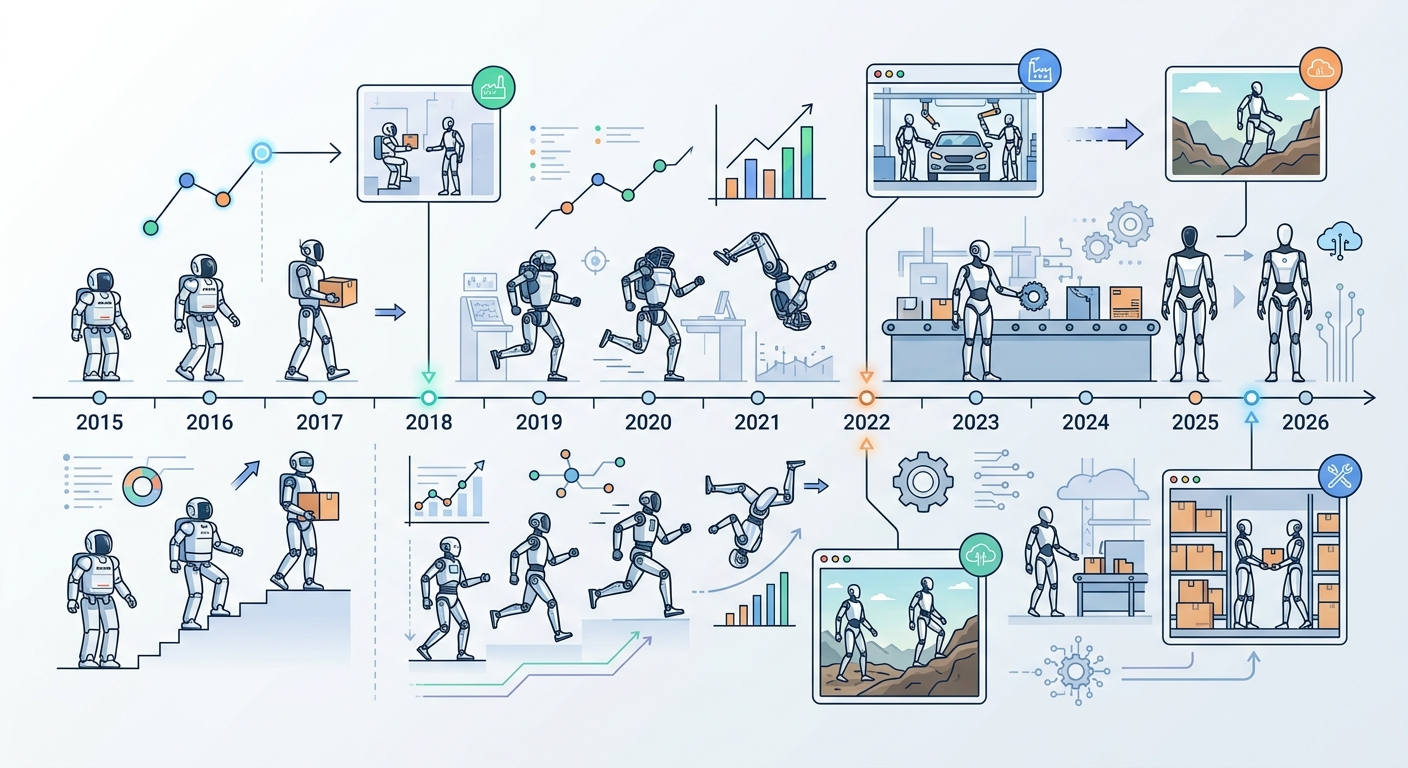
After decades in university labs and corporate research divisions, humanoid robots began their first serious commercial deployments in 2025. BMW, Amazon, and DHL all ran pilot programs. Tesla quietly integrated Optimus units into its Austin factory. Figure AI put Figure 01 to work in a South Carolina assembly plant. The numbers are still small — probably fewer than a thousand humanoid robots deployed worldwide as of mid-2026 — but the trajectory is clear. The technology has cleared enough hurdles to leave the lab. The remaining question is economics, not engineering.
This article maps the current landscape. It covers the companies deploying humanoid robots today, the tasks where they are earning their keep, the costs involved, the technical challenges that still limit scale, and the path forward.
The State of Humanoid Robotics in 2026
The 2025–2026 period marked an inflection point. After years of impressive demos and disappointing deployments, something changed. Two forces converged: hardware got reliable enough, and learning-based control methods finally scaled.
On the hardware side, a new generation of actuators and sensors brought end-effector and locomotion performance within range of commercial viability. Torque-dense series elastic actuators became cheaper. Onboard compute improved. Battery energy density increased enough to support 2–4 hours of continuous operation. None of these breakthroughs happened overnight. They accumulated across the supply chains of companies like Tesla, Figure AI, and Boston Dynamics.
On the software side, imitation learning and reinforcement learning pipelines reached a maturity that made it practical to teach new tasks without writing custom code for each joint. Instead of hand-programming a robot to pick up a specific object, engineers could demonstrate the task with teleoperation. The robot would learn a policy from that demonstration, then deploy it. This dramatically shortened the time from "unboxed robot" to "productive robot."
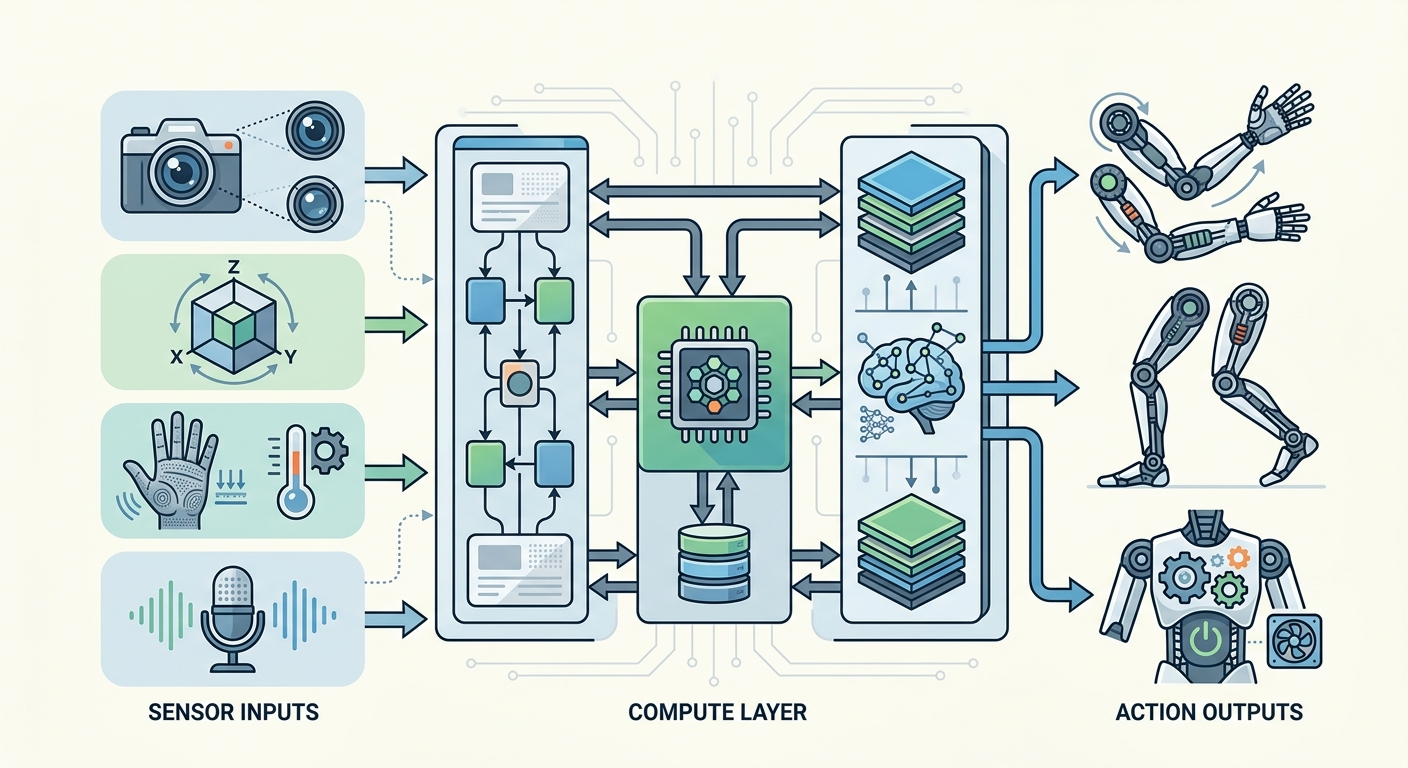
Sensors provide environmental awareness through cameras, IMUs, and tactile arrays. Actuators enable precise joint movement through torque-dense series elastic designs.
The result: first-generation commercial deployments in structured industrial environments. These are not general-purpose household robots. They are specialized tools doing specific tasks — mostly logistics, assembly assistance, and material handling — in environments designed around human workflows.
Humanoid robots are deployed in warehouses at BMW, Amazon, and DHL facilities alongside human workers. Robots learn from human demonstration using teleoperation, then apply learned policies to real tasks.
For the first time, the humanoid robot industry is generating real-world operational data at scale. That data is feeding back into better models, better sim-to-real transfer, and faster task learning. The virtuous cycle that autonomous driving has been chasing for fifteen years may actually be starting for robotics.
Who Is Deploying What — 2026 Landscape
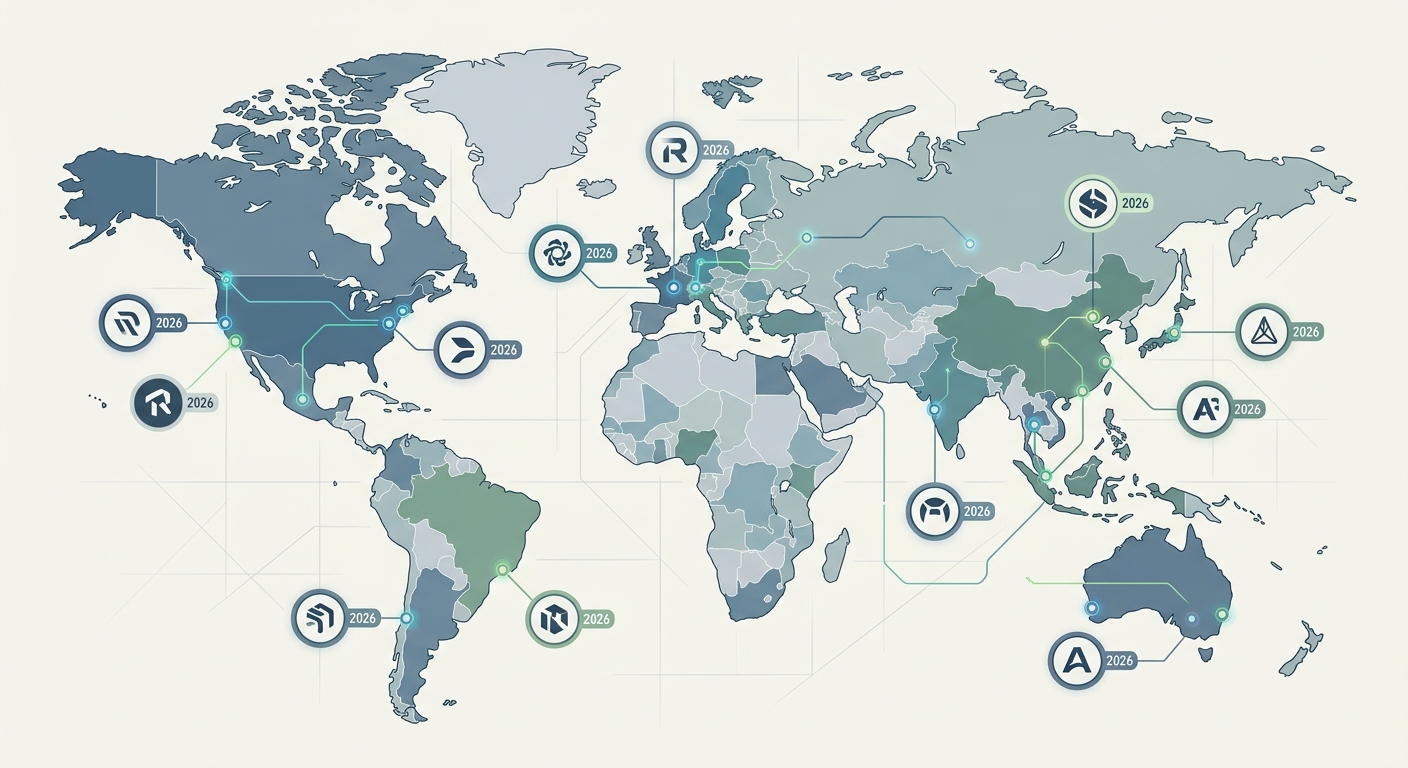
Figure AI — Figure 01
Figure AI signed a commercial agreement with BMW Manufacturing in 2024. By early 2026, Figure 01 units were operating in the BMW plant in Spartanburg, South Carolina — one of the largest manufacturing facilities in North America.
The tasks assigned to Figure 01 at BMW fall into logistics and material handling. Figure 01 performs pick and place tasks — it picks up totes, places them on conveyor systems, and handles components between workstation stations. These are tasks that require human-level dexterity and the ability to navigate a space designed for human workers.
The reported productivity gains are task-specific. For highly repetitive pick-and-place sequences, Figure 01 demonstrated throughput improvements in the range of 20–30% compared to the human baseline it supplemented. Error rates were lower for structured tasks but higher for anything requiring judgment in unstructured conditions.
Estimated unit cost for Figure 01 is in the range of $70,000 to $125,000, based on public statements and industry estimates. Figure AI has not published exact pricing.
Tesla Optimus
Tesla has taken a different approach. Rather than selling Optimus to third parties, Tesla is deploying it internally — first in the Gigafactory Texas campus outside Austin, and later in Berlin.
Tesla Optimus operates in Gigafactory environments — moving battery packs between stations, routing components through the production line, and handling parts that require two hands and human-scale reach. Optimus operates alongside human workers on the factory floor, with humans handling exceptions and quality checks.
Tesla's advantage is obvious: it controls the entire stack. Hardware, software, training data, and deployment environment are all in-house. This gives Tesla a level of iteration speed that commercial robot vendors cannot match. It also means external observers have limited visibility into actual performance metrics.
The latest Optimus hardware uses a redesigned hand with eleven degrees of freedom per hand. The robot can perform fine manipulation tasks that would have been impossible with earlier versions. Tesla's Dojo supercomputer provides the training compute needed to develop manipulation policies at scale.
Boston Dynamics — Atlas (Electric)
Boston Dynamics ended production of the hydraulic Atlas in 2024 and pivoted to a fully electric version. The electric Atlas was announced as commercially available in mid-2025.
The company positioned the new Atlas for industrial inspection, hazardous environment monitoring, and tasks requiring mobility in constrained spaces. The electric platform is quieter, more energy-efficient, and easier to maintain than its hydraulic predecessor.
Atlas retains its reputation for mobility. Humanoid robots walk on uneven terrain with Atlas demonstrating the most advanced whole-body control among commercial platforms. The robot can climb ladders, navigate uneven terrain, and recover from pushes and stumbles in ways that most bipedal platforms cannot match. This makes it relevant for use cases where wheeled robots simply cannot go.
1X Technologies — NEO
Norwegian company 1X Technologies raised a $125 million Series B in 2024 and has been developing NEO, a humanoid robot designed for domestic and light industrial use cases.
1X takes an embodied AI approach. Rather than programming task-specific behaviors, the company trains policies on large datasets of human video — essentially watching how humans perform tasks in real environments, then trying to replicate those policies on the robot.
This approach has potential advantages in generalization. A robot trained this way may adapt more easily to novel objects and environments than one trained purely in simulation. The downside is that the approach requires enormous amounts of diverse video data, which is still being collected.
Apptronik — Astral
Apptronik raised $403 million in a 2024–2025 funding round and is developing Astral, targeting logistics and manufacturing customers. Robot companies raise billion-dollar funding rounds to scale hardware manufacturing and develop learning-based control systems. The company's stated cost target is under $50 per operating hour — a level where humanoid robots become cost-competitive with human labor in most US markets.
Lower-Cost Alternatives — Unitree, Fourier Intelligence, AGIBOT
Outside the flagship Western companies, a new cohort of Asian manufacturers is producing humanoid robots at dramatically lower price points. Unitree's G1 is priced around $10,000–$16,000. AGIBOT (a Chinese company) has announced sub-$20,000 targets. Fourier Intelligence has been deploying rehabilitation humanoid systems in healthcare settings for several years.
Market projected to reach $38 billion by 2030 — driven by falling hardware costs, improving learning algorithms, and growing labor cost arbitrage in developed markets.
These lower-cost platforms are primarily serving research institutions, universities, and markets where full Western-priced robots are not viable. They represent an important parallel track — if the cost curve continues to decline, these companies could be positioned for rapid scaling in Asian markets before Western premium brands achieve mass adoption.
The Business Case — ROI and Total Cost of Ownership
The fundamental question for any commercial robot deployment is whether it is cheaper than the human it replaces. The answer is nuanced and highly task-dependent.
Hardware and Acquisition Costs
Current humanoid robot pricing spans a wide range. Commercial-grade platforms from Figure AI, Tesla, and Boston Dynamics are estimated in the $70,000 to $250,000 range per unit, depending on configuration and volume. Lower-cost research platforms from Chinese manufacturers are available for $10,000 to $40,000, though these are not yet built to commercial deployment reliability standards.
Annual maintenance costs are typically estimated at 15–25% of the initial hardware cost. This covers actuator wear, sensor calibration, software updates, and unplanned repairs. For a $150,000 robot, that is roughly $22,500 per year in maintenance.
Operational Cost Per Hour
Fully loaded human labor in a US warehouse costs $25 to $45 per hour, depending on location and role. This includes wages, benefits, payroll taxes, and workers' compensation.
Depreciating a $150,000 robot over five years with 4,000 operating hours per year gives a depreciation cost of $7.50 per hour. Adding energy ($1–2/hour), maintenance allocation ($5–6/hour), and software/infrastructure ($2–3/hour) brings the total operating cost to roughly $15–20 per hour for a robot working two full shifts.
Humanoid robots replace human labor at tasks where the economics make sense — repetitive, high-volume, structured tasks in high-wage markets. At roughly $18/hour all-in, robots are approaching cost parity with $30–35/hour human workers.
Break-even analysis for a US warehouse:
A humanoid robot depreciated over five years costs approximately $7.50 per hour — less than half the fully loaded cost of a $35-per-hour human worker before accounting for the robot's 2–3x productivity advantage in structured tasks.
For a repetitive pick-and-place task in a US warehouse:
- Human worker fully loaded cost: $35/hour × 8 hours = $280/day
- Robot daily operating cost: $18/hour × 20 hours = $360/day (with maintenance and depreciation)
- Robot daily productivity: approximately 2–3x human baseline for structured tasks
At 2x productivity, the robot produces roughly $560/day in value versus $280/day for the human worker. The robot's higher daily operating cost is more than offset by the productivity multiplier. Humanoid robot costs $150,000 per unit at current commercial pricing, with break-even achievable within 18–24 months in high-wage markets.
Where the Economics Still Fail
Not every task is viable. Any task requiring significant judgment, handling of novel objects in unstructured environments, or multi-step reasoning remains cheaper with human labor. Humanoid robots also cannot yet reliably perform tasks involving heavy lifting above 20–25 kg per arm, complex assembly requiring force sensing at millimeter precision, or operation in environments with significant clutter and variability.
The honest assessment: humanoid robots make economic sense today only in structured, high-volume, high-wage settings. The mass market — domestic use, small business, unstructured environments — remains out of reach economically and technically.
The Technical Bottlenecks That Remain
Despite the commercial progress, several fundamental technical challenges limit the scope of what humanoid robots can do today.
Dexterous Manipulation
The human hand has 27 degrees of freedom and can adapt to novel objects in milliseconds. A humanoid robot hand typically has 6–20 degrees of freedom and requires either prior training on a specific object category or teleoperation-based learning to handle new items.
Current state: humanoid robots perform at human level for objects and tasks they have been specifically trained on. They perform well below human level for novel objects in unstructured settings — the kind of everyday manipulation that a human does without thinking, like reorienting an unknown object to fit through a gap.
Robot hands achieve dexterous manipulation within narrow, trained domains but struggle with novel objects in unstructured environments. The sim-to-real gap for fine motor skills is significant. Tactile sensing is still crude compared to human skin. Contact dynamics modeling — predicting how objects will behave when pushed, grasped, or released — remains imperfect.
Progress in 2025–2026 has come primarily from scaling imitation learning. By collecting millions of teleoperation demonstrations across many robots and many tasks, companies like Figure AI and 1X have improved the breadth of manipulation capabilities. But generalization to genuinely novel objects and configurations remains limited.
Locomotion and Balance
Bipedal locomotion on flat, prepared surfaces is largely solved. Modern humanoid robots can walk, run, climb stairs, and recover from moderate perturbations without falling. Boston Dynamics Atlas remains the benchmark for mobility, but Tesla Optimus and Figure 01 have also achieved reasonable locomotion performance.
Humanoid robots walk on uneven terrain but still struggle with slippery surfaces, ladders, and highly contorted passages. The remaining challenges are in unstructured and adversarial environments. Surfaces with low friction (wet floors, oily factory floors), uneven terrain, narrow spaces requiring contortion, and tasks that require dynamic balancing (climbing ladders, crawling through passages) still push the limits of current systems.
Falls are a particular concern. A 70 kg robot falling on a factory floor is a safety hazard and a maintenance headache. Deployment requires safety certification — ISO 10218, ANSI/RIA 15.06, and emerging humanoid-specific standards govern how robots must behave in human-occupied spaces. Current systems use whole-body predictive control to avoid falls, but they cannot eliminate them entirely.
Sim-to-Real Transfer
Training a robot in simulation is attractive because it allows millions of trials in hours, without physical wear and tear. The challenge is transferring what the robot learns in simulation to the physical world.
Sim-to-real transfer has improved significantly, but the gap persists. Physical phenomena like contact, friction, deformation, and sensor noise are difficult to model accurately. Domain randomization — varying simulation parameters widely to make the policy robust to real-world variation — helps but does not close the gap entirely.
Sim-to-real transfers locomotion policies from simulated training to physical deployment through domain randomization and fine-tuning on real-robot data. By 2026, the leading companies are taking a hybrid approach: large-scale simulation training for the initial policy, followed by fine-tuning on real-robot data collected during teleoperation. This combination reduces the total data collection burden while improving transfer quality. As more robots deploy and generate real-world data, the sim-to-real pipeline improves continuously.
Energy and Battery
Battery technology remains a fundamental constraint. Current humanoid robots operate for 2–4 hours on a single charge, depending on task intensity. Charging takes 30–90 minutes. This creates a practical problem: a deployment requiring continuous coverage needs multiple robots per shift or opportunity charging infrastructure.
For comparison, a human worker can operate for 8 hours with a 30-minute break and does not require special charging infrastructure. The robot's energy efficiency — converting electrical energy to useful mechanical work — is also significantly lower than human muscle.
Solid-state batteries are frequently cited as a potential solution. By 2026, no commercial humanoid robot has shipped with solid-state batteries. Lithium-ion remains the standard. Research prototypes suggest 2–3x improvement in energy density is achievable in the 2028–2030 timeframe.
Data Collection and Policy Transfer
One underappreciated bottleneck: data collection. Each humanoid robot is slightly different due to manufacturing tolerances. A policy trained on one robot does not transfer perfectly to another. This means that every deployed unit requires some level of individual calibration and fine-tuning.
The industry is beginning to explore federated learning approaches — pooling anonymized data across deployed robots to improve base policies without sharing raw data. This is analogous to federated learning in mobile keyboards and autonomous vehicles. The approach is promising but still nascent for humanoid robotics.
Where Humanoid Robots Are Actually Winning
Against this backdrop of real technical limitations, which use cases have proven viable in 2026?
Structured Warehouse Tasks
Humanoid robots are deployed in warehouses at multiple facilities, performing tasks that play to their current strengths:
Bin picking of known objects. When objects are in known bins, organized by category, and the robot has been trained on that object class, pick rates approach or exceed human levels. Amazon and DHL have both run internal pilots with humanoid platforms for this task.
Tote packing and unpacking. Moving items between totes and conveyor belts is highly repetitive. Once trained for a specific configuration, humanoid robots can sustain high throughput for hours without fatigue.
Conveyor belt feeding. Keeping a conveyor belt supplied with components is a task that requires consistent placement precision. Humanoid robots excel at consistency once a task is learned.
Material transport. Moving carts and racks through a warehouse is within current locomotion capabilities and does not require sophisticated manipulation.
Visual quality inspection. Equipped with cameras and vision models, humanoid robots can perform pass/fail checks on products moving through a line. This is essentially a perception task, which current vision systems handle well.
Why the Humanoid Form Factor Matters Here
A humanoid robot can be deployed in a facility designed for humans without modification. Standard shelving heights, door widths, elevator dimensions, and workstation layouts all accommodate a 170 cm bipedal robot. This is a significant advantage over specialized automation, which often requires facility redesign.
Standard tools designed for human hands can be used by a humanoid robot. A screwdriver, a wrench, a handle — all the tools that exist in human workspaces were designed for human grippers. A humanoid robot with sufficiently capable hands can use them directly.
Human-Robot Collaboration
The 2026 deployment model is increasingly "cobotic" — robots handle the tedious, dangerous, and dirty tasks while humans supervise and handle exceptions. A single human worker can oversee two to four humanoid robots, intervening only when the robot encounters a situation it cannot handle.
This model plays to each party's strengths. Robots are tireless, consistent, and do not make repetitive strain injuries. Humans bring judgment, adaptability, and the ability to handle edge cases. The combination can outperform either alone.
The Road Ahead — 2027 and Beyond
The current deployment phase is best understood as the calibration period. Companies are learning which tasks work, which do not, and how to build the operational infrastructure — remote monitoring, predictive maintenance, fleet management software — to manage hundreds or thousands of deployed units.
Based on current trajectories, the most credible projections suggest 5,000 to 15,000 humanoid robots deployed globally by the end of 2027. That is a significant increase from the estimated fewer than 1,000 deployed in mid-2026, but still a fraction of the millions of industrial robots already operating worldwide.
Key milestones expected in the 2027–2028 timeframe:
Cost crossing $50 per operating hour. This would make humanoid robots cost-competitive with human labor in virtually all US and Western European markets. At that point, the economic incentive for deployment becomes overwhelming in high-wage sectors.
Eight-hour battery life. Solving the battery constraint would eliminate the need for multiple robots per shift in many use cases. This is an incremental improvement on current lithium-ion technology, not a breakthrough.
General-purpose manipulation benchmark. No humanoid robot has yet demonstrated reliable manipulation of arbitrary novel objects in unstructured environments. Achieving this would be the humanoid equivalent of GPT-4 for language — a step-change in capability and applicability.
The investment environment remains strongly supportive. Over $15 billion was invested in humanoid robotics companies in 2024–2026. Market projected to reach $38 billion by 2030 — this growth trajectory is driving rapid hardware iteration and software development. Cumulative investment through 2027 is expected to exceed $20 billion. This capital is funding hardware iteration, data collection infrastructure, and the software stack needed for commercial-scale deployment.
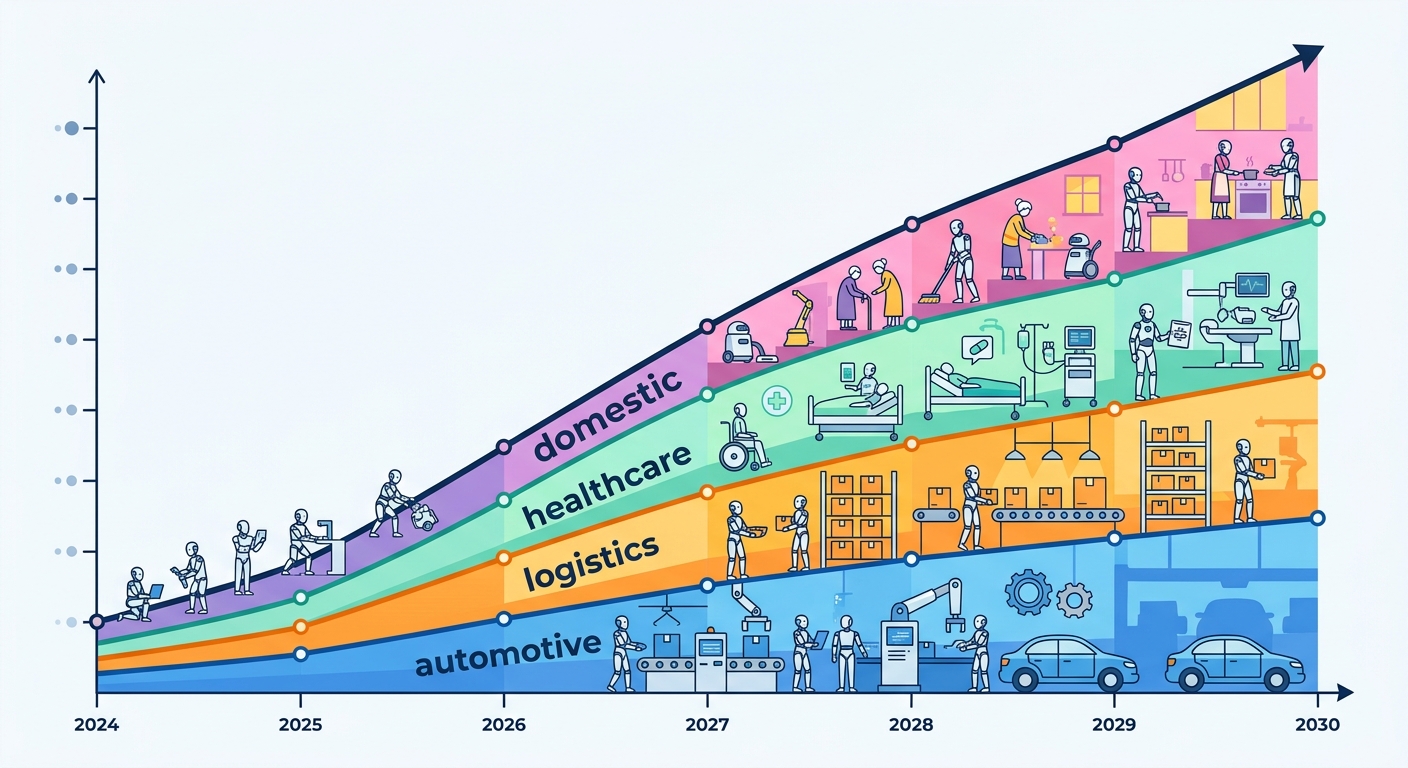
The path to mass market follows a familiar pattern: automotive and logistics first, then healthcare, then domestic use. Each step outward from structured industrial environments into unstructured real-world settings presents new technical challenges. The companies that solve those challenges will capture enormous value.
Expert Q&A
Q: What is the single biggest bottleneck preventing faster adoption of humanoid robots in commercial settings?
A: Dexterous manipulation in unstructured environments. Locomotion is largely solved for the environments where robots are deployed. Hardware reliability has improved to acceptable levels. The remaining challenge is the robot's ability to handle objects and situations it has not specifically been trained on. A robot that can only pick up boxes it has seen before is limited to very structured use cases. Solving few-shot manipulation generalization is the highest-value research problem in the field today.
Q: How should a company evaluate whether a specific task is viable for humanoid robot automation?
A: Ask three questions. First, is the task structured enough that the robot can be trained on the object and configuration variations it will encounter? If yes, the task is potentially viable today. Second, does the facility have the infrastructure to support robot deployment — network coverage, charging stations, space for robot maintenance? If no, factor in the infrastructure cost. Third, what is the fully loaded cost of the human currently doing the task, and what is the realistic productivity multiplier from automation? If the robot can achieve 2x or better productivity at the target operating cost, the business case is strong.
Q: Are humanoid robots a threat to human jobs, or do they create more value than they displace?
A: The evidence from 2025–2026 deployments suggests the latter in the near term. Companies deploying humanoid robots in logistics and manufacturing are not reducing headcount proportionally to robot count. They are using robots to handle volume growth that would otherwise require hiring, and to perform tasks (night shifts, hazardous environments) where labor availability is constrained. The displacement effect is real at the task level — specific roles involving repetitive physical labor will decline. The job-creation effect through robot supervision, maintenance, and the supply chain is real at the economy level. The net effect over the next five years is likely neutral to slightly positive for employment in deployed sectors.
Q: What safety standards govern humanoid robot deployment in workplaces?
A: Humanoid robots deployed alongside humans must comply with ISO 10218-1 and ISO 10218-2 (industrial robot safety) and ANSI/RIA 15.06 (American national standard for industrial robots). For collaborative applications, ISO/TS 15066 (collaborative robot safety) applies, though it was written primarily for cobots rather than full-sized humanoid robots. Several standards bodies are working on humanoid-specific standards, expected to publish in 2027–2028. Until then, companies typically implement additional safeguards — speed limiting, physical barriers, remote monitoring — beyond what existing standards require, as a matter of risk management and liability protection.
Q: What is the realistic timeline for a humanoid robot to appear in an average household?
A: Fifteen to twenty years is a reasonable estimate. The technical requirements for domestic deployment are significantly higher than industrial deployment. A home environment is unstructured, contains thousands of novel objects, requires safe interaction with children and pets, and must operate reliably without technical support. The cost target for household deployment is also lower — a robot that costs $100,000 is not viable for a consumer market. The path runs through commercial deployments that drive down cost and improve capability, followed by a gradual move into higher-end domestic applications (elderly care assistance, wealthy homeowner markets) before any mass-market entry.