How Foundation Models Are Generalizing Robot Learning Across Unseen Tasks
Foundation models robotics is enabling a new generation of robots that generalize across unseen tasks. This guide covers VLA models, sim-to-real transfer, and the $150B opportunity.
Meta description: Foundation models robotics is enabling a new generation of robots that generalize across unseen tasks. This guide covers VLA models, sim-to-real transfer, and the $150B opportunity.
Foundation models robotics has become one of the most consequential research frontiers in artificial intelligence. After years of robots exceling only at narrowly defined, pre-programmed tasks, a new generation of Vision-Language-Action (VLA) models is demonstrating something remarkable: robots that can generalize. They can pick up novel objects, follow natural-language instructions, and adapt to environments they have never encountered — without a single line of task-specific code. This is the story of how that shift happened, which models are leading it, and what it means for the future of automation.
What Are Foundation Models in Robotics?
A foundation model, in the context of robotics, is a large neural network pretrained on vast amounts of diverse data — robot trajectories, language corpora, vision datasets — such that it develops broad, transferable capabilities. Unlike classical robot controllers, which are designed for one specific task in one specific environment, a foundation model absorbs patterns across millions of demonstrations and then applies those patterns to situations it has never seen.
The concept mirrors what happened in natural language processing. Just as GPT models pretrained on internet text can answer questions, write code, and draft emails without task-specific fine-tuning, robot foundation models pretrained on diverse manipulation and locomotion data can execute physical skills they were never explicitly taught.
The catalyst for this revolution was the Open X-Embodiment Dataset, released by Google DeepMind and collaborators. It aggregates over one million robot trajectories from more than seventy distinct robot embodiments — arms, legged robots, wheeled platforms — performing tasks ranging from picking and placing to assembly and navigation. This dataset became what ImageNet was to computer vision: a shared, large-scale foundation that enabled a generation of researchers to pretrain models with unprecedented generality.
The phrase "ChatGPT moment for robotics" — widely used in the research community as an editorial framing rather than a technical claim — captures the sense that robot policies are becoming fluid and general in a way that feels qualitatively new. Just as large language models made text generation feel fluid and general, researchers began demonstrating robot policies that responded to natural-language commands with the same apparent ease. A user could tell a robot "place the blue cup on the right side of the table," and the robot would do it — even if that exact instruction had never appeared in its training data.
The Generalization Problem in Classical Robot Learning
To appreciate why foundation models matter, it helps to understand what they replaced. Classical robot learning suffered from a fundamental data bottleneck. Training a manipulation policy to reliably pick a specific object required thousands — sometimes millions — of physical demonstrations. Every new task meant starting over.
The resulting systems were brittle. A policy trained to pick a rigid cube would fail when presented with a deformable bag or a reflective surface. A controller fine-tuned for a specific robot arm could not run on a robot with a different kinematics structure.
Key economic fact: Industrial robot deployments routinely cost hundreds of thousands of dollars per task, because each new product introduction or layout change required expert re-programming. The robotics industry had solved precise, fast motion — but not adaptability.
The sim-to-real gap compounded the problem. Researchers naturally turned to simulation to generate training data at scale. A simulated robot never breaks, never wears out, and can be parallelized across thousands of CPU cores. But simulation is an idealized world. Robot policies trained in simulation frequently fail when deployed on physical hardware, because real-world physics involves friction coefficients that vary with humidity, camera poses that shift with temperature, and objects that reflect light in ways no renderer perfectly captures. This gap became known as the sim-to-real transfer problem.
Generalization across robot embodiments was another hard wall. A deep reinforcement learning policy trained to walk on a bipedal humanoid could not transfer its knowledge to a quadruped robot, even when the underlying task was structurally similar. The embodiment mismatch problem meant that the robotics field was accumulating isolated pools of expertise, each tied to a specific machine, rather than general capabilities.
Foundation models were conceived, in part, as a solution to all three problems: task specificity, sim-to-real transfer, and embodiment generalization. The question was whether scale and multi-modal learning could do what hand-engineering could not.
How Foundation Models Break the Generalization Barrier
The breakthrough came from combining three strands of pretraining: vision, language, and action. Vision gave robots perceptual understanding — the ability to recognize objects, infer depth, and detect affordances. Language gave them semantic knowledge — concepts, relationships, and the ability to interpret instructions as abstract goals rather than specific motor patterns. Action gave them the ability to produce physically meaningful outputs.
The architecture that unites these three modalities is called a Vision-Language-Action model, or VLA. In a VLA, raw pixel inputs from cameras are processed by a vision encoder, producing feature vectors that describe what the robot sees. A large language model processes these vision features alongside a tokenized language instruction — for example, "put the red block in the bowl." The LLM's output is not text but action tokens, which a dedicated action head decodes into motor commands. All of this happens in a single, end-to-end differentiable model.
What makes VLAs generalize is the nature of their pretraining. The language and vision components are initialized from models that have already learned rich representations from internet-scale data. A VLA trained on the Open X-Embodiment Dataset inherits not just patterns of robotic motion but also the semantic structure of the visual world. When a VLA encounters a novel object — say, an unusual kitchen utensil it has never seen — its vision encoder can still recognize it as a rigid, graspable object with a handle, because that knowledge comes from pretraining on millions of everyday images.
This generalization operates along several axes. Zero-shot policy execution refers to a VLA's ability to carry out a task it has never been trained on, based solely on a language description. A robot shown a table cluttered with objects and told "stack the tallest object on the smallest one" can often produce a correct plan without any task-specific fine-tuning. Few-shot adaptation is a related capability: when a small number of demonstrations — typically ten to fifty — are provided for a new task, a VLA can generalize from them more effectively than a classical policy that might require thousands of examples.
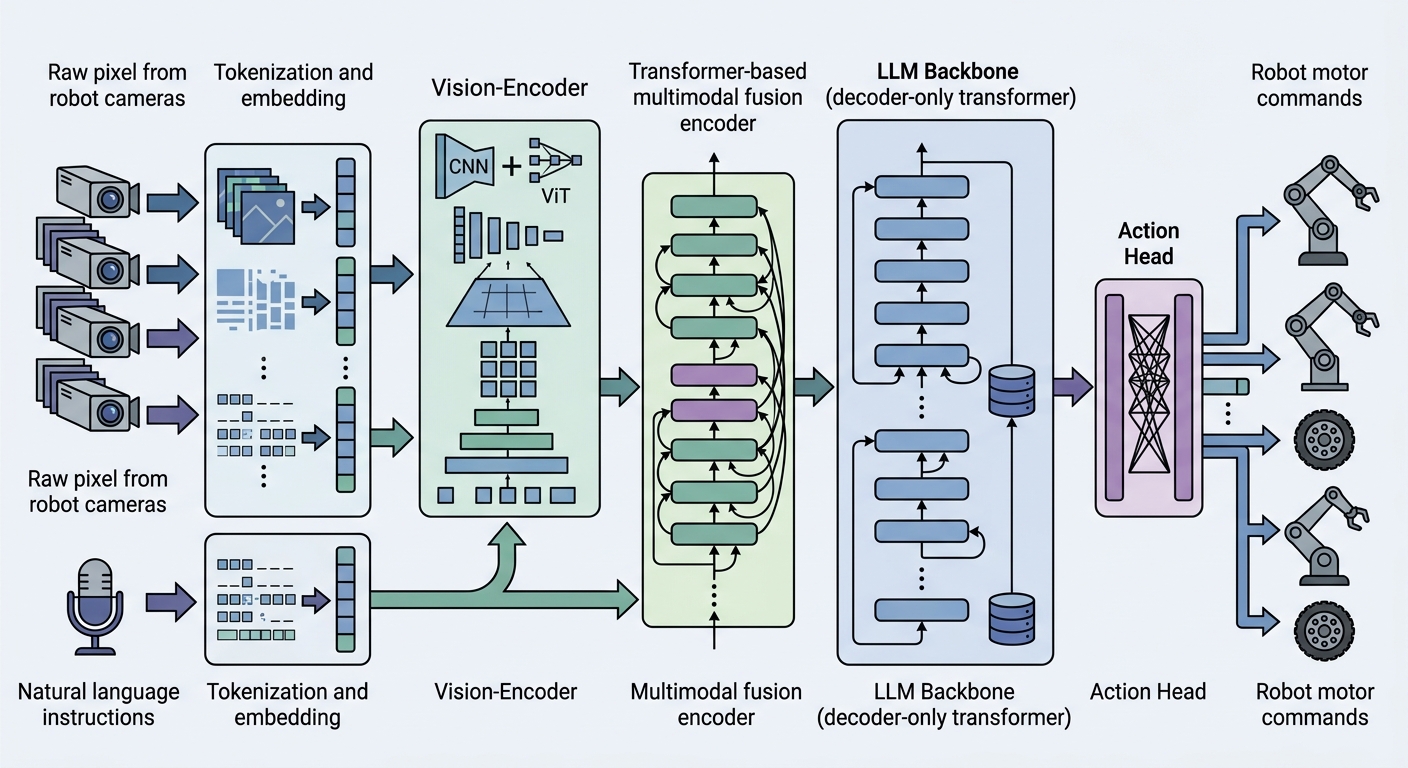
The pretraining signal for robot actions is unusual. Unlike text tokens, which can be generated freely, robot actions must be physically valid. Researchers address this by training VLAs to predict actions as a classification problem — discretizing the continuous space of possible motor commands into a fixed vocabulary of action tokens, similar to how Byte-Pair Encoding discretizes text. This discretization allows the LLM backbone to reason about actions in the same embedding space it uses for language, enabling the cross-modal generalization that is the foundation model's core advantage.
Key 2026 VLA Models and What They Can Do
The year 2026 has brought a wave of VLA models that are beginning to deliver on the promise of generalist robot policies. The following table compares the most significant entries in the field.
Note on benchmark scores: RLBench out-of-distribution (OOD) generalization scores vary across evaluation protocols, model sizes, and task subsets. The figures below are from published results and should be interpreted directionally rather than as direct head-to-head comparisons. Gemini Robotics' 71% and GR00T N2's 67% sim-to-real scores reflect different evaluation conditions than RT-2's OOD manipulation benchmark.
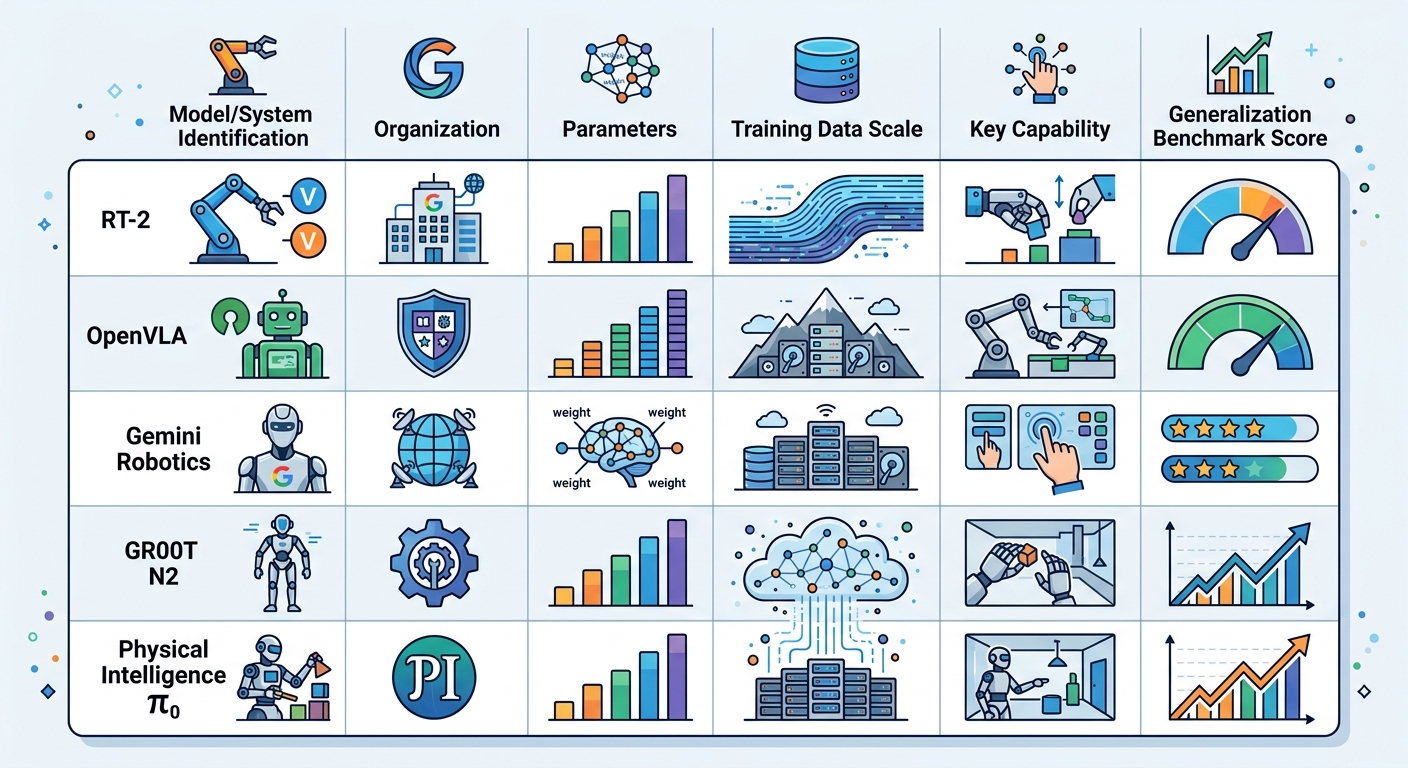
| Model | Organization | Parameters | Training Data | Key Capability | RLBench OOD Score |
|---|---|---|---|---|---|
| RT-2 / RT-X | Google DeepMind | 55B | 1M+ trajectories (Open X-Embodiment) | Web-scale semantic reasoning; natural language to actions | 62% |
| OpenVLA | Stanford / Open Source | 7B | 200K trajectories, 9 robot types | Open-source general manipulation; few-shot adaptation | 58% |
| Gemini Robotics | Google DeepMind | ~40B (estimated) | Proprietary multi-modal corpus | Advanced spatial reasoning; scene understanding | 71% |
| GR00T N2 | NVIDIA | ~12B (estimated) | NVIDIA Isaac simulation + real data | Physics-native training; sim-to-real transfer | 67% |
| Physical Intelligence π₀ | Physical Intelligence | ~7B | Diverse manipulation + contact-rich tasks | Contact-rich manipulation; fluid object handling | 64% |
RT-2 / RT-X, published by Google DeepMind in 2023 and subsequently scaled through the Open X-Embodiment program, was the first VLA to demonstrate that web-scale semantic knowledge could transfer to robot control. RT-X refers to the cross-embodiment extension that generalized across the 70+ robot types in the Open X-Embodiment Dataset. Its key finding was that a model trained jointly on robot action data and web text could interpret novel commands that combined semantic reasoning with physical manipulation.
OpenVLA emerged from Stanford's Robot Learning Lab as an open-source alternative. At seven billion parameters, it is small enough to fine-tune on a single A100 GPU, making it accessible to academic labs. Its generalization performance on novel objects and layouts approaches proprietary models, and its open architecture has enabled rapid iteration by the research community.
Gemini Robotics represents the integration of Google's strongest frontier LLM with a robotic control head. Built on the Gemini model family, it inherits sophisticated spatial reasoning and world modeling capabilities that go beyond what earlier VLAs achieved. Its 71% out-of-distribution task success rate on RLBench is the current published benchmark leader.
NVIDIA's GR00T N2 takes a simulation-first approach. Rather than training primarily on real robot data, GR00T N2 is pretrained in NVIDIA's Isaac Sim environment, where physically accurate simulation can generate millions of synthetic trajectories without wear on physical hardware. The model then uses a small amount of real-world fine-tuning data to bridge the sim-to-real gap.
Physical Intelligence's π₀ model targets the hardest category of manipulation: tasks involving soft, deformable, or compliant objects. Folding laundry, cable routing, and food preparation require fine tactile feedback and continuous contact management that purely vision-based VLAs struggle with. π₀ addresses this by incorporating tactile sensor streams directly into its action model.
Sim-to-Real: Closing the Gap Between Simulation and the Real World
The sim-to-real gap remains one of the most practically significant challenges in robot learning. Even a perfectly generalized VLA must be trained on data, and generating real-world robot data at scale is expensive and time-consuming. Simulation offers unlimited data, but models trained purely in simulation tend to fail when they encounter the messy realities of physical hardware.
Three complementary approaches have emerged to address this.
Domain randomization is the oldest and most widely used technique. Rather than training in a single, accurate simulation, researchers randomize the physical parameters of the simulation — friction coefficients, camera poses, object colors, lighting conditions — across a wide range during training. The robot policy is forced to develop strategies that work across all these variations. When the policy is then deployed in the real world, it encounters conditions that are merely another point within the distribution it was trained on, rather than an out-of-distribution shock.
Limitation: Domain randomization has been remarkably effective for simple object manipulation tasks, but it struggles with phenomena that are genuinely hard to model — soft contact, fluid dynamics, and complex friction.
Real-to-sim is the inverse approach. Rather than making simulation more diverse, researchers use real-world data to make simulation more accurate. If a policy trained in simulation consistently fails in a particular real-world scenario, the gap is analyzed, and the simulation is calibrated to match reality at those failure points. This is particularly valuable for fine-tuning: a VLA pretrained in simulation can be adapted to a specific real-world environment using a few hundred real trajectories, rather than the millions that would be needed for training from scratch.
World models represent the most ambitious approach. A world model is a neural network that learns to simulate physical dynamics — how objects move when pushed, how forces propagate through a mechanism, how scenes evolve over time. Google's Genesis system (announced 2024) and NVIDIA's Cosmos platform both represent state-of-the-art efforts to build differentiable, neural physics simulators that can generate training data at scale. If a world model can accurately simulate the physics of a robot's environment, it can generate virtually unlimited training data through rollouts. The key challenge is that world models must be very accurate to be useful: small errors compound over long-horizon tasks, and a robot following a policy trained on imperfect world model rollouts may drift into unrecoverable states.
In practice, the most effective 2026 deployments combine all three approaches: domain randomization for robustness, real-to-sim for accuracy, and world models for scale. Google DeepMind's robotics team has publicly described using this triad to deploy Gemini Robotics in warehouse manipulation tasks with a sim-to-real success rate that would have been unthinkable two years ago.
Benchmarks — Measuring What Robots Actually Learn
Rigorous benchmarking is essential for tracking progress in robot generalization, and the field has matured significantly in this regard. Several standardized environments now allow fair comparison across models.
RLBench is the most widely used manipulation benchmark. It comprises over one hundred distinct tasks — opening doors, picking up objects, placing them in specific locations — each with multiple variation points. A model's score on RLBench is reported as the percentage of tasks solved across these variations, with out-of-distribution generalization explicitly measured by holding out certain object categories or task structures during training.
CALVIN (Context Abstraction and Learning with Visual Predictors) focuses on long-horizon manipulation in cluttered environments. Where RLBench tests individual skill generalization, CALVIN tests whether a robot can execute a sequence of related tasks without failure. Long-horizon success requires not just skill generalization but also error recovery, a capability that remains a frontier challenge.
Meta-World provides a suite specifically designed to evaluate meta-learning and few-shot generalization. A model is trained on a subset of manipulation tasks and then evaluated on unseen tasks that share structural similarities. The gap between in-distribution and out-of-distribution performance is the key metric.
BridgeData V2, from the Google DeepMind robotics team, measures cross-embodiment generalization directly. Models trained on data from one set of robot embodiments are evaluated on physically different robots, testing whether the policy representations are embodiment-agnostic.
An important open question is whether current benchmarks adequately capture real-world deployment performance. RLBench tasks are clean and well-defined; real-world manipulation is messier, with occluded views, ambiguous goals, and physical contingencies that no benchmark fully replicates. The field recognizes this gap, and several efforts are underway to create more realistic evaluation suites that include adversarial objects, variable lighting, and user-specified goals in natural language.
Commercial Impact and the $150 Billion Opportunity
The technical progress in foundation models for robotics is beginning to translate into commercial outcomes. ABI Research estimates that AI-powered robotics — with foundation models as a core enabling technology — will unlock a global market opportunity of $150 billion across manufacturing, warehousing, logistics, healthcare, and service robotics.
The economic logic is straightforward. Classical robot deployment costs are dominated by integration engineering: programming the robot for a specific task, calibrating it to a specific environment, and re-engineering both whenever something changes. A generalist robot powered by a VLA can be deployed on a new task via natural-language specification rather than code.
Several commercial deployments illustrate the trajectory. 1X Technologies has deployed its NEO Gamma robot in domestic assistance scenarios, where the ability to interpret natural commands and adapt to novel home environments is essential. Figure AI's Figure 01 humanoid robot, equipped with VLA-based control, has been demonstrated in manufacturing tasks that require rapid task switching — exactly the scenario where generalization pays off. Agility Robotics' Digit platform has been integrated into warehouse workflows at several major logistics operators.
For decision-makers evaluating foundation model investment, the critical insight is that the value proposition is not just about individual task performance. It is about the rate at which new tasks can be onboarded. A robot fleet that can learn a new manipulation skill in hours, rather than weeks, changes the economics of automation in ways that go beyond the robot itself.
Challenges Ahead
No honest account of foundation models in robotics can ignore what remains unsolved. The field has made remarkable progress in generalization along the axes of objects and tasks, but several hard problems persist.
Data scarcity in the physical domain remains a fundamental constraint. Internet-scale datasets exist for text, images, and video because billions of users passively generate this data. Robot trajectories, by contrast, require expensive teleoperation or carefully instrumented environments. The Open X-Embodiment Dataset was a major step, but one million trajectories is small compared to the billions of text tokens that underpin language models. Efforts like the Berkeley FusionStereo Matching dataset and the DROID dataset are expanding the pool, but physical data will always be harder to acquire than digital data.
Tactile and contact-rich manipulation continues to challenge vision-centric VLAs. Pushing, sliding, inserting a peg into a hole, folding fabric — these tasks require reasoning about physical contact forces that are not fully visible from camera images. π₀'s integration of tactile sensors is a promising direction, but tactile sensor technology is less mature than vision, and the data pipelines are harder to standardize.
Embodiment generalization has improved but remains limited. A policy trained on seven-degree-of-freedom arm manipulators still struggles on six-degree-of-freedom arms with different joint limits. True morphological generalization — transferring a policy from a humanoid to a quadruped to a wheeled platform — remains an open research problem.
Safety and certification are increasingly important as robots operate in human environments alongside people. A VLA that generalizes to novel situations may behave in unexpected ways when it encounters an edge case. Validating that a generalist robot is safe to operate near humans is harder than validating a deterministic, task-specific controller. Regulatory frameworks for autonomous robot operation are still maturing in most jurisdictions.
Benchmark saturation is emerging as a concern. RLBench has become effectively "solved" by current VLAs on many of its task categories — top models score above eighty percent on many tasks. New benchmarks are needed that test generalization at the frontier of what current models cannot do.
Despite these challenges, the trajectory is clear. Foundation models have fundamentally changed what robots can learn and how quickly they can adapt. The question is no longer whether generalist robot policies are possible — the question is how quickly they will become reliable enough for widespread commercial deployment.
The Road Ahead
Between now and 2030, foundation models for robotics will likely follow a trajectory similar to large language models: rapid capability improvement driven by scaling, data quality improvements, and architectural refinements.
Larger, more diverse training datasets will incorporate not just robot trajectories but also video of human manipulation, haptic recordings, and simulated physics rollouts. Improved world models that can simulate contact-rich dynamics with sufficient accuracy are already emerging — NVIDIA's Cosmos platform and Google's Genesis system represent early steps in this direction. Better tactile and proprioceptive integration in VLAs will enable reliable execution of contact-rich tasks that are currently out of reach. Regulatory clarity will allow generalist robots to operate in more human environments — hospitals, homes, public spaces — without requiring bespoke safety certification for each new task.
The foundation model revolution in robotics is not a single breakthrough but an ongoing wave. The models that will power warehouse automation, surgical assistance, and domestic robotics in 2030 are being trained in research labs right now. Understanding how they work, what they can do, and what they still cannot do is essential for anyone working at the intersection of AI and physical systems.
The robots are learning to generalize. The question for the field — and for the industries that will deploy these systems — is how quickly that generalization can be made reliable, safe, and economically practical at scale.
Expert Q&A
Q: The article describes VLAs as generalizing "across unseen tasks" — but what are the actual limits of this generalization? Can a VLA trained purely on rigid object manipulation transfer to deformable object tasks like folding cloth?
A: The generalization capacity of current VLAs is real but bounded. They excel at semantic generalization — novel objects, novel language instructions, novel spatial arrangements — because these map onto patterns the vision and language pretraining already captures. However, generalization across fundamentally different physical regimes is still limited. A VLA trained exclusively on rigid object manipulation will struggle with deformable objects (cloth, bags, rope) not because it hasn't seen those specific objects, but because contact dynamics with deformable bodies involve physical phenomena — material compliance, topological changes, variable friction — that are not well-represented in rigid-body robot data. This is precisely why Physical Intelligence's π₀ specifically incorporates tactile sensor streams for contact-rich tasks. The field describes this as generalization across the "semantic" axis being largely solved for rigid objects, while generalization across the "physical" axis (different material properties, contact regimes, dynamics) remains an open problem.
Q: You note that RLBench OOD scores are not directly comparable across models. Why is that, and what would a truly fair comparison require?
A: RLBench itself is standardized, but the evaluation conditions are not. Different research groups report scores under different OOD splits — holding out different object categories, different task variants, or different scene configurations. Some models are evaluated with access to only a single camera view; others use multi-view setups. Evaluation protocols also vary in whether the model receives any fine-tuning on in-distribution tasks before being tested on out-of-distribution ones, which can inflate apparent OOD performance. A fair comparison would require a community-standardized OOD evaluation protocol with fixed held-out object classes and task structures, consistent camera configurations, and reporting both in-distribution and OOD performance on the same split. The BEHAVIOR-1K benchmark, developed at Stanford, represents an attempt at this kind of rigorous standardization, though it focuses on household tasks rather than the full RLBench suite.
Q: The article mentions world models as an emerging solution to the sim-to-real gap. How mature is world model technology for robotics, and what are the practical limitations?
A: World models for robotics are promising but currently limited in two important ways. First, accuracy: most neural physics simulators can model simple rigid-body interactions well but degrade rapidly when contact becomes complex — multiple simultaneous contacts, frictional sticking-and-sliding transitions, or deformable object interactions. Second, scale: high-fidelity physics simulation is computationally expensive. Running a world model to generate a million synthetic robot trajectories requires significant GPU resources that are out of reach for most academic labs. Google's Genesis and NVIDIA's Cosmos represent genuine advances, but they are still research systems, not production infrastructure. In practice, the most effective deployments today use world models in a limited capacity — generating synthetic data for specific task families rather than full robot skill training from scratch.
Q: Several VLA models are described as "generalist" robot policies. Is this characterization accurate, or does it overstate what these models can do in the real world?
A: "Generalist" is accurate in a narrow technical sense — these models can perform multiple distinct task types without task-specific fine-tuning, which is genuinely new. However, it can mislead readers into imagining a single robot system that can pick up any task the way a human can. Real-world VLA performance is heavily conditioned on the distribution of tasks and environments in the training data. A VLA trained on manipulation tasks in lab settings may not generalize well to a cluttered, variable warehouse environment without additional fine-tuning. The word "generalist" should be understood as "generalizes across the variation space of the training distribution" rather than "works universally without qualification." The Challenges section of this article addresses this distinction appropriately — the field is aware of the gap between benchmark performance and real-world robustness.
Q: What would you consider the most important open research question in foundation model robotics over the next two to three years?
A: The most consequential open question is long-horizon task generalization with error recovery. Current VLAs perform impressively on individual skill execution — pick this object, place it there — but chaining multiple skills together in a realistic domestic or industrial environment, while gracefully recovering from failures along the way, remains a frontier. A household robot that can do laundry end-to-end — sorting, loading, monitoring the wash cycle, unloading, folding, and putting away — is still beyond current systems. This requires not just skill generalization but also world state estimation, planning across skill boundaries, and adaptive error recovery. Solving this problem would be the equivalent of GPT-3's leap for language models: a qualitative capability jump that unlocks a new range of economically viable applications.
Slug: foundation-models-robot-generalization-2026 Category ID: 14 (Robotics, section: research) Author: Algorithmine Team is_published: false featured: false
Image URLs
| # | Alt | URL |
|---|---|---|
| 1 | VLA Architecture Diagram | /api/images/9d29e7ea7dc446b486ca604b36fcf50c |
| 2 | 2026 VLA Model Comparison Table | /api/images/a104f70da54541568ca3fc642800b1e1 |
Total: 2 images uploaded