The Enterprise AI Buying Cycle Is Broken: Inside the Pilot Purgatory Problem
Why enterprise AI pilots stall before production—and how to fix the broken buying cycle across vendor evaluation, security review, and budget approval.
The Pilot Purgatory Problem: Why Enterprise AI Deals Stall Before Production
Enterprises are running more AI pilots than at any point in the technology's short commercial history. Internal hackathons have given way to funded proofs of concept, and nearly every large organization now has a handful of LLM experiments in flight. Yet the conversion rate from AI pilot to production remains stubbornly low — a gap that industry surveys have flagged for several consecutive years, even as model capability has climbed. The pilots work. The buying cycle doesn't.
This is the defining tension of enterprise AI: capability has materially outpaced the procurement machinery built to evaluate and adopt it. The raw model-quality gap that dominated 2023 conversations has narrowed considerably with successive releases. What remains is a process problem — vendor evaluation, security review, budget ownership, and success criteria that were designed for a different category of software. Model reliability and evaluation are still hard, but they are no longer the usual reason a deal dies.
The result is what practitioners have started calling pilot purgatory: enterprise AI initiatives that neither succeed nor get killed. They persist in a state of indefinite evaluation, consuming engineering time and budget, and blocking the next wave of adoption behind them.
This article diagnoses why the enterprise AI buying cycle breaks, examines where vendors and buyers are beginning to fix it, and offers a practical playbook for teams that want to move from demo to deployment without burning another two quarters in limbo.
What Is "Pilot Purgatory"?
Pilot purgatory describes a specific failure mode: an AI pilot that never reaches a production decision in either direction. It isn't a failed pilot — failures get killed, lessons get captured, and teams move on. Purgatory is worse. The pilot keeps running, keeps getting renewed in small increments, and keeps consuming the attention of the people who could be shipping something else.
Defining the pattern
The pattern has recognizable symptoms. The pilot has a champion but no budget owner. It has a demo but no production success criteria. Security review is "in progress" and has been for months. The vendor relationship is warm but unsigned. Every quarter, someone asks whether to scale it, and every quarter the answer is "let's gather more data."
The key distinction is the absence of a decision, not the absence of results. Many purgatory pilots are technically successful. They generate plausible outputs, win internal enthusiasm, and occasionally get showcased in all-hands decks. What they never do is cross the threshold into a funded, governed, production deployment — because no one in the chain has both the authority and the evidence to make that call.
Why it's a procurement problem, not a technology problem
It's tempting to blame model limitations, hallucination rates, or integration complexity. In most stalled AI deals, none of those are the binding constraint. The bottleneck sits in vendor evaluation, security and legal review, and budget ownership — functions that were never designed for a category where the underlying product changes monthly and the value proposition is probabilistic rather than deterministic.
That last point deserves unpacking, because it's the root of the mismatch. Traditional enterprise software is deterministic: given the same input, it produces the same output, and its value can be specified in a contract and verified in acceptance testing. LLM-based systems are probabilistic. The same prompt can yield different outputs, quality varies by input, and "correct" is a distribution rather than a boolean. Procurement processes assume you can specify, verify, and warrant behavior up front. AI systems can't be fully specified up front — they have to be evaluated empirically, in context, against a baseline. When buyers apply deterministic acceptance criteria to a probabilistic system, the deal either fails review or stalls indefinitely waiting for a guarantee that cannot exist.
Engineering teams can usually get a pilot working. What they can't do is single-handedly navigate a procurement process built for multi-year SaaS contracts, a security review with no reusable AI framework, and a CFO who wants a hard ROI number before committing. That's a buying-cycle failure, and it requires buying-cycle fixes. (See our guide to enterprise AI procurement frameworks for reusable review templates.)
How We Got Here: The Anatomy of a Stalled AI Deal
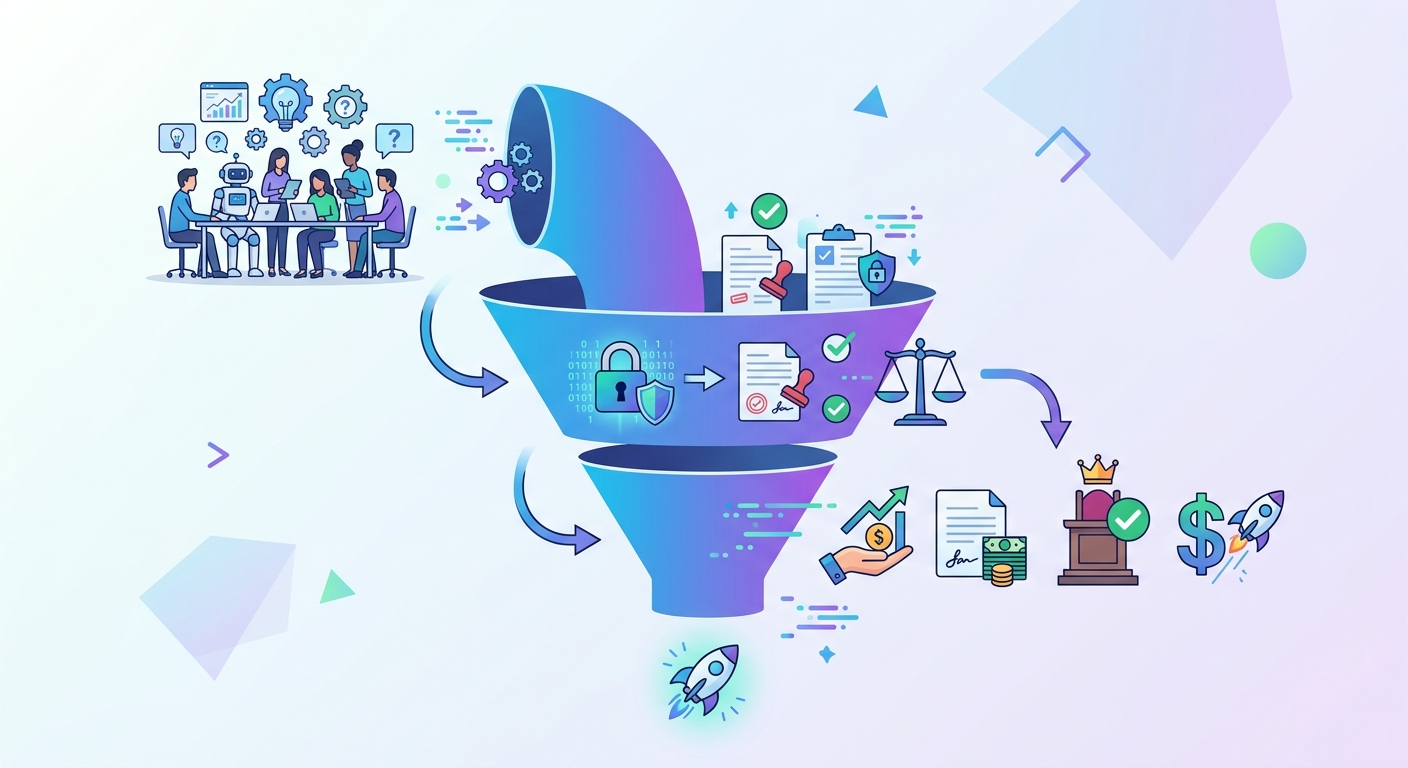
Pilot purgatory isn't caused by one bad decision. It's the predictable output of a three-stage handoff where each stage applies criteria the previous stage never optimized for. Walk through a typical stalled AI deal and the seams become obvious.
Stage 1 — The innovation-team pilot
An innovation or platform team spins up a pilot with a scoped use case — contract summarization, support triage, internal search — using sandboxed or synthetic data. The team defines success as a working demo that stakeholders find credible. They hit that bar. The model performs well on curated examples, latency is acceptable in a test environment, and the demo lands.
But the pilot was never instrumented for production. There's no cost-per-task measurement, no adoption data, no evaluation harness tied to real traffic. The team has proven feasibility and nothing else — and they hand off to security and legal with a demo, not an evidence package. (Learn how to build a production-grade AI evaluation harness before the handoff.)
Stage 2 — The security and legal gauntlet
Now the deal enters review. Security wants to understand data flows, model hosting, retention, and vendor posture. Legal wants to negotiate terms around data use, indemnification, and liability for model outputs. Data governance wants to know where prompts and completions live.
In many enterprises, this review restarts from scratch for every AI vendor, because there's no reusable AI procurement framework. The questions are genuinely new — training-data provenance, subprocessor chains, output ownership — and the reviewers are learning the category in real time. Weeks become months. The pilot keeps running on a temporary approval that everyone knows isn't a real approval.
This is changing at the margins. Emerging standards such as the NIST AI Risk Management Framework and ISO/IEC 42001 give security and governance teams a vocabulary and a checklist they can reuse across vendors, and more mature organizations now maintain a standing AI review board rather than assembling a new one per deal. But adoption is uneven, and in most stalled deals the review is still bespoke.
Stage 3 — The budget-owner standoff
Eventually the deal reaches the person who controls the money. They ask the reasonable question: what's the ROI? And they ask for it in terms finance understands — hard savings, headcount avoidance, measurable cycle-time reduction.
The problem is that the pilot was never designed to produce that evidence. It proved the model works; it didn't measure cost-per-resolved-ticket against the incumbent process. The budget owner isn't unreasonable — they're being asked to fund a line item on enthusiasm. The deal stalls, the pilot renews on a shoestring, and the cycle repeats next quarter.
The standoff is structural. The innovation team is measured on demonstrating capability. The budget owner is measured on capital efficiency and downside protection. These are different scorecards, and the handoff between them is where most deals die — not because either party is wrong, but because no one was tasked with producing the bridge: a defensible, baseline-anchored business case.
The Evidence Package: What a Production-Ready Pilot Actually Measures
The single highest-leverage fix for pilot purgatory is to define the evidence package up front — the artifacts a pilot must produce to earn a production decision. A demo proves feasibility. An evidence package proves value and manageability. It should include, at minimum:
- A quality baseline and a measured delta. Task-level accuracy or quality on a representative, held-out sample, compared against the incumbent process or a human baseline — not against curated demo inputs. State the evaluation method and the sample size.
- Cost per task, fully loaded. Inference cost, integration and maintenance engineering, and human-in-the-loop review time. A pilot that ignores review time will look artificially cheap.
- Latency and reliability under realistic load. p50 and p95 latency, error and timeout rates, and behavior under peak concurrency — not just the latency of a single test call.
- Failure-mode analysis. What the system does when it's wrong, how often, and how the failure surfaces to the user. A system that fails safely and visibly is often deployable even when its raw accuracy is imperfect.
- Adoption and workflow-fit signals. Who uses it, how often, and whether it displaces or adds to existing steps. A tool that adds a step is a tool that gets abandoned.
- A defined production scope. Which users, which data, which guardrails, and what "rollback" looks like if quality degrades.
A pilot instrumented to produce these artifacts converts or dies on a clear timeline. A pilot that produces only a demo will sit in purgatory indefinitely, because it has given the budget owner nothing to decide on.
Where Vendors Are Starting to Fix It
The buying cycle is a two-sided problem, and vendors are beginning to adapt — some of them well.
The strongest vendors now ship evaluation and evidence tooling as part of the sales process: reproducible benchmarks on the customer's own data, documented failure modes, and cost models that map to per-task economics rather than per-seat licensing. They arrive at security review with a pre-built package — data-flow diagrams, subprocessor lists, retention policies, and mappings to frameworks like NIST AI RMF or ISO/IEC 42001 — instead of answering the same questions from scratch for every prospect.
Others are restructuring the commercial model around the probabilistic reality: outcome-based or consumption-based pricing, bounded pilots with explicit decision gates, and contractual language that addresses output liability and data use directly rather than deferring to generic SaaS terms. These moves don't just speed up individual deals; they lower the cost of the next evaluation, which is what actually unblocks a stalled pipeline.
The vendors that don't adapt — those that sell on demo charisma and leave the evidence and security work to the buyer — are the ones whose deals most reliably end up in purgatory.
A Practical Playbook: From Demo to Deployment
If you're running an enterprise AI initiative and want to avoid another quarter in limbo, treat the buying cycle as a design constraint from day one.
- Name the budget owner before the pilot starts. If no one with funding authority has agreed to a decision date and a decision criterion, you don't have a pilot — you have a science project. Get the budget owner into the success-criteria conversation in week one.
- Define the evidence package and the decision gate up front. Agree in writing what artifacts will trigger a scale/kill decision and by when. A pilot with no gate is a pilot that never ends.
- Build the evaluation harness before the demo. Instrument for quality, cost-per-task, latency, and failure modes on representative data from the start. Retrofitting measurement after the demo is where quarters disappear.
- Run security and legal review in parallel, not in sequence. Engage reviewers during the pilot, hand them a pre-built package, and push for a reusable AI review framework so the next deal is cheaper than this one.
- Anchor the business case to a baseline. Measure against the incumbent process, not against nothing. ROI is a delta, and a delta requires a "before."
- Make the decision binary and time-boxed. Scale or kill. "Gather more data" is a decision to stay in purgatory, and it should be treated as such.
Pilot purgatory is not a technology problem waiting on a better model. It's a process problem waiting on better instrumentation, clearer ownership, and decision gates that force a call. The organizations that fix their buying cycle — and the vendors that make it easy for them — will convert pilots into production while everyone else is still gathering more data.