The Agent Framework Shakeout: Which Platforms Survived 2026
The 2026 agent framework market consolidated fast. See which AI agent platforms survived, what drove the shakeout, and how to choose a framework built to last.
Note to readers: This is an analytical forecast, not a post-hoc report. It is grounded in verifiable 2024–2025 consolidation trends and extrapolates the forces most likely to determine which agent platforms remain viable entering 2027. Forward-looking claims are labeled as such.
At the start of 2025, an engineering leader shopping for an AI agent framework faced a crowded field: dozens of credible options spanning hyperscaler SDKs, well-funded startups, and active open-source projects, most solving overlapping problems with incompatible abstractions. That proliferation is already contracting. The agent framework market is entering the kind of consolidation enterprise software periodically endures — acquisitions, sunsets, abandoned projects, and acqui-hires — and a smaller set of platforms is emerging as the default choices.
The stakes are concrete. Teams that standardize on a framework now facing end-of-life face migration projects measured in quarters. Teams that pick a durable platform extend their deployments instead of rewriting them. For practitioners and engineering leaders evaluating agent platforms today, the operative question is no longer "which framework is most capable?" but "which framework will still be supported when my production agents depend on it?"
This analysis breaks the likely survivors into three categories — enterprise incumbents, open-source holdouts, and orchestration-layer specialists — and examines the technical and commercial factors separating them from the casualties.
How the Agent Framework Market Is Consolidating
The arc is familiar from earlier platform cycles. The 2024–2025 period brought explosive proliferation: model providers, cloud vendors, startups, and open-source projects all shipped agent frameworks. Consolidation becomes inevitable once enterprise buyers begin standardizing, and the early signs — acquisitions, deprecations, and maintainer attrition — are already visible.
"Shakeout" here means something specific. It is not a single event but a cluster: acquisitions that absorb frameworks into larger platforms, formal sunset and end-of-life announcements, open-source projects abandoned by their primary maintainers, and talent absorption where engineering teams are hired away and their projects left unmaintained. The net effect is the same — fewer choices, deeper platforms, and higher switching costs for anyone who picked wrong.
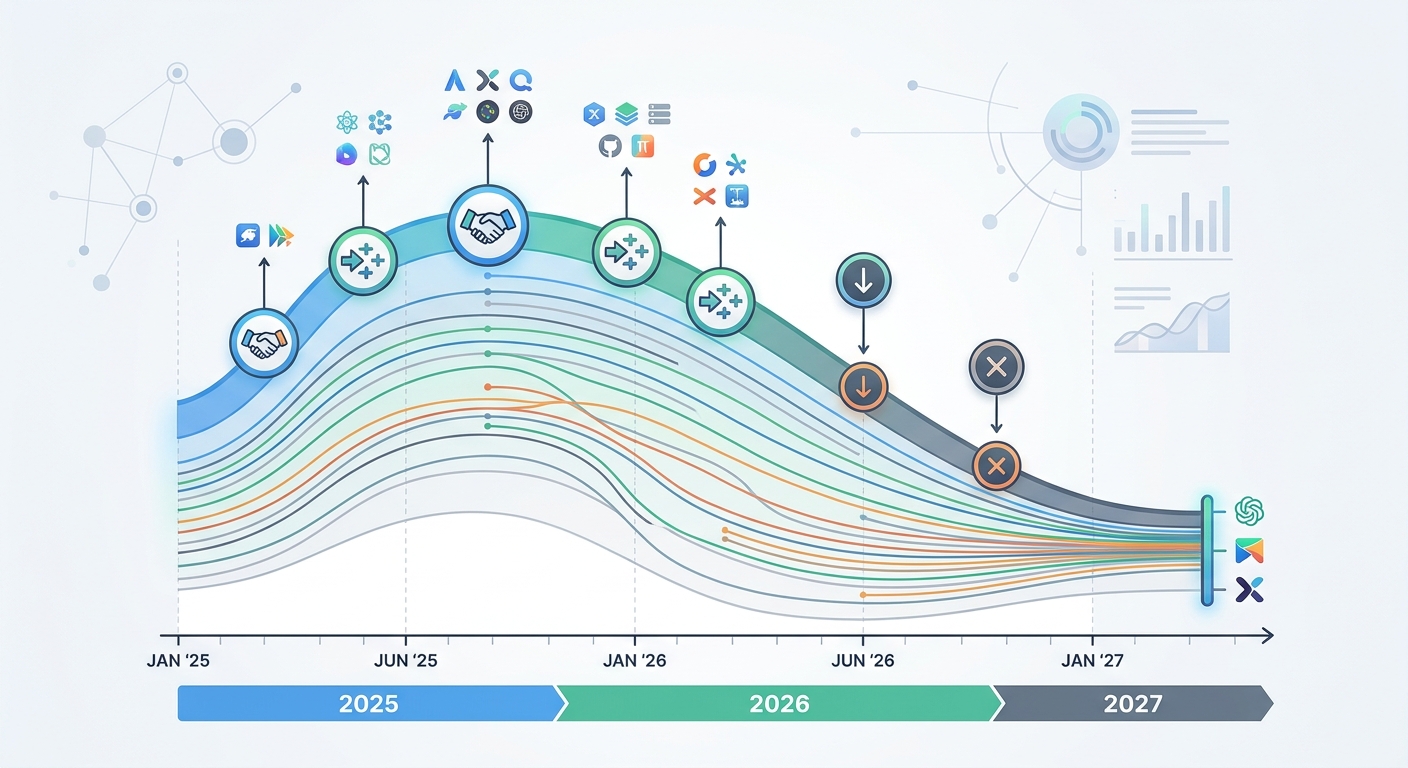
The pattern has a recognizable shape for anyone who lived through the container orchestration wars of 2014–2017 or the early serverless era. In both cases, dozens of vendors and projects competed on overlapping abstractions, buyers eventually converged on a small number of defaults, and the losers were absorbed, deprecated, or quietly abandoned. Agent frameworks are tracking the same curve, compressed into a shorter window because the underlying model layer is itself consolidating and because enterprise procurement cycles are already primed for AI spend.
What Drives the Shakeout
Four forces do most of the work.
- Procurement consolidation. Enterprise buyers push back on point solutions. Security reviews, vendor management, and legal overhead make every additional framework a cost, and CIOs want fewer vendors, not more. A typical Fortune 500 security review runs four to eight weeks per vendor; a framework that duplicates functionality already covered by an approved platform rarely clears that bar twice.
- The cost of in-house orchestration. Maintaining agent infrastructure — retries, durable state, observability, evals — is a full-time platform team's job. A production-grade orchestration layer with durable state, tracing, and regression evals realistically consumes three to six engineers, and that team is competing for headcount with the product work the agents are supposed to enable. Most organizations conclude they cannot afford to build and maintain it themselves.
- Hyperscaler bundling. Cloud and enterprise AI platforms fold agent capabilities into products customers already own, eroding the standalone-framework value proposition. When the agent SDK ships inside a cloud contract the customer has already signed, the marginal adoption cost approaches zero.
- A funding reset for undifferentiated frameworks. Investors have stopped funding thin wrappers. Buyers consolidate onto platforms with SLAs, support contracts, and roadmap commitments. A framework that is essentially a prompt-chaining library with a thin tool-calling layer has no defensible moat once the model providers ship the same primitives natively.
A fifth force is often underweighted: model provider verticalization. When the largest model providers ship their own agent SDKs and hosting, third-party frameworks that merely wrap their APIs lose their reason to exist. The framework that adds no abstraction beyond the provider's own SDK is the first to go.
The Technical Criteria That Actually Predict Survival
Consolidation is driven by commercial forces, but survival is decided by architecture. Before evaluating any vendor's roadmap, score each candidate on these dimensions:
- State and durability model. Can a long-running agent survive process restarts and resume mid-task (durable execution), or is state held in memory? Durable execution is the single strongest predictor of production fitness. An agent that loses its place when a pod restarts is a demo, not a deployment.
- Tool and protocol interoperability. Does it support open tool/protocol standards (e.g., the Model Context Protocol) and model-agnostic tool calling, or does it hard-bind to one provider? Hard-binding is a bet that one provider wins outright — a bet the framework's users pay for if it loses.
- Human-in-the-loop primitives. First-class pause/approve/resume for approvals and escalations, not bolted-on callbacks. Approval flows that require the agent to be re-run from scratch to incorporate a human decision are a common failure mode in early frameworks.
- Observability. OpenTelemetry-compatible tracing, span-level cost and latency attribution, and replayable execution logs. Without span-level attribution, a single runaway agent loop can burn a month's inference budget before anyone notices.
- Evaluation harness. Built-in or first-class integration for regression testing agent behavior before and after model or prompt changes. Teams that ship agent changes without a regression harness discover breakage in production, where the cost of a bad tool call is measured in customer impact rather than test failures.
- Governance and licensing. Foundation or multi-vendor stewardship, clear CLA/licensing terms, and a documented deprecation policy. A single-vendor open-source project can still be re-licensed or abandoned — the re-licensing shock that hit several infrastructure projects in the 2018–2021 window is the cautionary precedent.
A framework that scores well here is more likely to attract integrations, maintainers, and buyers — the conditions that carry a platform through a consolidation.
The pattern is consistent: frameworks without a clear buyer, a funded maintainer, or a distribution channel through an existing enterprise platform struggle to survive a consolidation.
The lesson for buyers is that a framework's governance and architecture are procurement criteria, not afterthoughts.
The Likely Survivors: Three Archetypes
The platforms most likely to hold their ground do not all win the same way. They fall into three archetypes, each with a distinct value proposition and a distinct set of trade-offs.
The Enterprise Incumbents
Hyperscalers and major enterprise AI platforms are the biggest beneficiaries of consolidation. Their agent offerings — folded into broader AI platforms customers already license — absorb smaller frameworks and their teams.
They win for reasons that have little to do with technical superiority. Distribution, compliance posture, and existing procurement relationships carry the day. An enterprise that already has a cloud contract, a data residency agreement, and a completed security review can adopt an incumbent's agent tooling without reopening those conversations. For regulated industries, audit trails and governance controls baked into incumbent platforms are decisive — a framework that cannot produce an auditable record of every tool call and model invocation is a non-starter in financial services or healthcare regardless of how elegant its abstractions are.
The trade-off is real: incumbents tend to lag on cutting-edge orchestration patterns, can lock customers into a single ecosystem, and often move slower on protocol and model interoperability. A team that wants to run the same agent across two model providers may find the incumbent's SDK assumes its own. For most enterprises, that is an acceptable price for support contracts, SLAs, and a vendor that will still exist next year.
The Open-Source Holdouts
A small number of open-source agent frameworks resist acquisition, buoyed by strong maintainer communities and permissive licensing. These projects survive by turning themselves into standards — becoming the default abstraction other tools integrate with, rather than a product to be sold. The mechanism is concrete: adopting and driving open protocols (such as MCP), publishing framework-agnostic interfaces, and moving stewardship to a foundation or multi-vendor governance model to survive any single maintainer's exit.
The trade-off mirrors the incumbents. Open-source holdouts offer flexibility, control, and no vendor lock-in, but they shift operational burden onto your team: you own upgrades, security patching, and the risk that a critical dependency goes unmaintained. A single-maintainer project that suddenly goes quiet leaves every downstream team holding a dependency with no clear owner. The mitigation is to require evidence of durable stewardship — multiple corporate contributors, a foundation or documented governance, and a track record of timely security releases — before betting production on one.
The Orchestration-Layer Specialists
A third group survives by owning a specific, hard problem rather than the whole stack: durable execution, workflow orchestration, or evaluation and observability for agents. These platforms are valuable precisely because they are framework-agnostic — they sit beneath or beside whichever agent SDK you choose, reducing coupling and making them a hedge against framework churn.
The trade-off is scope. Specialists solve one layer well and expect you to assemble the rest, which raises integration effort and means you still own the top-level architecture. A team that adopts a durable execution engine still has to choose an agent SDK, wire up tool calling, and build its own evaluation harness. But for teams that want to avoid re-platforming every time an agent SDK changes, a durable orchestration layer is often the most defensible long-term bet — it is the layer least exposed to which model provider or agent library wins.
How to Choose — and How to Hedge
Given genuine uncertainty about which platforms endure, the soundest strategy is to reduce coupling to any single agent framework:
- Separate orchestration from agent logic. Put durable execution and state management in a layer you control or in a framework-agnostic specialist, so swapping the agent SDK does not mean a rewrite. The test: if replacing the agent library required touching more than a thin adapter layer, the coupling is too tight.
- Standardize on open protocols. Prefer tool-calling and context standards (e.g., MCP) over proprietary abstractions to keep the model and tool layer portable. Protocols outlive products more reliably than products outlive protocols.
- Require a deprecation policy in writing. Ask every vendor for its end-of-life notice per