The 2026 Enterprise AI Budget Reset: Where the Money Actually Moved
Enterprise AI budgets didn't shrink in 2026—they moved to production, inference, and platform teams. See where the money went and what it means for 2027.
Budgets Didn't Shrink — They Moved
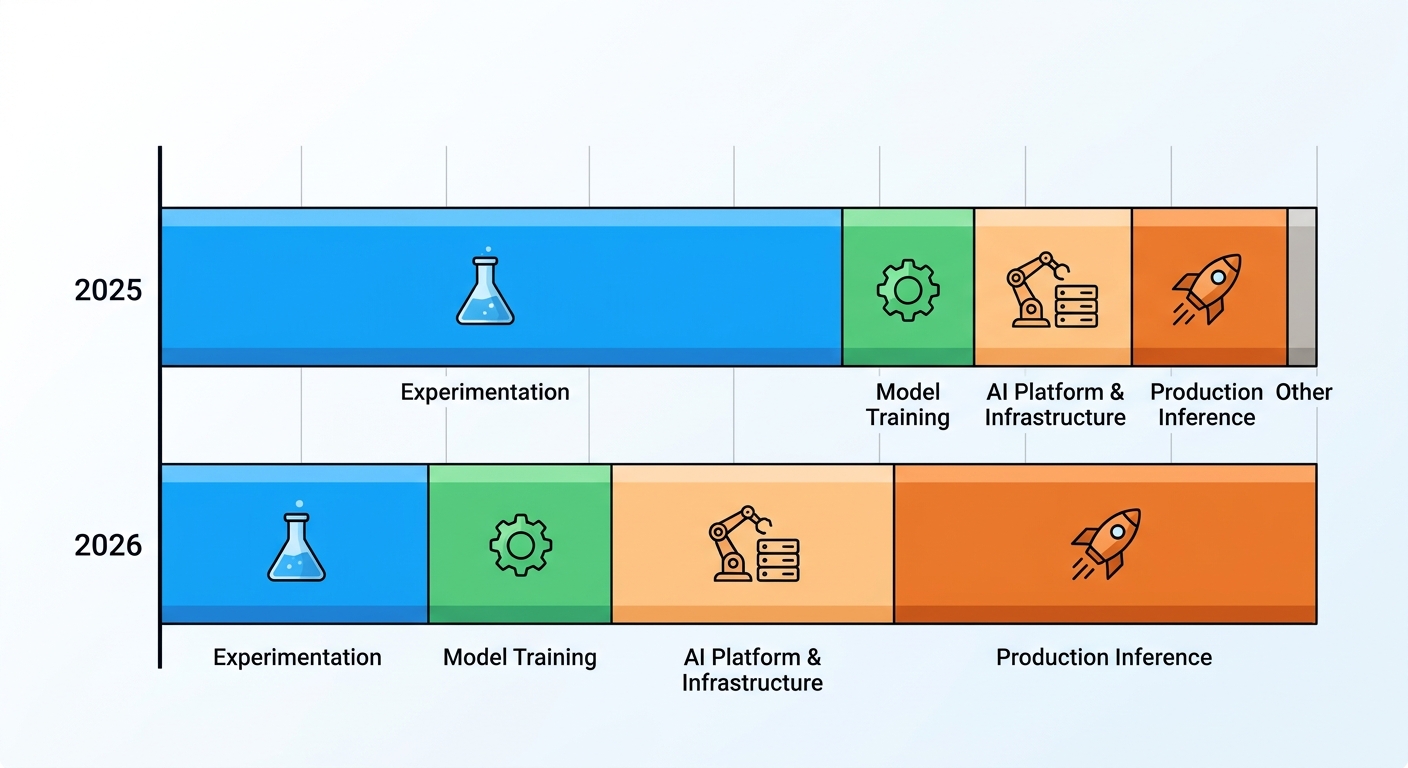
Enterprise AI spending didn't fall in 2026. It re-sorted itself. IDC's Worldwide AI Spending Guide has consistently projected total AI spending approaching $1.5 trillion by 2028, and the 2026 update did not reverse that trajectory — but the composition of 2026 enterprise budgets looks nothing like the 2025 plan. The share of AI budget allocated to experimentation and proof-of-concept work dropped below 20% for the first time in most large-enterprise samples, while production workloads absorbed the difference. That's a reallocation, not a retreat — and the distinction matters for anyone defending a 2027 line item.
The shift happened between planning and execution. CFOs who signed off on broad "AI transformation" envelopes in late 2024 and 2025 spent most of 2026 clawing that money back and re-issuing it against named workloads with owners and SLAs. The pattern showed up in the timing of procurement: enterprise AI deals that once cleared in a single annual approval cycle were, by mid-2026, being split into two and three tranches, each tied to a checkpoint the business unit had to hit before the next check was written. Finance teams described it less as a cut and more as a change in the release schedule. This analysis breaks down where enterprise AI spending moved, where it left, and what buyers and builders should do before the next budget cycle locks. (See also: [How to Build an AI Budget That Survives the CFO Review])
The Headline: Enterprise AI Budgets Grew, But Not Where You Think
The macro number is boring and mildly misleading. Total worldwide AI spending grew again — Gartner's October 2025 forecast put it at roughly $1.5 trillion for 2025, with generative AI alone near $644 billion — but that figure spans all segments (infrastructure, services, devices, consumer), not the enterprise AI budget line that this article is about. Conflating the two is the most common error in 2026 planning decks. A CIO who cites the $1.5 trillion figure to justify a flat enterprise envelope is quoting a number that includes data-center buildouts, consumer devices, and consulting services their budget will never touch.
The enterprise story is narrower and more useful: net-new budget versus reallocated budget. Most of the 2026 reset is reallocation. Few enterprises increased their total AI envelope more than 10–15% year over year. What they did was move money inside that envelope — out of sandbox pilots, out of generic copilot seats, out of exploratory SI engagements, and into production inference, platform engineering, and a small number of funded, named workloads.
The copilot seat line is the clearest example. Enterprises that bought thousands of productivity-assistant seats in 2025 found that active usage clustered in a small fraction of users, and renewal negotiations in 2026 shrank seat counts or converted them to usage-based terms. That reclaimed spend didn't disappear from the AI budget — it reappeared as inference capacity and platform headcount.
What the Q3–Q4 2026 Reallocation Data Shows
The pattern is consistent across the practitioner surveys and procurement benchmark data that surfaced through the second half of 2026 (large-enterprise samples, generally n>200):
- Production share up, experimentation share down. The proportion of AI budget tied to workloads with defined KPIs and production SLAs crossed 60% in most large-enterprise samples, up from roughly 40% a year earlier.
- Fewer vendors, bigger contracts. Median AI vendor count per enterprise fell as point solutions got consolidated into platform deals.
- Inference line items ballooned. Serving and runtime costs grew as a share of AI budget while new training spend flattened.
- New cost center appeared. A dedicated "AI platform" budget — evals, observability, guardrails, governance — showed up as a standalone line item in a majority of large-enterprise budgets for the first time.
The net effect: enterprises are spending about the same or slightly more, but on fewer, deeper, more accountable things. A representative mid-cycle example: a financial-services firm that had funded eleven separate gen AI pilots in 2025 consolidated to three production workloads in 2026, retired the other eight, and moved the reclaimed budget into a dedicated inference capacity reservation and a four-person platform team. Total AI spend rose about 8%. The number of funded initiatives fell by more than half.
How the Money Actually Moved: The Funding-Gate Mechanism
Reallocation didn't happen through a single annual decision. It happened through a change in how AI money is released. In 2025, most enterprises funded AI through an annual envelope approved at the portfolio level. In 2026, that model gave way to stage-gated, quarterly-released funding: a workload gets a small tranche to prove a metric, then a larger tranche only after the metric holds in production. Two mechanics did the heavy lifting:
- Quarterly release instead of annual commitment. Unspent pilot dollars stopped rolling forward automatically; they returned to a central pool and were re-issued against the next gate.
- Inference chargeback/showback. Once serving costs were attributed back to the consuming business unit, "free" pilots became visibly expensive and the long tail of experiments retired itself.
This is the mechanism behind every number in this article. Budgets didn't get cut; the release valve got tighter. The failure mode to watch is gate inflation: when every workload must clear the same bar, genuinely exploratory work with a long time horizon gets starved, and enterprises can find themselves in 2027 with production depth but no pipeline of new ideas. The organizations that handled the reset well kept a small, explicitly labeled exploration reserve — typically 5–10% of the AI budget — outside the gate structure, so that research didn't have to masquerade as a production business case to get funded.
Where Enterprise AI Spending Moved
From Pilots to Production: The Consolidation Shift
The pilot-to-production conversion rate is the number to watch. Through 2025, industry surveys consistently found that only a minority of gen AI pilots reached production — commonly reported in the 20–35% range depending on survey and definition, with McKinsey's State of AI research showing a persistent gap between experimentation and scaled value capture. In 2026, budget flowed toward the pilots that did convert. (Related: [Why Most Gen AI Pilots Stall Before Production])
Practically, this means enterprises funded a smaller portfolio of production workloads — contact-center automation, document processing, code assistance, internal knowledge retrieval — and retired the long tail of undifferentiated experiments. The money didn't leave AI; it concentrated. Fewer bets, larger checks, harder KPIs.
The workloads that survived shared recognizable traits: a measurable baseline they improved on, an owner in the business rather than only in IT, and an integration path that didn't require rebuilding the surrounding system. The ones that died were typically horizontal "AI assistant" deployments with no defined outcome, or pilots whose success metric was user satisfaction in a demo rather than a production number.
Inference Overtakes Training
The single biggest line-item shift in 2026: inference and serving costs now dominate AI budgets at most enterprises that have scaled usage. Training a model is a one-time capital event; serving it is an ongoing operating cost that scales with adoption — and adoption is the whole point.
This forced a discipline that didn't exist in the pilot era: FinOps for AI. Teams are now negotiating reserved capacity, right-sizing models (routing easy queries to smaller models), caching aggressively, and tracking cost-per-token and cost-per-outcome as first-class metrics. Token economics became a procurement topic, not just an engineering one. (See: [A Practical Guide to AI FinOps and Token Cost Control])
The concrete levers teams pulled in 2026 were unglamorous and effective: model routing that sends simple classification and extraction requests to small models and reserves frontier models for genuinely hard queries; prompt and response caching that cut repeated-context costs; batch processing for non-interactive workloads; and reserved-capacity commitments negotiated at volume. A team that had been paying list price per token for a high-volume support workload could often cut serving cost by half or more through routing and caching alone, without touching model quality on the tasks that mattered.
"The question stopped being 'can we run this model?' and became 'what does it cost us per resolved ticket, per closed document, per completed task?' That's a different budget conversation entirely." — a pattern that recurred across enterprise AI platform leads in 2026 planning cycles
The Rise of the AI Platform Team Line Item
The most structurally significant change: a dedicated AI platform budget emerged as its own cost center. Evals, observability, guardrails, prompt/version management, governance, and model routing stopped being informal engineering overhead and got funded explicitly.
This is the maturity signal hiding in the reallocation data. Enterprises that got burned by unmonitored deployments in 2025 now fund the plumbing that makes AI systems auditable and safe. The platform line item is small relative to inference — typically a single-digit percentage of total AI budget — but it's the one that determines whether the rest of the budget produces defensible results. (Learn more: [What an AI Platform Team Actually Owns])
The tools in this stack are converging on recognizable categories: eval and testing frameworks for regression-checking prompts and models before release; observability platforms that trace requests, cost, and quality per call; guardrail and safety layers that intercept outputs; and governance tooling that produces the audit trail a regulator or internal risk function will demand. The build-versus-buy trade-off is real here — many enterprises assembled a platform from a mix of vendor tooling and in-house glue — but the budget line itself is now non-negotiable. The failure mode is underfunding it: a platform team stretched across too many workloads becomes a bottleneck, and the guardrails that were supposed to make production safe instead slow it down.
Vendor Consolidation
Procurement consolidated. Rather than stitching together a dozen AI point solutions, enterprises pushed toward platform deals with fewer vendors — hyperscaler AI stacks, major SaaS platforms with embedded AI, and a short list of specialized vendors with clear production track records. The driver wasn't preference; it was the platform-team line item above. Every additional vendor is another integration, another eval surface, and another contract to defend at the next gate. Enterprises traded marginal best-of-breed gains for a smaller attack surface.
The trade-off is worth stating plainly: consolidation buys operational simplicity at the cost of optionality. An enterprise that standardizes on one hyperscaler's model stack gains unified billing, shared governance, and a single integration path — but gives up the ability to swap in a better or cheaper model the moment one appears. The enterprises that managed this well kept an abstraction layer between their workloads and any single provider, so that consolidation reduced vendor count without locking in a model. Those that didn't are discovering in 2027 that their "platform deal" is a switching cost they didn't budget for.
What This Means for 2027 Planning
The 2026 reset sets the template for the next cycle. Three implications for buyers and builders:
- Fund the gate, not the envelope. Budgets that survive review are structured as staged releases tied to production metrics, not annual portfolio envelopes.
- Price the whole lifecycle. A workload's budget case is now inference-plus-platform-plus-people, not model-plus-pilot. Cost-per-outcome, not cost-per-seat, is the defensible unit.
- Keep the platform line item protected. It's the smallest line and the first one cut — and the one that determines whether everything above it is auditable when the CFO asks.
The enterprises that won 2026 didn't spend more on AI. They spent it on fewer things, with harder numbers, and a tighter release valve. The 2027 cycle will reward the same discipline.