Enterprise AI Budgets Shift from Pilots to Production: What the 2026 Spend Data Shows
2026 data shows enterprise AI budgets shifting from pilots to production. See where spend is going, ROI benchmarks, and what buyers should do differently.
The pilot era of enterprise AI is ending—not with a bang, but with a budget line. Across 2026 survey and analyst reporting from firms including Gartner, McKinsey, and IDC, the directional signal is consistent: production AI deployments now capture the majority of net-new enterprise AI spend, a reversal from as recently as 2024, when experimentation and proof-of-concept work absorbed the lion's share of discretionary budgets. The direction of travel is unambiguous: fewer, larger, and longer-lived deployments are replacing sprawling portfolios of small pilots.
A note on the numbers in this piece: analyst firms define "AI spend," "production," and "pilot" differently, and figures are revised between releases. Treat the percentages below as directional consensus rather than audited fact, and verify against the current report release before you cite them in a board deck. (Sources to check: Gartner's IT spending and AI spending forecasts, McKinsey's State of AI survey, and IDC's Worldwide AI spending guide.)
That matters for anyone who signs off on AI spend or builds the systems behind it. Budget committees are no longer funding curiosity; they are funding measured outcomes, and the bar for evidence has risen sharply. Engineering leaders who can instrument cost and ROI will find capital available. Those who cannot will find their initiatives quietly defunded.
This analysis breaks down what the 2026 spend data actually shows, where the money is moving, and what engineering leaders and enterprise buyers should do differently in the year ahead.
Enterprise AI Budgets in 2026: Where the Money Is Going
The aggregate picture is one of continued growth with a decisive reallocation. Analyst forecasts point to enterprise AI budgets growing at a strong double-digit rate year over year, but the composition of that growth has flipped. Where a large share of 2024 AI budgets went to experimentation, pilots, and exploratory vendor engagements, 2026 reporting shows production and scaled deployment capturing a clear majority of net-new dollars—commonly described as roughly 55–65% across major surveys, though definitions vary enough that the exact figure should be treated as approximate.
The category breakdown tells the more useful story for practitioners:
- Model and API spend continues to grow but is under pricing pressure, with buyers negotiating volume terms and routing across providers rather than committing to single-vendor contracts. Frontier models still command premium pricing for the hardest tasks, so "commoditized" overstates it—the real shift is toward routing: cheap models for routine work, premium models where quality justifies the cost. That routing logic carries its own engineering and evaluation overhead. (See our guide to multi-model routing strategies.)
- Infrastructure—particularly inference compute and data pipeline capacity—has become one of the fastest-growing line items as production workloads scale. (Related: inference cost optimization.)
- Platform and tooling spend, including observability, evaluation, and orchestration layers, is rising sharply as teams discover that deployed systems require operational discipline pilots never demanded.
- Talent remains a significant allocation, but the mix is shifting from research and experimentation roles toward platform engineering and AI reliability.
- Vendor and systems integration services are growing as enterprises move from buying tools to buying completed deployments.
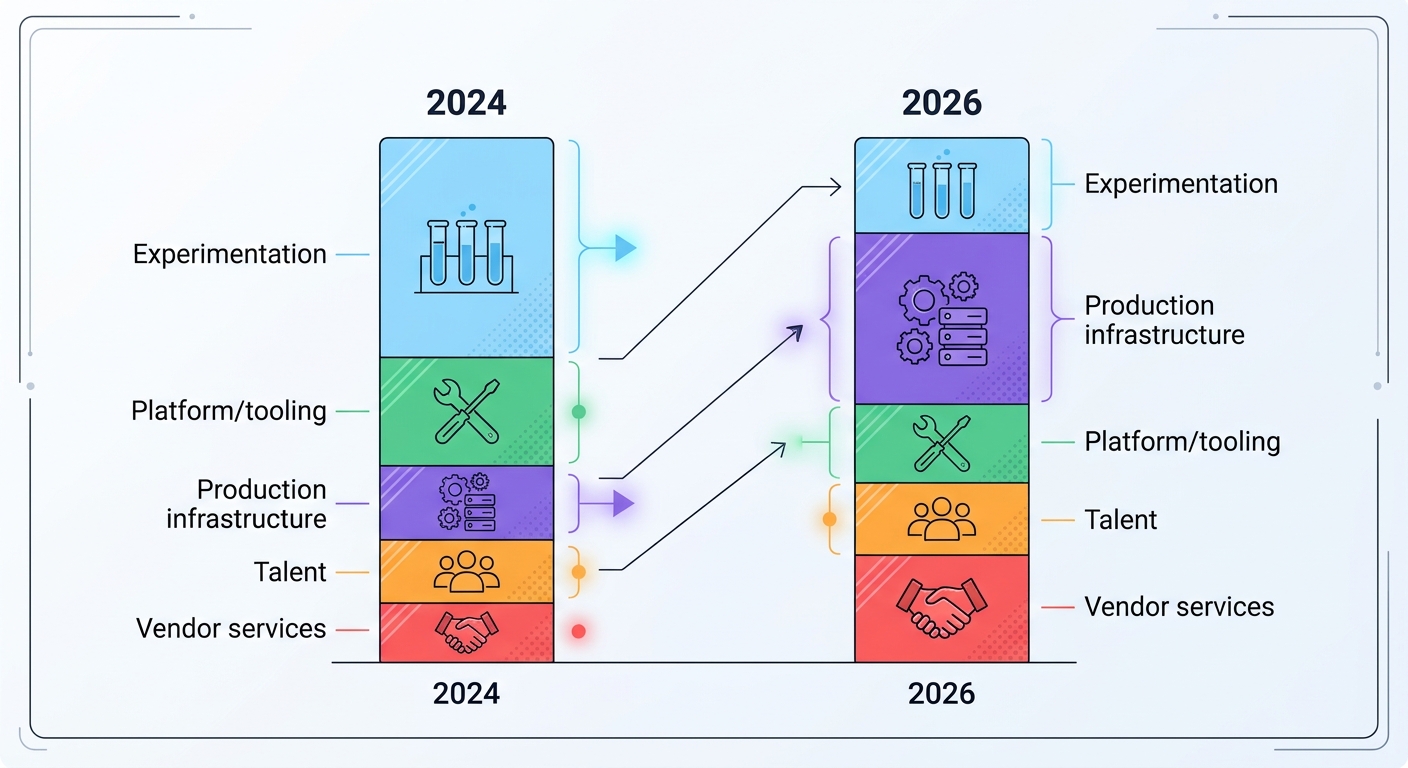
The headline is not simply "more money for AI." It is more money for AI that ships, with a corresponding squeeze on everything that does not.
A few concrete dynamics sit behind the category shift. On the model side, buyers are increasingly signing annual commitments with negotiated per-token ceilings rather than paying list prices, and procurement teams now routinely ask vendors for pricing that scales down with volume—terms that were rare in 2024. On the infrastructure side, the growth is less about training clusters than about steady-state inference: reserved GPU capacity, vector database storage, and data pipeline throughput that grows with every production use case. Platform and tooling spend is the quietest but most telling line: observability vendors, evaluation frameworks, and orchestration layers (LangSmith, Weights & Biases, Arize, and their peers) are appearing in enterprise budgets as line items that simply did not exist two years ago. That is a structural signal. Pilots could run on a credit card; production systems need a procurement category.
From Pilot Purgatory to Production: What Changed
For two years, the dominant pattern in enterprise AI was high pilot volume paired with painfully low conversion to production. Organizations stood up dozens of proofs-of-concept—chatbots, document summarizers, internal assistants—and watched most of them stall at the validation stage. The reasons were consistent: unclear ownership, no evaluation framework, integration debt, and no credible path to measuring value.
Self-reported 2026 survey data indicates that pattern is easing. Enterprises are running fewer experiments, but the ones they run are larger, better governed, and more likely to reach production. Low-value experiments are being actively sunsetted rather than left to linger, and budget is consolidating around a smaller number of strategic deployments. Treat these figures with appropriate caution: conversion is self-reported, "pilot" and "production" are not standardized across firms, and organizations that respond to these surveys skew toward those with formal AI programs.
The Pilot-to-Production Ratio
Conversion rates appear to have improved. Where earlier surveys frequently reported that only a small fraction of AI pilots reached production, recent analyst surveys describe conversion climbing toward roughly one in three to nearly one in half for well-governed programs—still imperfect, but a meaningful improvement over prior years.
Two drivers stand out. First, evaluation and governance maturity: teams that built systematic evaluation harnesses, red-teaming processes, and clear deployment gates convert pilots far more reliably. (See building an AI evaluation framework.) Second, executive sponsorship with defined success metrics, which prevents pilots from drifting into indefinite limbo.
The failure modes of the pilot era were remarkably consistent, and naming them helps explain the conversion gain. The most common was the demo-to-production gap: a system that answered questions correctly in a curated demo failed on messy real-world inputs—typos, ambiguous requests, documents with tables—because no one had built an evaluation set drawn from actual usage. The second was orphaned ownership: a pilot launched by an innovation group with no line-of-business owner to inherit it, so it had no budget home once the innovation fund closed. The third was integration debt: a prototype wired to a spreadsheet and a single API that could not survive contact with the enterprise identity system, data governance policies, or the security review that production requires. The organizations converting pilots now are the ones that addressed these three failure modes up front—building eval sets from real traffic, assigning a business owner before launch, and scoping integration work into the pilot itself rather than deferring it.
What Buyers Are Funding Now vs. 2024
The use-case mix has shifted decisively:
- 2024: conversational chatbots, general-purpose assistants, exploratory content generation, scattered departmental experiments.
- 2026: agentic workflows with defined task boundaries, retrieval-augmented generation (RAG) systems over proprietary data, coding assistants embedded in engineering workflows, and customer operations automation with measurable deflection targets. (Related: agentic workflow design patterns.)
The common thread is measurability. Buyers are funding systems whose output can be counted, compared, and tied to a business metric—not systems whose value is described in adjectives.
The practical difference shows up in how proposals are scoped. A 2024 chatbot proposal might have promised "improved customer experience." A 2026 customer-operations proposal names a deflection target—say, resolving 30% of tier-one tickets without human handoff—and a cost-per-resolution ceiling to beat. Similarly, a coding assistant proposal now typically specifies adoption rate among target engineers, accepted-suggestion rate, and cycle-time impact rather than "developer productivity" in the abstract. That specificity is what lets a finance committee compare an AI deployment against a headcount hire or a process-outsourcing contract, and it is why proposals without it lose.
The ROI Reckoning: Spend Follows Evidence, Not Enthusiasm
The single biggest change in 2026 is procedural: budget committees now require measured ROI before scaling. The era of funding AI because competitors were funding AI has given way to a disciplined, evidence-driven review process. In practice, deployment proposals are evaluated against concrete metrics—cost per task, cost per successful resolution, quality-adjusted throughput, and deflection or conversion rates tied to a named business owner.
That raises the engineering bar. To win and keep budget, teams need to instrument three things:
- Unit economics per task. Track cost per request and cost per successful outcome, not just raw token or GPU spend. A system that costs more per call but resolves twice as many cases is the cheaper system.
- Cost attribution. Route inference, retrieval, and orchestration costs to the specific use case and team that consumed them. Shared, unattributed cloud spend is where AI budgets go to die—and where finance loses trust.
- Eval-linked cost gates. Tie spend thresholds to quality metrics so that scaling a workload cannot silently degrade accuracy or inflate cost per resolution. Instrumentation without evaluation measures the wrong things precisely.
Teams that can present a live cost-and-quality dashboard in a budget review convert far more reliably than teams presenting a narrative. The data does not have to be perfect; it has to be credible and current.
Consider a worked example of why cost per successful outcome matters. Suppose a retrieval-augmented support system routes routine questions to a small, cheap model and escalates hard cases to a frontier model. The blended cost per request might be a few cents, but if 15% of requests fail to resolve and require human follow-up at several dollars each, the effective cost per resolution is dominated by failures, not tokens. A team that reports only token spend will look efficient and lose budget the moment finance audits the human-escalation line. A team that reports cost per resolution—and shows it falling as routing and retrieval improve—has the evidence to justify expansion. The instrumentation itself becomes a competitive advantage inside the organization.
The same logic applies to cost gates. A common failure pattern is a workload that passes its quality bar at pilot volume, then gets scaled to ten times the traffic and silently degrades—not because the model changed, but because the input distribution widened and the evaluation set never covered the new cases. Tying spend authorization to a quality threshold that is re-measured on live traffic prevents this. It also gives engineering a defensible reason to pause a rollout, which is often harder politically than technically.
What the 2026 Data Doesn't Show
A disciplined read of the spend shift also means naming its risks, because scaled deployments fail differently than pilots:
- Runaway inference costs. Production traffic is variable and unbounded in a way pilots never were. Without rate limits, caching, and routing discipline, a successful deployment can become a budget problem precisely because it worked.
- Reliability and governance debt. Agents that perform well in demos can accumulate failure modes—drift, prompt injection, silent regressions—that only surface at scale. Scaled deployments need monitoring and incident response that most teams under-budget.
- Vendor lock-in. Multi-model routing reduces lock-in to any single model but concentrates dependency in the orchestration layer. Plan for portability at the routing tier, not just the model tier.
The produ