The Pilot-to-Production Gap: Where Enterprise AI Budgets Are Actually Going in 2026
Enterprise AI budgets hit records in 2026, yet most pilots stall. See where the money is really going—infrastructure, evaluation, governance, and enablement.
Record Budgets, Stalled Production
Enterprise AI spending is at an all-time high, but the share of pilots that reach production remains stubbornly low. That's the defining tension of 2026: CFOs are approving larger AI line items than ever while engineering leaders struggle to move proofs-of-concept past the demo stage. The gap isn't primarily a failure of the technology. It's a failure of budgeting and operating models — pilots are funded like experiments, while production demands the funding discipline of an ongoing operation.
The thesis of this article is straightforward: budgets are quietly shifting from experimentation toward the unglamorous work of production — infrastructure, evaluation, governance, and enablement. Understanding where that money is actually landing tells you more about enterprise AI maturity in 2026 than any pilot count ever will. (See also: enterprise AI maturity model)
The 2026 Enterprise AI Budget Reality Check
Analyst consensus points in one direction even where the decimals disagree. Gartner's recurring forecasts have projected double-digit growth in enterprise AI spending, with an increasing share moving from experimentation toward operational infrastructure. McKinsey's State of AI survey series has consistently found that most organizations use AI in at least one function, while a much smaller cohort has scaled it across the enterprise. IDC's spending guides describe the same reallocation: the mix is shifting from pilots toward platforms and production operations.
Treat these as directional signals, not precise figures. Forecasts get revised, survey populations differ, and vendors have every incentive to inflate the numbers. The durable takeaway is the trend line, not any single percentage.
The headline — record AI budgets — is real. The nuance is in the allocation. A useful mental model: the average enterprise is not spending less on pilots in 2026, but each pilot dollar is a smaller slice of a much larger pie. The growth is concentrated in the line items that keep systems running after the demo.
Where the money is landing
Directionally, enterprise AI spend in 2026 is splitting into four buckets:
- Pilot and experimentation budgets, still substantial but increasingly departmental and capped.
- Platform and infrastructure spend, growing fastest as inference workloads scale.
- Evaluation, observability, and governance, a line item that barely existed in 2023 and is now a procurement and compliance requirement for most regulated buyers. (Related: AI governance checklist)
- Talent and enablement, chronically under-budgeted relative to its impact.
The first two buckets are visible to the CFO as capital or project spend. The last two behave like operating expense — recurring, growing, and easy to under-fund in year one and impossible to skip in year two. That asymmetry is the core of the pilot-to-production gap.
The enablement bucket deserves special attention because it is the most frequently under-scoped. A production AI system touches roles that didn't exist in the pilot: prompt and configuration owners, evaluation maintainers, on-call engineers trained to triage model-specific failures, and business-side reviewers handling escalations. Budgeting headcount for these roles is unglamorous and slow to approve, which is precisely why organizations defer it — and then discover at launch that no one is staffed to operate the system they just built.
Why "pilot sprawl" persists
If pilots are so cheap to launch, why don't more graduate? Because the incentives favor starting over finishing. Departmental budgets fund pilots without requiring production commitments. Vendor free tiers and credits drive the marginal cost of experimentation toward zero. And ownership of production — who operates the model, who pays for inference, who's on call when it drifts — is often left undefined at kickoff.
The result is sprawl: dozens of demos, few deployments, and a growing backlog of "almost ready" projects that no one owns. The organizational failure mode has a recognizable signature. A business unit sponsors a pilot to solve a local problem. The pilot works. The sponsor declares victory and moves on, because the next quarter's objectives don't include operating a model. The system runs on credits until they expire, then quietly stops. Six months later, a different team rebuilds the same capability because no one recorded that it existed.
There's a second, subtler driver: success criteria defined to be cheap. A pilot that measures "did users find the demo useful?" will almost always pass. A pilot that measures "does this reduce cost-per-resolution by 15% at production volume?" is a much harder test — and a far better predictor of whether the thing should be scaled. When the metric is soft, the pilot succeeds and the production case never gets made. (See also: AI pilot success metrics)
A third driver is organizational politics. Pilots are a low-risk way to signal innovation, and a failed pilot carries far less career risk than a failed production launch. When the incentive structure rewards visible experimentation over durable operations, sprawl is the rational outcome — which is why fixing it requires changing budget incentives, not just engineering practices.
Anatomy of the Pilot-to-Production Gap
The gap between a working demo and a production system is not a single wall — it's a series of failure points, each with its own budget and stakeholder implications. Pilots are funded as projects; production is funded as operations. Different budget lines, different approval chains, different success criteria.
The four failure points
- Data readiness. Production-grade AI needs clean, accessible, lineage-tracked data. Pilots often run on curated extracts that don't reflect the messiness of systems of record. When the data pipeline has to be rebuilt, the project stalls. (Related: AI data readiness guide)
- Integration debt. Connecting a model to core systems introduces latency, security, and reliability requirements that demos never surface. Integration work is expensive and rarely scoped in the pilot budget — a demo that calls an API is not an integration; a production integration handles auth, retries, rate limits, schema drift, and failure modes across every downstream system.
- Evaluation gaps. Many pilots ship without agreed success metrics or an evaluation harness. When it's time to justify scaling, no one can prove the system works — or catch it when it doesn't.
- Ownership ambiguity. Who funds inference at scale? Who monitors drift? Who handles incidents? Without a named production owner, pilots quietly expire when the champion moves on.
Each failure point has a distinct cost profile, which is why they're so often mis-budgeted. Data readiness is the largest and least predictable — retrofitting lineage, access controls, and quality checks onto legacy systems can consume more engineering time than the model work itself. Integration debt is the most underestimated. Evaluation is the most deferred. Ownership is the cheapest to fix and the most frequently neglected.
A worked example
Consider a mid-size insurer piloting an AI assistant for claims intake. The pilot runs on a curated sample of 5,000 claims, calls a hosted model API, and is evaluated by a handful of adjusters who rate responses on a five-point scale. It looks excellent. The production case, however, requires ingesting live claims from three legacy systems with inconsistent schemas, enforcing PII redaction before any model call, routing low-confidence cases to human reviewers, logging every interaction for audit, and holding latency under a threshold the adjusters' workflow demands. Each of those requirements maps to a failure point — data readiness, integration, evaluation, and ownership respectively — and none of them appear in the pilot's budget or timeline. This is the typical shape of the gap: the pilot answers a narrow question well, and the production question was never asked.
What Production Actually Costs (and Why Pilots Hide It)
The structural reason pilots don't graduate is that their cost curve is nearly flat while production's is not.
A pilot's spend is bounded: a fixed team, a fixed timeline, a bounded dataset, and often subsidized inference. Production introduces recurring costs that scale with usage and never terminate:
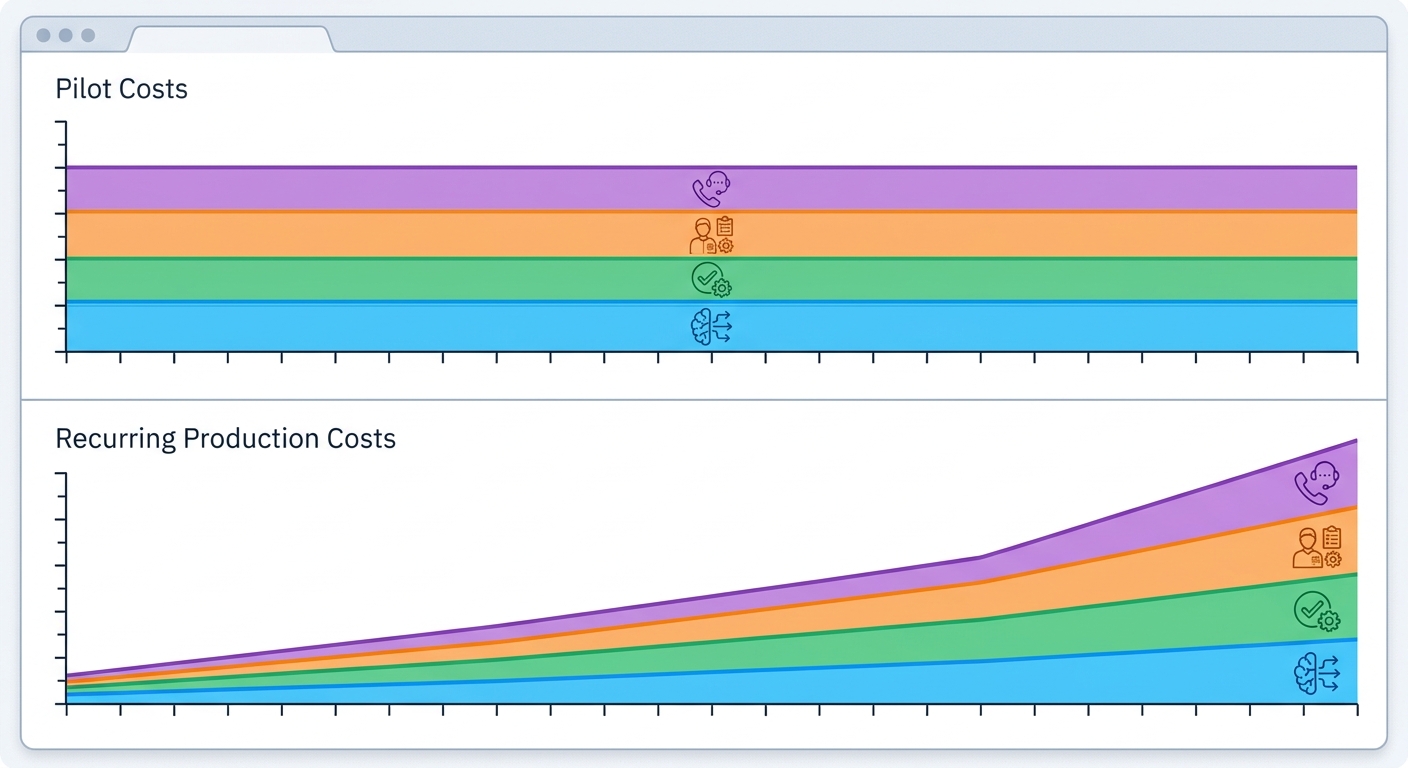
- Inference and serving. Cost scales with traffic, not with the pilot's user count. Token pricing changes frequently and varies by model tier, provider, and deployment mode (hosted vs. self-hosted). Model the cost at realistic production volume and peak, not at demo volume — and include the fallback path when your primary provider degrades.
- Evaluation and monitoring. Continuous evaluation is a capability, not a one-time harness: golden datasets, regression suites, calibrated LLM-as-judge scoring, and periodic red-teaming. This requires engineering time every release cycle, not just at launch.
- Human-in-the-loop review. Most production systems at this maturity level need review capacity for edge cases and escalations. That's a staffing line, not a software line.
- Drift and incident response. Models, prompts, and upstream data change. Someone must own on-call, alerting, and rollback. This is the operational expense that pilot budgets structurally omit.
- Retraining and re-tuning. Whether you fine-tune or re-prompt, the system needs maintenance as data and requirements evolve.
None of these are exotic. All of them are recurring. That's the point: a pilot budget answers "can this work?" A production budget answers "can we afford to operate this every month, indefinitely?" Most organizations approve the first question and never formally ask the second.
The hidden multipliers
Three cost multipliers deserve explicit budget attention because they routinely surprise teams that modeled only inference.
Peak versus average load. Inference cost scales with traffic, but capacity must be provisioned for peaks. A customer-service assistant that sees ten times normal volume during a billing outage needs headroom that average-load modeling misses. Budget for peak concurrency, or budget for graceful degradation — but budget for one of them.
Evaluation cost per release. If your team ships weekly and each release requires running a regression suite against a golden dataset, evaluation becomes a recurring line item that grows with both release cadence and dataset size. Teams that modeled evaluation as a launch expense discover in month three that it is the second-largest recurring cost after inference.
Compliance and audit overhead. For regulated buyers, logging, retention, and auditability requirements add storage and tooling costs that a pilot — frequently run outside the compliance perimeter — never surfaces. These costs are fixed and non-negotiable once the system touches regulated data.
The trade-off is unavoidable: you can reduce any one of these costs, but usually by shifting risk to another. Cutting evaluation frequency lowers opex and raises the probability of a silent quality regression. Reducing human review lowers staffing cost and raises the rate of uncaught errors. Mature teams make these trade-offs explicitly and document them; immature teams make them by accident.
Fixing the Budget Model
The gap closes when production costs are funded the way they actually behave — as operations.
1. Require a production cost model at pilot kickoff. Before a pilot is approved, require a one-page estimate of monthly run cost at production volume: inference, evaluation, human review, monitoring, and on-call. If the sponsor can't produce it, the pilot isn't ready to start.
2. Name the production owner before the pilot ends. Ownership is the cheapest failure point to fix and the most commonly skipped. A named owner with a funded budget line prevents the "credits expire and it quietly stops" outcome.
3. Define success criteria in production terms. Replace "did users find it useful?" with a metric measured at production volume against a baseline. If you can't measure the baseline, building it is the pilot.
4. Fund evaluation as a standing capability. Budget evaluation harness maintenance and monitoring as recurring opex, not a launch deliverable. Treat it as infrastructure.
5. Convert pilot spend into platform investment deliberately. Rather than letting dozens of departmental pilots each fund their own integrations and evals, consolidate shared capabilities — data access, eval tooling, observability, guardrails — into a platform line item that every project draws on.
Making the case to the CFO
The budget conversation is easier when framed in the CFO's language. Three arguments tend to land. First, pilot sprawl is a hidden cost: every abandoned pilot consumed engineering time, integration effort, and vendor credits that produced no durable asset. Second, a platform line item amortizes shared costs across projects, so the marginal cost of the fifth production system is far lower than the first. Third, recurring opex is predictable in a way project spend is not — a funded operations budget makes AI costs forecastable rather than lumpy. The organizations that win this conversation stop presenting AI as a series of bets and start presenting it as a portfolio with a maintenance budget.
The trade-off to acknowledge honestly: consolidating into a platform slows individual teams down at the start and speeds them up later. That delay is real, and it is the price of not rebuilding the same integration five times.
The 2026 Verdict
The organizations closing the pilot-to-production gap aren't the ones with the most pilots or the biggest AI budgets. They're the ones that stopped treating production as the end of a project and started funding it as the beginning of an operation. The money is already moving in that direction. The enterprises that win 2026 will be the ones whose budget models move first — from experiments to infrastructure, from projects to operations, from pilots to the unglamorous, recurring work of running AI in production.