AI Code Tools Race: How GitHub Copilot, Cursor, and Claude Are Reshaping Software Development Teams in 2026
The AI coding assistant market is worth $8–11B and growing at a pace that makes every quarter feel like a new inflection point. In 2026, three platforms dominat
AI Code Tools Race: How GitHub Copilot, Cursor, and Claude Are Reshaping Software Development Teams in 2026
The AI coding assistant market is worth $8–11B and growing at a pace that makes every quarter feel like a new inflection point. In 2026, three platforms dominate the conversation — and the way development teams are using them says as much about the future of software as the tools themselves.
In 2023, fewer than 10% of enterprise engineers used AI code assistants. By mid-2026, that number has crossed 50% in most competitive markets, with Gartner projecting 75% enterprise adoption by 2028. The tools that got us here — and the tools that will define the next phase — are GitHub Copilot, Cursor, and Claude Code.
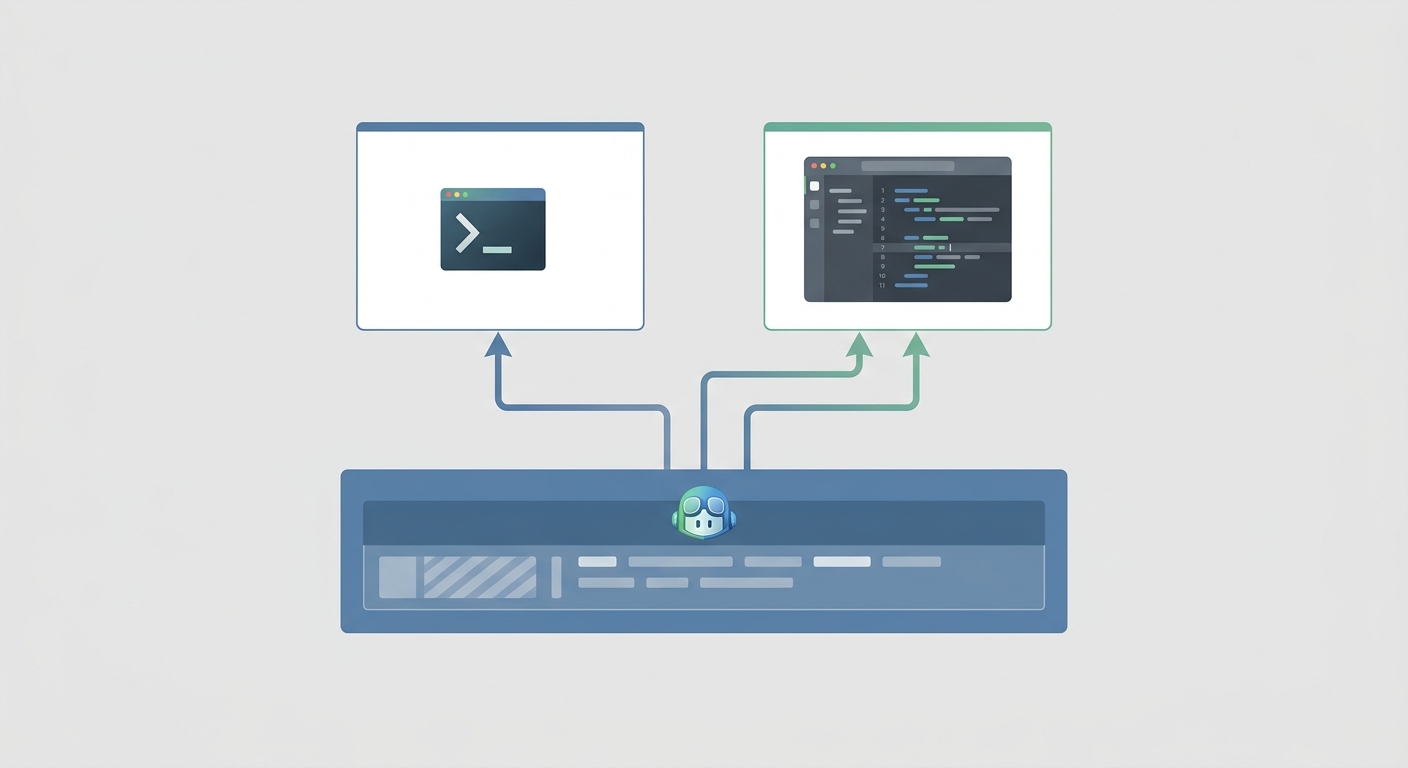
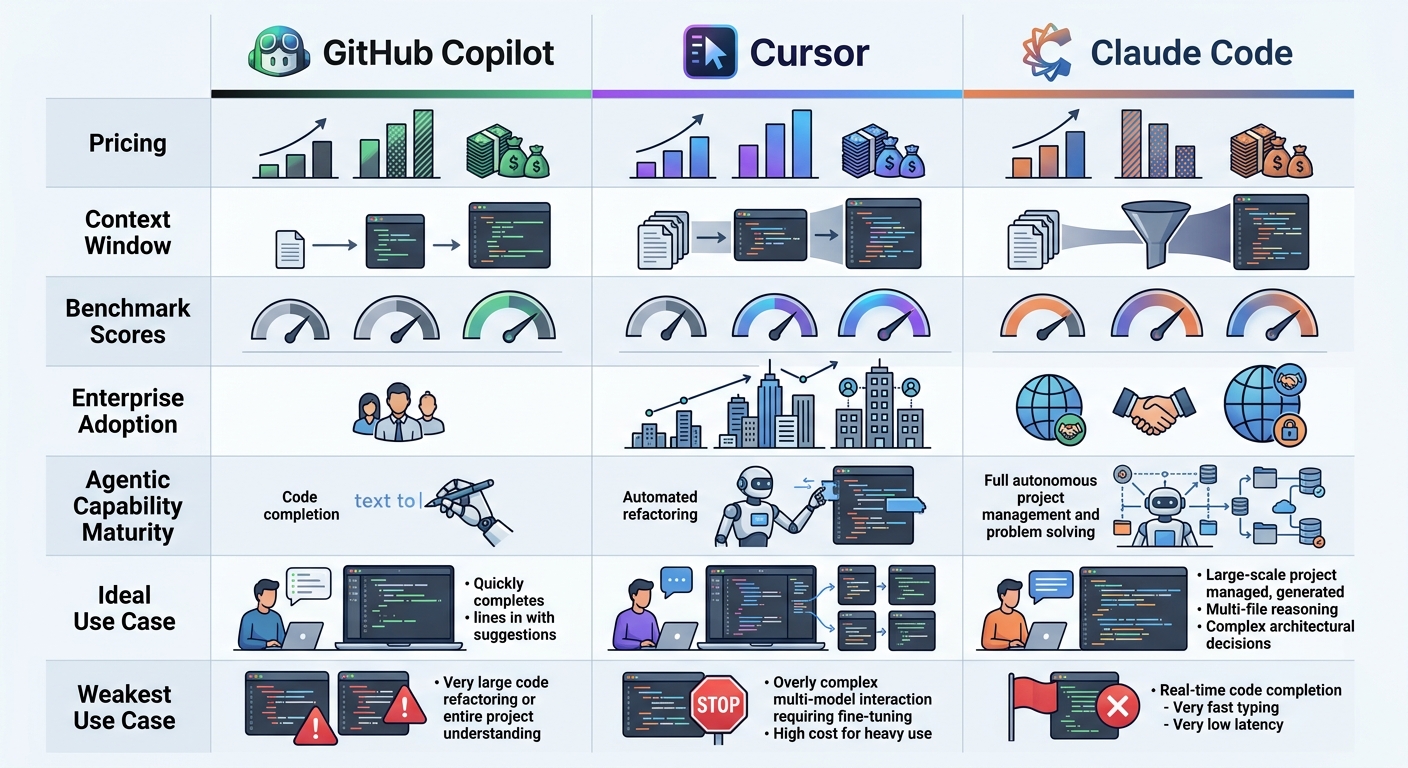
These three platforms took radically different paths to the same destination: making AI an integral part of how software gets written. Copilot is an IDE extension from Microsoft's GitHub. Cursor is a purpose-built AI-native IDE. Claude Code is a terminal-native agent from Anthropic. Different shapes, same ambition.
But here's what makes 2026 unique: the story is no longer about choosing one tool. It's about how high-performing teams combine all three — and what that combination reveals about where software development is heading.
The AI Code Tools Race in 2026: Market Snapshot
The numbers are striking. The global market for AI coding assistants reached $8–11B annually in early-to-mid 2026, with projections pointing firmly upward. GitHub Copilot crossed 4.7 million paid subscribers by January 2026 — a 75% year-over-year increase from its 2025 base. Cursor hit $4 billion in annualized recurring revenue in May 2026, growing from $100 million just 15 months earlier, making it one of the fastest-growing SaaS companies ever recorded. Claude Code, launched publicly in May 2025, reached $1 billion ARR within six months and $8 billion ARR by May 2026.
Key insight — The three platforms have fundamentally different business models: Copilot as per-seat subscription, Cursor as usage-accelerated SaaS, Claude Code as premium agentic platform. Their growth rates reflect these positioning choices.
On the ground, adoption is nearly universal among professional developers: approximately 90% now use at least one AI coding tool at work. The days of AI coding assistants being a niche experiment are over.
What changed in 2026 is the nature of the work these tools do. The shift from simple autocomplete to agentic AI — systems that can plan, execute, and verify multi-step tasks across an entire codebase — is the defining transition of this year. Each of the three market leaders embodies a different approach to that transition.
GitHub Copilot — The Enterprise Baseline
GitHub Copilot is the tool most enterprise teams start with, and for good reason. Its integration into Visual Studio Code, JetBrains IDEs, and Vim/Neovim through a lightweight extension makes it the lowest-friction entry point for teams that need to roll out AI assistance at scale.
The scale is staggering. As of July 2025, Copilot had accumulated approximately 20 million total users and 4.7 million paid subscribers. Ninety percent of Fortune 100 companies have deployed it. More than 50,000 organizations pay for it. Among companies with 10,000+ employees, 56% have adopted Copilot — the highest enterprise penetration of any AI coding tool.
Key insight — Copilot's dominance in large enterprises is partly structural: its per-seat subscription model aligns with how enterprise IT budgets are organized, making procurement straightforward.
The productivity numbers back up the adoption. Developers using Copilot complete individual coding tasks 55% faster. Pull request times have fallen by 75% in Copilot-enabled repositories. And in those same repositories, AI-generated code now accounts for 46% of all code written — a figure that would have seemed implausible three years ago.
The June 2026 pricing shift deserves attention. GitHub moved Copilot's agent mode to a metered AI Credits model while keeping standard code completions unmetered on paid plans. For organizations using Copilot primarily for inline suggestions, this change is effectively invisible. For teams running autonomous agent tasks frequently, it introduces a variable cost element that requires monitoring. The implication is clear: GitHub is positioning standard autocomplete as the baseline value proposition and treating agent-mode usage as a premium, consumption-based tier.
Where Copilot excels: Daily autocomplete, GitHub ecosystem users, regulated industries where IP indemnity matters, broad team rollouts where IT departments need a predictable, enterprise-grade tool with a known vendor.
Where it lags: Among senior engineers who need deep codebase reasoning and complex multi-step autonomous work, Copilot consistently ranks below Cursor and Claude Code in satisfaction surveys.
Cursor — The AI-Native IDE Disruptor
Cursor did something that seemed improbable in 2024: it built an entirely new category — the AI-native IDE — and then made it mainstream in under two years.
The revenue trajectory is the most visible indicator of its impact. Cursor went from $100 million in annualized recurring revenue in January 2025 to $4 billion by May 2026. For context, that kind of growth put Cursor in rare company alongside the fastest enterprise software companies ever built. By March 2026, enterprise customers accounted for approximately 60% of Cursor's revenue — up from just 25% in late 2024. The enterprise transition happened faster than almost anyone predicted.
Adoption is accelerating at scale. Sixty-four percent of Fortune 500 companies now have developers using Cursor. Over 50,000 engineering teams globally use it. Cursor reports more than 1 million daily active users and more than 1 million paying customers. Developer user base has surpassed 5 million, growing at 120% year-over-year.
Key insight — Cursor's growth is driven by a specific bet: that developers want AI to be the foundation of their IDE, not a layer on top of an existing one. This philosophy is winning over teams frustrated by the limitations of AI extensions.
Cursor's core differentiation is its Agent Mode — a capability that allows the IDE to autonomously write, edit, test, and run code across multiple files based on high-level natural language goals. Unlike a chatbot that suggests code, Agent Mode operates with a kind of project awareness: it can read and understand an entire codebase, track ongoing changes, and execute multi-step plans without the developer micromanaging every line.
This makes Cursor particularly strong for complex, multi-file refactoring tasks, parallel agent workflows on virtual machines, and developers who want an IDE where AI is not a layer on top of an existing tool but the foundation of the experience itself.
Where Cursor excels: Complex multi-file editing, large project navigation, developers who want a modern AI-first IDE experience, parallel autonomous workflows, teams that prioritize rapid iteration on features.
The cost nuance: Cursor's base plan starts at $20/month, but daily agent users frequently report bills in the $60–100/month range when third-party API usage is factored in. For heavy agent-mode usage, that's a meaningful line item that doesn't show up in the headline price.
Claude Code — The Senior Engineer's Choice
If Copilot is the tool that got AI coding into the enterprise and Cursor is the one that made AI-native development cool, Claude Code is the one that convinced senior engineers to take it seriously as a professional instrument.
The satisfaction data is the most immediate signal. Claude Code posts a 91% customer satisfaction score and a Net Promoter Score of 54 — the highest of any AI coding tool in the market. In The Pragmatic Engineer Survey, 46% of developers named Claude Code their "most loved" AI coding assistant. Among developers who regularly use AI agents, 71% prefer Claude Code as their primary tool.
These numbers reflect something deeper than marketing. Claude Code leads on the technical benchmarks that matter for complex work. On SWE-bench Verified — a benchmark testing an AI model's ability to resolve real-world software engineering issues from open-source repositories — Claude Code scores 80.8%, the highest recorded at time of publication. It offers a 1 million token context window, giving it the ability to reason over an entire large codebase in a single context window.
Key insight — Claude Code's strength lies in reasoning depth rather than raw speed. For tasks that require sustained logical chains across a large codebase, its context window and benchmark performance give it a structural advantage.
The growth story is equally striking. Claude Code launched publicly in May 2025. Within six months it had reached $1 billion in ARR. By February 2026, that figure was $2.5 billion. By May 2026, approximately $8 billion. More than half of that revenue comes from enterprise customers. Anthropic, the company behind Claude Code, generates roughly 80% of its business from enterprise accounts.
Usage intensity tells its own story. The average developer using Claude Code spends 20 hours per week with the tool. By February 2026, Claude Code was responsible for approximately 4% of all public GitHub commits globally — a figure projected to exceed 20% by the end of 2026 if current adoption velocity holds.
Where Claude Code excels: Complex multi-step refactoring, deep codebase reasoning, autonomous multi-file coding tasks, genuinely hard problems that require sustained logical chains, senior engineers doing high-leverage work.
The pricing structure: Base tier starts at $20/month, with higher tiers ($100–200/month) offering clearer spending limits for heavy users. The rolling usage window model, however, can create uncertainty — long work sessions can exhaust quotas in ways that feel opaque compared to fixed-tier pricing.
The Two-Layer Enterprise Stack — How Teams Actually Use All Three
Here is the insight that most AI coding tool comparisons miss: most professional development teams in 2026 are not choosing between Copilot, Cursor, and Claude Code. They are using all three — and the pattern is becoming structured enough to have a name.
The emerging consensus among engineering leaders is what some are calling the two-layer enterprise stack. Layer one is Copilot: the baseline, the tool deployed broadly across the organization for inline autocomplete and everyday coding assistance. It is low-friction, predictable, and integrates with the IDEs developers already use. For most developers on most days, this is the layer that touches most of their code.
Layer two is Claude Code or Cursor: the high-leverage tools reserved for complex work — large refactoring projects, architectural decisions, debugging sessions that span multiple systems, CI/CD automation, and tasks that require genuine multi-step reasoning. Senior engineers tend to spend more time at this layer. So do teams working on the most technically demanding parts of the codebase.
Key insight — The two-layer stack isn't about replacing human judgment. It's about using AI to amplify the leverage of your most experienced engineers on the tasks where that leverage matters most.
This is not accidental. The economics of the two-layer stack are intuitive. Copilot's flat per-seat pricing makes it economical to deploy broadly. Claude Code and Cursor's higher per-seat cost is justified by the leverage they provide on complex work where senior engineers' time is the scarce resource.
Cursor and Claude Code serve slightly different niches within layer two. Cursor is often preferred for its IDE experience and parallel agent capabilities — tasks that benefit from a visual, interactive context. Claude Code is frequently chosen for its reasoning depth and agentic autonomy in terminal-based workflows.
The pattern is not universal. Small teams frequently start with a single tool and add others as they identify specific workflow gaps. But among teams with the budget to optimize, the two-layer stack is becoming the reference architecture.
Gartner's projection is worth sitting with: 75% of enterprise software engineers will use AI code assistants by 2028. What the two-layer stack pattern suggests is that this adoption will not look like a uniform rollout of a single tool. It will look like a differentiated tool stack — and managing that stack will become a distinct engineering discipline.
Security in the Age of AI Code Generation
With AI now generating 46% of the code in Copilot-enabled repositories, security has become a first-class concern for engineering organizations — not an afterthought.
The fundamental shift in security posture is captured in a doctrine that has become widely adopted in 2026: treat all AI-generated code as untrusted by default. This is not about distrusting the tools; it is about acknowledging that AI models can and do produce code that is syntactically correct but semantically wrong — and that the failure mode can be subtle enough to survive code review without careful scrutiny.
The security implications are structural. AI models trained on public codebases may reproduce patterns that include vulnerabilities. Prompt injection attacks — where an attacker manipulates the input context to cause the model to produce harmful code — represent a relatively novel attack surface that traditional security tooling does not yet fully cover. The speed advantage that AI provides in writing code also means vulnerabilities can be introduced faster than human review can catch them if the review process is not specifically designed for AI output.
Key insight — The organizations navigating AI security best are treating it as a process design problem, not a tooling problem. The question isn't which scanner to add — it's how to structure code review workflows to specifically account for AI-generated code patterns.
The response from mature engineering organizations has been to embed security validation directly into the CI/CD pipeline for AI-generated code. Automated static analysis, dependency vulnerability scanning, and, where feasible, AI-assisted security review are becoming standard layers in the development workflow. Some organizations have introduced mandatory human review for any code change that exceeds a certain size threshold, specifically to address the risk of undetected AI-generated vulnerabilities.
Developer training is another component. Writing secure prompts — understanding what context to provide and what to withhold — has become a practical skill that organizations are explicitly teaching. The goal is not to limit AI tool usage but to ensure that the velocity gains from AI coding are not partially negated by a corresponding increase in security incidents.
Measuring Real ROI — Productivity Gains and Business Impact
The productivity gains from AI coding tools are real and measurable — but they are not uniform, and building an honest ROI case requires understanding where the gains come from and at what cost.
GitHub Copilot's internal data and third-party studies converge on roughly 55% faster completion of individual coding tasks. Pull request cycle times in Copilot-enabled repositories have fallen by 75%, though this figure includes the effect of AI-generated boilerplate and documentation that may not always represent net-new functionality. For teams doing large-scale refactoring, Claude Code users report time reductions of 40–60% on complex, multi-file changes. Cursor teams report 30–50% faster iteration cycles on complex features, particularly in greenfield development or major architectural updates.
Key insight — The most credible ROI models measure task velocity before and after deployment at the organizational level, not just industry benchmarks. Every team's baseline varies significantly based on codebase complexity and existing process efficiency.
These numbers are compelling. But the honest ROI calculation includes costs that are easy to overlook. The learning curve for getting productive with agent-mode capabilities in Cursor or Claude Code is real — it typically runs 2–4 weeks for a team that is new to the tools. Token and credit costs can be unpredictable, particularly with metered pricing models like Copilot's agent mode or Cursor's API-based usage. Security review overhead — the additional QA and code review cycles needed to safely absorb AI-generated code — adds a cost that many early ROI models omit.
A practical approach to measuring ROI: establish a baseline of developer velocity (tasks completed per sprint, cycle time for PRs, time to first commit on new features) before wide AI tool deployment. Re-measure at 30, 60, and 90 days after deployment. The delta gives you a real, organization-specific productivity number to build your business case on — rather than relying on industry benchmarks that may not reflect your team composition, codebase complexity, or workflow.
What 2026's AI Coding Race Means for Your Team
The most important thing about the race between Copilot, Cursor, and Claude Code is not which tool wins. It is what their collective trajectory tells us about where software development is going.
The tools that will define the next phase of this market are not the ones that write the most code. They are the ones that best integrate into how professional development teams actually work — across multiple files, multiple sessions, multiple contexts, and multiple team members.
For small teams and startups, the decision is relatively straightforward: start with the free or low-cost tier of whichever tool best matches your primary workflow. Copilot at $10/month is the lowest-risk entry point for IDE-bound autocomplete. Cursor's free tier is substantial enough to evaluate its AI-native IDE experience. Claude Code's free tier provides access to a capable agentic coding environment that outperforms on complex tasks.
For enterprise teams, the two-layer stack is the emerging reference architecture. Broad Copilot deployment provides consistent baseline productivity across the team. Senior engineers and specialized teams get access to Claude Code or Cursor for the complex, high-leverage work where AI agent capabilities provide the most return.
The role of the individual developer in this environment is changing. The developer who thrives is not the one who writes the most code but the one who directs, reviews, and architects most effectively — using AI to amplify their leverage rather than simply multiplying their output. In that sense, 2026 is not just the year the AI code tools race intensified. It is the year the nature of software development work began its most significant structural shift in decades.
The tools are ready. The question for every engineering leader in 2026 is how quickly — and how deliberately — their teams are prepared to meet them.
Keywords covered: ai code tools 2026, github copilot vs cursor vs claude code, AI coding tools enterprise, AI developer tools comparison, AI coding tools market share, Claude Code vs Copilot, cursor enterprise adoption, AI coding tools ROI, AI coding tools security, enterprise AI coding stack
Expert Q&A
Q: Our team currently uses only GitHub Copilot. What is the strongest argument for adding Claude Code or Cursor to our workflow?
A: The strongest argument is task specialization. Copilot is excellent at inline autocomplete and routine code suggestions — tasks that happen dozens of times per day. Claude Code and Cursor excel at complex, multi-step work: large refactoring projects, debugging sessions that span multiple files, architectural changes that require sustained reasoning over a large codebase. The ROI case for adding a second tool is highest when your senior engineers are spending significant time on tasks where Copilot's suggestions hit their limits. A practical test: identify the three most complex or time-consuming tasks your team does regularly. If Copilot struggles with those, a layer-two tool is worth evaluating.
Q: We are concerned about AI-generated code introducing security vulnerabilities. What is the minimum viable security process for a team using AI coding tools?
A: The minimum viable security process for AI-assisted development has three components. First, mandatory static analysis scanning (e.g., Semgrep, CodeQL, or an equivalent) running on every pull request — it should be configured to fail the build on high-severity findings. Second, a policy that all AI-generated code receives at least one human review before merge, regardless of the reviewer's confidence level. Third, dependency vulnerability scanning on any new libraries introduced via AI suggestions, since AI frequently recommends packages that developers may not have independently evaluated. These three controls address the primary risk categories without creating so much overhead that they undermine the productivity gains from AI tools.
Q: Cursor is significantly more expensive than Copilot when you factor in API costs. Is the productivity difference real, or is Cursor's growth driven by marketing?
A: The productivity difference is real but task-dependent. For standard autocomplete and routine coding tasks, Copilot and Cursor are closer in output quality than their marketing suggests. For complex multi-file editing, large codebase refactoring, and agentic autonomous tasks, Cursor's Agent Mode consistently scores higher in developer satisfaction surveys. The API cost premium is most visible for teams using Cursor's agent capabilities heavily — daily heavy users report $60–100/month all-in costs versus Copilot's flat $19/month per seat. Whether that delta is justified depends on how much complex work your team does and how much senior engineer time it saves. Teams doing mostly CRUD development may not see payback; teams doing significant architectural work or large-scale refactoring frequently do.
Q: The article mentions that teams are using a "two-layer stack" — Copilot plus Claude Code or Cursor. But what about small teams that can only afford one tool?
A: For small teams with a budget constraint, the choice depends on primary workflow. If your work is primarily IDE-bound autocomplete across a moderate codebase, Copilot at $10/month (or $19/month for the full tier) is the highest-value starting point. If your work involves more complex, agentic tasks — significant refactoring, complex debugging, CI/CD automation — Claude Code's free tier is the strongest single-tool entry point, and its reasoning depth on complex tasks exceeds what Copilot provides in its base autocomplete mode. The honest answer is that most small teams will eventually benefit from two tools, but the priority order depends on where they spend their hardest engineering time.
Q: What does "agentic AI" actually mean in practical terms, and how is it different from the autocomplete that Copilot started with?
A: Autocomplete AI — the model Copilot launched with — predicts the next token or line based on current context. It responds to what you have already typed. Agentic AI is different in kind, not just degree. An agentic system can receive a high-level natural language goal (e.g., "refactor the authentication module to use OAuth 2.0"), formulate a multi-step plan, read across multiple files in the codebase to understand the current implementation, execute changes across those files, run tests to verify correctness, and report back what it did and what it could not resolve. This requires the model to maintain state across a sequence of actions, use tools (file system, terminal, git), and handle failures iteratively. In 2026, Copilot, Cursor (Agent Mode), and Claude Code all have agentic capabilities, but they vary significantly in depth and reliability — which is why the two-layer stack pattern has emerged, with teams using different tools for different agentic task types.
Q: The article says Claude Code could be responsible for 20%+ of public GitHub commits by end of 2026. Isn't that an overstatement?
A: The projection of 20%+ by end of 2026 is an extrapolation from current growth trajectories, not a confirmed forecast. As of February 2026, the measured figure is approximately 4% of public GitHub commits globally. The 20% projection assumes the growth rate observed in the preceding months continues at a similar pace through the end of 2026 — a reasonable but not guaranteed assumption. The directional trend (AI-assisted commits growing rapidly) is well-supported. The specific percentage should be treated as an informed estimate rather than a confirmed statistic, and readers applying this data should verify current figures before citing them in external contexts. The key substantive point — that AI's share of code authorship is growing rapidly and will represent a significant portion of all code written by 2027 — is robust regardless of the exact percentage.
Q: Should engineering leaders be worried about developer over-reliance on AI coding tools — the risk of skills atrophying?
A: This is a legitimate concern that the industry is actively debating. The evidence suggests the risk is real but manageable. Developers who use AI tools heavily for autocomplete and routine tasks may indeed develop weaker pattern-recognition skills for syntax and basic implementation over time — the same concern that arose when IDEs introduced auto-completion in the 2000s. The mitigation is intentional practice: teams that periodically constrain AI usage for learning purposes (e.g., implementing a familiar pattern without AI assistance, or doing whiteboard architectural design before opening the IDE) maintain broader skill depth. Engineering leaders who want to manage this risk should make deliberate skill development part of the team culture rather than assuming AI usage patterns will self-regulate. The developers who will thrive long-term are those who use AI as an amplifier of their judgment, not a replacement for it — and that distinction requires conscious cultivation.