Prompt Engineering in 2026: From Basic Prompts to Autonomous Agent Orchestration
How prompt engineering evolved from writing clever prompts to orchestrating multi-agent autonomous systems — and what context engineering means for production AI builders.
Prompt engineering looks nothing like it did in 2023. The era of hand-crafting clever one-liners for chatbots is over. In 2026, prompt engineering has evolved into a systems discipline that sits at the intersection of software architecture, data engineering, and cognitive science. If you are building AI agents that run in production — ones that reason, call tools, collaborate with other agents, and operate autonomously for hours at a stretch — the quality of your prompts is still important. But it is just one piece of a much larger picture.
This article maps the full landscape. You will learn the foundational prompting techniques that still underpin every agent interaction. You will understand why context engineering — not prompt writing — is the real skill behind reliable autonomous systems. And you will see how the shift from single-prompt interactions to orchestrated multi-agent workflows is reshaping how teams build with LLMs.
What Prompt Engineering Actually Means in 2026
The term "prompt engineering" is an oversimplification that persists because it is catchy, not because it is accurate. When Andrej Karpathy described an LLM as a CPU and the context window as RAM, he was making a point that the field has only recently fully absorbed: the engineer's job is not to write clever prompts — it is to load the right working memory for every task.
A prompt is the tip of the iceberg. What determines whether an autonomous agent succeeds or fails is almost always the quality of context assembly — what information is in the context window, in what order, with what framing. Bad agent outcomes are rarely the result of a poorly worded instruction. They are the result of bad context.
This is why the job title is shifting. "Prompt engineer" is giving way to "context architect" or "AI systems engineer." These roles demand skills that look less like copywriting and more like operating system design: managing memory, structuring information retrieval, defining tool interfaces, and building guardrails for systems that make decisions at scale.
The underlying skill is still knowing how to communicate with an LLM. But the practice in 2026 is fundamentally a systems discipline.
The Prompting Toolkit: From Zero-Shot to Few-Shot
Every agent interaction starts with a prompting technique. Understanding the toolkit — and knowing when each technique applies — is the foundation everything else builds on.
Zero-Shot Prompting
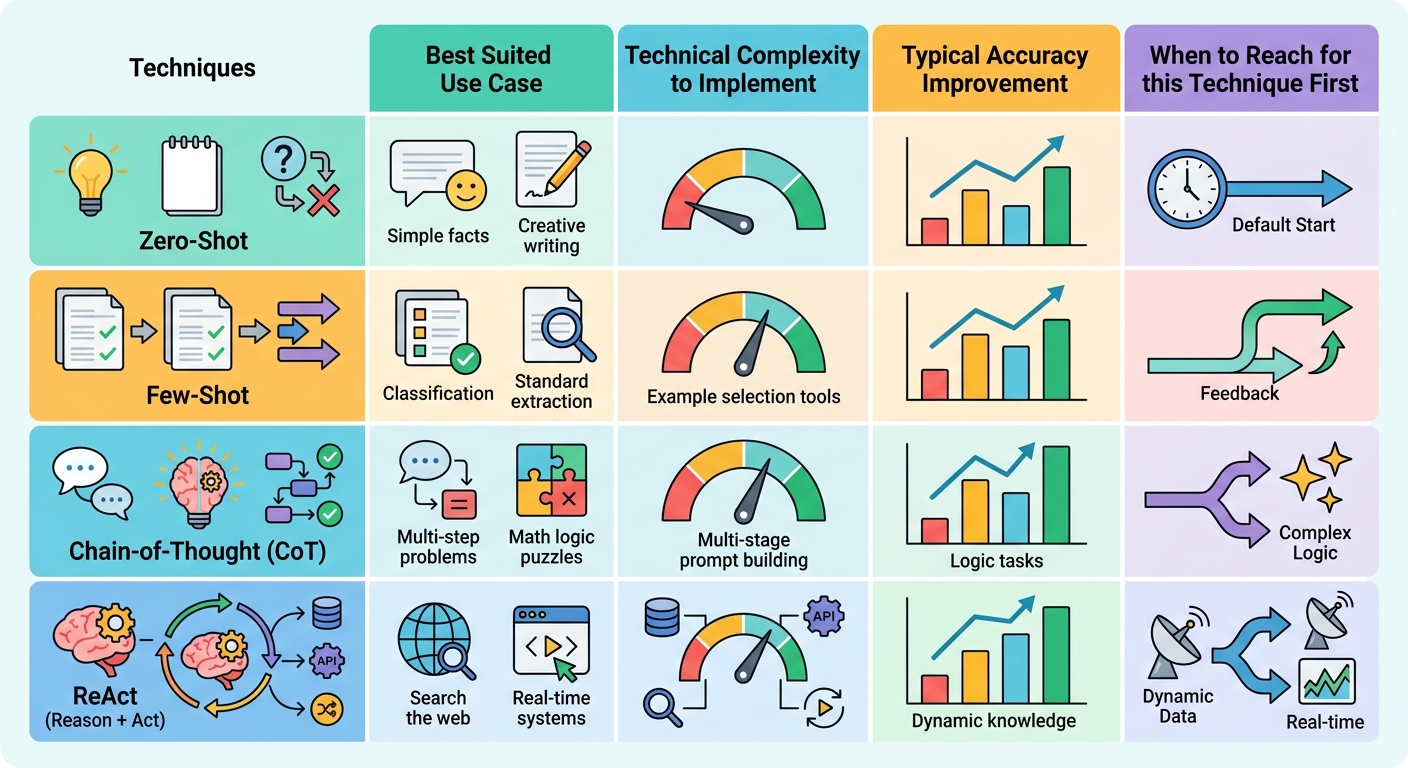
Zero-shot prompting means asking an LLM to perform a task without any examples. You describe what you want in natural language, and the model responds based on its training.
Zero-shot works reliably when you are using a frontier model with strong internal reasoning and when the task maps cleanly to patterns the model was trained on. Common classification, straightforward summarization, and well-defined transformations often need nothing more.
The failure mode is ambiguity. If your instruction can be interpreted multiple ways, zero-shot models will pick one — and it may not be the one you intended.
Few-Shot Prompting
Few-shot prompting provides 1 to 5 examples of input-output pairs within the prompt. The model learns the pattern from the examples and applies it to new inputs.
Few-shot is the right choice when the desired output format is complex or non-obvious — for example, extracting structured data from unstructured text, generating code in a specific style, or producing responses that follow a precise template.
The marginal benefit drops sharply after 3 examples. Beyond 5, you are burning context budget without accuracy gains. If you need more than 5 examples, your task is probably too complex for few-shot and needs a different architecture.
Chain-of-Thought Prompting
Chain-of-Thought (CoT) prompting asks the model to reason step by step before giving a final answer. The technique was a breakthrough when it emerged: it measurably improves accuracy on arithmetic, logical deduction, and multi-step reasoning tasks.
There are two variants. Zero-shot CoT works by appending "Let's think step by step" to the prompt. Few-shot CoT embeds examples that include the full reasoning chain before the answer.
In 2026, a wrinkle has emerged. Many flagship models — including GPT-5-class systems and Claude Opus 4 — now generate internal chain-of-thought traces before producing output, even without explicit prompting. For these models, adding an explicit "think step by step" instruction can be redundant or mildly counterproductive. CoT remains essential for tasks where you need transparent, auditable reasoning traces. But for general use with frontier models, it is worth testing with and without.
ReAct Prompting
ReAct (Reasoning + Acting) is the technique that makes autonomous agents possible. Where CoT keeps reasoning entirely internal, ReAct alternates between generating reasoning steps (Thought), taking actions in the external world (Action), and incorporating the observed results (Observation).
The ReAct loop is: Thought → Action → Observation → repeat until task completion or termination.
- The agent articulates a Thought explaining its reasoning for the next step.
- It takes an Action — typically calling a tool, API, or search function.
- The system returns an Observation.
- The agent processes the Observation and decides the next Thought.
- This continues until the task is complete or a termination condition fires.
ReAct is not always better than CoT. If the agent has all the information it needs internally and the task is purely reasoning-based, CoT is simpler and faster. ReAct earns its complexity when the agent needs to ground its reasoning in external data — live search results, database queries, API responses, or real-time user input.
Key insight — Most agent failures in production are not reasoning failures. They are tool-call failures: malformed JSON to an API, a search returning empty results that the agent does not handle, or a timeout that breaks the observation loop without a recovery path. Debugging ReAct agents means tracing the Action and Observation steps, not just the Thoughts.
Delimiters and Structured Output
Three patterns appear in almost every production prompt regardless of framework:
Delimiters separate instructions from input data. Common choices are XML tags (<instructions>...</instructions>), triple backticks, or triple dashes. Delimiters help the model parse multi-part prompts correctly, especially when user input is mixed with system instructions.
Role setting establishes the agent's persona and authority. "You are a senior backend engineer reviewing code for security vulnerabilities" produces different output than "You are a helpful assistant."
Structured output — typically JSON Schema — constrains the model's response format. For production agents that feed their outputs into downstream systems, structured output is not optional. It is the interface contract.
Context Engineering — The Real Skill Behind Reliable Agents
Once you understand prompting techniques, the next and harder problem is context management. In agentic systems, the context window is a shared resource that gets consumed, compressed, and sometimes exhausted over the course of a long task.
Context engineering is the discipline of managing that resource deliberately. It encompasses several distinct practices.
Context persistence means maintaining state across turns. A long-running research agent cannot reload its entire conversation history on every call — that would be cost-prohibitive and slow. Instead, production agents use memory banks or state stores that hold compressed summaries of prior interactions. On each new turn, the agent receives just enough context to be effective.
RAG-based retrieval grounds agent responses in authoritative, up-to-date data. Without retrieval, an agent's knowledge is frozen at training time. With retrieval, it can query live documents, databases, or APIs to build responses that reflect the current state of the world. RAG also reduces hallucination because the agent's responses are anchored in retrieved facts rather than inferred from weights.
Context compression and summarization become necessary when long conversations exceed what can fit in the context window. Strategies include progressive summarization (summarizing older turns more aggressively), hierarchical summarization (a summary of summaries for very long sessions), and dynamic eviction (dropping the least relevant context tokens when space runs low).
Context isolation matters in multi-agent systems. If agent A and agent B share a context window, their memories can bleed into each other, causing cross-contamination of goals and knowledge. Production multi-agent frameworks handle this by maintaining separate context stores per agent and controlling exactly what gets passed during handoffs.
Key insight — The most common failure mode in production agents is not a bad prompt. It is context overflow: the context window fills up, relevant information gets evicted, and the agent loses track of what it was doing. Building robust context management is what separates production-grade agents from demos.
From Single Prompts to Agentic Workflows
A prompt interaction is a single exchange. An agentic workflow is a sequence of exchanges with state, tools, and termination conditions. The shift from one to the other is the architectural decision that determines whether your AI system stays simple or becomes a genuine autonomous actor.
Chain Prompting
Chain prompting breaks a complex task into smaller, interconnected steps. The output of each step becomes the input to the next. This is not multi-agent — it is a single agent operating in stages.
Chain prompting reduces hallucination because each step has a narrower scope. It also makes debugging easier: if the final output is wrong, you can inspect each step individually to find where things went off track.
Tool Definitions as First-Class Design
For agents that interact with external systems, tool definitions are as important as the system prompt itself. A tool definition has two parts: a description of what the tool does (which the LLM uses to decide when to call it) and a schema for its inputs and outputs.
Poorly written tool descriptions are a common source of agent failures. A description like "search the web" is ambiguous. "Search Google for up to 10 results matching a user query string, returning title, URL, and snippet for each result" gives the model enough structure to call the tool correctly and interpret the results.
Termination Conditions
Every autonomous workflow needs a stopping rule. Without one, an agent in a loop can exhaust your API quota, generate infinite outputs, or spin until the user kills it manually.
Common termination conditions include a fixed maximum number of iterations, a cost ceiling (stop if estimated cost exceeds X), a task-completion check (the agent evaluates whether the goal has been reached), and deadlock detection (if the agent repeats the same Action with the same Observation, escalate or halt).
Guardrails
Guardrails are runtime policies that constrain agent behavior beyond what the prompt alone can enforce. They cover latency limits (abort if a single step exceeds X seconds), error thresholds (halt after N consecutive failures), output size limits, and content filtering.
Key insight — The 80/20 rule applies strongly to agent architecture. Approximately 80% of use cases are served adequately by a single well-designed agent with the right tools. Multi-agent orchestration is genuinely needed for the remaining 20%: parallel specialization, fundamentally different skill sets per agent, or distinct security boundaries. Adding multi-agent complexity before you have hit a real single-agent limitation is one of the most common architectural over-engineering mistakes in the field.
Multi-Agent Orchestration — When and How
Multi-agent systems emerge when a single agent — no matter how well tooled — cannot efficiently cover the full scope of a task. The drivers for multi-agent architecture are typically parallel specialization, role-based goal structures, or distinct tool sets that do not belong in the same context.
Role-Based Design
In a role-based multi-agent system, each agent has a defined persona, a specific goal, its own set of tools, and a backstory that frames how it approaches tasks. A research crew might include a Researcher agent (specialized in finding and extracting information), an Analyzer agent (specialized in evaluating quality and relevance), and a Writer agent (specialized in producing polished, publishable output).
Role definition is not cosmetic. The backstory and goal framing significantly affect how an agent allocates attention and makes trade-offs. A Researcher with the goal "identify the most recent developments in X" will prioritize recency differently than one with the goal "build a comprehensive overview of X."
Task Pipelines
Task pipelines define the sequence and branching logic of work across agents. Two patterns dominate:
Sequential execution runs agents one after another. The output of agent A feeds into agent B. This is appropriate when later steps depend on earlier outputs.
Parallel execution runs independent agents simultaneously and merges their results. This is appropriate when the same input needs to be processed through different lenses — for example, three different analysis perspectives on the same document, run concurrently.
Handoff Protocols
In multi-agent systems, handoffs are the moments when one agent's context is passed to another. The design of the handoff protocol determines how much context travels with the transfer, what format the transfer takes, and what happens if the receiving agent cannot process the incoming context.
Poorly designed handoffs are a major source of compounding errors. In a long-running multi-agent task, small context losses at each handoff accumulate. By step ten, the final agent may have a substantially distorted understanding of the original goal. Building handoff protocols that preserve critical context — goal statement, constraints, key findings from prior agents — is essential for multi-agent reliability.
Failure Handling in Multi-Agent Systems
Multi-agent systems introduce failure modes that do not exist in single-agent designs. The primary risk is error compounding: a small mistake in an early agent propagates through subsequent agents and can amplify at each step.
Mitigation strategies include checkpointing (saving agent state at key milestones so the workflow can resume from a known good point), voting and consensus (running parallel agents and comparing outputs before proceeding), and graceful degradation (if one agent fails, the system either falls back to a simpler path or surfaces the failure to a human operator rather than blindly continuing).
The Three Dominant Frameworks in 2026
The framework landscape for building autonomous agents has consolidated around three viable options. Each has a distinct design philosophy and is optimized for different use cases.
LangChain and LangGraph
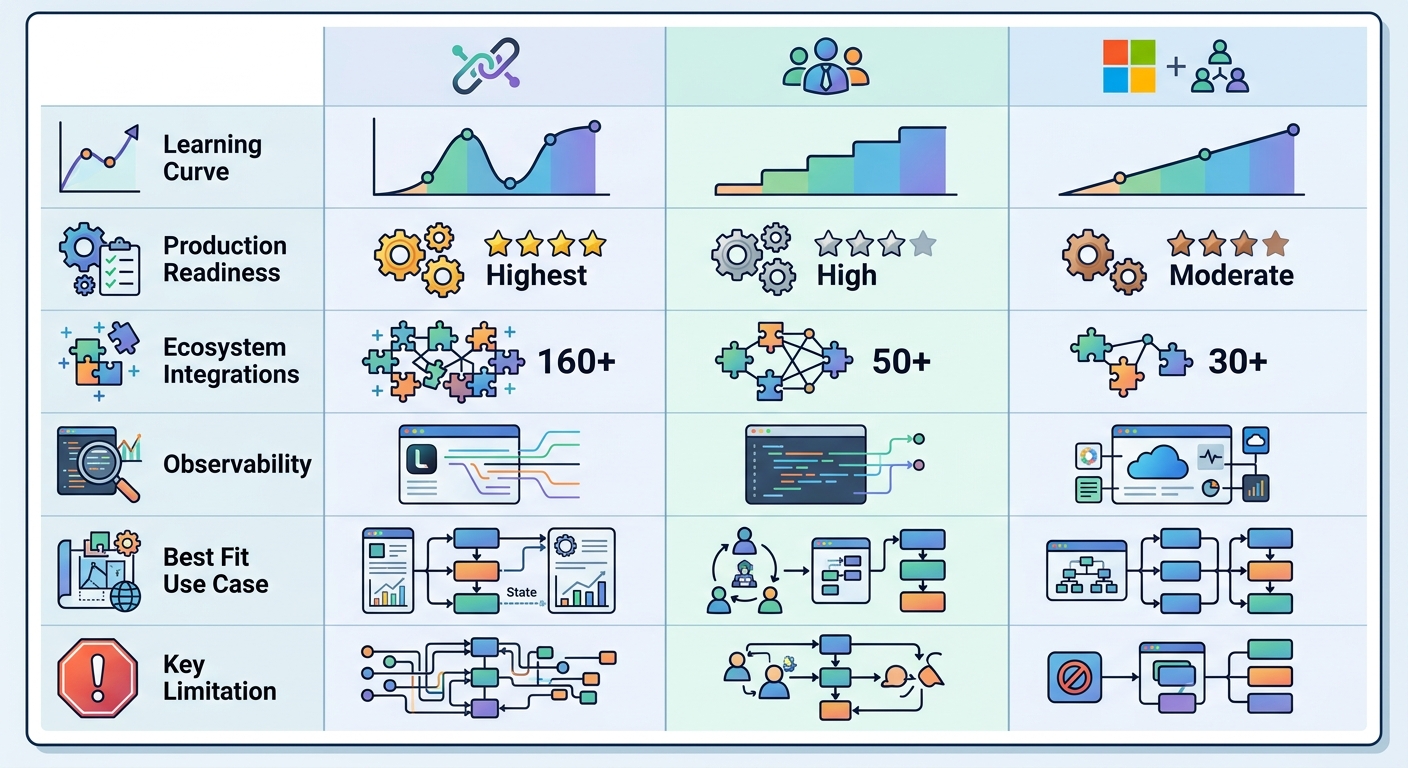
LangChain remains the most broadly adopted framework for LLM application development. Its strength is its ecosystem: over 160 third-party integrations covering vector stores, document loaders, tool APIs, and observation platforms.
In 2026, agents built with LangChain primarily use LangGraph — LangChain's library for modeling agent workflows as state machines. Where LangChain's original chain abstraction was linear, LangGraph models workflows as directed graphs with nodes (functions) and edges (transitions). This supports loops, conditional branching, and human-in-the-loop checkpoints — the primitives needed for durable production agents.
LangSmith provides enterprise-grade observability: tracing every LLM call, measuring latency, and capturing the full prompt and response history for debugging.
LangGraph's trade-off is learning curve. The graph-based mental model takes time to internalize. Teams typically need 2–3 weeks to become productive, versus days with more opinionated frameworks. LangChain has also had a history of breaking changes between versions, which creates maintenance overhead.
Best for: Production systems requiring high reliability, complex state management, extensive integrations, or regulated-industry audit trails.
CrewAI
CrewAI is built around the "team of specialists" metaphor. You define agents with roles, goals, and tools, then assign tasks that agents work through either sequentially or in parallel. The orchestration engine handles handoffs automatically.
The appeal of CrewAI is speed. A functional multi-agent prototype can be running in an afternoon. The API is clean, the documentation is clear, and the open-source model means no licensing costs.
The fragility is in long multi-step workflows. Memory and context management can break down when workflows run for extended periods with complex inter-agent dependencies. CrewAI is also Python-first — if your stack is not Python, integration requires additional work.
Best for: Developer teams building multi-agent prototypes quickly, content and research pipelines, and any project where speed of initial development matters more than long-run durability.
Microsoft Agent Framework
The Microsoft Agent Framework (MAF) is the GA successor to AutoGen, which entered maintenance mode in October 2025. MAF reached general availability in April 2026 and unifies AutoGen's conversational multi-agent abstractions with Semantic Kernel's enterprise features — session-based state management, middleware, telemetry, and type safety.
MAF uses graph-based workflows for explicit control over multi-agent execution paths, supporting sequential, concurrent, handoff, and group collaboration patterns. It integrates natively with Azure AI Foundry for observability and responsible AI features including task adherence, PII protection, and prompt injection defense. Deployment targets include Cloud Run, GKE, and Vertex AI Agent Engine.
MAF is open-source under the MIT license.
Best for: Teams in the Microsoft and Azure ecosystem that need enterprise-grade features, graph-based control, and seamless integration with Azure services.
Trade-off: Existing AutoGen users need to migrate to MAF for new features and ongoing support.
Prompt Governance — Version Control, Testing, and Audit Trails
Prompts in production are code. They need to be treated that way.
Version control means storing prompts in Git, code-reviewing changes before deployment, and rolling back when regressions occur. A prompt that works today may produce subtly different outputs after a model update — without version control, you have no way to trace what changed.
Evaluation sets are curated datasets of inputs and expected outputs used to test prompt quality before deployment. Building a reliable evaluation set is time-consuming, but it is the only systematic way to catch prompt regressions. A good evaluation set covers the happy path, edge cases, and known failure modes.
Prompt registries centralize approved prompts for production use. Changes to production prompts go through a review and approval workflow rather than being made ad hoc. This is especially important in regulated industries where the specific wording of an AI-generated response may have legal implications.
Audit trails log which prompt version was used for each production interaction. When a system produces an incorrect or harmful output, an audit trail lets you reproduce the exact context that caused it — essential for incident response and regulatory compliance.
Key insight — Monitoring prompt drift is an underappreciated operational need. When a model provider updates their models — even with a minor version bump — prompt behavior can shift. Establishing a regression suite that runs against every model update is the only way to catch silent degradation before it reaches users.
The Road Ahead — Where Context Engineering Is Heading
Three trends are reshaping the discipline in real time.
Adaptive prompting is the idea that LLMs can iteratively improve their own prompts based on feedback. Rather than a human engineer hand-crafting every prompt variant, the system generates prompt candidates, evaluates them, and selects the best performers. This does not eliminate the need for human context architects — but it changes their job from writing prompts to designing prompt evaluation systems.
The Model Context Protocol (MCP) is an emerging standard for cross-framework agent communication. As enterprises build agents on different frameworks — some using LangGraph, some using CrewAI, some using MAF — the inability of these agents to communicate with each other is becoming a bottleneck. MCP aims to provide a common interface language for agents built on different stacks to discover and communicate with each other. Its adoption will be one of the defining infrastructure stories of the next two years.
And finally, the role itself is evolving. "Prompt engineer" as a job title peaked in 2024 and has declined roughly 30% since, according to job posting data. But the underlying skills are in higher demand than ever — they are just embedded in broader roles: AI engineer, LLM engineer, context architect, AI solutions architect.
The global prompt engineering market is projected to grow from $893.7 million in 2026 to $2.06 billion by 2030 — a 32.8% CAGR that reflects the increasing integration of AI into every business function.
The prompt is still there. But it is just the surface layer of something much deeper — and more interesting — than anyone expected when the term was coined.
Expert Q&A
Q: You mention that most agent failures are tool-call failures, not reasoning failures. What is the most common specific tool-call error you see in production? A: Malformed tool input is the most frequent. The agent correctly decides to call a tool, but sends a schema that does not match what the tool expects — wrong field types, missing required arguments, or a JSON structure that the downstream API rejects. This usually stems from the tool description being too vague in the prompt. The fix is to be explicit about the schema: list every field, its type, whether it is required or optional, and what valid values look like. Think of the tool description as an API contract, not a paragraph description.
Q: When should a team actually introduce multi-agent architecture? You mention starting with a single agent, but what is the concrete signal that a single agent has hit its limit? A: The practical signal is when you find yourself writing conditional logic in the system prompt that says "if the task is X, do this; if it is Y, do that" — and that conditional tree is growing faster than the core agent logic. Another signal is when two parts of the task require fundamentally different system prompts (different roles, different tool sets) that conflict when merged into one context. A third signal is performance degradation: the single agent is slow because it is juggling too many responsibilities. Multi-agent is not a scale-up from single-agent; it is a different architecture. It should solve a specific structural problem, not just add capacity.
Q: How do you handle the context overflow problem in long-running agents without losing the thread of what the agent is trying to accomplish? A: The most effective pattern is a hierarchical memory store with a working memory and a long-term summary. The working memory holds the most recent N turns at full fidelity. Older turns get progressively summarized, with key decisions and constraints preserved. At decision points, the agent can "re-read" the full summary to re-establish context. A second pattern is explicit checkpointing: at each major milestone, save a state snapshot that includes the original goal, the current hypothesis or direction, and key findings. If context overflow forces a reload, the agent can reconstruct a reasonable approximation of where it was rather than starting from scratch.
Q: The article mentions that MCP could be a major standardization story. What would need to happen for it to actually achieve cross-framework adoption? A: Two things need to happen. First, at least one major framework (likely LangChain given its market position) needs to adopt MCP natively and demonstrate production success with it. That creates a proof point. Second, an enterprise customer needs to need cross-framework agent communication badly enough to pressure their vendors. Right now, most enterprises are still building single-framework agent systems. Cross-framework need is nascent. MCP will gain traction when a visible, high-profile enterprise use case demonstrates the value of agents on different stacks talking to each other — something like a procurement workflow where one agent system handles vendor research and another handles contract analysis, and they need to exchange structured context.
Q: What is the single biggest mistake teams make when first moving from prototyping agents to production deployment? A: Treating the transition as a deployment problem rather than a testing and observability problem. Prototype agents work in demos because the person watching can immediately see when something goes wrong and intervene. Production agents run unattended, at scale, and failures might not be noticed until they cause downstream damage. The teams that struggle most are those that deploy an agent without investing in three things first: structured logging (every tool call, every handoff, every decision point logged in a queryable format), regression evaluation (a set of known test cases that catch behavioral regressions), and alerting thresholds (rules that tell you when an agent is behaving outside expected parameters). Building these three things before production is what makes the difference between an agent that runs reliably and one that causes incidents.
This guide is for IT professionals and software engineers building with LLMs in 2026. For more on AI agents, automation patterns, and production LLM infrastructure, explore the Algorithmine learn section — or subscribe to get new articles as they publish.