Prompt Caching and Context Economics: Cutting LLM Costs 60% in 2026
Learn how prompt caching and context economics cut LLM costs up to 60% in 2026. Design cache-friendly prompts, measure hit rates, and model real savings.
Why Context Is Now Your Largest LLM Cost Line Item
For most production LLM workloads in 2026, output tokens are no longer the cost driver. Context is. System prompts, tool schemas, retrieved documents, and conversation history now account for the majority of billed tokens in typical RAG and agentic deployments. Teams that optimized for short completions a year ago are discovering that their real bill is a context bill.
The practical consequence: token economics is no longer a billing detail you reconcile at month-end. It is a budgeting discipline you design into the prompt layer, the retrieval layer, and the deployment pipeline. Teams reporting 50–70% LLM spend reductions are not negotiating harder — they are architecting context so that most of it is reused rather than re-billed. (See: LLM cost optimization strategies)
The shift from token pricing to context economics
Larger context windows have made the problem worse, not better. A 200K-token window invites teams to stuff more retrieved chunks, more history, and more tool definitions into every call. Cost scales linearly with that stuffing. Quality often does not — retrieval precision degrades, instruction-following weakens, and latency climbs.
Consider a concrete pattern that became common in 2025 and is now the default failure mode: an agent with 40 tool definitions, a 6,000-token system prompt, and a retrieval step that injects 12 chunks per turn. At 20 turns per session, the same tool schemas and system instructions are re-billed 20 times. In a workload of 100,000 sessions per month, that is tens of billions of redundant input tokens — paid for at full price unless caching captures them.
The cheapest token is the one you never re-send. The second cheapest is the one you re-send from cache.
That is the core insight behind prompt caching. Providers price cached input at a steep discount because cached prefixes don't require full recomputation. If your architecture reuses context, you capture that discount. If it doesn't, you pay full freight on every request. (See: how prompt caching reduces LLM inference costs)
The economics compound because context growth is rarely deliberate. It accretes: a tool schema added for one edge case, a few more retrieved chunks to improve recall, a conversation buffer that grows unbounded. Each addition is individually defensible and collectively expensive. Context economics is the discipline of asking, for every token in the prompt, whether it needs to be there on every call — and if it does, whether it can live in a cacheable prefix instead of the dynamic tail.

How Prompt Caching Actually Works
Prompt caching reuses the computed state of an identical leading sequence of tokens — the cacheable prefix — across requests within a time-to-live (TTL) window. When a new request shares that exact prefix, the provider serves it from cache instead of recomputing it. The savings come from the read discount.
Cache prefixes, hit windows, and TTL mechanics
The mechanics differ by provider, but the shape is consistent:
- Explicit cache breakpoints (Anthropic-style): you mark where the cacheable prefix ends; writes are billed at a premium, reads at a discount, and the cache lives for a defined TTL that refreshes on use.
- Automatic prefix caching (OpenAI-style): the provider detects shared leading tokens and applies discounted pricing to cached portions. Current implementations also let you steer routing with a cache key and control retention, so "fully automatic" undersells the levers you now have.
- Context caching (Google-style): you create a cached content object explicitly and reference it across calls, with its own storage and TTL economics.
Provider mechanics and prices change frequently — verify against current documentation before you model a budget. The structural economics, however, are stable across all three: cache writes cost a premium; cache reads cost a steep discount. A prompt sent once and never reused is strictly more expensive with caching than without.
Compute your own breakeven rather than trusting a rule of thumb. If a write costs w times an uncached token and a read costs r times an uncached token, the number of reads needed to recover the write premium is (w − 1) / (1 − r). Under a typical 1.25× write and 0.10× read, that is roughly 1.2 reads — meaning a prefix reused even a couple of times inside the TTL already wins. If your TTL expires and the prefix must be re-written, add the write premium back into the denominator.
Two constraints quietly gate all of this: providers typically require a minimum cacheable prefix length (on the order of 1,024–2,048 tokens depending on model) before caching engages at all, and caches are generally scoped per organization and API key — so multi-tenant fan-out does not share a cache.
The TTL constraint deserves its own paragraph because it is where most savings models quietly break. A cache that lives for five minutes and refreshes on every hit behaves very differently from one that expires after an hour of inactivity. If your traffic is bursty — a support queue that spikes at 9 a.m. and goes quiet at noon — you will re-write the prefix at the start of every burst. Model your write count from your traffic arrival pattern, not from your average request rate. A workload averaging 500 requests per hour but arriving in five-minute spikes of 200 requests will have a different write-to-read ratio than the same volume spread evenly, and the write premium is where that difference shows up.
What gets cached — and what silently doesn't
Caching is token-sequence-exact. The moment the token sequence diverges from the cached prefix, everything after it is a miss. The failure modes are subtle and expensive:
- Timestamps or request IDs at the top of the system prompt — invalidates the entire prefix on every call.
- Dynamic user IDs or session metadata early in the prompt — same effect.
- Whitespace and formatting drift — a trailing space, a reordered JSON key, or a changed newline produces a different token sequence and breaks the match.
- Reordered tool definitions — schema serialization order matters; non-deterministic serializers silently destroy hit rates.
- A/B test variants or per-user personalization injected above the static block.
The tool-schema failure deserves emphasis because it is the most common in agentic systems. Many language runtimes serialize dictionaries in insertion order, and many HTTP clients or ORMs rebuild those dicts from unordered sources. A tool registry that loads definitions from a database without an explicit sort will produce a different schema order on some requests than others — and the cache will miss on those requests with no error, no warning, and no log line. The fix is boring and effective: sort tool definitions by name at serialization time, pin the serializer version, and snapshot the rendered prefix in CI.
Most "caching isn't working" incidents are not infrastructure problems. They are a timestamp on line three of the system prompt. (See: debugging low cache hit rates)
The 60% Math: Where LLM Cost Savings Come From
The headline number is a blended outcome, not a universal guarantee. It depends on two variables: prefix size and hit rate. Hit rate is the single most important lever — a large prefix with a 40% hit rate can beat a small prefix with a 90% hit rate on absolute savings, while the small-prefix team captures a higher percentage reduction.
Worked example: cached vs. uncached request costs
Assume a RAG assistant with a 20,000-token static prefix (system instructions, tool schemas, and a pinned reference corpus) serving 500 requests per hour. For illustration we use a stylized pricing model — a 1.25× write premium and a 0.10× read discount on a $3.00/1M uncached input rate, with output at $15.00/1M. Substitute your provider's current sheet.
| Component | Rate (per 1M tokens) |
|---|---|
| Uncached input | $3.00 |
| Cache write (1.25×) | $3.75 |
| Cache read (0.10×) | $0.30 |
| Output | $15.00 |
Uncached baseline: 20,000 tokens × 500 requests × $3.00/1M = $30.00/hour on the static prefix alone.
Cached, at 90% hit rate: 50 writes × 20,000 × $3.75/1M = $3.75; 450 reads × 20,000 × $0.30/1M = $2.70. Total: $6.45/hour.
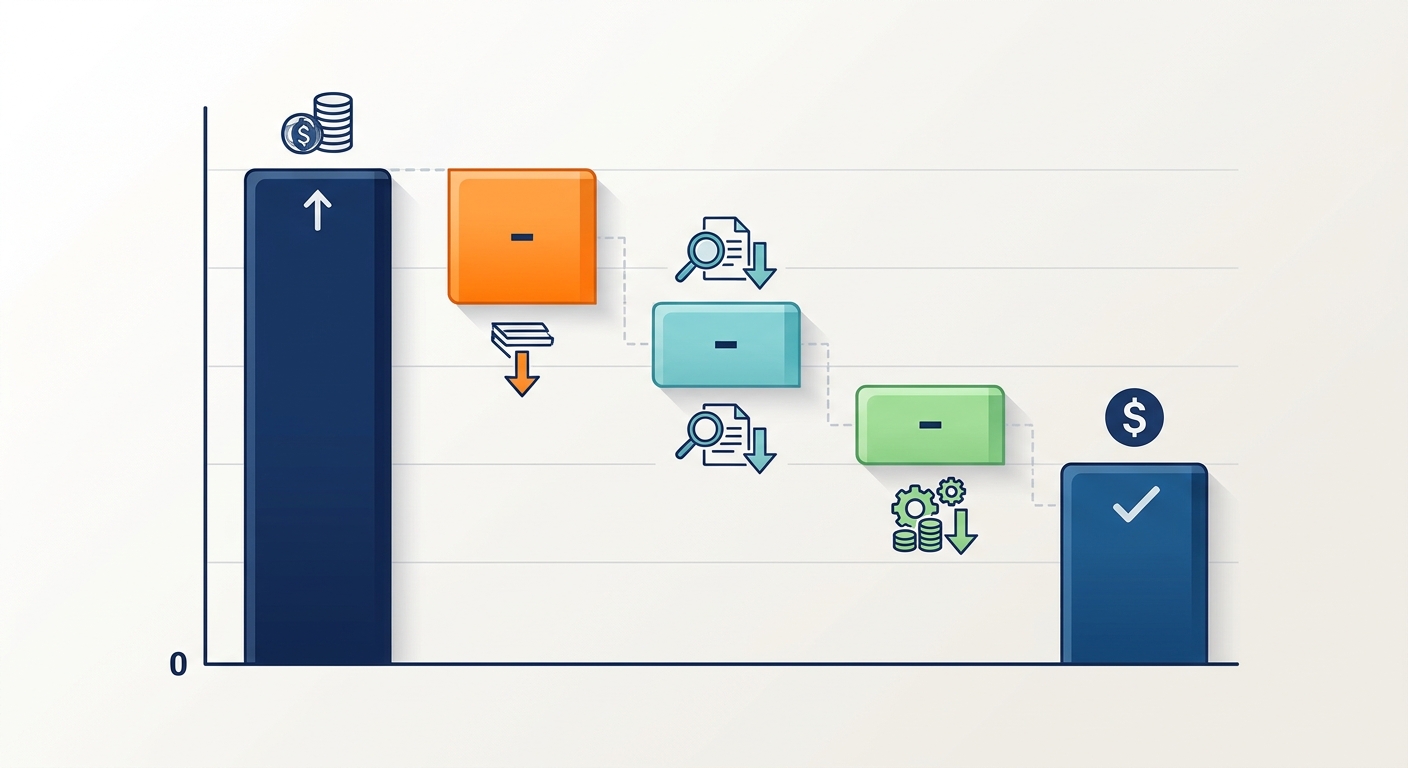
That is a 78% reduction on the static prefix. The whole-workload number follows a simple blend: total savings = static_prefix_share × prefix_reduction. If the static prefix is 70% of baseline spend and you cut it 78%, the whole workload drops about 55% before any change to dynamic or output tokens. That is where the realistic 55–60% range comes from — and it requires the dynamic and output portions to stay flat, which is why output-token reduction is a separate lever.
Run the same formula at lower hit rates and the picture changes fast:
- 60% hit rate → ~45% reduction on the static prefix → ~32% whole-workload at a 70% static share.
- 30% hit rate → caching barely clears the write premium; treat it as breakeven and fix your prefix architecture before modeling savings.
The sensitivity is worth internalizing: moving from 60% to 90% hit rate roughly doubles your savings on the prefix. That is why the engineering work in the next section — deterministic serialization, static-first ordering, prefix snapshotting — pays for itself far faster than any negotiation with a provider.
State your assumptions, measure your real hit rate from provider usage metadata, and model your own blended number. The 60% figure is realistic for well-architected, high-reuse workloads — not a default.
Designing Prompts for Cache Hit Rates
Cache hit rate is an architectural property, not an optimization trick. Design it in.
Prefix architecture and static/dynamic separation
Order your prompt static-first, dynamic-last. Put the invariant system instructions, tool schemas, and pinned reference material at the top; push retrieved chunks, user turns, and per-request metadata to the bottom. Then verify the split survives serialization: sort tool definitions deterministically, strip volatile fields, and snapshot the rendered prefix in a test so any accidental change shows up as a diff rather than as a silent hit-rate collapse in production.
Rules: