Prompt Caching as a Cost Strategy: What Actually Saves Money in 2026
Prompt caching can cut input costs 60–80%—or quietly raise them. See the break-even math, TTL traps, and workloads that actually save money in 2026.
Why Prompt Caching Is a Line Item Now — and Why Most LLM Cost Savings Claims Are Inflated
By 2026, prompt caching has moved from a clever engineering trick to a standard line item on inference invoices. The major providers — Anthropic, OpenAI, and Google — now bill cache writes at a premium and cache reads at a discount, and procurement teams have started asking pointed questions about "cache hit rate" in renewal conversations. The pitch is seductive: reuse your expensive context, pay a fraction on repeat calls, and watch your LLM cost optimization numbers drop.
The reality is messier. Prompt caching saves real money — often 60–80% on the cached input tokens of a high-reuse workload — but only when cache hits, TTL windows, and workload shape actually align. That 60–80% is a discount on one line item, not on your total bill; output tokens and uncached input usually dominate. Teams routinely model savings against a perfect hit rate, then discover their traffic pattern never reaches it. Others optimize a small input-token line while output tokens quietly dominate the invoice. (See our guide to LLM token cost breakdowns for where the money actually goes.)
This article separates the savings that show up on your invoice from the theater. We'll cover the mechanics, the break-even math, the workloads that win, the ones that lose, and a decision framework you can apply this quarter.
How Prompt Caching Works Under the Hood
Prefix caching vs. full context reuse
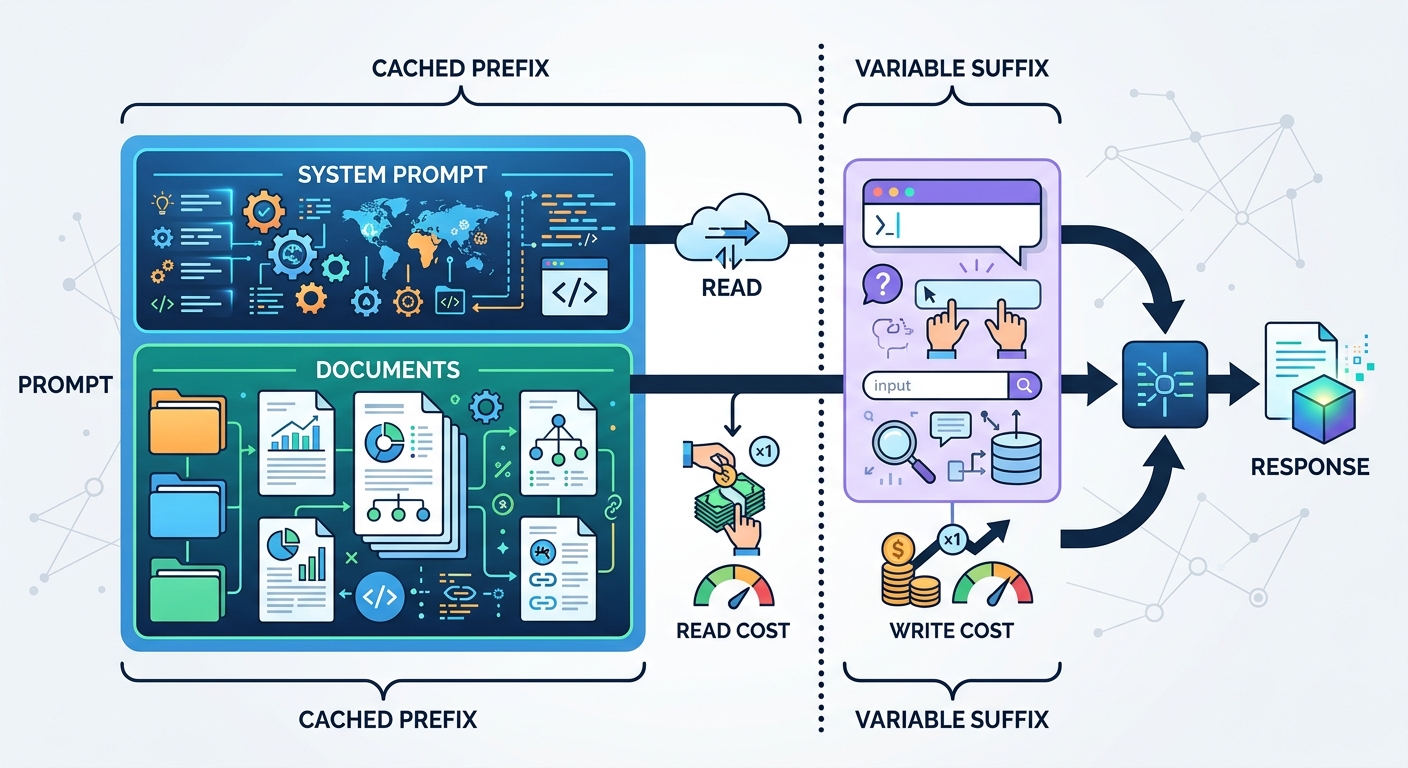
Most production prompt caching in 2026 is prefix-based. The provider stores the computed key-value (KV) state for a leading portion of your prompt — typically the system message and any stable documents — and reuses it when a subsequent request begins with the identical token sequence. Change one token early in the prompt and the cache misses for everything after it.
This is why prefix caching rewards structure, not just repetition. A long system prompt with a variable user query appended at the end caches beautifully. A prompt that injects a timestamp at the top does not. Some providers offer more granular block-level or explicit cache-control markers, but the dominant model is still "match the prefix, reuse the state." (For prompt design patterns that maximize cache hits, see structuring prompts for cacheability.)
What providers actually bill for cache writes vs. cache reads
Providers price caching asymmetrically. A cache write usually costs more than a normal input token — commonly in the 1.25× to 2× range — because you're paying to persist state. A cache read is discounted, often to 10–50% of the standard input price. These multipliers vary by provider, by model tier, and by TTL choice (an extended one-hour cache typically carries a higher write premium than a default five-minute one), and they change. Treat any specific number as illustrative and check current pricing before you model.
The write premium is the part teams forget. If your cache never gets read, you paid extra for nothing.
That asymmetry is the entire game. Caching is profitable only when reads outnumber writes by enough to overcome the write premium and the TTL risk. Provider variance matters too — a strategy tuned for one vendor's multipliers can lose money on another's. (Compare current multipliers in our LLM API pricing comparison.)
The Unit Economics: Where the Savings Come From
Break-even math for cache writes and reads
Here's a worked example, using illustrative multipliers of a 1.25× write and a 0.25× read. Say you have a 20,000-token system prompt reused 50 times a day, with a standard input price of $3 per million tokens.
- Without caching: 20,000 tokens × 50 calls = 1M tokens/day = $3.00/day in input cost.
- With caching: one write at 1.25× = 25,000 effective tokens = $0.075, plus 49 reads at 0.25× = 245,000 effective tokens = $0.735. Total ≈ $0.81/day.
That's roughly a 73% saving on that input line — real, but note the absolute number: about $2.19/day. Multiply across a fleet and it matters; on a single low-traffic service it's noise.
The break-even ratio falls out of the multipliers. Caching pays off when your reads-per-write exceeds (write multiplier − 1) ÷ (1 − read multiplier). With a 1.25× write and a 0.25× read, that's (0.25) ÷ (0.75) ≈ 0.33 reads per write — i.e., you need roughly one read for every three writes before caching breaks even, and the margin improves fast as reads climb. Below that ratio, caching is a cost increase. Run this arithmetic on your actual multipliers and TTL costs before committing engineering time.
And keep the denominator honest: this saving applies to the cached prefix only. If output tokens are 70% of your bill, a 73% cut on the cached input line might move total spend by single digits. Model the whole invoice, not the line item.
TTL windows and the cost of a cold cache
Caches expire. Default TTLs are commonly around five minutes, with extended windows (often one hour, at a higher write premium) available on some providers. Every expiration means the next request pays the write premium again — and you've now paid that premium more often than you modeled.
The trap is bursty traffic. A workload that fires 200 calls in ten minutes then goes quiet for an hour gets one write and 199 cheap reads — great. A workload that fires one call every twelve minutes with a five-minute TTL gets a write every single time — a pure loss. Your inter-arrival time relative to TTL is the single most predictive variable for whether caching helps. Map your request cadence before you map your savings.
Prefix stability is an engineering discipline, not a default
The math above assumes your prefix actually stays identical between calls. In practice, the most common reason caching underperforms is silent prefix drift. Guard against it:
- Version your system prompts. A deploy that edits the preamble invalidates every cached prefix on the next call.
- Keep volatile data out of the prefix. Timestamps, request IDs, user IDs, session tokens, and A/B flags placed early in the prompt guarantee a miss. Move them to the suffix.
- Serialize deterministically. JSON key ordering, whitespace, and tool-schema ordering must be stable across calls or the "identical" prefix isn't.
- Append retrieved context after the stable block. In RAG, the stable instructions and static corpus go first; per-query chunks go last.
A prompt that is logically the same but byte-different on each call gets a 0% hit rate and a write premium on every request.
Workloads That Actually Save Money
High-reuse patterns (agents, RAG, system prompts)
Caching wins where the same large context is read many times in a tight window:
- Agent loops. Multi-step agents re-send the same system prompt, tool definitions, and accumulated scratchpad dozens of times per task. This is the strongest caching case in 2026 — high read-to-write ratio, short inter-arrival gaps.
- RAG with stable instructions. Retrieval-augmented generation that keeps a fixed instruction block and a large static corpus segment at the front of the prompt caches well, as long as retrieved chunks are appended after the stable prefix.
- Long system prompts and few-shot banks. Any service with a fat, stable preamble and a thin variable query is a natural fit.
These patterns share a shape: large stable prefix, small variable suffix, high call frequency. That's the profile prompt caching was built for. (See prompt caching best practices for agent architectures for implementation details.)
Low-reuse patterns where caching loses
Caching loses — sometimes badly — when the read-to-write ratio stays under break-even or the prefix can't be held stable:
- Low-frequency, high-variance requests. One-off queries, interactive chat with long idle gaps, or per-user prompts that never repeat. If inter-arrival time exceeds TTL, you pay the write premium on every call.
- Prompts with volatile prefixes. Anything that front-loads a timestamp, user ID, or freshly retrieved document that changes per call. You get writes with no reads.
- Small prompts. If the prefix is a few hundred tokens, the absolute savings are negligible and the engineering and monitoring overhead isn't worth it. Caching is a large-context play.
- Workloads where output dominates. Caching does nothing for output tokens. If your cost is mostly generation, optimize prompt length, output length, and model tier first.
The failure mode is consistent: teams adopt caching as a default and pay a write premium on traffic that never generates reads.
A Decision Framework You Can Apply This Quarter
Run these five checks before you build:
- Measure your prefix. Is there a stable block of at least a few thousand tokens at the front of most requests? If not, stop here.
- Map inter-arrival time against TTL. Pull request timestamps for a representative week. What fraction of requests arrive within the cache window of the previous one? That fraction is your realistic hit rate — not 100%.
- Compute break-even on real multipliers. Apply the formula above using your provider's current write/read multipliers and TTL costs. Compare your realistic hit rate to the break-even ratio.
- Model the whole invoice. Apply the projected saving to the cached prefix only, then check what share of total spend that prefix represents. If the prefix is a small slice of the bill, the project is low-priority.
- Instrument hit rate in production. Ship with per-request cache-hit telemetry from day one. A hit rate that drifts down after a deploy is your early warning that prefix stability broke.
The Bottom Line
Prompt caching is a genuine cost lever, and in 2026 it belongs in your inference budget planning — but it is a conditional lever. It rewards large, stable prefixes read many times inside the cache window, and it punishes volatile prompts, sparse traffic, and small contexts with a silent write premium. Do the break-even arithmetic on your real multipliers, map your request cadence against TTL, treat prefix stability as an engineering invariant, and measure the saving against the whole invoice rather than the cached line. Teams that do this capture real, defensible savings; teams that treat caching as a checkbox pay for state they never read.