Context Engineering in 2026: How Prompt Caching Rewrote the Economics of Long Prompts
Learn how prompt caching rewrites the cost math of long prompts—plus context engineering patterns that keep prefixes stable and cut per-request costs.
In 2024 and 2025, long prompts were a cost problem. Teams wanted richer system instructions, bigger retrieval payloads, and longer conversation memory, but every additional token multiplied across every request—and the bill scaled with it. By 2026, that math has inverted. Prompt caching turned long, stable context from a liability into a design lever, and the practitioners who understand it are shipping more capable agents at a fraction of the per-request cost.
The shift matters beyond infrastructure. Context engineering—curating system prompts, tool definitions, retrieval, memory, and history as one designed artifact—is now an economics discipline, not just a prompting craft. This article explains how prefix caching works, how it changes the cost math, and which context patterns exploit it. (See also: what is context engineering?)
Why Long Prompts Became the Default
From prompt engineering to context engineering
Prompt engineering optimized a single instruction string. Context engineering optimizes everything the model sees: system instructions, tool schemas, retrieved documents, memory, and conversation history, assembled deliberately per request. As models gained larger effective context windows, teams stopped compressing and started curating. The question shifted from "how short can we make this?" to "what does the model need to see to be reliable?" (Related: prompt engineering vs. context engineering)
The practical result is that production prompts grew from a few hundred tokens to tens of thousands. A customer-support agent might carry a 6K-token style guide, a 3K-token escalation policy, and a dozen tool schemas with full parameter descriptions. A coding assistant might front-load repository conventions, linting rules, and API references. A document-analysis pipeline might prepend a taxonomy of categories and extraction rules. None of this is waste—each block measurably improves reliability—but it all lands in the input window on every call.
The cost wall that stopped teams cold
Agentic workflows, retrieval-augmented generation, detailed system instructions, and multi-turn memory all push token counts up. Before caching, cost scaled linearly with context length—a 20K-token context cost twenty times a 1K-token one, on every single call. At high volume, rich context became unaffordable, so teams stripped instructions, truncated retrieval, and shipped weaker systems to protect margins. That tradeoff defined the era.
The failure modes were predictable. Support bots forgot escalation rules and routed angry customers to the wrong queue. Coding assistants ignored house style and produced diffs that failed review. Analysis pipelines mislabeled documents because the taxonomy had been trimmed to fit a budget. Teams knew the missing context would fix these problems, but the unit economics said no. Some teams built elaborate compression schemes—summarizing policies, distilling retrieval—and discovered that the summarization itself cost tokens and lost fidelity. The wall was real, and it shaped system design for two years.
What Prompt Caching Actually Does
Two mechanisms, one goal
"Prompt caching" covers two distinct mechanisms that are easy to conflate:
- Automatic prefix caching. The provider transparently detects and reuses repeated leading token sequences. No configuration; you simply benefit (or don't) based on how stable your prefix is. Discounts and TTLs are provider-managed.
- Explicit cache APIs. You mark specific content as cacheable (e.g., via cache-control blocks), and the provider bills cache writes and cache reads separately—often at different multipliers from normal input pricing. This gives control but adds a cost model you have to reason about.
Both reward the same thing: a long, identical prefix at the front of the request. The difference is who manages the lifecycle and how the billing splits. With automatic caching, you optimize by structuring your prompt; with explicit caching, you optimize by structuring your prompt and your cache markers, and you carry responsibility for deciding when a write is worth paying for.
Prefix caching mechanics in plain terms
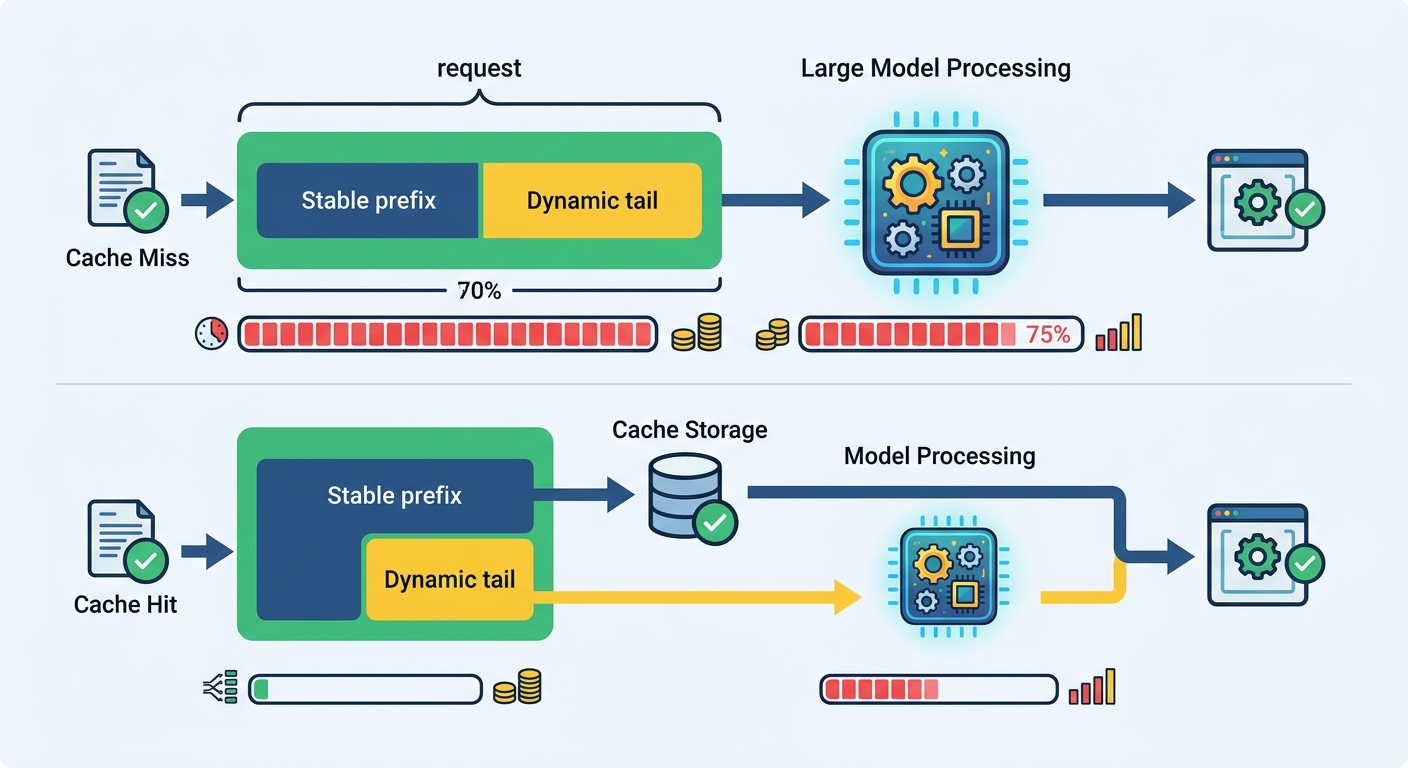
Prefix caching reuses the processed representation of an identical leading token sequence across requests. If the leading tokens of a request match a previously seen prefix, the provider serves that prefix from cache and bills it at a reduced rate. The model still generates fresh output, but the expensive part of ingesting a long, unchanging preamble is skipped.
Two details matter for design:
- Matching is at cache-block granularity, not token-by-token. Providers typically segment the prefix into blocks (commonly on the order of ~128 tokens, though this varies). Changing one token early invalidates the cache from that block onward—not necessarily the entire prompt, but everything downstream of the change.
- A hit requires the whole prefix to match. Partial-prefix reuse is not guaranteed across providers. In practice, treat the cacheable region as an all-or-nothing unit up to the point where content diverges.
Some providers also enforce a minimum cacheable prefix length (often around 1,000 tokens); shorter prefixes may not be eligible at all. Caching therefore rewards stability at the front of the prompt—and enough length to clear the threshold. (Learn more: how LLM prompt caching works)
Cache hits, misses, and the TTL tradeoff
A cache hit occurs when the prefix matches a stored entry; a miss means full-price processing. Providers typically expire cached prefixes after a time-to-live window—measured in minutes to hours—and the specifics vary by provider and model. Some offer explicit cache controls or extended retention; others handle it automatically with no configuration. These parameters change frequently, so verify current TTLs, minimum prefix lengths, and discount rates against your provider's docs before they drive a build decision.
The TTL creates a real tradeoff. Short windows mean caches go cold during quiet periods, so bursty traffic pays miss prices repeatedly. Long windows help steady workloads but, under explicit caching, may carry write or storage costs. The practical rule: caching pays when request volume keeps the prefix warm. Intermittent traffic rarely benefits.
Consider the traffic shape. A consumer app with steady daytime volume keeps its prefix warm for hours; a batch job that runs once at midnight warms the cache and then lets it expire before the next run. A support tool that sees a burst at 9 a.m. and then goes quiet may pay the write premium on every burst. Before committing to a long-prefix architecture, measure your inter-arrival times against the TTL: if the gap between requests routinely exceeds the window, you are paying for a cache you never read.
The write premium and the break-even you have to clear
This is the part most teams miss. Under explicit caching, a cache write often costs more than normal input processing—a common pattern is a write multiplier above 1× (e.g., ~1.25×) paired with a read discount well below 1× (e.g., ~10% of input price, though this varies widely). That means a cache is net-negative until it has been read enough times to amortize the write premium.
The rough rule: if a write costs w× input and a read costs r× input, you break even at roughly (w − 1) / (1 − r) reads per write. With illustrative w = 1.25 and r = 0.1, that's about 0.28 reads—so a single read already pays it back. But with a shallower discount (say r = 0.5), the breakeven rises to roughly 0.5 reads, and with a heavier write premium it climbs further. The point isn't the exact number—it's that write premium and read discount must be evaluated together, per workload, not assumed.
Two corollaries follow. First, a prefix that is written once and never read is strictly worse than no caching under explicit APIs—so never mark content cacheable that only appears in a single request. Second, the break-even shifts with the length of the cached region: the longer the prefix, the more absolute dollars the read discount saves, so long prefixes clear break-even faster than short ones. This is why caching and long context are complements, not substitutes.
The New Cost Math: Why Cached Tokens Change Decisions
A worked example: long-context agent vs. short-prompt agent
Consider an agent with a 20K-token stable context—system instructions, tool definitions, policy documents—handling 100,000 requests per day. The numbers below are illustrative, but the shape holds across providers.
- Uncached long context: 20K tokens × 100K requests = 2 billion input tokens per day at full price.
- Cached long context: the same 2 billion tokens, but most of them billed at a cache-read discount. The blended rate depends on the read price and how many requests are hits. At a steep discount (reads near 10% of input price) and a high hit rate, the effective bill can fall to a small fraction of the uncached total; at a shallower discount (reads near 50%), the savings are real but far more modest.
- Short-prompt alternative: a 2K-token prompt costs roughly a tenth per call if it actually contains the same information—but it usually doesn't. It either loses the rich context or duplicates a subset of instructions inside every request, and it still pays full price every time.
Under steady traffic and a steep read discount, the long stable context can cost less than repeatedly shipping duplicated instructions in short prompts—while delivering better reliability. That's a conditional, not a universal: it holds when the cache stays warm, the discount is deep, and the short-prompt baseline genuinely duplicates tokens. The break-even point has moved: context length is no longer the primary cost driver; prefix volatility is.
Where the savings evaporate
Caching is not free money. Savings collapse when:
- The prefix is volatile. A timestamp, request ID, or rotating user greeting at the top of the prompt invalidates everything after it.
- Instructions change frequently. Every edit forces a cache miss until the new prefix warms up.
- Volume is low. If requests arrive too sparsely to keep the cache alive, most calls pay full price.
- TTLs are short relative to traffic patterns. Overnight gaps can reset the economics daily.
- Dynamic content sits early. Retrieved documents or history injected near the front destroy reuse for everything downstream.
- The write premium isn't amortized. Under explicit caching, a prefix read only once or twice may cost more than not caching at all.
Caching doesn't reward long prompts. It rewards stable long prompts. The cost lever isn't context size—it's how much of the context never changes.
Context Engineering Patterns That Exploit Caching
Stable-prefix architecture
Design every prompt as a fixed head and a variable tail. **Static instruct