Context Engineering: Why Assembling the Model's Input Beats Writing a Better Prompt
Stop rewriting prompts. Learn context engineering—treating the LLM context window as a budget with retrieval, ranking, and compression that fixes accuracy.
The Prompt Was Never the Bottleneck
If you've spent the last two years on an LLM product team, you've lived this cycle. Output quality disappoints, so someone rewrites the prompt. It gets better. A week later it regresses. So you rewrite it again—add a role, add "think step by step," bolt on three few-shot examples, try XML tags, then JSON, then a different model. Quality inches up and then stalls.
Here's the uncomfortable finding most teams eventually reach: the prompt was rarely the thing holding them back. The model usually fails because it doesn't have the right document, is working from stale data, or is drowning in twelve retrieved chunks where two would do. No amount of clever phrasing fixes missing or noisy information.
That's why the discipline is shifting from prompt engineering to context engineering—the deliberate assembly of everything the model sees at inference time. This article covers what that shift means, how to treat the context window as a budget, where the approach pays off in RAG and agent systems, and a repeatable workflow with metrics you can actually track. (See also: how RAG pipelines fail in production.)
Why Prompt Engineering Plateaus
Why prompt engineering stops paying off
Prompt engineering earned its reputation. Early on, small phrasing changes frequently produced large, measurable gains—clear roles, explicit output formats, and worked examples often moved accuracy substantially. But those wins came from a low baseline, and their size depended heavily on the task and starting point. Once your prompt is "good enough"—clear task, defined format, a couple of examples—the marginal return on further rewording collapses.
The plateau isn't a skill problem. It's structural. Prompting can only shape how the model reasons over what it was given; it can't manufacture facts it never received. When the failure is "the answer isn't in the context," every rewrite is a guess dressed up as engineering. Teams burn weeks chasing phrasing while the real defect sits upstream in retrieval, data freshness, or tool wiring. (Related: debugging retrieval quality vs. prompt quality.)
The shift from phrasing to assembly
The reframe is from instruction design to information architecture. You stop asking "how do I word this?" and start asking "what does the model need to see, in what form, in what order, and how much of it?" That's a systems question, not a copywriting one. It involves retrieval, ranking, compression, and budgeting—the same concerns you'd apply to briefing a human analyst with a curated packet rather than handing them a filing cabinet.
This isn't a rejection of prompt engineering. It's an acknowledgment that the prompt is one layer inside a larger discipline, and that most remaining quality is captured by the layers around it. Prompt engineering is still the right lever when the failure is genuinely ambiguous instructions or an underspecified output format—but it's the wrong lever when the information itself is missing, stale, or buried.
What Context Engineering Actually Means
Context engineering is the deliberate selection, structuring, compression, and ordering of everything the model sees at inference time. It treats the model's input as an engineered artifact—assembled per request from multiple sources—rather than a static string someone typed once.
The five components of a context payload
Every inference call carries a payload built from some mix of these:
- System instructions and policies — role, constraints, tone, safety rules, output schema.
- Task input — the user's actual query or the triggering event.
- Retrieved knowledge (RAG) — documents, chunks, records pulled from a knowledge base or database.
- Tool outputs and state — API results, function returns, environment variables, current step in a workflow.
- Conversation and agent memory — prior turns, summarized history, durable facts about the user or task.
Most teams over-invest in the first two and under-invest in the last three. That's precisely backwards for enterprise workloads, where retrieved knowledge and tool state usually determine correctness. (Deeper dive: designing a context payload schema.)
Context engineering vs. prompt engineering
| Dimension | Prompt engineering | Context engineering |
|---|---|---|
| Primary focus | Wording, examples, format | Source selection, ranking, budget, ordering |
| Unit of work | The instruction string | The full payload per request |
| Failure it fixes | Ambiguous task | Missing, stale, or noisy information |
| Freshness | Static, versioned by hand | Dynamic, assembled at runtime |
| Owner | Prompt author | Platform / retrieval / agent team |
| Scales by | Copy-paste tweaks | Pipelines, ranking, and budgets |
Context engineering sits above prompt engineering and encompasses it. The system prompt is still a context component—it just isn't the whole story, and it's rarely where the remaining gains live.
The LLM Context Window Is a Budget, Not a Bucket
The most common and most expensive mistake is treating a large context window as an invitation to fill it. Bigger windows are a capability, not a strategy. More tokens is not more signal—past a point, it's more noise, and noise degrades accuracy while inflating cost and latency.
Two distinct failure modes: position and distraction
Long-context behavior degrades in two separate ways, and conflating them leads to the wrong fixes.
1. Positional recall bias. The well-known "lost in the middle" findings (Liu et al., 2023) showed that models recall information most reliably at the beginning and end of the context, with accuracy sagging for material buried in the middle. This effect is task- and model-dependent—it shows up clearly in retrieval-style QA and can be partially mitigated by prompt patterns such as placing the query after the documents rather than before—but it's a real design constraint, not a rounding error.
2. Distraction from irrelevant content. Separately, performance degrades as irrelevant or off-topic content accumulates, even when the window is nowhere near full. A single distractor passage can pull a model off a correct answer. This is the "context rot" effect, and it's the one that quietly wrecks production systems where retrieval returns plausible-but-wrong chunks.
The practical lesson: a 200K-token window does not mean 200K tokens of useful capacity. Effective capacity is smaller, position-sensitive, and inversely related to noise. Curating ten high-signal chunks beats stuffing in forty mediocre ones—for accuracy, cost, and latency simultaneously. (Background: the lost-in-the-middle problem explained.)
Budget mechanics: reserve, allocate, and cache
Treating the window as a budget means making allocation explicit. A workable starting heuristic for a typical request:
- Reserve output headroom first. Decide your max output length and subtract it before anything else. A 128K window with a 4K output reservation gives you 124K to spend on input—not 128K.
- Cap each component. Assign soft ceilings: system instructions (often 1–3K tokens), retrieved knowledge (the largest bucket), tool state, and memory. When a bucket overflows, compress or drop—don't spill into another bucket's space.
- Spend on signal, not volume. Rank retrieved chunks and stop at the point where marginal relevance drops below a threshold, rather than at a fixed top-k.
- Use prompt caching for the stable prefix. System instructions and static reference material that don't change per request can be cached, cutting cost and latency on the parts you send every time. Put stable content first so the cache prefix stays intact.
The budget framing also makes cost and latency first-class. Every token you add is a line item on both. Teams that never modeled this are often paying for 3–5x the context they need, with worse accuracy as a bonus.
Where Context Engineering Pays Off
RAG systems
In retrieval-augmented generation, correctness is dominated by what you retrieve and how you present it—not by the final instruction. Context engineering here means better ranking (rerank before you assemble), deduplication (near-identical chunks waste budget and add noise), freshness checks (TTL and source timestamps), and clear delimiting so the model can tell a document from an instruction. Most "the model hallucinated" incidents in RAG trace back to a retrieval or assembly defect, not a phrasing one.
Agent systems
Agents accumulate context fast: tool outputs, intermediate reasoning, environment state. Left unmanaged, the payload balloons until it's mostly stale scratch work. Context engineering for agents means summarizing completed steps, evicting resolved tool outputs, keeping durable facts in a compact memory store, and re-injecting only what the current step needs. This is the difference between an agent that stays coherent over a long task and one that forgets its objective by step twelve.
A Repeatable Workflow
- Instrument the payload. Log the full assembled context per request (sources, token counts per component, ordering). You can't engineer what you can't see.
- Build a labeled eval set. Real queries with known-good answers and known-good supporting documents. This is the foundation for every metric below.
- Measure context quality, not just output quality. Track retrieval precision/recall against the labeled set, and groundedness (does the answer trace to provided context?).
- Track efficiency. Token count per request, cost per resolved task, and p95 latency. Accuracy gains that triple cost are not automatically wins.
- A/B the assembly, not just the prompt. Change one variable at a time—chunk count, ordering, compression, freshness policy—and measure against the eval set.
- Regression-test on every pipeline change. Retrieval, ranking, and model changes all shift context; a change that helps one query class can silently break another.
Metrics worth tracking: context precision and recall (retrieval), groundedness/attribution rate, answer accuracy on the eval set, token efficiency (tokens per resolved task), cost per resolved task, and p95 latency.
The Takeaway
If output quality has plateaued, stop rewriting the prompt and start auditing the payload. Ask what the model actually saw, in what order, how much of it, and whether the answer was even in there. In most enterprise systems, the gains are sitting in retrieval, ranking, compression, and budgeting—the layers around the prompt. The prompt was never the bottleneck. The context was.
If placeholders such as 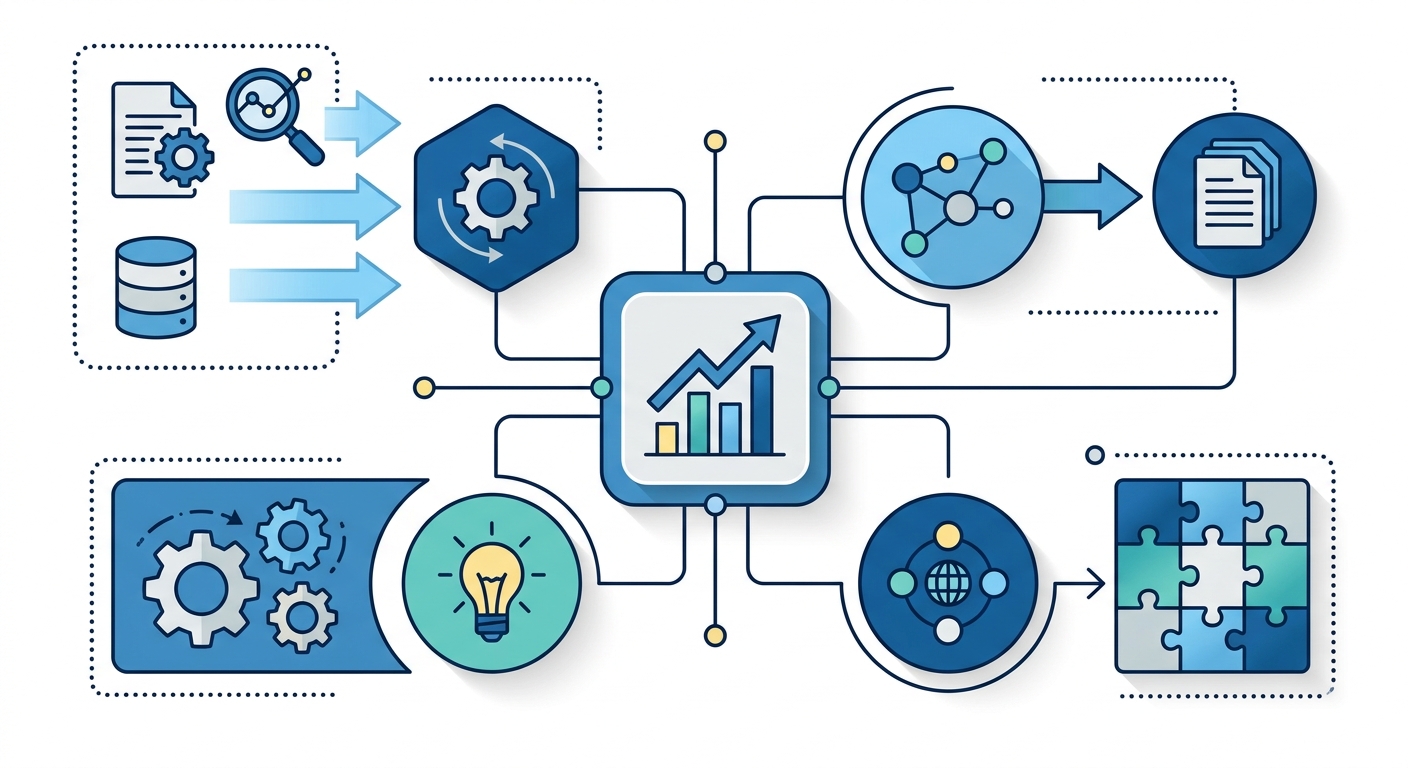 appear in your source, restore each one at its original position—none were present in the text supplied for review.