Diffusion Models Beyond Images: How Stable Architecture Is Entering Code, Audio, and Robotics
How diffusion models are moving beyond images into code generation, audio synthesis, and robotics AI, with Stable Diffusion-style ideas reshaping AI.
Introduction: The Quiet Revolution — Diffusion Models Escaping the Image Canvas
For a few years, diffusion models were treated as image machines. If you heard the term, you likely thought of photorealistic portraits, synthetic product shots, concept art, or text-to-image systems such as Stable Diffusion. That framing is now outdated.
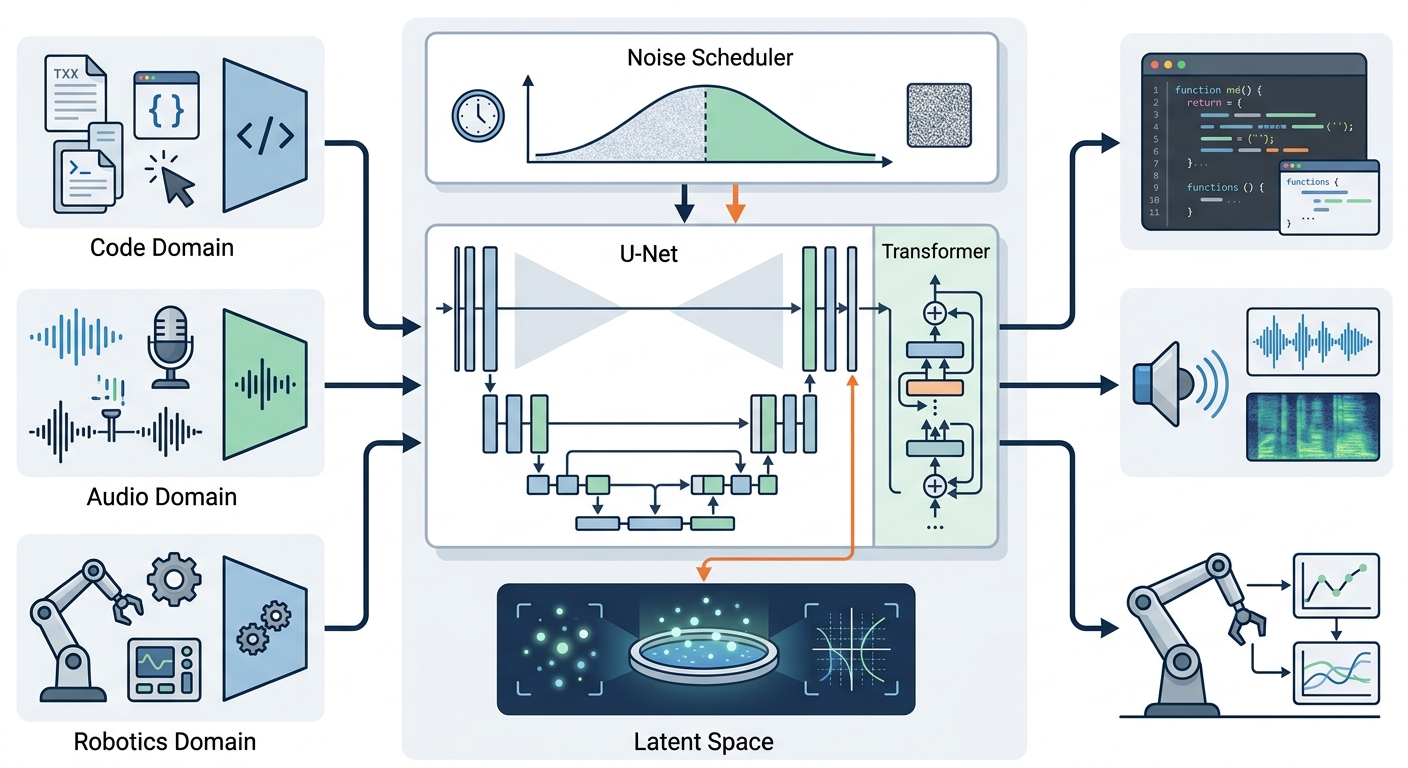
A quieter and arguably more consequential shift is underway: diffusion is becoming a general-purpose generative architecture. The same core idea that made image generation controllable and high quality—gradually denoising a corrupted representation back into a structured sample—is now showing up in code generation, audio synthesis, and robotics AI. In each of these domains, researchers are finding that diffusion does more than imitate existing autoregressive systems. It changes the shape of the problem.
In code, diffusion opens the door to parallel generation and iterative constraint repair rather than token-by-token commitment. In audio, it offers a path to higher-fidelity waveform and latent synthesis without inheriting all the brittleness of strictly sequential generation. In robotics, it provides a flexible way to model trajectories, policies, and action distributions that are inherently multimodal and uncertain.
What makes this transition notable is that it is not driven by metaphor. The architecture itself transfers. Noise schedules, score matching objectives, latent compression, and guidance mechanisms can be reinterpreted across modalities with surprisingly little conceptual strain. A denoiser trained on images becomes, in another setting, a denoiser over code tokens, spectrogram latents, or action trajectories.
That does not mean diffusion will replace transformers or autoregressive modeling everywhere. In practice, the emerging picture is hybrid. But if you work in AI, you should now think of diffusion not as an image specialty, but as a family of generative tools competing for a place in the broader foundation-model stack.
For more on image-era systems that set the stage, see our analysis of Stable Diffusion and Flux in 2026.
Diffusion Models in Code Generation: Beyond Autoregressive Dominance
Code generation has long been dominated by autoregressive language models. The logic is familiar: code is a sequence, so predict the next token. This approach works remarkably well, but it also inherits structural weaknesses. Once a model emits an early mistake, every later token is conditioned on that error. Long-range syntactic constraints, type consistency, and editing tasks can become awkward because the generation process is fundamentally one-way.
Diffusion models offer a different bias. Instead of committing to tokens left to right, a diffusion model can start from noise and iteratively refine an entire code sample or latent program representation. That matters because code is not just sequential text. It is a highly constrained object with nested structure, long-distance dependencies, and validity conditions that often benefit from global revision.
Stability AI’s Stable Code helped broaden interest in this direction, even as most production code models remained transformer-based. The significance was less about claiming diffusion had already won and more about legitimizing the idea that code synthesis could borrow from image-generation-style iterative refinement. Around the same time, diffusion-flavored approaches associated with DeepSeek-Coder research threads and related literature explored how denoising objectives could support code completion, infilling, and structured editing.
A particularly important line of work includes systems such as CDCD and UUIDiff, which investigate diffusion for discrete code-like sequences. The key technical challenge is obvious: code is discrete, while standard diffusion is naturally comfortable in continuous spaces. Researchers address this in several ways:
- Diffusing over latent continuous embeddings rather than raw tokens
- Using masked or replacement corruption processes tailored to discrete syntax
- Applying denoising objectives to tree-structured or graph-aware representations
- Combining diffusion with compiler or parser feedback
Why is this attractive for code?
Parallel generation
Autoregressive models generate one token at a time. Diffusion models can refine many positions simultaneously. For code completion, repair, and infilling, this means you are not forced into a strictly serial decoding path. In principle, large code blocks can be revised globally rather than appended incrementally.
Constraint satisfaction
Code quality is often less about local fluency and more about consistency:
- Matching brackets and indentation
- Maintaining variable scope
- Respecting function signatures
- Preserving imports and dependencies
- Satisfying tests and type checks
A diffusion process can repeatedly push a candidate program toward these constraints over multiple denoising steps. That iterative repair loop resembles how humans often code: draft, inspect, revise, and only then finalize.
Better support for editing and infilling
Real software development is not pure generation from scratch. You more often:
- Rewrite functions
- Fill missing implementation details
- Port code across frameworks
- Refactor while preserving behavior
Diffusion is naturally suited to partial conditioning. You can hold some regions fixed and denoise others, making it attractive for structured editing workflows.
That said, diffusion in code is still early. Benchmarks remain less mature than for language modeling, latency remains a practical obstacle, and syntax-valid generation is not enough if semantic correctness lags. But the conceptual fit is stronger than many expected. If code generation evolves from “next-token prediction” into “iterative program construction,” diffusion may become a serious architectural contender.
Diffusion Models for Audio Synthesis: From Music Generation to Speech Synthesis
Audio synthesis is one of the clearest domains where diffusion models have already proved they are more than a research curiosity. If you compare the current landscape to the era dominated by WaveNet-style autoregressive waveform synthesis, the shift is striking.
WaveNet demonstrated that sequential modeling could produce stunning audio fidelity, especially for speech. But it was computationally expensive and inherently slow because it generated one sample at a time. Later GPT-style and token-based models improved scalability by operating on compressed acoustic tokens, but they still carried the logic of autoregressive generation: each step depends on the previous one.
Diffusion changed the trade-off. Models such as Dance Diffusion showed that iterative denoising could generate long-form audio with compelling texture and continuity. AudioLDM pushed this further by leveraging latent diffusion for text-to-audio generation, mapping text prompts into compressed audio representations and then denoising in latent space. This substantially improved efficiency compared with operating directly on raw waveforms.
Stability AI’s Stable Audio brought the idea into a product-oriented context. It signaled that diffusion audio was becoming practical enough for commercial-grade music and sound generation, not just academic demos. At the same time, systems such as UniAudio explored unified generation across multiple audio tasks, including speech, music, and environmental sounds. SoundStorm, while not a pure diffusion model in the narrowest sense, is part of the same broader movement away from naive sample-by-sample generation toward faster parallel or semi-parallel synthesis over acoustic tokens.
Why does diffusion work so well for audio?
Audio is globally structured
Sound unfolds over time, but quality depends on more than local continuity. Good audio generation must preserve:
- Rhythm and meter
- Timbre consistency
- Harmonic relationships
- Long-range repetition and variation
- Natural prosody in speech
A denoising process can revise global structure over multiple steps, which is often preferable to irreversibly committing at each time step.
Latent audio spaces make diffusion efficient
Raw audio is extremely high dimensional. Direct waveform diffusion is possible, but expensive. The breakthrough came from operating in compressed latent spaces:
- Spectrogram latents
- Codec token embeddings
- Learned acoustic representations
This is analogous to latent diffusion in images. Once audio is compressed into a lower-dimensional semantic space, diffusion becomes significantly more tractable.
Text conditioning and controllability improve
For music and sound design, users care about control:
- Genre
- Instrumentation
- Mood
- Duration
- Tempo
- Scene description
Diffusion models often integrate conditioning cleanly through cross-attention and guidance, making prompt-based generation more controllable than earlier synthesis pipelines.
The speech side is equally important. Diffusion-based text-to-speech systems can produce more natural prosody and smoother acoustic detail than some traditional pipelines, especially when paired with strong vocoders or latent codecs. The iterative denoising process helps recover subtle waveform characteristics that matter for realism.
Still, trade-offs remain. Diffusion audio systems can be slower than highly optimized token decoders. Alignment between text prompts and generated sound remains weaker than text-to-image alignment. And evaluation is hard: unlike image generation, there is no single dominant benchmark culture for prompt fidelity, musical coherence, and production utility.
Even so, audio synthesis is probably the strongest evidence that diffusion has already escaped the image world in a durable way.
Diffusion Models in Robotics AI: Trajectory, Policy, and World Model Learning
Robotics AI may be the most intellectually exciting non-visual frontier for diffusion models because it reframes generation as decision-making. In this context, the model is not generating pixels or sound. It is generating action sequences, trajectories, policies, or predicted future states of the world.
That is a natural fit for diffusion because robot behavior is rarely unimodal. Given the same goal, there may be many valid ways to move an arm, grasp an object, or navigate around obstacles. Traditional policy learning methods often struggle with this multimodality. If you train a regressor to predict the “average” action, you can get unrealistic or unstable behavior. Diffusion models, by contrast, are good at representing complex multimodal distributions.
A landmark example is Diffusion Policy from Columbia and collaborators. The core idea is to represent robot action generation as iterative denoising in action space. Instead of predicting a single deterministic next action, the policy samples and refines candidate action sequences conditioned on observations and task goals. This approach has shown strong results across manipulation benchmarks, particularly where demonstrations admit multiple successful strategies.
Related systems such as RoboDiff, DDX, and 3D Diffusion Actor extend this logic into different robot learning settings:
- Trajectory generation in continuous control
- 3D-aware action planning for manipulation
- Denoising-based control conditioned on visual input
- Structured prediction over future motion and scene interaction
These approaches matter because robotics combines several hard problems at once:
- Partial observability
- Noisy sensors
- Delayed rewards
- Safety constraints
- Multimodal futures
- Limited real-world data
Diffusion is appealing here for both representational and optimization reasons.
Modeling multimodal action distributions
If a robot can grasp a cup from the left or the right, a good policy should preserve both possibilities until the context resolves them. Score-based models and diffusion-style policies handle this more naturally than simple regression or some VAE-style formulations.
Better trajectory quality than GANs and VAEs
Earlier generative approaches in robotics often used:
- VAEs, which can oversmooth trajectories
- GANs, which can be unstable to train and difficult to evaluate
Diffusion models tend to produce more stable training behavior and better sample diversity. On several robot learning benchmarks, denoising-based methods have outperformed prior generative baselines in trajectory realism, task success, or robustness under distribution shift.
Planning as denoising
One of the most compelling ideas is that planning itself can be formulated as iterative refinement. You can start with a noisy candidate trajectory and repeatedly denoise it under constraints from:
- Task goals
- Object geometry
- Collision avoidance
- Dynamics models
- Visual observations
This turns planning into a conditional generation problem rather than a handcrafted search procedure.
World model learning
The connection to foundation models for robotics is increasingly important. Large-scale efforts such as RT-X emphasize cross-robot, cross-task generalization using broad multimodal training corpora. While many of these systems are not purely diffusion-based, the future likely includes hybrid stacks in which:
- Transformers encode language and perception
- Diffusion models generate or refine action plans
- Learned world models simulate futures
- Policies are guided by uncertainty-aware denoising
This matters because real robots do not just need a next action. They need a plausible distribution over futures. Diffusion is good at modeling exactly that.
The obstacles are real. Sampling speed is an issue when decisions must be made in tight control loops. Sim-to-real transfer remains difficult. Robotics datasets are small relative to web-scale image or text corpora. But the empirical signal is strong: score-based models are becoming serious tools for policy learning and planning, not merely exotic alternatives.
For broader context on multimodal perception architectures, read our guide to vision transformers in modern AI systems.
Diffusion Models Under the Hood: Why Stable Diffusion Adapts to Any Modality
If diffusion models are spreading across code, audio, and robotics, the obvious question is why the architecture transfers so well. The answer is that diffusion is less tied to images than people initially assumed. Its core recipe is unusually modular.
At a high level, a diffusion model learns to reverse a corruption process. You take a structured sample, gradually add noise, and train a model to recover the original data or predict the noise that was added. At inference time, you start from noise and run the reverse process until a coherent sample emerges.
That recipe is abstract enough to fit many data types.
Noise prediction is a universal objective
The most transferable feature of diffusion is the learning objective itself. Predicting noise, or equivalently learning a score function over corrupted data, does not depend on whether the target is an image, a spectrogram, a code embedding, or an action trajectory. That is why score-based models travel so well across domains.
Representation matters more than modality labels
What changes across domains is not the diffusion recipe so much as the representation being denoised. Images may use pixels or latent visual embeddings. Audio may use spectrograms or codec latents. Code may use continuous token embeddings or structured latent programs. Robotics may use future action chunks or state trajectories.
This is also why latent diffusion matters so much. By moving denoising into compressed spaces, systems gain efficiency while preserving high-level semantics. The success of Stable Diffusion in images made this pattern legible, but the same principle now powers advances well beyond visual media.
Conditioning mechanisms transfer cleanly
Another reason diffusion adapts well is that conditioning is modular. You can guide denoising with:
- Text prompts
- Partial observations
- Fixed code context
- Sensor input
- Goal states
- Class labels
Cross-attention, classifier-free guidance, and related mechanisms can be reused with surprisingly little conceptual change. That makes diffusion attractive for multimodal systems that must combine language, perception, and structured outputs.
Hybrid stacks are likely to win
This does not point to a future where diffusion replaces transformers outright. More likely, the winning systems will be hybrid. Transformers remain excellent at sequence understanding, retrieval, and next-token modeling. Diffusion shines when generation benefits from iterative global revision, multimodal uncertainty, or controllable denoising.
In practice, that may mean:
- Transformers for reasoning and context encoding
- Diffusion models for structured generation
- Retrieval systems for grounding
- Verifiers or simulators for feedback
This hybrid pattern is already visible in production AI. It is especially relevant in agentic workflows, where planning, editing, and revision matter as much as raw generation. See our breakdown of AI agents in production environments.
FAQ: Diffusion Models Beyond Images
What are diffusion models good at beyond image generation?
Diffusion models are increasingly useful for code generation, audio synthesis, and robotics AI. In these areas, they support iterative refinement, multimodal outputs, and better handling of global constraints than strictly autoregressive systems.
Why are diffusion models promising for code generation?
They can refine many parts of a program at once instead of generating tokens strictly left to right. That makes them attractive for code completion, infilling, editing, and constraint-heavy software tasks where global consistency matters.
How does latent diffusion help audio synthesis?
Latent diffusion compresses raw audio into a lower-dimensional representation before denoising. This reduces computational cost while preserving meaningful structure, making text-to-audio and speech systems more practical.
What is Diffusion Policy in robotics AI?
Diffusion Policy is a robotics approach that models action generation as iterative denoising in action space. Instead of predicting one fixed next action, it refines candidate action sequences conditioned on observations and goals, which helps with multimodal decision-making.
Conclusion: Diffusion Models Are Becoming a General Generative Primitive
The old mental model is no longer enough. Diffusion models are not just image generators, and they are not merely extensions of Stable Diffusion into adjacent media categories. They are emerging as a broader generative primitive—one that fits especially well when the output space is structured, uncertain, and best improved through iteration rather than one-shot prediction.
In code generation, that means global revision and constraint repair. In audio synthesis, it means high-fidelity generation in compressed latent spaces. In robotics AI, it means modeling trajectories and policies as multimodal objects that can be denoised toward success. Across all three, the same pattern holds: diffusion changes not only what models generate, but how they generate it.
That does not guarantee architectural dominance. Latency, evaluation, and system complexity remain real constraints. But the direction is clear. As AI systems become more multimodal, more agentic, and more grounded in action, diffusion is moving from image specialty to infrastructure.