Sparse Attention in 2026: Which Efficient Variants Actually Hold Up at Scale
Which sparse attention variants actually hold up at scale in 2026? We compare block-sparse, sliding-window, and native sparse attention across four axes.
Long Context Is Now a Product Requirement
Two years ago, a million-token context window was a demo. In 2026, it increasingly shows up in procurement documents. Teams building document analysis, codebase reasoning, agentic workflows, and long-horizon chat all assume context windows in the 128K–1M+ range, and they expect them to be fast and affordable.
That shift has moved sparse attention from a research curiosity to an architecture decision. The problem is arithmetic: dense attention's prefill compute scales quadratically with sequence length, and at production context lengths that quadratic term dominates prefill cost. Decode is a different story — per-token attention is linear in context length, but it's memory-bandwidth-bound on the KV cache, and that linear read is what makes long-context serving expensive token-by-token. The solution — attend to fewer things — is easy to state and hard to deploy. Dozens of sparse attention variants look excellent on benchmarks. Far fewer survive contact with real batch sizes, real kernels, and real quality bars.
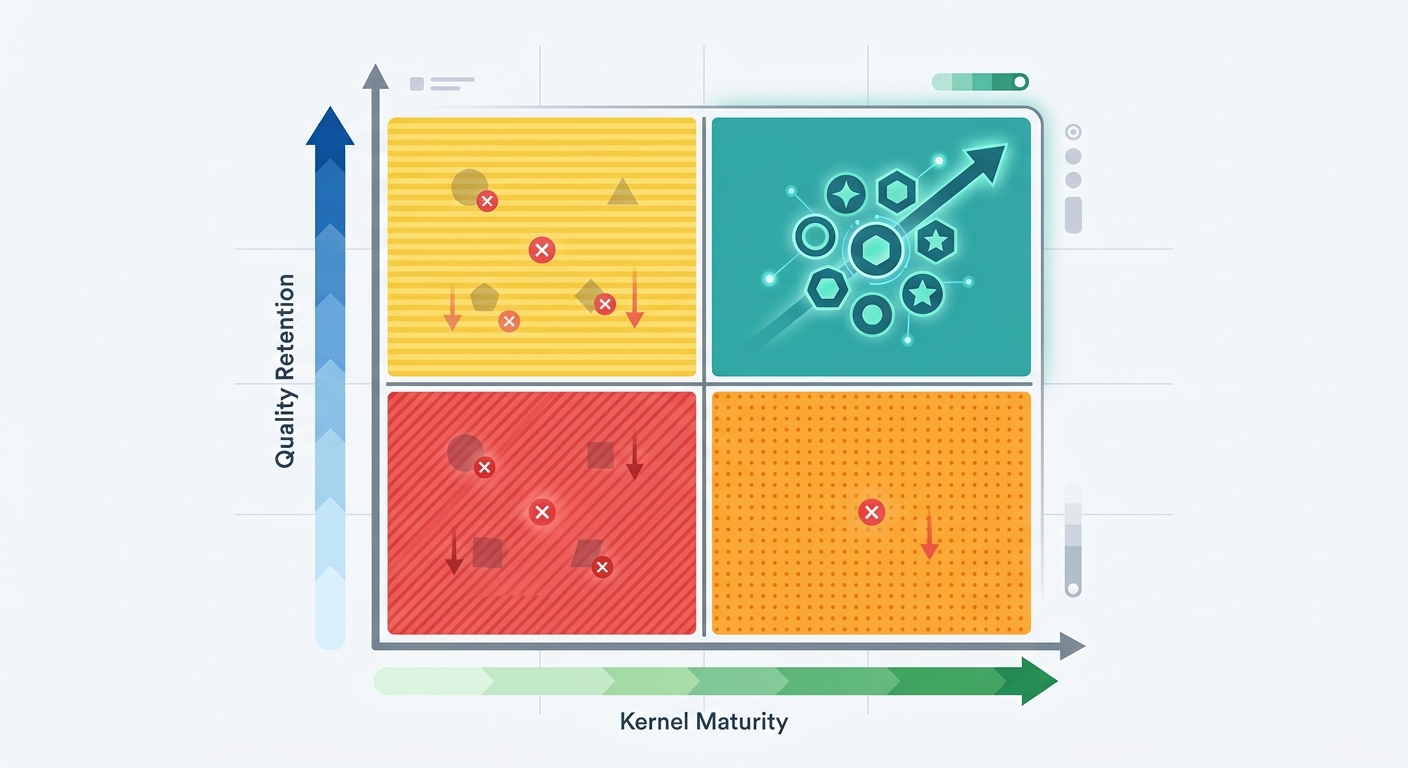
This article evaluates the major sparse attention families against four axes — quality retention, throughput and memory at production batch sizes, kernel maturity, and ecosystem support — and separates the variants that hold up at scale from the ones that only hold up in papers.
Why Sparse Attention Matters More Than Ever in 2026
The Economics of Long Context
Dense attention's cost curve is unforgiving, but it has two distinct shapes that teams routinely conflate:
- Prefill (prompt processing): attention compute scales quadratically with sequence length. At 128K tokens, attention is a meaningful fraction of prefill cost; at 1M tokens, it can dominate prefill time and FLOPs.
- Decode (token generation): per-step attention work is linear in context length, but each step must read the KV cache, so long-context decode is bound by memory bandwidth, not raw FLOPs. This is why KV-cache size and layout matter as much as attention math.
For teams serving long-context requests at scale, both terms are the difference between a viable product margin and a money-losing feature. (See our breakdown of [KV-cache optimization techniques] for the memory side of the same problem.)
Sparse attention attacks the compute term directly: instead of every token attending to every other token, each token attends to a structured or learned subset. Done well, this cuts attention compute by an order of magnitude or more. It does not, by itself, shrink the KV cache — every token's keys and values are still stored and read in most sparse implementations. Cache reduction comes from a separate set of mechanisms (windowed cache eviction, KV retrieval, or compression) that are often paired with sparsity but should not be conflated with it. Done poorly, sparsity silently degrades reasoning on exactly the long-context tasks customers care about.
What "Holding Up at Scale" Actually Means
Benchmark wins are necessary but not sufficient. A sparse attention variant holds up at scale when it clears four bars simultaneously:
- Quality retention on real long-context tasks — retrieval, multi-hop reasoning, summarization — not just perplexity on a synthetic set.
- Throughput and memory at production batch sizes, where kernel efficiency and KV-cache behavior matter more than FLOP counts.
- Kernel maturity — FlashAttention-class implementations, compiler and framework support, and the ability to run on the accelerators you actually own.
- Ecosystem support — integration with serving stacks, quantization tooling, and the ability to fine-tune without retraining from scratch.
A sparse variant with no production-grade kernel isn't an architecture choice. It's a research artifact with a marketing page.
The Evaluation Framework: How We Judge Each Variant
The four axes below are worth reusing in your own evaluations. The key discipline: a variant that fails any single axis is effectively disqualified, regardless of how it scores on the others. (For a broader view, see our guide to [evaluating LLM inference performance].)
Quality Retention at Long Context
Measure degradation, not raw scores. Compare each variant against a dense baseline on tasks that require genuine long-range dependency — needle-in-a-haystack is table stakes; multi-document synthesis and long-codebase reasoning separate the real from the fragile. Watch for quality that holds at 32K but collapses at 256K, and test retrieval at the far end of the context, not just the middle (the "lost in the middle" effect persists even with sparse patterns that were supposed to fix it).
Throughput and Memory at Production Batch Sizes
Benchmarks often report single-sequence latency. Production runs batched. A variant that shines at batch size 1 can fall apart at batch size 32 due to irregular memory access, poor cache utilization, or KV-cache layouts that defeat paged attention. Measure tokens-per-second and peak memory at the batch sizes your serving stack actually uses — and measure prefill and decode separately, because they stress different bottlenecks.
Kernel and Ecosystem Maturity
This is where most variants die. If there's no fused, well-tuned kernel — ideally integrated into the major serving frameworks and compatible with quantization — the theoretical efficiency never materializes. The mechanics matter: fused attention kernels and paged/virtual KV-cache layouts assume dense, contiguous access. Block-structured patterns can reuse these kernels almost unchanged; arbitrary or learned sparsity usually cannot without a custom kernel, which is why block-sparse variants punch above their weight in production. One more interaction to check: most 2026 production models use grouped-query attention (GQA) or multi-query attention, and sparse patterns must be validated against shared-KV-head layouts, not just full multi-head attention.
Ecosystem maturity also covers the adoption constraint most articles skip: sparsity patterns are typically baked in at pretraining time. You generally cannot bolt a new pattern onto a dense pretrained model and recover quality without continued pretraining. For each variant below, we flag whether it's adoptable at fine-tuning time or requires training from scratch.
Variant-by-Variant Assessment
Block-Sparse and Structured Sparsity
Mechanism: Attention is restricted to a fixed pattern of blocks — local blocks, strided blocks, or a combination — so computation maps cleanly onto hardware-friendly tiles.
Verdict: The strongest all-around performer on the maturity axis. Structured patterns align with GPU memory hierarchies and paged-KV layouts, so they reuse existing fused kernels with minimal custom work. Quality tradeoffs are real but manageable when the sparsity pattern is chosen to match the workload rather than fixed arbitrarily. The main risk is pattern rigidity: a static pattern can miss the long-range dependencies a specific task needs. Adoption: pattern is set at pretraining; some continued-pretraining recipes adapt a dense model to a structured pattern, but expect a real quality-recovery cost.
Sliding-Window and Local Attention Hybrids
Mechanism: Each token attends to a fixed window of neighbors, sometimes with a few global tokens or periodic full-attention layers to preserve long-range signal.
Verdict: The most widely deployed family and the safest quality floor. Sliding-window hybrids are battle-tested in shipped production models and have excellent kernel and framework support; windowed attention also enables genuine KV-cache eviction, so this is one of the few families that reduces both compute and cache footprint. Their limitation is genuine: local attention has limited true long-range recall, and global-token patches help but don't fully close the gap. Excellent for streaming, chat, and latency-sensitive workloads; weaker for tasks that hinge on retrieving a specific fact from deep in a long context. Adoption: the most fine-tune-friendly family — you can often add or widen a window with limited continued training.
Learned and Dynamic Sparsity
Mechanism: The model learns which tokens or blocks to attend to per input (content-based routing, top-k selection, or gating), rather than following a fixed pattern.
Verdict: The highest ceiling and the lowest floor. Dynamic patterns can, in principle, capture exactly the long-range dependencies a task needs, which is why they post strong quality numbers in papers. In production they are the hardest to serve: irregular, input-dependent memory access defeats fused kernels, batch-level utilization drops because different sequences attend to different blocks, and the routing overhead can eat the compute savings. Adoption: pretraining-only in practice. Treat published quality gains with skepticism until you can reproduce them at your batch sizes.
Native Sparse Attention (Hardware-Aligned, Trainable)
Mechanism: Recent designs (the DeepSeek-style "native sparse attention" line) build a trainable, hardware-aligned sparse pattern into pretraining — typically combining a compressed/coarse attention path with a fine-grained selected path and a sliding window, with the selection learned end-to-end.
Verdict: The most credible "sparse by design" family in 2026. Because the pattern is trainable and deliberately block-aligned, it retains more quality than fixed patterns while staying kernel-friendly. The catch is adoption cost: it's a pretraining-time architecture, so it's a reason to pick a model, not a retrofit for one you already have. Ecosystem support is improving but thinner than sliding-window or block-sparse. Adoption: pretraining-only.
Hybrid Linear-Attention and State-Space Approaches
Mechanism: Interleave or replace attention layers with linear-attention or state-space (SSM) layers that process long sequences in linear time, often keeping a small number of full-attention layers for precise recall.
Verdict: The most important adjacent family, and arguably the real long-context winner for many workloads. These hybrids sidestep the quadratic term entirely rather than sparsifying it, and several have shipped in production models. Quality on pure retrieval can trail full attention, which is why the best designs keep some dense layers. If your workload is throughput-dominated long-context generation rather than exact retrieval, evaluate these against sparse attention rather than assuming sparse attention is the answer. Adoption: pretraining-only.
How to Choose: A Practical Decision Table
| Your situation | Start here | Why |
|---|---|---|
| Adopting an existing open model, want long context cheaply | Sliding-window hybrid or hybrid linear/SSM model | Best kernel + ecosystem support; fine-tune-friendly |
| Training from scratch, retrieval-heavy workload | Native sparse attention or block-sparse | Trainable, kernel-aligned, strong long-range recall |
| Throughput-dominated long generation | Hybrid linear/SSM | Removes the quadratic term rather than thinning it |
| Need to retrofit a dense pretrained model | Sliding-window (limited) — expect continued-pretraining cost | Only family that tolerates late adoption |
| Research/experimentation | Learned/dynamic sparsity | Highest ceiling, but budget for custom kernels |
What We'd Actually Deploy in 2026
For most teams, the honest answer is not to hand-roll sparse attention at all. Pick a model whose architecture already made the choice — a sliding-window hybrid, a native-sparse model, or a linear/SSM hybrid — and spend your engineering effort on the parts that actually move your margin: KV-cache management, quantization, batching, and prefill/decode disaggregation. Sparse attention is an architecture decision with a multi-month lead time; treat it like one.
The variants that hold up at scale share three traits: block-aligned patterns that reuse mature kernels, quality validated at the far end of long contexts, and an adoption path you can actually execute — usually pretraining, occasionally fine-tuning. Everything else is a paper with a benchmark chart. Choose accordingly.