From Data Lakes to Decision Engines: Reinventing Enterprise Data Science for the LLM Era
Data lakes store data, but they don't drive decisions. See how semantic layers, lakehouses, and governed AI agents turn raw enterprise data into automated, auditable action.
Most teams built a data lake to hold everything. It worked. Raw data landed in one place, and analysts could query it. Yet the real problem never went away. Someone still had to decide what the data meant, write the right query, and translate the answer into action. In 2026, large language models change this relationship. The lake becomes a foundation, not a finish line. The goal shifts to a decision engine — a system that turns governed data into automated, trustworthy actions.
Why Data Lakes Stopped Being Enough
Data lakes solve storage, but they lack decision governance. They centralize files, but they do not define what a metric means or who is allowed to see it. Every analyst re-derives the same business logic, and every report carries the risk of being slightly wrong.
Industry experience points to a blunt truth: a large share of enterprise AI failures trace back to data issues rather than model limits. Estimates put that share between 70% and 85%. The model is rarely the weak link. The mess beneath it is. When definitions live in people's heads, LLMs have nothing reliable to reason over.
The core shift in 2026 — the bottleneck moved from storing data to making it trustworthy enough for an LLM to act on.
The result is what practitioners call the "data quagmire": rich in raw data, poor in usable insight.
The Difference Between Storing Data and Acting on It
Storage is a noun. Decisions are a verb. A dashboard reports what happened last quarter. A decision engine converts data into governed, automated actions. The gap between the two is where most analytics budgets quietly disappear.
Anatomy of a Decision Engine
A decision engine is not a single tool. It is a layered architecture that moves data from source to action with governance and context intact. Think of it as five connected layers.
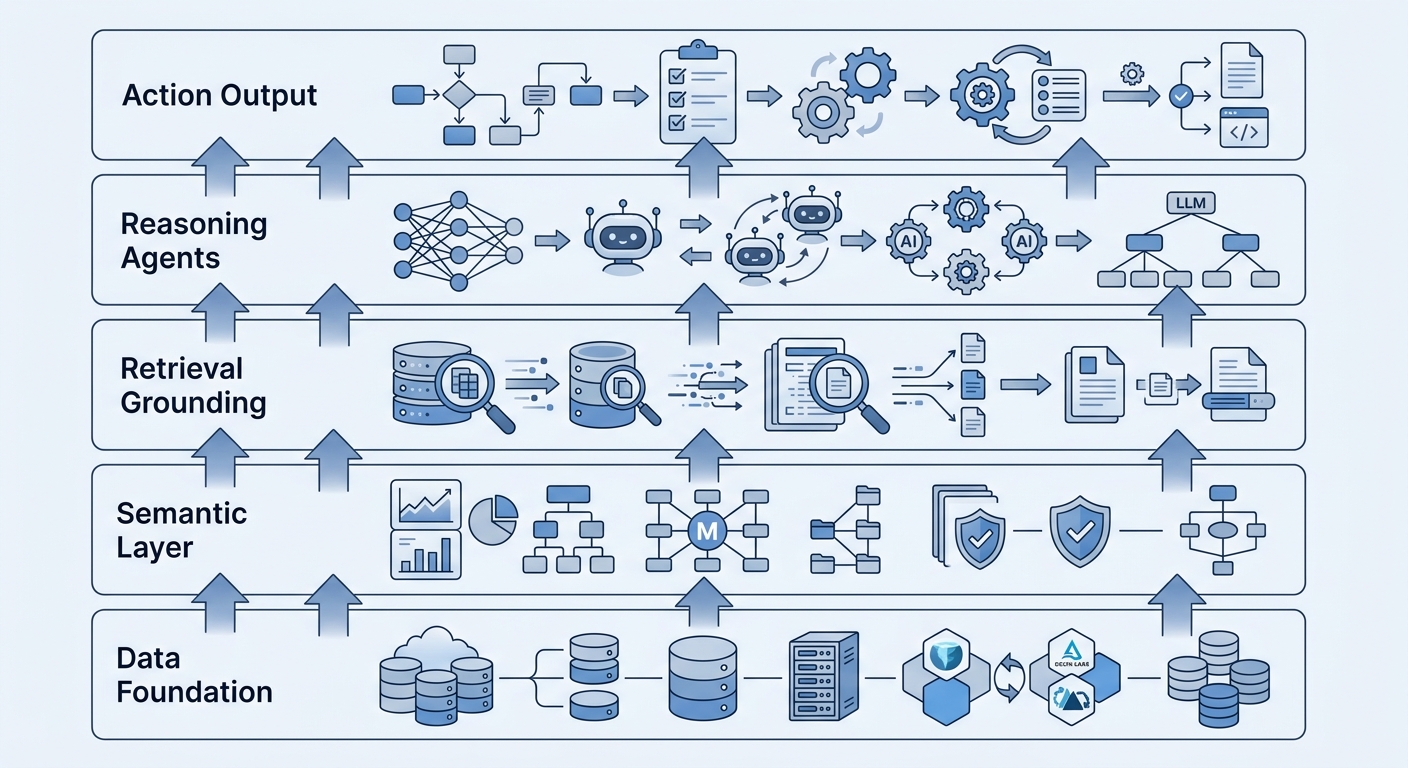
The first layer is the data foundation. A lakehouse stores structured and unstructured data in open table formats. It becomes the single home for AI-ready data. Above it sits the semantic layer. This defines metrics, dimensions, and access rules once. Next comes retrieval grounding, which uses retrieval-augmented generation (RAG) to keep LLM answers tied to real data instead of memorized guesses.
The reasoning layer follows. Here, agents orchestrate multi-step queries and actions across systems. Finally, the output layer embeds results into operational workflows, alerts, or downstream applications.
Each layer depends on the one below it. Skimp on the semantic layer, and everything above degrades.
The Semantic Layer: The Missing Translator
The semantic layer is the quiet hero of reliable AI analytics. Semantic layers define metrics once so that LLM queries stay accurate. It defines a metric like "revenue" once, so every query means the same thing. This sounds simple. In practice, it is what separates a trustworthy system from a flashy demo.
This is where text-to-SQL gets its reliability. Modern LLMs can write SQL well. The problem is not syntax. The problem is context. A raw prompt like "show revenue by region" has no agreed definition of revenue, region boundaries, or time zone. The semantic layer supplies that context, and the query comes out right.
Access policy also lives here. Rules are enforced before execution, so the model never sees data it is not allowed to use. This protects sensitive fields without slowing down legitimate analysis.
Why this matters for ROI — a governed semantic layer converts AI analytics from a novelty into a repeatable, auditable capability.
Text-to-SQL Without a Semantic Layer Is a Trap
The temptation is to skip straight to natural language queries. Raw text-to-SQL fails without business context and validation. It fails in predictable ways. Schema drift changes column names and breaks naive prompts. Ambiguous terms — "active user," "net revenue" — produce inconsistent answers. Without grounded context, models also risk inventing plausible-looking output.
Production systems pair the model with the semantic layer. It is the difference between a prototype and a decision surface you can defend in a review board.
Lakehouse vs Warehouse: Picking the AI-Ready Foundation
You do not need to tear out your warehouse to start. By 2026, most enterprises run a mix. The choice depends on the workload.
Lakehouse architectures serve as the AI-ready data foundation. Open table formats like Iceberg, Delta Lake, and Hudi handle structured and unstructured data together. A large share of enterprises — estimates suggest over 60% of large organizations — are adopting lakehouse architectures to support AI workloads.
Warehouses still win for governed, predictable reporting. Financial statements and fixed regulatory reports want consistency above all. Hybrid is the sensible default rather than a compromise.
From Report Factories to Decision Ownership
Generative BI changes who does what. Natural language questions replace repetitive ad-hoc queries. Analysts stop being report factories. Data scientists move up the value stack, into modeling, evaluation, and product work.
Generative BI frees analysts from repetitive ad-hoc reporting. This is a talent unlock, not a headcount cut. The scarce, expensive people in your data team start working on the hard problems. The robot handles the routine pulls.
The talent shift in practice — freed from ad-hoc reporting, data scientists focus on feature engineering, model reliability, and business-facing judgment.
Governance for AI Agents: Trust Before Autonomy
Agents are moving from support tools to operational participants. Industry forecasts put the inflection point close: a major analyst firm projects that half of business decisions will be augmented or automated by AI agents by 2027. That makes governance non-negotiable, not optional.
AI agents execute decisions when governed and auditable. Policy must be enforced before an agent acts. Personal data across retrieval and inference paths needs explicit protection. Every decision path needs an audit trail. You should be able to trace any automated decision back to its data and logic.
Measuring ROI of a Decision Engine
Numbers make the case. Measure the baseline before you build, then track the delta.
Start with decision latency. A report that took days now resolves in minutes. Count analyst hours saved per quarter, since those are direct labor savings. Track error and rework reduction, because wrong reports have quiet costs. Zero-copy architecture queries data at source to cut cloud egress costs and removes duplication.
The composite story is strong: faster decisions, cheaper infrastructure, and a workforce pointed at high-value work.
A 90-Day Pilot Roadmap
A decision engine does not arrive as a big-bang platform. It lands as a focused pilot.
Pick one high-value, low-risk decision domain. Pricing, churn risk, or inventory are good starters. Define the metrics and governance in the semantic layer first. Then deploy a retrieval-grounded LLM query path on top. Measure the baseline against the new flow. Only after the pilot is trusted do you scale domain by domain.
This sequence keeps risk small and proof concrete. It also builds internal confidence, which matters more than any architecture diagram.
The Lake Is a Foundation, Not a Finish Line
The modern data lake was a necessary upgrade. It is not the destination. In the LLM era, the winning organizations are the ones that add definition, governance, and action on top of their storage. A decision engine turns raw data into a competitive advantage — predictable, auditable, and fast.
Want more practical guidance on data science, AI agents, and architecture for the LLM era? Subscribe to Algorithmine for implementation-focused articles that skip the hype and get to what works.
Expert Q&A
Q: What is the single biggest mistake teams make moving to LLM-powered analytics? A: Jumping straight to natural-language querying over raw tables. Without a semantic layer, definitions are ambiguous and answers are inconsistent. Define your metrics and governance first, then add the LLM on top.
Q: Do we need to abandon our data warehouse for a lakehouse? A: No. Run hybrid. Keep the warehouse for fixed, governed reporting, and add a lakehouse for AI and exploratory workloads. The decision engine does not care which physical store you use as long as the semantic layer supplies consistent context.
Q: How do we keep automated decisions safe and defensible? A: Enforce access policy before the agent acts, protect PII across retrieval and inference, and keep an audit trail for every decision path. Trust is earned through governance and traceability, not through the model alone.
Q: How long until we see real ROI? A: A focused 90-day pilot on one high-value, low-risk decision domain usually shows measurable gains in decision latency and analyst hours saved. Scale only after that pilot is trusted.