Data-First Agentic AI: How Modern Data Pipelines Become the Moats for Enterprise AI Agents
A 2026 expert guide to data-first agentic AI: how data flywheels, context engineering, and the four-pillar agent-ready data stack turn proprietary data into a durable enterprise moat.
The conversation about enterprise AI has quietly flipped. For years, teams chased the best model. They benchmarked, fine-tuned, and swapped providers to win a few points of accuracy. That mindset made sense when model quality was the bottleneck. It no longer is.
In 2026, frontier models have effectively converged. They are fast, cheap to call, and broadly capable. What still separates one enterprise deployment from another is not the model. It is the data and context layered beneath it.
This article explains why data-first agentic AI is becoming the defining strategy of the decade. You will learn how modern data pipelines — not model checkpoints — become durable moats. You will get a reference architecture, a readiness roadmap, and the ROI math to defend the investment.
Why Agents Fail on Bad Data — and Why Good Data Is the Real Moat
Here is the uncomfortable truth most pilot stories leave out. Your agent is only as good as the context it can retrieve. When that context is stale, scattered, or wrong, the agent fails. And because agents act autonomously, those failures do not just produce a bad answer. They produce a bad action.
Think about a support agent resolving a refund. It needs the policy, the customer history, and the order record. If any of those live in a silo, or carry conflicting definitions, the agent guesses. A human might notice the guess. An enterprise agent often does not, especially when its task runs at scale.
This is the core of the data moat argument. Competitors can license the same model tomorrow. They cannot license your years of proprietary data, your curated knowledge, your feedback loops. That asymmetry is what makes data the real differentiator.
Key insight — When models reach parity, the only defensible edge is the data-plus-context layer that feeds them. Every dollar spent on clean, governed, agent-ready data compounds; every dollar spent chasing benchmark points does not.
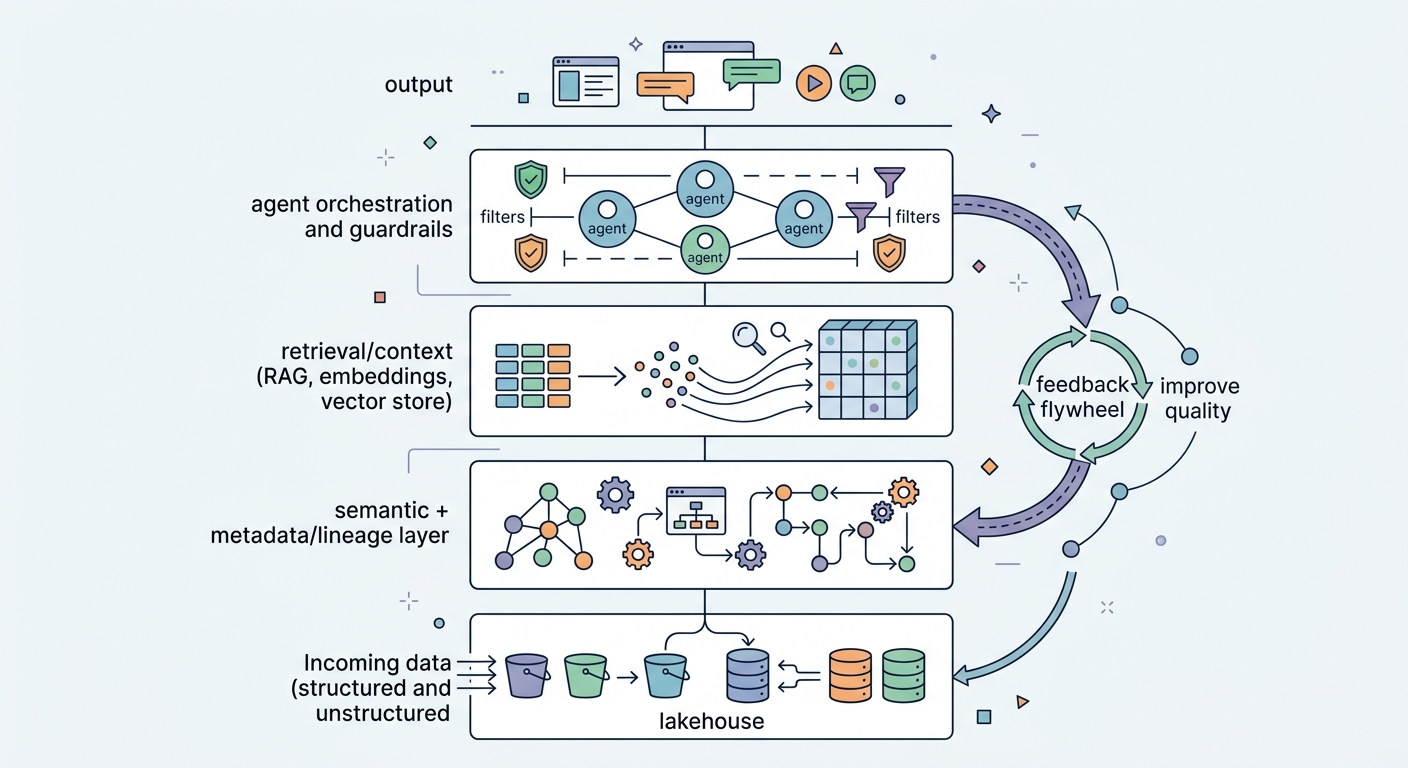
The mechanism that turns this into a moat is the data flywheel. It works like this: your agents act on good data, producing useful outcomes. Those outcomes generate feedback and new records. That feedback improves your data. Better data makes your agents better. Better agents produce more outcomes. The loop compounds, and competitors start from scratch.
From Model-First to Data-First: What Actually Changed
For most of the past few years, enterprise AI was model-first. Teams picked the biggest model they could afford. They built elaborate prompts. They measured success by benchmark scores and token accuracy. The model was the product.
Data-first inverts that. The model becomes a replaceable commodity. The durable investment is the data infrastructure that supplies context, keeps definitions consistent, and logs provenance. Success is measured by how well the agent performs on your data, not on a public benchmark.
The shift is more than philosophical. It changes budgets, teams, and ownership:
- Budgets move from model API spend toward data engineering, retrieval, and governance.
- Ownership moves from a central "AI team" toward data engineers who build agent-ready pipelines.
- Timelines relax from "ship a model" to "build a compounding data asset."
Consider a concrete case. A logistics company deploys an order-adjustment agent. The model is standard. What makes the agent reliable is the unified product catalog, the consistent pricing definitions, and the real-time inventory feed. A competitor with a slightly better model, but messy data, ships a worse agent. The model did not matter. The data did.
That example repeats across industries. Scoring, claims, forecasting, onboarding — the pattern is identical. High-quality, governed data beats a marginally smarter model every time.
The Four Pillars of an Agent-Ready Data Stack
To move from model-first to data-first, you need an architecture built for agents. In practice that stack rests on four pillars. Each one maps to a specific capability your agents depend on.
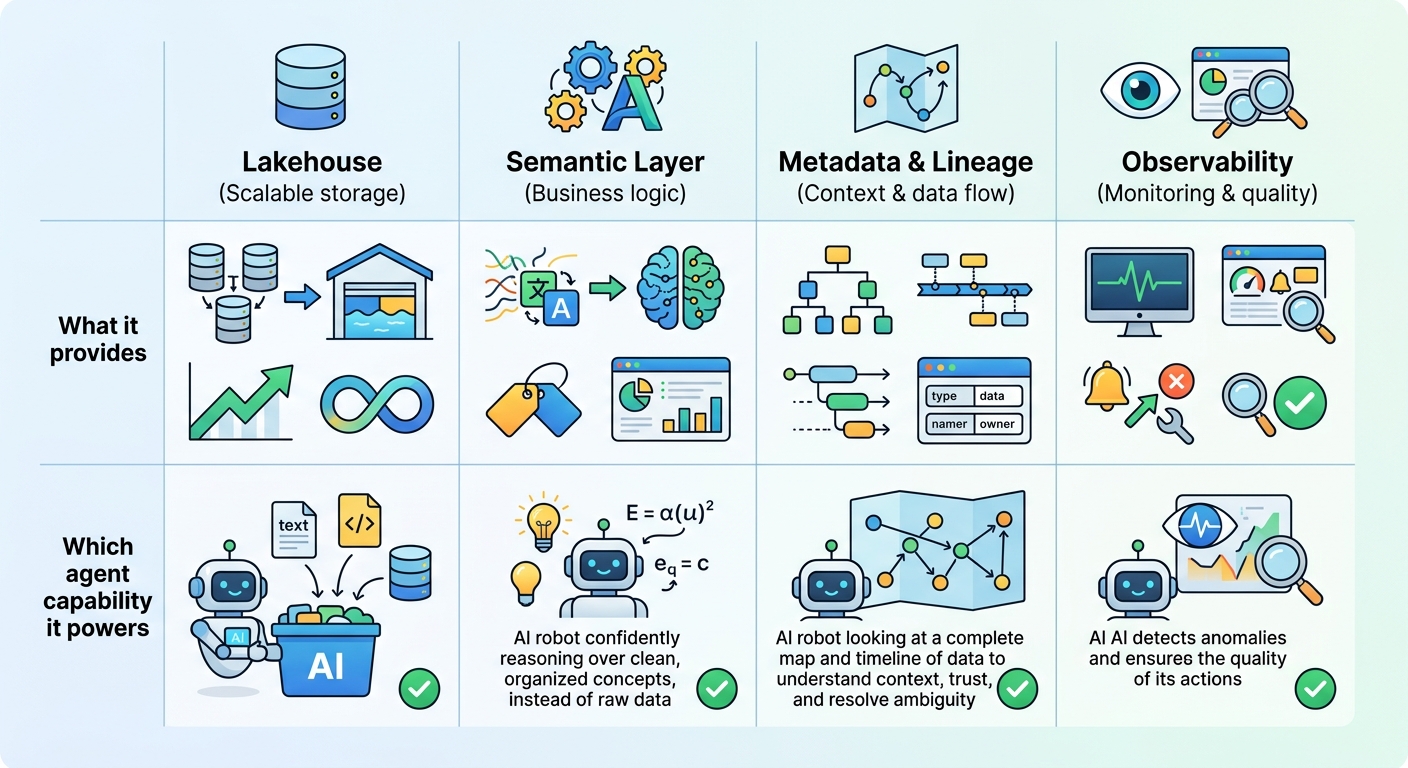
Pillar 1 — Lakehouse: unified, governed storage. A lakehouse combines the scale of a data lake with the management of a warehouse. It gives agents one governed home for structured and unstructured data. That single source of truth removes the silos that break retrieval.
Pillar 2 — Semantic layer: consistent business definitions. Agents reason over numbers. If "revenue" means one thing in sales and another in finance, an agent resolves the conflict by guessing. A semantic layer (sometimes called a metrics layer) stores canonical definitions so every agent reasons with the same vocabulary.
Pillar 3 — Metadata and lineage: provenance and trust. Metadata describes your data — when it was created, who owns it, how it was transformed. Lineage traces its path end to end. Together they let you debug a wrong agent output, prove compliance, and answer "where did this number come from?"
Pillar 4 — Observability: freshness, drift, and anomalies. Data observability continuously monitors the pipeline. It flags stale tables, schema drift, and anomalies before an agent consumes bad data. For autonomous systems, catching drift early is not nice-to-have. It is the difference between a bad answer and a bad action.
The map from pillar to capability is worth making explicit:
| Pillar | What it provides | Agent capability it powers |
|---|---|---|
| Lakehouse | Unified, governed storage | Grounded retrieval across silos |
| Semantic layer | Canonical business definitions | Consistent reasoning over metrics |
| Metadata & lineage | Provenance and trust | Debugging and compliance |
| Observability | Freshness and drift detection | Reliable real-time actions |
Notice what holds this together. Every pillar makes the agent trustworthy enough to act. That trust is the real product.
Context Engineering for Autonomous Agents
Raw data in a lakehouse does nothing by itself. Agents need it delivered as high-quality context at the moment of reasoning. This is where context engineering comes in.
Context engineering is the deliberate design of everything you feed the model: retrieved documents, tool outputs, memory, and governance rules. It goes beyond prompt engineering, which only tunes the instructions. Context engineering tunes the entire information flow.
For autonomous agents, the retrieval layer is where this gets interesting. Static RAG (retrieval-augmented generation) pulls a few top documents and stuffs them into the prompt. Agentic RAG is smarter. The agent refines its own query, retrieves from multiple sources, and chains steps together. It decides what context it still needs and goes and fetches it.
Two more pieces matter for autonomy:
- Memory — stores what the agent learned and decided across a session, so it does not re-derive everything.
- Tool use — lets the agent call internal systems (order systems, CRMs, databases) to get live data and act on it.
Ground all of that in your four pillars, and you get an agent that reasons over current, consistent, governed data. Skip any piece, and reliability drops.
Key insight — Prompt engineering tunes instructions. Context engineering tunes the entire information flow. For autonomous agents, the second is what separates demos from production.
Agentic Data Engineering: Building Pipelines Agents Can Actually Use
Delivering that context reliably requires pipelines designed for agents, not just for dashboards. Agentic data engineering is the discipline of building and operating data pipelines whose outputs are directly consumable by autonomous agents.
Traditional pipelines optimize for human-readable business intelligence. They produce polished tables for dashboards and reports. Agents need something different: machine-readable, semantically rich, and ready for retrieval. That means shifting outputs from "a clean table" to "the right embedding, with the right context, at the right time."
Practically, agentic data engineering means:
- Embedding-ready outputs — data transformed into vectors for semantic search and RAG, not just relational rows.
- Semantic schemas — outputs annotated with meaning, so agents interpret values correctly.
- Retrieval surfaces — dedicated indexes and vector stores built for how agents query, not how analysts filter.
- Self-healing operations — pipelines that flag anomalies and, increasingly, autonomously remediate them under human supervision.
There is a pleasant symmetry here. As agents get better at reasoning, they can operate the pipelines that feed them. An agent can monitor a pipeline, detect a schema drift, and open a fix for a human to approve. The data teams that embrace this pattern become force multipliers instead of bottlenecks.
The bottom line is that your pipelines are a product, and autonomous agents are demanding customers. Engineer them with that expectation, and the rest of the stack works as designed.
Data Quality as the Agent's Hard Limit
There is a ceiling on agent performance, and it is not the model. It is data quality. An agent cannot reason its way around missing, duplicate, or stale records. It can only reason with what it is given.
The stakes are higher for agents than for human analysts, for one reason: autonomy compounds errors. A human who misreads a stale number might pause and ask. An agent executes, and then its decision feeds back into the system. One bad action becomes the input to the next. Failures multiply.
The quality dimensions you must watch:
- Freshness — is the data current enough for the decision?
- Completeness — are key fields present?
- Schema drift — did a source change structure without telling you?
- Duplicates — is the same entity counted multiple times?
- Lineage gaps — can you trace the value to its origin?
Each one quietly degrades agents. Stale pricing causes bad quotes. Duplicated customers cause double-counted metrics. Missing fields cause guarded, low-confidence actions.
The fix is not a one-time cleanup. It is continuous. Agents need data quality monitoring built into the pipeline, with the same seriousness as uptime monitoring. You detect a regression, you catch it before it reaches an agent, and you trace it to the source.
Here is the compounding risk, and why it deserves board-level attention. Every agent action is a learning opportunity. When your flywheel is healthy, good actions improve your data. When your flywheel is poisoned by bad data, bad actions get recorded as "experience" and make the asset worse. Quality is not a hygiene task. It is the input that keeps the moat growing instead of eroding.
Governance, Guardrails, and the Human-in-the-Loop
Autonomy without control is a liability. Enterprise buyers will not hand an agent the keys unless there are guardrails. And in a data-first world, the most powerful guardrails are data-level, not model-level.
Deterministic guardrails define hard rules an agent cannot break. "Never approve a refund above $500 without a manager." "Never change a price outside this range." These are enforced at the orchestration layer, so the model cannot talk its way past them.
Alongside guardrails, you need approval gates. For high-impact actions, the agent prepares the decision, and a human confirms. This is the human-in-the-loop pattern. It keeps autonomy on low-risk steps while preserving control on the ones that matter.
Where does data come in? Two ways.
First, data lineage gives you auditability. When a regulator or an executive asks why an agent acted a certain way, you can trace the decision to the exact data it used. That evidence is what makes autonomous operation defensible in regulated industries.
Second, governed data keeps agents in bounds. An agent that draws only from approved, lineage-tracked sources cannot wander into unvetted or out-of-policy data. Governance becomes a form of control that models alone cannot provide.
Key insight — The most durable guardrails are data-level, not model-level. Governed, lineage-tracked data constrains an agent's information space, which is a stronger control than any prompt instruction.
From Pilot to Production: A Data-Readiness Roadmap
In my work with enterprise teams, most agent projects die between pilot and production. The model works on a curated demo set, then collapses on real data. The fix is a deliberate data-readiness roadmap. Here is a phased plan you can apply starting Monday.
Phase 1 — Inventory and quality audit. Map every data source your agents will touch. Run a quality scan across freshness, completeness, schema drift, and duplicates. Document the worst offenders. You cannot fix what you have not measured.
Phase 2 — Build the semantic and lineage foundation. Establish canonical definitions for the entities and metrics your agents reason over. Wire lineage so every value is traceable. This is the boring, high-leverage work that makes everything downstream reliable.
Phase 3 — Stand up agent-ready retrieval and observability. Build embeddings and vector search over your governed data. Add observability so freshness and schema drift surface before they reach an agent. Test retrieval quality explicitly — measure whether the right context surfaces for real questions.
Phase 4 — Scale the flywheel with feedback capture. Instrument every agent action to capture feedback and outcomes. Feed that back into the data asset. This closes the loop that turns usage into a compounding moat.
A quick readiness checklist to run today:
- Can an agent retrieve the full context for its top 10 tasks in one round-trip?
- Are the key metrics it reasons over defined in one canonical place?
- Can you trace any given agent input back to its source?
- Will you detect a stale table or schema change before an agent consumes it?
- Is feedback from agent outcomes captured and stored for improvement?
If the answer to any of these is "no," that gap is your first blocker. Close it before you scale.
Measuring ROI of a Data-First Program
Data infrastructure is expensive, so decision-makers will ask for the math. Build the ROI case around four cost levers and three value levers.
Cost levers:
- Data engineering — building and maintaining agent-ready pipelines, embeddings, and retrieval.
- Retrieval and context — vector storage, search, and context assembly.
- Governance — lineage, quality monitoring, and compliance tooling.
- Agent compute — model calls, orchestration, and guardrail enforcement.
Value levers:
- Fewer failures — clean data cuts hallucination and bad actions, saving rework and risk.
- Faster rollouts — a governed foundation means new agent use cases ship in weeks, not quarters.
- Compounding returns — the flywheel makes your data more valuable every quarter, which no competitor can copy.
Here is the framing that lands with leadership. Model spend is a cost. Data spend is an asset. A benchmark score decays as the frontier moves. A curated, governed, feedback-fed data asset appreciates. That single reframe justifies the investment and aligns it with strategy.
Frequently Asked Questions
What exactly is data-first agentic AI? It is an approach where the durable investment is the data and context layer, not the model. Teams build agent-ready pipelines, consistent definitions, and feedback loops. The model is treated as a replaceable commodity.
How is a data moat different from a model moat? A model moat depends on access to a better model, which competitors can buy too. A data moat depends on proprietary, governed, feedback-fed data that compounds over time. That is much harder to copy.
How does context engineering differ from prompt engineering? Prompt engineering tunes the instructions you give a model. Context engineering designs the entire information flow — retrieved documents, tool outputs, memory, and governance. For autonomous agents, context engineering matters far more.
Why do agents fail when data quality is poor, even with good models? Agents can only reason with the context they receive. Stale, duplicate, or missing data produces wrong actions. Worse, errors compound under autonomy and feed back into learning loops.
What is the minimum data infrastructure before scaling agents to production? At minimum you need a unified source of truth, canonical business definitions, lineage for traceability, and observability for freshness and drift. Without those, scaling multiplies failures rather than value.
Expert Q&A
Q: Should we rip out our existing warehouse and lake, or can we retrofit for agents? A: Retrofitting is usually the right call. You rarely need to abandon the warehouse or lake you already run. Instead, add the agent-friendly layers on top: an embedding and vector store for retrieval, a semantic layer for consistent definitions, and lineage plus observability for trust. Treat your existing storage as the governed base, then build the context layer above it. That gets you to production far faster than a migration.
Q: What is the most common mistake teams make when they first open their data to agents? A: Letting agents consume raw, ungoverned tables directly. It works in the demo, where the data is small and clean, then breaks in production when schema drift and stale rows appear. The fix is to make the data pipeline the gatekeeper. Agents should only read from curated, lineage-tracked, observability-monitored surfaces. It is more setup work, but it is what keeps agents reliable at scale.
Q: How do deterministic guardrails and data governance fit together, and do we need both? A: You need both, but they do different jobs. Deterministic guardrails are hard rules at the orchestration layer — "no refund above $500 without approval." Data governance constrains the information space the agent draws from, so it cannot even see out-of-policy data. Guardrails stop bad actions; governed data stops bad inputs. Together they give you defense in depth, which is what makes autonomous operation defensible to auditors.
Q: We are a small team. Should we buy an integrated data platform or assemble point tools? A: For a small team, buy the integrated platform first. Assembling lakehouse, semantic layer, vector store, lineage, and observability as separate tools multiplies your integration burden, which is exactly where small teams lose time. A platform that covers the pillars out of the box gets you to a working agent sooner. Revisit point tools only when you hit a specific capability the platform cannot match.
Q: How quickly should we expect the data flywheel to actually pay off? A: There is no instant payoff. The flywheel compounds, so early quarters feel slow. Expect the first value to show when quality data measurably cuts bad agent actions — usually within a quarter of standing up monitoring. The compounding advantage — where your proprietary feedback data makes agents better than anything a competitor can replicate — typically becomes visible inside a few quarters of disciplined feedback capture. Patience and consistency are the price of the moat.
Build Your Data-First Advantage with Algorithmine
The shift to data-first agentic AI is not a one-time project. It is a continuous discipline — a compounding asset you protect and grow. If you are building the data foundation for enterprise agents, you know how fast the space moves and how little room there is for trial and error.
That is why we built Algorithmine as a learning hub for exactly this work. Our Data Science and AI Agents tracks walk you through the modern data stack, context engineering, and the agentic architectures that turn clean data into durable moats. No fluff, no vendor theater — just the implementation knowledge that ships systems.
Subscribe to the Algorithmine portal and get hands-on courses, field-tested playbooks, and expert Q&A on every pillar in the stack. Start with the data-first fundamentals, and you will never have to re-learn the basics while the frontier moves around you. Join today and make your data the reason your agents — and your company — win.