Vision Transformers in Industrial Quality Control: Real Deployment Benchmarks for 2026
Vision Transformers are transforming industrial quality control in 2026. This benchmark report covers ViT vs CNN deployment accuracy, real-time inference speeds, edge AI implementations, and hybrid ar
The numbers are in. A Vision Transformer-based inspection system deployed in a casting manufacturing facility achieved 99.7% defect detection accuracy. Inference ran at 56.87 milliseconds per image. That performance—faster than a human can blink—marks a turning point for industrial quality control in 2026.
Vision Transformers (ViTs) have moved decisively from research papers to factory floors. The global market for Vision Transformers in manufacturing is projected to reach $0.50 billion in 2026, climbing to $5.66 billion by 2034 at a compound annual growth rate of 35.51%. But the real story is not the market size. It is the deployment data: concrete accuracy figures, hardware platforms, and architecture choices that manufacturers are using right now to catch defects that human inspectors miss.
This article cuts through the hype. It delivers benchmark data that engineers and decision-makers can actually use. Whether you are evaluating Vision Transformers for industrial quality control for the first time or looking to compare ViT vs CNN performance on real manufacturing defect detection benchmarks, the numbers here will ground your decision.
The Architecture Shift: Why Vision Transformers Are Moving Into Manufacturing
Traditional Convolutional Neural Networks have been the workhorse of industrial visual inspection for over a decade. CNNs excel at local feature extraction. They process images through stacked convolutional filters that detect edges, textures, and shapes hierarchically. Their inductive bias toward locality and translation equivariance makes them data-efficient on smaller datasets—critical in manufacturing where labeled defect images are expensive and scarce.
Vision Transformers take a different approach. They divide an input image into fixed-size patches, embed those patches as tokens, and process the full sequence through self-attention layers. From the very first layer, every patch can interact with every other patch. This enables ViTs to capture long-range spatial dependencies that CNNs must build up gradually, layer by layer.
Vision Transformers excel at detecting defects that span large areas or exhibit irregular spatial distributions—precisely the class of flaws that CNNs often miss.
In industrial settings, this global context awareness translates into measurable advantages. Deployments using ViT-based inspection systems have reported a 23% reduction in false positives compared to CNN-based systems. Fewer false alarms mean less wasted labor on re-inspecting good parts and faster production line throughput. This 23% false positive reduction is one of the most frequently cited ViT vs CNN manufacturing benchmarks in 2026 industry reports.
Benchmark Data: ViT vs CNN Performance in Production
Numbers vary by application, dataset size, and defect type. The following benchmarks represent deployed or rigorously evaluated Vision Transformer defect detection systems as of early 2026.
1. Casting Manufacturing (Pump Impeller Inspection) A CNN-based system achieved 99.7% accuracy with inference at 56.87ms per image. This is the CNN baseline that ViTs must beat or match to displace existing deployments.
2. Semiconductor Wafer Defect Classification The DeiT (Data-efficient Image Transformer) model achieved 90.83% classification accuracy on a semiconductor wafer defect dataset. This outperformed several CNN models on the same benchmark, with a clear advantage in patch-level anomaly localization.
3. Glass-Encapsulated Electrical Connectors A hybrid Multi-Scale Vision Transformer-CNN (MS-ViT-CNN) architecture detected internal micro-defects including tiny bubbles, microcracks, and interface inclusions. The hybrid approach achieved high accuracy with real-time inference capability on NVIDIA Jetson NX edge hardware.
4. Hot-Rolled Strip Steel Integrating multi-layer fully connected components from VGGNet into a ViT architecture increased defect classification accuracy compared to CNN-only baselines.
5. Wind Turbine Blade Defect Detection This benchmark illustrates the data dependency problem. On a relatively small labeled dataset—common in industrial settings—a lightweight CNN achieved 98.2% accuracy. The best-performing pure ViT reached only 50.6%. The lesson: architecture choice depends heavily on dataset size. ViTs need sufficient training data or strong pre-training to outperform CNNs on small industrial datasets.
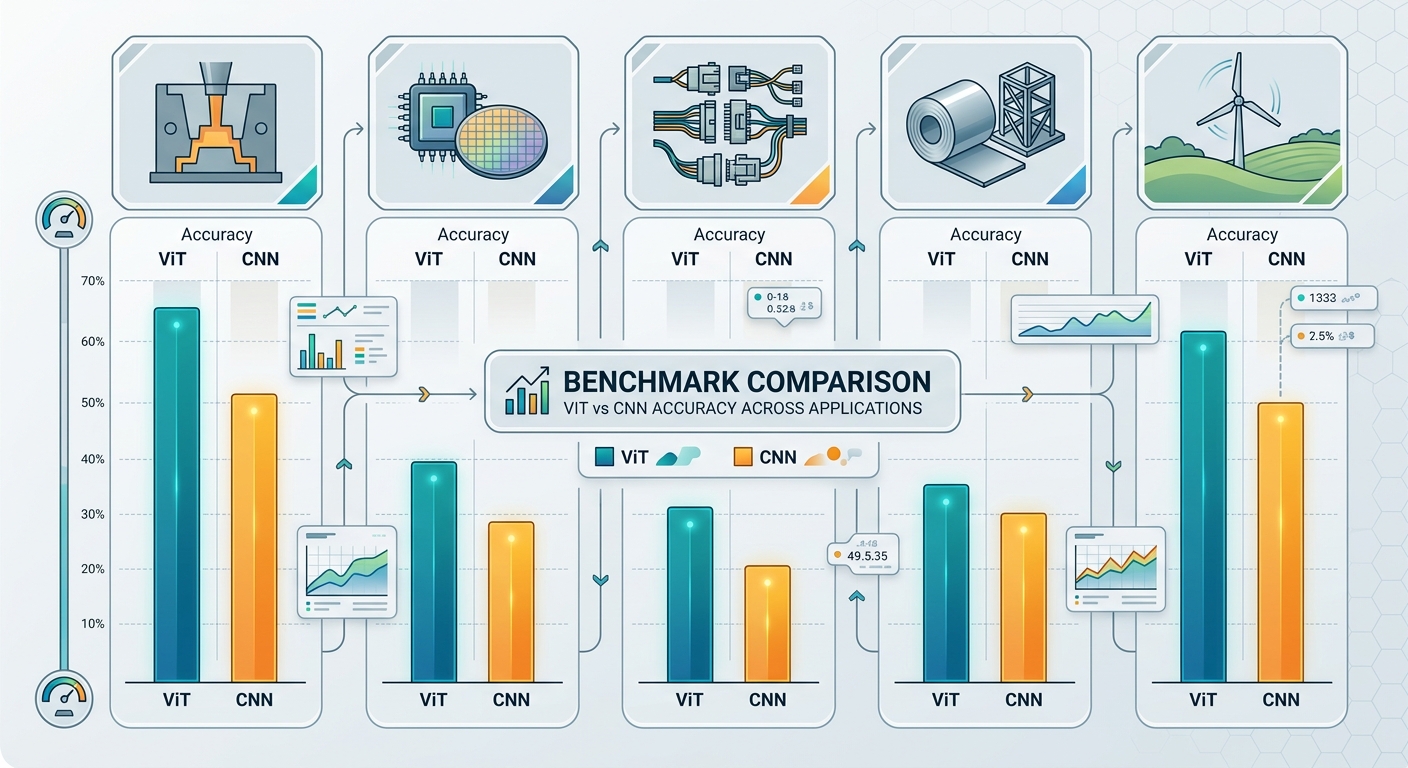
The pattern is consistent across these Vision Transformer deployment benchmarks. On large, well-labeled datasets, ViTs match or exceed CNNs. On small datasets, CNNs retain an edge due to their strong inductive biases. Hybrid architectures are emerging as the practical solution: CNNs handle local feature extraction efficiently, and Transformers add global context reasoning.
Where ViTs Win: Global Context Defect Detection
Certain defect categories play directly to Vision Transformer strengths. These are the applications where Transformer-based inspection adds the most value in 2026 industrial quality control.
Semiconductor Manufacturing Wafer defect detection requires identifying subtle, spatially distributed anomalies across high-resolution images. ViTs capture patch-level context across the entire wafer surface simultaneously. This global reasoning capability gives them a structural advantage over CNNs that must build up wide-area context through many convolutional layers.
Additive Manufacturing / 3D Printing Layer-by-layer manufacturing produces defects like under-extrusion and over-extrusion that are inherently global: they depend on the relationship between adjacent layers, not just local pixel patterns. ViTs fused with depth sensing can classify these conditions by reasoning about the whole layer at once.
Automotive and Aerospace Metal Surfaces Cracks, dents, and scratches on metal components vary in size and shape. Some span large surface areas. ViTs handle this variability through their patch-based self-attention mechanism, which is inherently size-agnostic.
Railway Freight Car Maintenance ViT-based damage detection in sheet metal flooring and wooden load spaces has demonstrated equivalent or superior performance to CNNs, even with sparse training data. The self-attention mechanism appears to generalize better than CNNs when defect examples are limited.
The Hybrid Architecture Era: CNN-Transformer Dominance in 2026
Pure ViT deployments remain a minority in 2026. The fastest-growing deployment pattern is hybrid CNN-Transformer architecture, combining the strengths of both approaches for industrial visual inspection.
The logic is straightforward. CNNs are exceptionally efficient at extracting local features from images. Convolution operations are highly optimized on GPU and NPU hardware. Transformers add global context reasoning on top of those local features. Combining them captures the best of both worlds for defect detection in manufacturing.
The MS-ViT-CNN architecture exemplifies this approach. The CNN backbone processes the input image and extracts local feature maps. Those feature maps are then divided into patches and fed into Vision Transformer layers. The Transformer head captures global relationships, enabling detection of defects that depend on long-range spatial context.
Real-world deployment data supports this hybrid approach. On the Jetson NX edge platform—a popular choice for factory-floor AI—the MS-ViT-CNN hybrid achieved real-time inference suitable for production line speeds. This matters because edge deployment is a hard requirement in most manufacturing environments. Cloud connectivity adds latency, creates bandwidth costs, and introduces reliability risks that most plant operators will not accept.
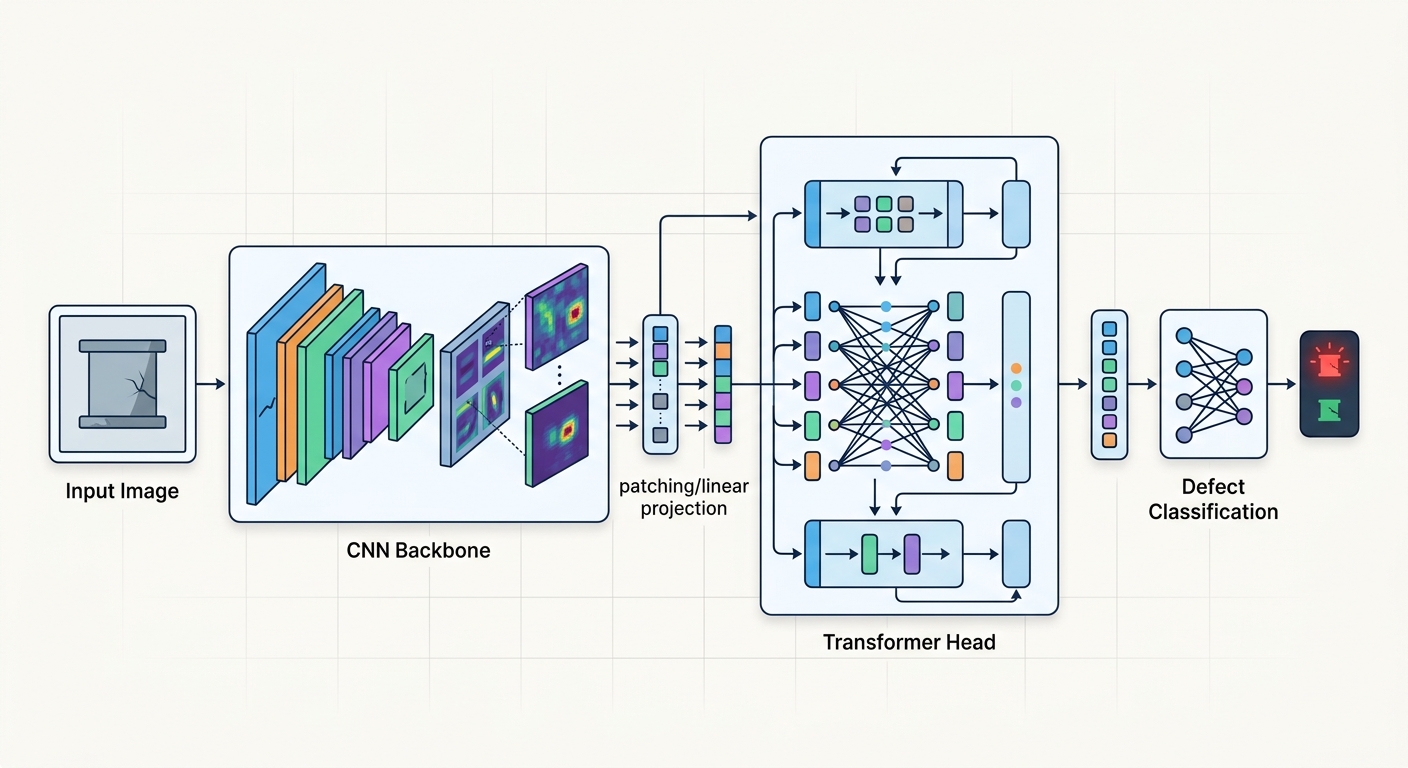
Industry benchmark suites like MVTecAD and BTAD (BeanTech Anomaly Detection) are increasingly including hybrid models in their evaluations. Results consistently show hybrids outperforming both pure CNNs and pure ViTs on complex anomaly detection tasks. For manufacturers evaluating Vision Transformers vs CNN manufacturing options, these MVTecAD benchmarks provide standardized comparison data.
Edge AI: Real-Time Vision Transformer Inspection on the Production Line
Industrial quality control has a hard constraint that research benchmarks often ignore: speed. On a high-speed production line, defect detection must complete faster than products move through the inspection station. This means processing 20 to 60 frames per second depending on line speed.
Sub-100ms inference time is the practical target for real-time manufacturing defect detection. Modern Vision Transformers optimized for deployment—including distilled and pruned variants—achieve this on edge hardware. Vision AI accelerators and neural processing units (NPUs) integrated into smart cameras and sensors now run lightweight ViT models directly at the edge. No cloud round-trip. No bandwidth dependency.
This edge-first architecture enables 100% inspection coverage. Traditional sampling-based inspection checks one in every hundred or thousand parts. Real-time edge AI makes it economically feasible to inspect every single unit that rolls off the line.
Automating visual inspections with AI reduces inspector fatigue and stabilizes inspection accuracy across different shifts, creating a consistent quality baseline across the production facility.
The latency advantage is concrete. A cloud-dependent system adds network round-trip time on top of inference time. An edge-only system runs inference locally. The difference is often the difference between meeting and missing the sub-100ms window on high-speed lines.
Edge deployment also simplifies integration with Industry 4.0 ecosystems. Computer vision inspection connects directly to robotics, predictive maintenance, and logistics systems through local networks, enabling automated reject, sort, and reroute workflows without cloud middleware.
The Data Challenge: Synthetic Data and Transfer Learning for Vision Transformers
Vision Transformers are data-hungry. This is their most significant deployment barrier in manufacturing. A pure ViT trained on a small industrial dataset with limited labeled defect examples will underperform a well-tuned CNN.
The industry is addressing this in two ways for industrial vision AI deployment.
Synthetic Defect Data Generation Generative AI models can produce realistic synthetic defect images that expand training datasets without requiring physical defect samples. This is particularly valuable for rare defect types that might appear once in every ten thousand units. Synthetic data augmentation has become a standard preprocessing step in leading ViT-based inspection pipelines.
Transfer Learning from Pre-Trained ViTs Models like DeiT (Data-efficient Image Transformer), Swin Transformer, and BEiT (Bidirectional Encoder representation from Image Transformers) provide pre-trained weights learned on massive image datasets. Fine-tuning these models on a manufacturer's specific defect dataset requires far fewer labeled examples than training from scratch. Transfer learning bridges the gap between ViT data requirements and manufacturing's limited labeled data availability.
The practical result: even manufacturers with relatively small defect datasets can deploy competitive Vision Transformer-based inspection systems by combining synthetic data augmentation with pre-trained model fine-tuning. This approach is becoming a standard best practice for ViT deployment in industrial quality control.
Explainable AI: Building Operator Trust in Vision Transformer Predictions
A defect detection system that flags a component as faulty but cannot explain why will face adoption resistance on the factory floor. Operators and quality engineers need to understand the basis for model predictions, both for trust and for regulatory compliance.
Vision Transformers offer a natural advantage here: attention maps. The self-attention mechanism that enables global context reasoning also produces attention weights that show exactly which image regions contributed most to a prediction. These attention maps can be rendered as heatmaps overlaid on the original image, giving operators a visual explanation of why the model flagged a defect.
Gradient-based attribution methods provide additional explainability. Techniques like Grad-CAM and attention rollout produce attribution maps that highlight the pixels and image structures driving each decision. This is critical for explainable AI manufacturing quality control applications.
Leading ViT inspection vendors have incorporated XAI dashboards into their deployment platforms. Quality engineers can review attention visualizations alongside raw model outputs, enabling faster root cause analysis and continuous model improvement across production runs.
2026 Deployment Outlook: Vision Transformers as Industrial QC Infrastructure
The trajectory is clear. Vision Transformers in industrial quality control are not a future promise. They are a present reality with proven deployment benchmarks.
The market is projected to grow from $0.50 billion in 2026 to $5.66 billion by 2034 at 35.51% CAGR. Hybrid CNN-Transformer architectures are the dominant deployment pattern for new Vision Transformer industrial installations. Edge-first deployment ensures real-time performance on high-speed lines without cloud dependency. Explainable AI is building the operator trust required for broad adoption across shift schedules.
The shift goes beyond defect detection. Machine learning models incorporating Vision Transformers analyze time-series sensor data alongside visual inputs to detect process anomalies before defects form. This moves manufacturing from reactive quality control—catching bad parts after they are made—to predictive quality—preventing defects by identifying unstable process windows in real time.
For manufacturers evaluating their quality control infrastructure in 2026, the data supports acting now. The technology is mature, deployment benchmarks are available, and the competitive advantage of 100% real-time inspection is measurable across automotive, semiconductor, steel, pharmaceutical, and additive manufacturing sectors. The question is no longer whether Vision Transformers will transform industrial QC. It is how quickly your industry will adopt them.
Keywords: vision transformers industrial quality control, ViT defect detection manufacturing, Vision Transformers vs CNN manufacturing, hybrid CNN-Transformer defect detection, edge AI quality control, real-time manufacturing defect detection, MVTecAD Vision Transformer benchmark, explainable AI manufacturing, industrial vision AI 2026, CNN ViT accuracy comparison