Vision-Language-Action Models Are Leaving the Lab for the Warehouse Floor
How vision-language-action models are entering supervised warehouse pilots—VLA inference loops, WMS/WES integration, constraints, and buyer checklist.
The Warehouse Floor Is Where VLA Models Get Real
A picker at a third-party logistics hub faces a tote of mixed SKUs: a shrink-wrapped multipack, a dented cosmetic carton, a polybag that shifts under its own weight, and a loose item that rolled out of its packaging in transit. A classical robotic cell would stall or reject the tote. A human resolves it in seconds. This is exactly the gap that vision-language-action (VLA) models are being built to close.
VLA models combine a vision encoder, a language backbone, and an action head into a single policy that maps camera pixels and a natural-language instruction to robot commands. For two years they lived in research papers and tabletop demos. Now they are entering supervised production pilots in warehouses—not homes, not highways. The warehouse offers what no other environment does: high task variety, measurable KPIs, existing sensor infrastructure, and a business case that tolerates narrow scope but not unreliability.
The economics are what changed. A single pick-station exception that stalls a line can cost a facility thousands of dollars per hour in missed SLA penalties and downstream rework, and labor markets for reliable pickers remain tight in most US metros. That cost asymmetry—cheap to scope narrowly, expensive to get wrong—is why operations leaders are willing to fund pilots that handle a bounded slice of the work rather than wait for general-purpose manipulation.
This article covers what VLA models actually do on the floor, how they integrate with WMS, WES, and fleet software, where the hard constraints bite, and what buyers should demand before signing a pilot. The framing throughout is narrow, supervised deployment—not general-purpose robots. (See also: Warehouse Robotics Deployment Models.)
Why the Warehouse Is the First Real Test Bench for VLA Models
The Gap Between Lab Benchmarks and Dock-to-Stock Reality
Manipulation benchmarks report success rates on curated object sets under controlled lighting. The warehouse delivers the opposite: SKU churn commonly measured in the thousands per quarter, reflective shrink-wrap, damaged packaging, variable pallet quality, and human co-workers moving unpredictably through the same cell.
A policy that scores well on a tabletop suite can fail on a single deformed carton. The mechanism is well understood: a learned policy is tuned to the distribution it was trained and evaluated on, and a curated benchmark is a narrow slice of the long-tailed SKU distribution a real dock presents. When the evaluation set and the deployment set diverge, reported success rates overstate field performance—sometimes dramatically. A policy that reports 90% grasp success on a benchmark can drop into the 60s on a live dock where a third of the SKUs are polybags, blister packs, or items whose packaging has already failed. Benchmark success rates do not transfer linearly to dock-to-stock reality, and vendors who quote them as production proxies are telling you something about their maturity.
The tell is in how a vendor frames evaluation. Ask whether their numbers come from a held-out set drawn from your SKU mix or from a public benchmark. Ask what fraction of failures were recoverable versus hard stops. A team that can answer those questions precisely has done the field work; a team that pivots to model architecture has not.
What Warehouse Work Demands That Benchmarks Don't Measure
- Uptime under SLA. A pick cell running three shifts cannot tolerate daily policy regressions. Ninety-nine percent availability sounds strong until you realize it means roughly seven hours of unplanned downtime a month—enough to miss commitments on a busy line.
- Cycle-time consistency. Mean performance matters less than the tail; a 95th-percentile pick that takes several times the median breaks the line. A cell that averages 400 picks per hour but spikes to multi-second stalls on 5% of items will starve downstream sorters regardless of its average.
- Recovery behavior. When a grasp fails, the system must detect it, retry intelligently, and escalate cleanly to a human. Silent failures—where the policy believes it succeeded and the WMS records a phantom pick—are worse than visible ones, because they corrupt inventory truth.
- Auditability. Every action needs a log an operations manager can reconstruct after an incident: what the camera saw, what instruction was active, which action was chosen, and why the safety layer intervened if it did.
Warehouses fit VLA strengths—task diversity, natural-language specification, camera-rich environments—but they punish VLA weaknesses with equal precision. That tension is why the warehouse is the proving ground: success and failure are both measurable in currency. (See also: Warehouse KPIs for Robotic Automation.)
What Vision-Language-Action Models Actually Do on the Floor
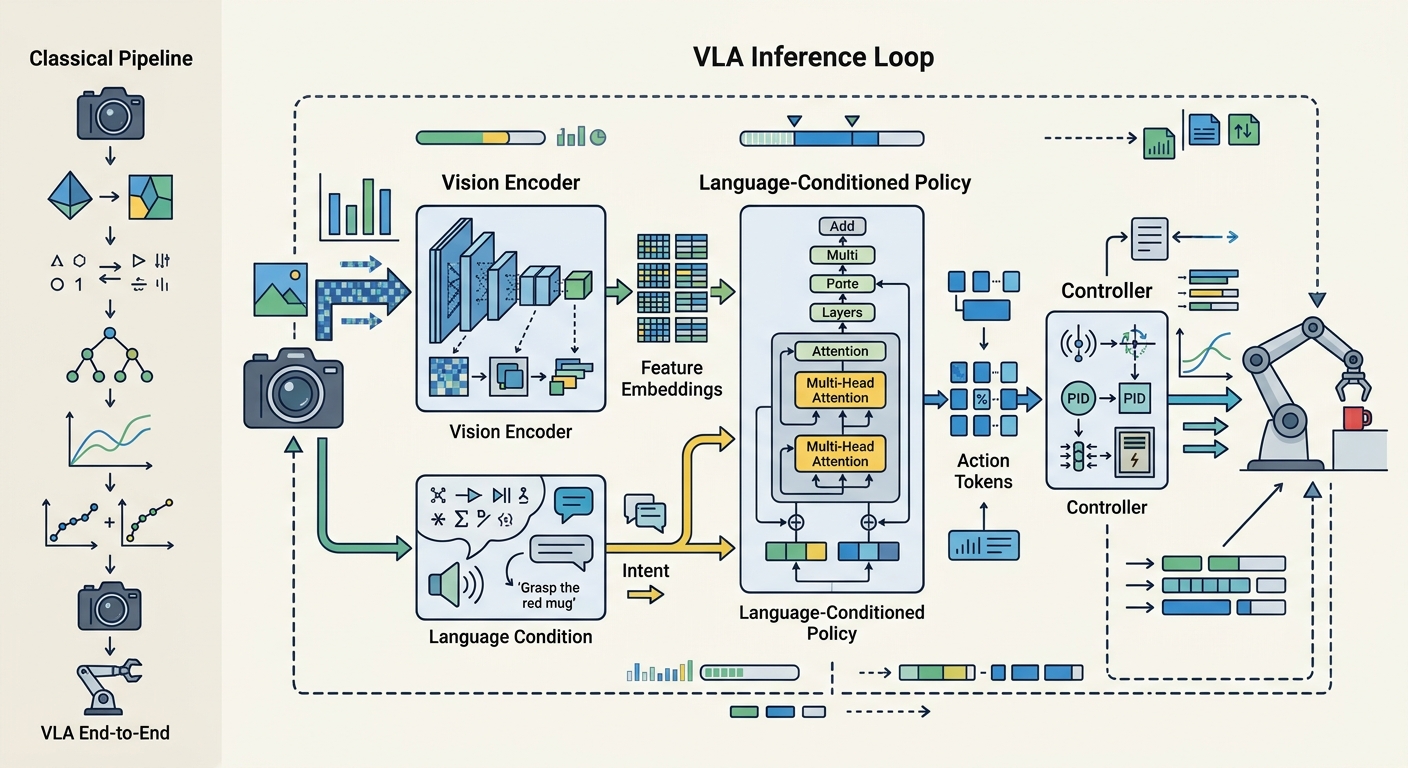
From Perception to Grasp: The VLA Inference Loop
The loop is conceptually simple and operationally demanding:
- Camera input captures RGB-D frames of the workspace.
- Vision encoder converts pixels into embeddings, often fused with proprioceptive state.
- Language-conditioned policy interprets an instruction such as "depalletize cartons onto conveyor B, damaged units to the exception lane" alongside the visual context.
- Action output is decoded into end-effector trajectories or waypoints.
- Controller executes the motion through the robot's low-level servoing layer.
The language conditioning is the differentiator. Instead of engineering a new perception-and-planning pipeline per SKU family, operators specify tasks in natural language and the policy generalizes across novel objects.
Step 4 hides an important architectural fork. VLA policies differ materially in how they emit actions: autoregressive token policies (a language model emits discretized action tokens, à la RT-2), diffusion or flow-matching action heads (the policy generates a trajectory by iterative denoising, à la diffusion policy), and fast action-chunking methods (a transformer predicts a short horizon of actions in one forward pass, à la ACT). The choice trades off expressiveness against inference latency and control frequency—a diffusion head that produces smooth, multimodal grasps may be too slow for a 100 Hz control loop, while a token policy may be fast but coarse. Action-chunking methods sit in the middle: they amortize inference over a short horizon, which suits pick-and-place cycles where the policy can commit to a few hundred milliseconds of motion before re-planning. Buyers should ask which class a vendor uses and why it fits the cell's cycle time.
"The value of a VLA policy is not that it replaces the robotics stack. It's that it can shorten the re-tasking cycle—in observed deployments, from months of bespoke engineering toward days of supervised fine-tuning—provided the operator has the data pipeline and safety envelope to support it."
Representative floor tasks include depalletizing mixed cartons, exception handling at pick stations, tote induction, and quality inspection where the grasp decision depends on visible damage. Each is narrow, bounded, and measurable—the right shape for a pilot.
The failure modes are equally specific. A depalletizing policy may misjudge a carton whose shrink-wrap has torn, reading the exposed product as a separate object. An exception-handling policy may correctly identify a damaged unit but choose a grasp point that crushes it further, turning a returnable item into scrap. A tote-induction policy may succeed on the grasp but drop the item at the transfer point because the language instruction never specified placement tolerance. These are not model failures in the abstract; they are specification failures, and they are fixed by tightening the task instruction and the evaluation harness, not by retraining from scratch.
Where VLA Models Beat Classical Robotics Stacks
Classical stacks hand-engineer perception for known geometries and plan motion per SKU family. They are excellent at what they were built for and brittle at everything else. VLA models win where object variance and task re-specification dominate—mixed-SKU handling, exception queues, and lines that change weekly.
Classical automation still wins on high-speed fixed cycles: a case packer running deterministic motions at fixed rates has no reason to adopt a probabilistic policy. The honest architecture is hybrid—VLA for the messy edges, classical for the deterministic core. In practice this means a facility might run a fixed-cycle depalletizer on homogeneous pallets and route only mixed or damaged pallets to a VLA-equipped station, keeping the probabilistic policy where variance actually lives and the deterministic machinery where throughput matters most. (See also: Hybrid Robotics: Classical vs. Learning-Based Automation.)
The Deployment Stack: Integrating VLA Models with WMS, WES, and Fleet Software
A VLA policy is not a system. It is a component, and it sits below orchestration and above actuation.
- WMS owns inventory truth and order priority.
- WES sequences work and allocates it to stations and robots.
- Fleet manager handles traffic, docking, and mission assignment across AMRs.
- VLA policy layer executes manipulation tasks within a station or on a mobile manipulator.
- PLC safety layer enforces hard limits—e-stops, speed zones, light curtains—independent of the policy.
Interoperability in a typical stack follows established interfaces rather than bespoke glue: VDA 5050 for AMR-to-fleet traffic and mission messaging, OPC UA or REST/JSON for WMS–WES–fleet integration, and ROS 2 (often over DDS) as the on-robot middleware between the policy node and the motion controller. The policy layer should expose a clean task API—accept a task spec, return a success/failure and a structured log—so it can be swapped or upgraded without re-integrating the orchestration tiers above it.
The integration discipline that matters most is keeping the policy stateless from the orchestrator's perspective. A WES should be able to dispatch a manipulation task the same way it dispatches a conveyor divert or an AMR mission: fire the task, wait for a terminal state, handle the exception if one comes back. If the VLA layer leaks its internal state—partial grasps, retry counters, model version—into the orchestration contract, every model upgrade becomes an integration project. Version the task API, not the model.
Where the Hard Constraints Bite
The integration is the easy part. The constraints that decide whether a pilot survives are physical and regulatory:
- Inference latency vs. control frequency. A manipulation policy must run fast enough to close a stable control loop. If perception-plus-inference latency exceeds the cell's tolerance, the policy cannot react to a shifting polybag or a moving co-worker in time. Vendors must report end-to-end latency, not just model FLOPs, and show it against the cell's required rate. A policy that needs 150 ms per inference may be perfectly adequate for a slow depalletizing cycle and entirely inadequate for a high-rate induction line where the belt does not wait.
- Safety certification of learned policies. A probabilistic policy is hard to bound for a formal risk assessment under ISO 10218 and ISO/TS 15066. The workable pattern is to keep the learned policy inside a deterministic safety envelope—speed-and-separation monitoring, reduced-force limits, and a certified safety PLC that can stop the robot regardless of what the policy decides. The policy proposes; the safety layer disposes. This also means the safety case is built around the envelope, not the model, so a policy update does not automatically trigger a re-certification.
- Data collection and fine-tuning cost. Generalization across novel objects is real but not free. Each new SKU family or exception type typically needs labeled demonstrations and supervised fine-tuning. Budget for the data pipeline, not just the model: teleoperation rigs, annotation labor, a replay buffer that captures both successes and recoveries, and an evaluation harness that can score a candidate policy against held-out SKUs before it touches the floor.
- Sim-to-real gap. Policies trained or validated heavily in simulation inherit the simulator's assumptions—idealized friction, clean segmentation masks, no cable snags, no dust on the lens. The gap shows up as a policy that performs beautifully in the training environment and hesitates on the first reflective polybag it meets. Closing it requires real-world fine-tuning data from the actual cell, which loops back to the data pipeline cost above.
None of these constraints is a reason to avoid a pilot. They are the checklist that separates a pilot that produces a defensible go/no-go decision from one that produces a demo. The buyers who get value from VLA deployments in the next two years will be the ones who scope the cell tightly, instrument it honestly, and hold vendors to field numbers rather than benchmark numbers.