Document AI in 2026: Why Vision-Language Models Are Replacing OCR Pipelines
See why vision-language models are replacing OCR pipelines in 2026—benchmarks, architecture trade-offs, and a practical migration path for US enterprises.
The OCR Pipeline Era Is Ending
Document AI in 2026 looks fundamentally different from the stack most enterprises deployed five years ago. The center of gravity has moved: vision-language models (VLMs) now sit at the core of document processing, and OCR has been demoted—in many architectures—from the extraction engine to a preprocessing and fallback layer. This is not a vendor talking point. It reflects a real shift in accuracy, generalization, and engineering economics.
The thesis is straightforward: classic OCR pipelines were built for a world of predictable, printed, template-bound documents. That world is gone. Invoices arrive in dozens of formats, contracts run to hundreds of pages, and a growing share of critical documents are handwritten, scanned, or photographed. This article covers what changed, what the 2026 benchmarks actually show, the architecture trade-offs engineering leaders now face, and a practical migration path.
To be precise up front: this is not a claim that OCR is dead. OCR engines remain fast, cheap, and deterministic, and most production VLM systems still ingest extracted text alongside the page image. What has changed is where the reasoning happens. The structured extraction decision has moved from a rules-and-templates layer to a model that reads the whole page.
Why OCR Pipelines Are Breaking Down
What the classic OCR stack actually does
The traditional document AI stack is a chain of specialized components:
- Image preprocessing — deskew, denoise, binarize, and crop.
- OCR engine — character and word recognition (Tesseract, ABBYY, cloud OCR APIs).
- Layout analysis — detect blocks, columns, tables, and reading order.
- Template or rule layer — regex, anchor-based extraction, coordinate mapping.
- Post-processing — normalization, validation, and confidence scoring.
Its virtues are real: determinism and auditability. The same input produces the same output, every character decision can be traced, and per-page cost is predictable and low. For a decade, that was the right trade.
The three failure modes that finally broke the pipeline
Three structural weaknesses compounded until the economics flipped for many document classes.
- Brittle templates. Every new vendor format, redesigned invoice, or shifted field position required engineering work. Template libraries grew into maintenance liabilities that never quite kept up with reality.
- Error compounding. A single OCR character error—an "O" read as "0," a decimal point lost—propagates silently through parsing and extraction. Downstream validators catch some of it; the rest becomes bad data in production systems.
- Poor handling of hard inputs. Handwriting, low-quality scans, complex tables, and multi-column layouts demanded heavy custom engineering, and even then performance degraded. These are exactly the documents where manual review costs the most.
The pipeline didn't fail because OCR got worse. It failed because the documents got harder and the tolerance for template maintenance went to zero.
How Vision-Language Models Read Documents Differently
From character recognition to document understanding
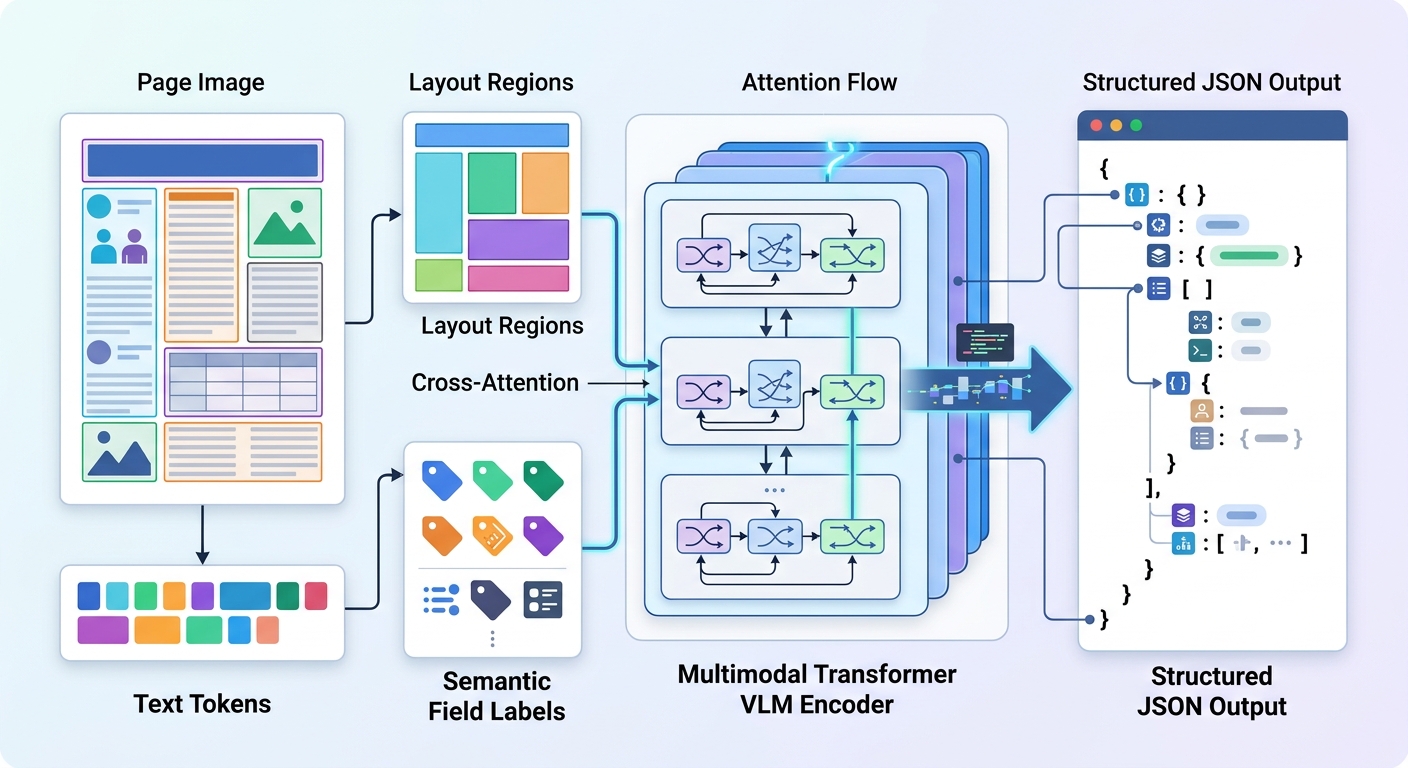
A VLM takes a page image—often alongside extracted text—and reasons over the whole page at once. Instead of transcribing characters and then inferring structure, the model generates the structured output directly: JSON fields, tables, key-value pairs, summaries.
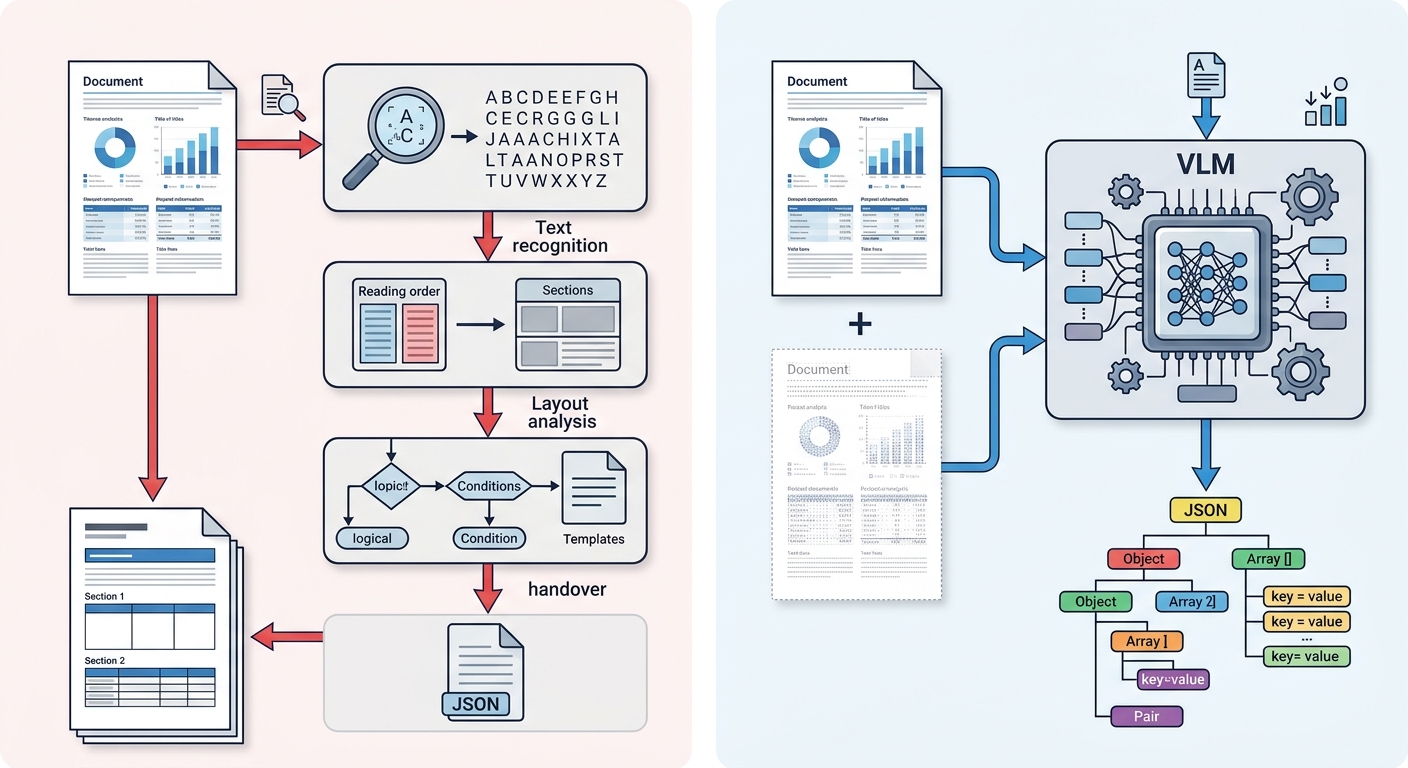
That reframes extraction as a generation task rather than a parsing task. You prompt the model with a schema, and it returns populated fields. The model brings world knowledge to the page—it knows what an invoice number typically looks like, where a total usually sits, and what a signature block implies.
It is worth correcting a common oversimplification here: VLMs are not immune to character-level misreads. What changes is the consequence. A misread digit in an OCR stream corrupts downstream parsing silently. In a VLM, the model can reconcile a misread character against the semantic context of the field—a total that doesn't match the sum of line items, an invoice date outside a plausible range—and either correct it or flag it. The error is contextualized rather than silently propagated. This is a meaningful reliability gain, but it is not the same as eliminating character errors, and any production system still needs field-level validation.
Why layout and semantics are learned jointly
In a classic pipeline, layout analysis and semantic understanding are separate stages stitched together by rules. In a VLM, they are learned together during pretraining on large corpora of document images and their text. The model internalizes reading order, table structure, and field semantics as a single joint representation.
The practical consequence is strong zero-shot generalization to unseen document types. A model that has never seen your specific purchase order format can often extract it correctly on the first attempt, because it understands the category of document rather than memorizing a template. "Often" is doing real work in that sentence—zero-shot performance is good but not uniform, and it degrades on dense, domain-specific, or poorly scanned documents. (See our guide to intelligent document processing use cases for where this matters most.)
What the 2026 Document AI Benchmarks Show
Structured extraction accuracy vs. OCR-then-parse
Across public benchmark families, the directional finding is consistent: VLMs lead on handwriting, complex tables, and unseen layouts, often by wide margins.
Read the benchmark categories carefully, because they measure different things:
- DocVQA — document visual question answering; tests reading comprehension over a page, not field extraction.
- FUNSD — form understanding via entity labeling; tests semantic labeling of form fields, not end-to-end structured output.
- CORD — receipt key-value extraction; closest to a real extraction task, but narrow in domain.
- Structured-extraction benchmarks (e.g., OmniDocBench and related field-level evaluations) — the most relevant family for enterprise extraction, and the one to cite when making accuracy claims.
On messy real-world inputs, the gap widens further. Handwritten forms and photographed receipts, where OCR engines historically struggled, are now routine wins for VLM-based extraction. Field-level accuracy on unseen templates has improved to the point where zero-shot extraction frequently matches or beats a tuned legacy pipeline—though "tuned" is the operative word, and a well-maintained pipeline on a stable document class can still hold its own.
Two methodology caveats matter:
- Benchmark contamination. Many public document benchmarks now appear in pretraining corpora. Treat headline scores as directional, not definitive.
- Prompt sensitivity. VLM results vary with prompt design, schema phrasing, and decoding settings. A benchmark number without the prompt is not reproducible.
Where OCR pipelines still win
The honest counterpoint: OCR pipelines remain stronger on high-volume, fixed-format, fully printed documents where deterministic output, sub-cent per-page cost, and character-level auditability are the priority. A high-volume remittance-processing operation with a stable template and a regulatory requirement to trace every character decision should not rip out its OCR stack. The right question is not "OCR or VLM" but "which document classes justify which architecture."
The Economics Nobody Puts in the Slide Deck
The claim that "the economics flipped" deserves numbers. For a B2B buyer, three cost dimensions decide the architecture:
- Per-page inference cost. OCR is cheap and largely flat. VLM inference scales with page resolution and output length—dense pages and long JSON schemas cost more. In 2026, distilled and smaller document-specialized models have narrowed this gap considerably, but at high volume the difference is real. Caching, batching, and routing easy pages to cheap paths are now standard cost controls.
- Latency. OCR is fast and predictable. VLM inference is slower and varies with output complexity. For synchronous workflows (a clerk waiting on a field), this matters; for batch overnight processing, it usually doesn't.
- Determinism and auditability. This is the trade most teams underestimate. VLM outputs are not bit-for-bit reproducible across model versions, and even at temperature zero, provider-side changes can shift results. Mitigations—version-pinning the model, logging the exact prompt and schema, storing raw model output alongside the parsed result, and running a validation layer—restore most of the audit trail, but they are engineering work, not free.
The migration math usually works out because template maintenance cost dominates for heterogeneous document classes. For a stable, high-volume class, it often doesn't.
Deployment and Governance: The Procurement Blocker
For regulated industries, architecture decisions are gated by data handling, not accuracy.
- Data residency and PII. Sending page images of contracts or patient records to a third-party API is a non-starter for many enterprises. On-prem, VPC, and private-endpoint deployments of document VLMs are now standard requirements, and providers have responded.
- Redaction before inference. Where full on-prem isn't feasible, pre-inference redaction of PII fields is a common compromise—but it adds a pipeline stage and its own failure modes.
- Model versioning as a compliance control. Because outputs can shift across model updates, treat the model version as part of the system of record. Pin it, test it on a golden set before upgrading, and document the change.
A Practical Migration Path
The teams getting this right in 2026 are not doing rip-and-replace. They are running a staged migration:
- Inventory and classify document types by volume, format stability, and error cost. Stable, high-volume, fully printed classes are candidates to stay on OCR. Heterogeneous, handwritten, or template-churning classes are candidates to move.
- Build a golden evaluation set per document class—a few hundred labeled pages including the ugly ones. Every architecture decision is measured against it, not against a benchmark leaderboard.
- Run VLM extraction in shadow mode alongside the existing pipeline. Compare field-level accuracy, latency, and cost on real traffic before cutting over.
- Add a validation layer that doesn't depend on the model: arithmetic checks, cross-field consistency, and confidence thresholds that route low-confidence pages to human review.
- Route by document class. Send easy, high-volume pages to the cheap deterministic path; send hard pages to the VLM. This hybrid routing is where most mature deployments land.
- Instrument and pin. Log prompts, schemas, model versions, and raw outputs. Re-run the golden set on every model upgrade.
The Bottom Line
VLMs have genuinely changed what document AI can do. They handle the documents that broke OCR pipelines—handwriting, complex tables, unseen formats—and they move the maintenance burden from template engineering to model evaluation and validation. But the shift is a re-architecture, not a switch. The enterprises that win in 2026 route by document class, keep a deterministic path where it pays, invest in golden evaluation sets, and treat model versioning as a compliance control. OCR isn't gone. It's been demoted to a component—and the reasoning layer is where the value now sits.