Document VLMs vs OCR: When Vision Models Replace Your Parsing Stack
Compare document VLMs and OCR pipelines: when vision models beat traditional parsing, where OCR still wins, and how to decide what to retire.
The Parsing Stack Decision Facing Every Document AI Team
For two decades, the document parsing stack has been a solved problem — or so we told ourselves. You bolted an OCR engine onto a pipeline, layered on layout analysis, wrote a thicket of regex and templates, and shipped. It worked, until it didn't.
The cracks show up in familiar places. A vendor reissues an invoice with the remit-to block moved two inches right and your template silently returns a null for the PO number. A new carrier sends shipping labels in a slightly different font and the OCR confidence drops from 0.97 to 0.81, tripping a threshold nobody remembers setting. A regional office starts scanning intake forms in Spanish and the pipeline routes them to a human queue that grows by a few hundred documents a week.
Now vision language models (VLMs) can read a scanned invoice, a handwritten intake form, or a multi-page contract and return structured JSON — often in a single inference call for shorter documents, and via chunked inference for long ones. Models like GPT-4o, Claude, Gemini, and open-weight options such as Qwen2.5-VL and Llama 3.2 Vision have moved document understanding from research demos to production APIs in under two years. Buyers are asking the obvious question: does this make OCR obsolete?
The honest answer is no — and also, yes, in specific places. The current reality is not OCR versus VLMs. It's a question of which layer of the parsing stack each technology should own, and how much of your existing pipeline you can retire without trading reliability for capability. This research brief maps that decision.
The Parsing Stack You Built Is Showing Its Age
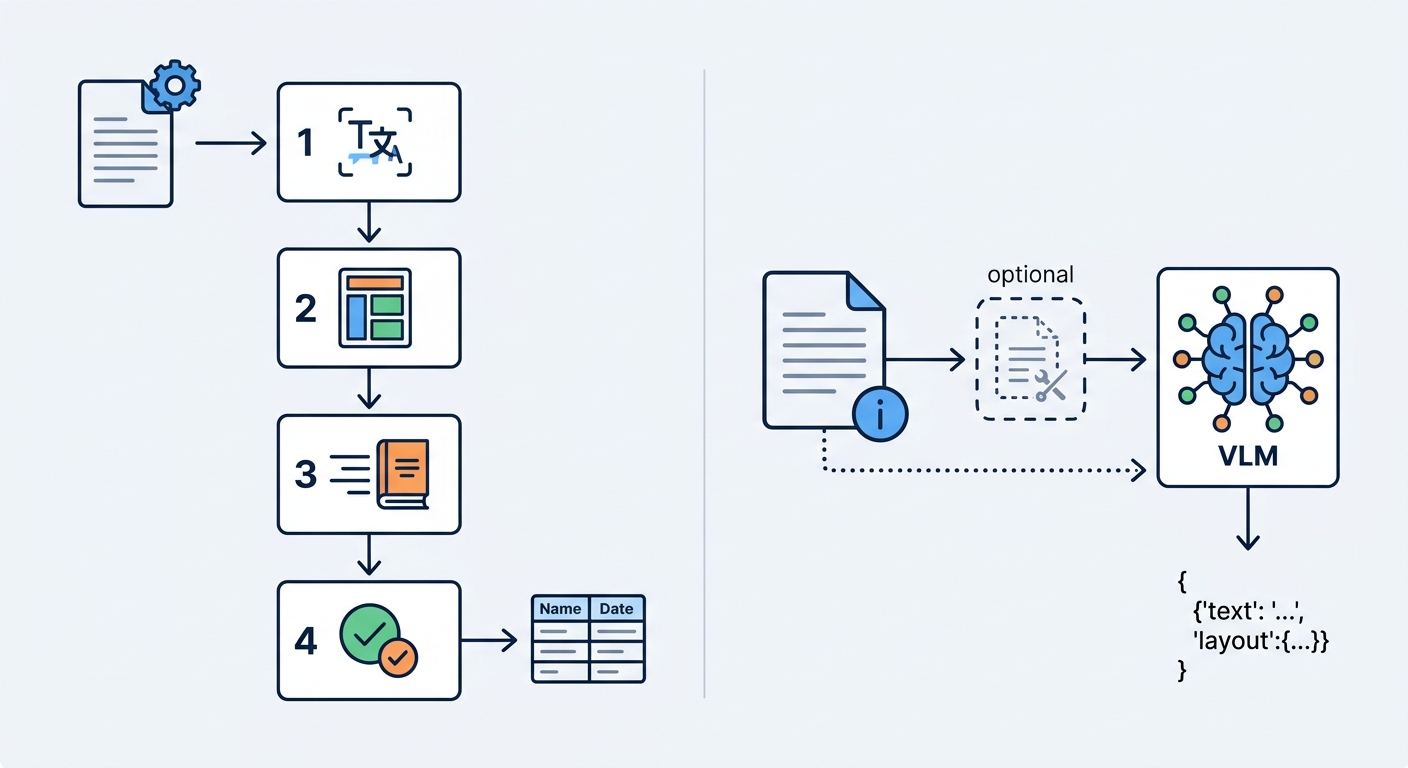
Most enterprise document pipelines follow the same architecture: an OCR engine extracts characters, a layout analyzer groups them into blocks and tables, a rules layer matches patterns and templates, and a validation step catches what falls through. It's repeatable, traceable, and was the right call for its era.
The problem is that this stack encodes assumptions about documents that no longer hold. Templates are brittle by design. A vendor changes a logo position, shifts a column, or adds a field, and extraction silently degrades — often without anyone noticing until downstream reconciliation fails.
The maintenance burden is the real cost. Every new document type means a new template. Every vendor format change means a ticket. Every language means another OCR model to provision and tune. Teams end up with a "document parsing team" whose actual job is keeping a fragile rules engine from falling over.
The numbers are sobering. A mid-size accounts payable operation processing 50,000 invoices a month across 400 vendor formats will typically maintain 200–300 active templates, each with its own regression fixtures. Industry surveys of document automation teams consistently report that 50–70% of engineering time goes to template maintenance and exception handling rather than new capability. When a single Fortune 500 procurement team audited its parsing pipeline, it found that 12% of invoices were being routed to manual review purely because of layout drift — not because the documents were illegible.
The hidden expense of legacy parsing isn't the OCR license — it's the engineering headcount spent defending templates against layout drift.
This is why document parsing is being re-platformed, not merely upgraded. The question isn't whether to add a VLM, but how much of the deterministic stack it should absorb.
How OCR Pipelines and Document VLMs Actually Differ
The two approaches solve overlapping but distinct problems. Understanding the mechanics matters, because the failure modes and cost profiles diverge sharply.
The Classic OCR Pipeline, Step by Step
A traditional pipeline is a chain of specialized stages:
- Character recognition — the OCR engine converts pixels to text with per-character confidence scores. Engines like Tesseract, ABBYY FineReader, Google Cloud Vision, AWS Textract, and Azure Document Intelligence each have distinct strengths: Tesseract is free and open-source but weakest on handwriting; ABBYY leads on structured forms; Textract and Azure ship with table and key-value extraction built in.
- Layout analysis — bounding boxes are grouped into paragraphs, columns, tables, and reading order. Tools like LayoutParser, Docling, and the layout models inside Textract handle this stage, but multi-column and nested-table documents routinely defeat them.
- Post-processing — rules, regex, and templates map extracted text into structured fields. This is where the thicket lives: hundreds of regexes, per-vendor templates, and conditional logic that only one engineer understands.
- Validation — checksums, field-level rules, and confidence thresholds gate what passes downstream. A failed check sends the document to a human queue, which is where the operational cost concentrates.
Each stage is repeatable and traceable. Given the same input and the same engine version, you get the same output, and you can trace which region produced which character and which rule produced which field. (OCR is not perfectly deterministic across engine versions, hardware, or preprocessing changes, and it has its own error modes — character confusion on similar glyphs like 0/O and 1/l/I, layout misreads when a table border is faint, and total failure on handwriting — which is exactly why per-character confidence scores exist.) Cost scales predictably per page, and latency is measured in milliseconds to low seconds.
What a Vision Language Model Sees
A VLM takes the document image as input and produces structured output — a JSON object, a set of fields, a summary — in a single model call. It reasons jointly over visual layout and language semantics rather than treating them as separate stages.
This is where a common misconception needs correcting: modern VLMs don't simply "skip" OCR — many learn to read text as part of their visual encoding, and production systems often combine both signals. In practice there are three architectures:
- End-to-end VLM parsing — the model reads the page image directly and emits structured fields. Best for semantic extraction and messy layouts; weakest on dense, small, or non-Latin text. A page of 8-point footnotes or a table of 200 rows will exceed what a single call can reliably transcribe.
- OCR-augmented prompting — a lightweight OCR pass feeds recognized text into the VLM alongside the image, giving the model both pixel-level and text-level signal. This pattern, popularized by tools like Unstructured and LlamaParse, tends to outperform either approach alone on dense text.
- Hybrid grounding — OCR provides coordinates and spans that the VLM uses to cite where each extracted value came from, enabling verification against the source. This is the architecture most production teams converge on when auditability matters.
The trade-offs are real. VLMs are probabilistic, so outputs can vary run to run and can hallucinate plausible-but-wrong values — a model asked for a total may return a digit that appears nowhere on the page. Per-page cost is higher — order of cents to tens of cents per page versus fractions of a cent for OCR, depending on model, image resolution, and page count. A 10-page contract at high resolution can consume 8,000–15,000 input tokens, and at current frontier-model pricing that lands in the $0.05–$0.30 range per document. Latency is measured in seconds rather than milliseconds — typically 3–15 seconds per page for frontier models, versus 200–800 milliseconds for a tuned OCR engine. But the output is semantic and structured from the start — you ask for "total amount due," not for the characters in a bounding box.
Making VLMs Production-Grade
The gap between a demo and a deployed VLM parser is reliability engineering. The practices that close it:
- Constrained decoding — force output to a JSON schema so the model cannot return malformed structures. Providers now support native structured outputs (OpenAI's
response_formatwith JSON schema, Anthropic's tool-use modes), and open-weight deployments use grammar-constrained decoding libraries like Outlines or Guidance. - Grounding and citation — require the model to return the page and span supporting each field, then verify that span exists in the source. If the model claims a total of $14,320.00 on page 3, the string "14,320.00" must appear in the OCR text for page 3, or the field is flagged.
- Field-level validation — apply the same checksums, ranges, and cross-field rules you used downstream before; they catch VLM errors as well as OCR errors. A line-item sum that doesn't match the stated total is a red flag regardless of which engine produced it.
- Self-consistency and confidence — sample or score multiple passes on high-value fields and route low-confidence extractions to human review. Running the same document through the model three times at temperature 0.2 and taking the majority vote catches most hallucinations on numeric fields at roughly 3x the inference cost — often worth it on payment amounts but wasteful on free-text descriptions.
None of this is exotic, but it is the difference between "the model usually gets it right" and a pipeline you can put in front of finance. Teams that skip grounding and validation typically see field-level accuracy in the 85–92% range on messy documents; teams that add the full reliability layer report 97–99% on the same corpus, with the residual errors routed to review.
Where VLMs Beat OCR: Five Concrete Scenarios
The case for VLMs is strongest where documents resist templating. These are the scenarios where the deterministic stack has always struggled.
Complex Layouts and Multi-Column Forms
Nested tables, multi-column forms, checkboxes, stamps, and signatures break traditional layout analyzers. A VLM reads the page as a reader would — understanding that a signature block belongs to the party above it, or that a nested table's totals row applies to a specific sub-section. Reading order and grouping become reasoning problems, not heuristics. A classic layout analyzer will flatten a two-column insurance form into a single stream of text and pair the wrong label with the wrong value; a VLM keeps the columns distinct because it understands the form's structure semantically.
Handwriting and Degraded Scans
Low-quality faxes, skewed scans, and noisy backgrounds are where character-level OCR confidence collapses. VLMs bring language context to bear: a smudged word in "Invoice Number: INV-2026-____" is more likely a digit than a letter because the surrounding structure says so. Handwriting recognition, historically a separate model category, folds into the same call. On a corpus of handwritten patient intake forms, teams routinely report field accuracy jumping from 60–70% with a dedicated handwriting OCR model to 90%+ with a frontier VLM plus validation.
Semantic Extraction, Not Just Text Capture
This is the biggest shift. OCR gives you text; VLMs give you meaning. Extracting "the termination clause" or "the total amount due including tax" requires understanding document semantics, not just capturing glyphs. A VLM can return the field you actually need — and cite the page and span it came from. Ask a regex pipeline for "the governing law jurisdiction" and you'll get a template that fails on the next contract revision; ask a VLM and it reads the clause and returns "Delaware."
Mixed-Script and Multilingual Documents
A single page mixing English, Spanish, and Chinese, or a form where labels are in one language and values in another, forces a classic stack to provision and arbitrate between multiple OCR models. A VLM handles the page as one document, using cross-lingual context to disambiguate. (Validate carefully on non-Latin scripts — dense CJK and right-to-left text remain a weak spot for many models and warrant targeted testing.)
Long-Tail and Variable Document Types
The economic case sharpens when document types are numerous and low-volume: a hundred vendor invoice formats, each appearing rarely. Templating each one never pays back. A VLM generalizes across formats from a field specification, so the marginal cost of a new document type drops from "build a template" to "add a field definition and test." A team that once budgeted two engineer-weeks per new vendor format can onboard one in an afternoon.
Where OCR Still Wins — and Should Stay
The decision is not "replace everything." OCR remains the right tool where its properties are exactly what you need:
- Dense, small, or structured text at high volume — OCR engines are cheaper and more accurate on clean, high-volume text than general-purpose VLMs. A page of 6-point regulatory disclosures or a 500-row bank statement is OCR territory; a VLM will miss lines or miscount rows.
- Latency-critical paths — sub-second requirements favor OCR. Check-scanning at a teller window or barcode-adjacent document capture cannot absorb a 5-second model call.
- Full auditability — regulated workflows that must trace every character to a pixel favor the deterministic stack. When a regulator asks why a loan application shows a stated income of $82,000, "the OCR engine recognized these glyphs at this bounding box with 0.98 confidence" is a stronger answer than "the model returned it."
- Cost-sensitive bulk processing — millions of pages of clean, uniform documents (utility bills, standard tax forms, remittance stubs) are an order of magnitude cheaper to process with OCR than with a frontier VLM. At ten million pages a month, the difference between $0.0005 and $0.05 per page is $495,000 versus $500,000 — not a rounding error.