Video Understanding Models in 2026: What Multimodal Benchmarks Actually Measure
Multimodal video benchmarks measure narrow proxies, not true understanding. A practical look at VideoQA, temporal reasoning, contamination, and how to evaluate video models for production in 2026.
Video understanding models are everywhere in 2026. They power surveillance systems, sports analytics, medical imaging, and autonomous vehicles. Yet the benchmarks that rank them tell a confusing story. A model can top a leaderboard and still fail on your footage. This article explains what those benchmarks actually measure and how to translate them into a defensible model choice.
What a Video Understanding Benchmark Actually Measures
A video understanding benchmark is a standardized test for models that process moving images. It usually pairs videos with questions or captions and scores how well a model responds. The goal is a number you can compare across models. The reality is more complex.
A single score hides several distinct abilities. Most benchmarks combine different skills into one aggregate number. That number can hide a model that is strong in one area and weak in another.
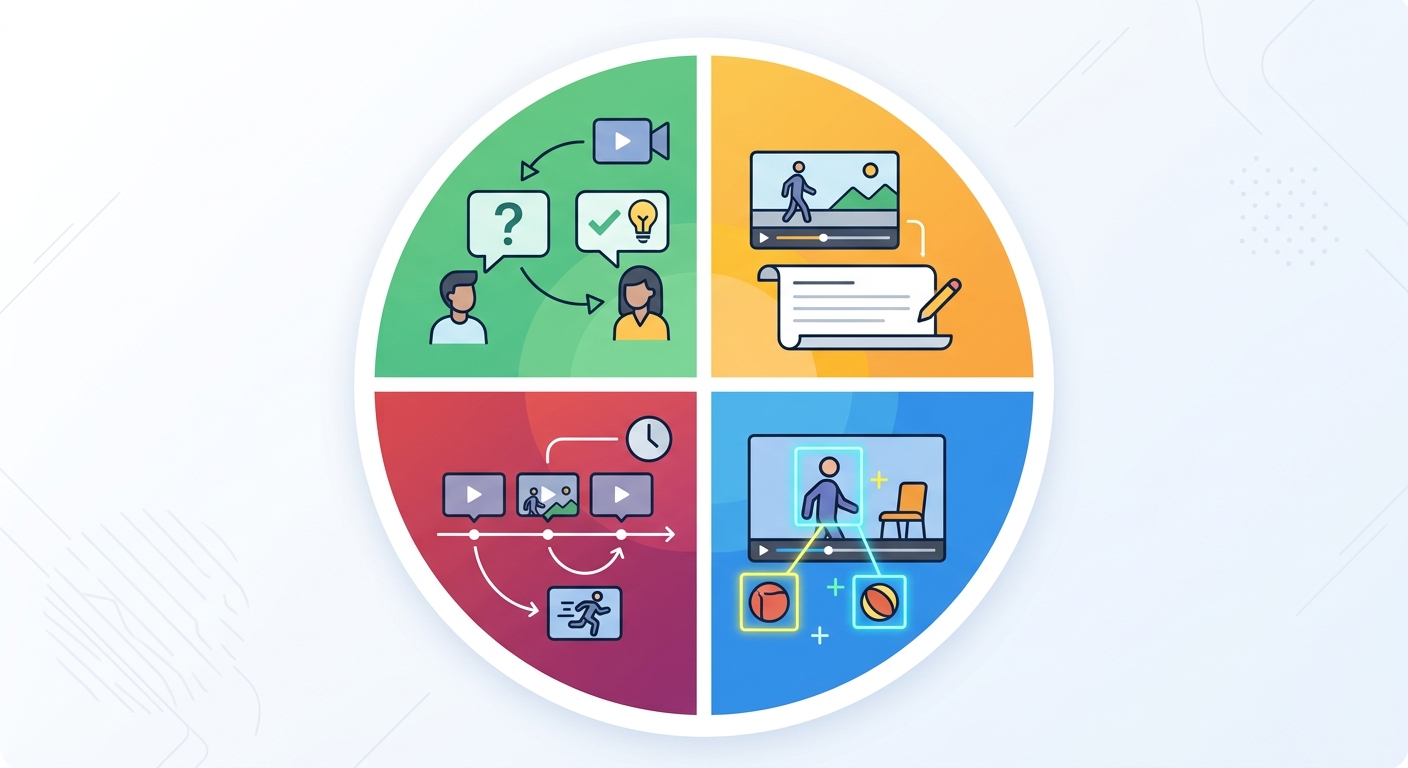
The building blocks fall into four groups:
- Video question answering (VideoQA): A model answers questions about a video. Questions can test facts, actions, or relationships between objects.
- Captioning: A model writes a text description of what happens in a video. Metrics compare the text against human-written captions.
- Spatial grounding: A model locates objects or actions in space and time. It must point to where and when something occurs.
- Temporal reasoning: A model understands order, cause, and change over time. It must say what happened before, after, or because of an event.
These four skills are different. A model can caption a clip well yet reason poorly about cause and effect. This is why understanding is several skills, not one number. Benchmarks measure narrow proxies, not general video understanding. When you read a leaderboard, check which skills the score actually covers.
The Rise of Temporal Reasoning
Temporal reasoning is the most distinctive video capability. It is also the hardest. A single image cannot test it. The model must track change across frames and infer what came next.
Order matters. A clip of a person pouring milk, then a glass tipping, then a spill on the floor tells a story. A model must place these events in sequence. It must also infer cause: the spill followed the tip, so the tip caused the spill.
Static-image models fail temporal tests. They see one frozen frame and have no sense of time. Modern video models process many frames together and build a mental timeline. This is why temporal benchmarks separate strong video models from generic multimodal ones.
Causality is even harder. A model must distinguish correlation from cause. Two events may repeat together in training data. That does not mean one caused the other. Benchmarks like EgoSchema and parts of Video-MMMU probe this distinction directly.
Multimodal Means Audio Plus Vision
Modern video is not just moving pixels. It has sound. Speech, background noise, and music carry meaning that vision cannot capture. A truly multimodal model fuses both streams.
Consider a clip with no visible speaker. The visual frames show a room. The audio reveals who is talking and what they say. A vision-only model fails. A multimodal model that aligns audio with video succeeds.
Cross-modal alignment is the technical term. It means the model matches information across senses. A knocking sound must connect to a hand striking a door. A voice must connect to a moving mouth.
Some benchmarks now test audio as the only cue. They additionally remove or mute visual input and check whether audio alone supports the answer. This reveals whether a model listens or just looks. For production systems with noisy footage, this matters a great deal.
The practical takeaway: do not judge a video model on vision alone. Evaluate audio fusion if your data has sound. Many real-world videos, from meetings to factories, carry critical signals in audio. Multimodal evaluation must combine audio, vision, and text together.
The Problem of Benchmark Contamination
Benchmark scores are not always honest. Contamination is the biggest culprit. It happens when a model has already seen the test data during training. The model "memorizes" answers instead of reasoning.
Open web-scale training is the source. Many benchmarks draw clips from public video. Those clips end up in training corpora. The model then scores high because it recognizes the material, not because it understands.
Single-frame shortcuts are a related trap. Some "video" benchmarks can be solved from one frame. A distinctive scene or object gives the answer away. The model never needs to reason about time. Real production video is rarely so forgiving.
Verbosity bias inflates scores too. Captioning metrics reward long, elaborate text. A model that writes more words often scores higher, even when those words are wrong. Shorter, accurate captions can rank lower. This is a measurement flaw, not a capability gap.
Contamination and single-frame shortcuts inflate leaderboard scores. The result is a leaderboard that overstates capability. This is why benchmark scores diverge from production. Your footage is novel. Your tasks need real reasoning. A contaminated metric measures memory, not mastery.
Long-Video Evaluation: Compute, Sampling, and Summarization
Most benchmarks test short clips of a few seconds. Production video is often an hour or more. Evaluating long-video models raises three questions: compute, sampling, and summarization.
A model cannot process every frame of an hour-long video cheaply. Frame sampling is the answer. The model picks a subset of frames to analyze. Sparse sampling (a frame every few seconds) is fast but may miss brief events. Dense sampling finds more but costs more compute.
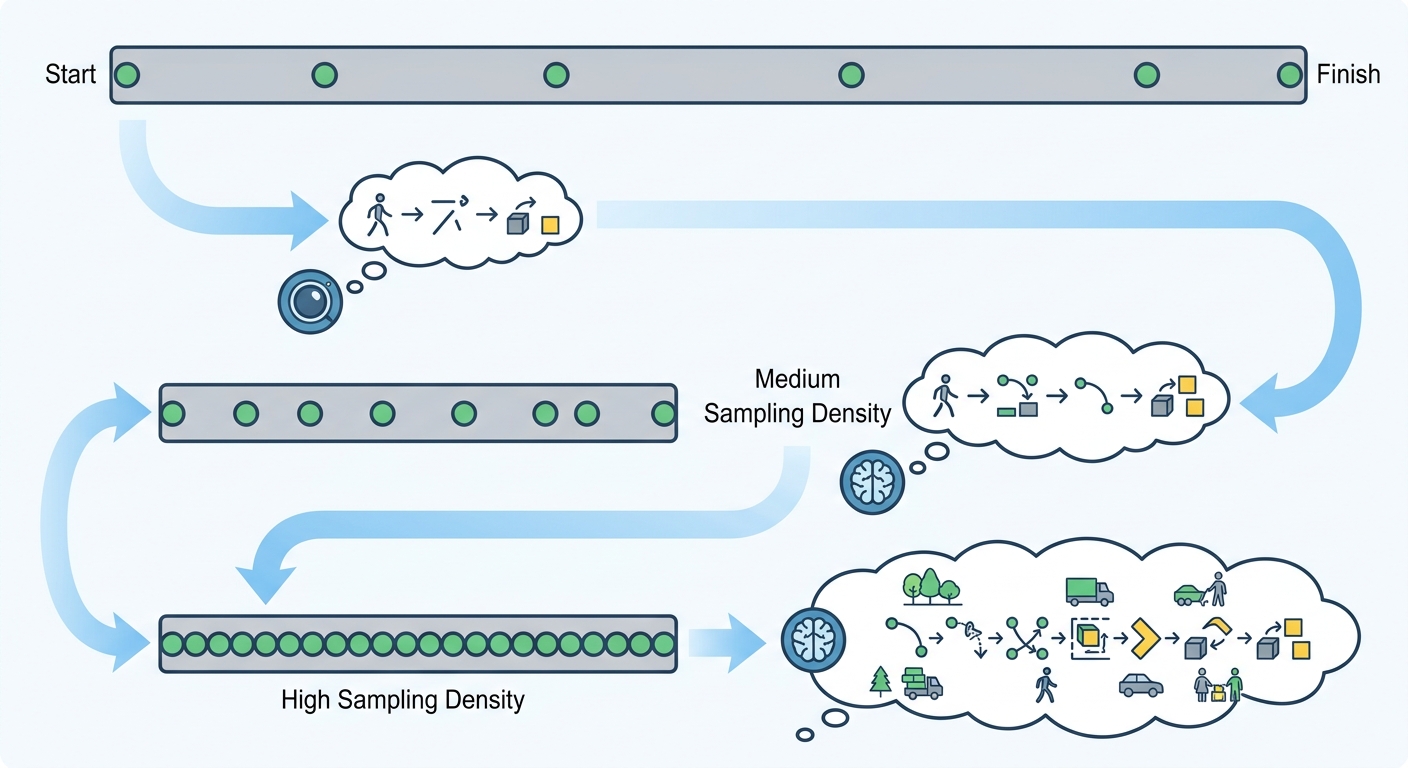
Sampling density changes what a model can perceive. A punch thrown in under a second disappears between sparse frames. A slowly opening door is visible even at low density. The right density depends on your events and your latency budget. Long-video evaluation stresses compute, sampling, and summarization quality.
Summarization quality is the second issue. Long video is often reduced to a summary or highlights. Evaluating summaries needs faithfulness (did it match the video?), coverage (did it include key events?), and redundancy (did it repeat itself?). Few public benchmarks test all three together.
Long-video evaluation forces an economic decision. You trade capability against compute cost. A model that understands hours of footage is useless if it costs too much to run at scale. This is where benchmarks stop helping and your own measurement must begin.
From Leaderboard to Production: A Practical Evaluation Protocol
Public benchmarks give you a shortlist. They do not pick your model. For a real deployment, you need a protocol that measures what your system actually does.
First, build a domain evaluation set. Collect clips from your own data. Label them with tasks you care about: detection, reasoning, captioning, or QA. Even a few hundred labeled clips outperform a generic benchmark for your use case. This set reflects your lighting, your camera angles, and your events. Production validation needs a domain-specific evaluation set, not just public benchmarks.
Second, measure cost and latency. Run each candidate on your hardware. Record inference time, memory, and per-video cost. A model that scores 2 percent higher is not worth a 10x cost increase. Public benchmarks rarely show these numbers.
Third, test reliability. Run the same clip multiple times. Check consistency. Probe edge cases: low light, occlusion, fast motion, overlapping speech. Production systems fail on edges, not on average cases.
Finally, build a human baseline. Have a few people answer the same questions or label the same clips. Compare model scores against human agreement. This shows the ceiling and reveals which skills your model under-delivers on. Human baselines reveal what benchmarks over- and under-measure.
This protocol is not glamorous. It is the only reliable way to convert leaderboard hype into a working system. Public benchmarks measure proxies. Your evaluation set measures the task.
Conclusion
Multimodal video benchmarks are useful but limited. They measure narrow proxies like VideoQA, captioning, grounding, and temporal reasoning. They rarely capture the full difficulty of production video. Contamination, single-frame shortcuts, and verbosity bias inflate scores. Long-video evaluation adds compute and sampling trade-offs.
The path forward is clear. Treat benchmarks as a starting filter, not a verdict. Build a domain-specific evaluation set. Measure cost, latency, and reliability. Compare against human baselines. That combination tells you far more than any leaderboard.
At Algorithmine, we publish practical research like this to help teams make better model decisions. If you want ongoing analysis of video understanding, evaluation methods, and computer vision, subscribe to our portal. We break down the claims, expose the measurement gaps, and give you the protocol that works in production.