Test-Time Compute Scaling: What Actually Improves With More Thinking Tokens
Learn where test-time compute scaling improves accuracy and where it just adds cost. A practical guide to reasoning budgets, verifiers, and inference scaling.
The "Just Think Longer" Assumption
If a model gets better when it reasons longer, why not always max out the reasoning budget? That premise has driven a wave of product decisions over the past two years — turn the reasoning dial to eleven, ship it, and let the benchmark chart climb. The intuition is seductive because it is partly true. On the right tasks, spending more tokens at inference produces genuine, measurable accuracy gains. On competition math, models that score in the low 40s on a first attempt can climb into the 70s and 80s once you allow sampling against an answer checker. Teams have watched those curves and concluded the budget is a free lunch.
But the gains are conditional, not universal. They cluster tightly in verifiable, decomposable problems and decay into pure cost everywhere else. Push a customer-support classifier or a summarization task to a 32,000-token reasoning budget and you typically buy latency, spend, and a small uptick in overthinking errors — not accuracy. The teams getting real value from test-time compute in 2026 are not the ones running the longest chains of thought — they are the ones routing each request to an appropriate reasoning budget. This guide separates what actually improves from what merely gets more expensive. (Related: how to route requests to the right reasoning budget)
What Test-Time Compute Scaling Actually Means
Test-time compute scaling means spending more inference-time computation per request to improve output quality. That computation can take several forms: longer chains of thought, repeated independent samples, search over candidate solutions, and self-verification loops. The model weights are frozen; you are buying accuracy with tokens and latency instead of with training runs.
This is a distinct lever from anything you do at pretraining or fine-tuning, and it behaves differently in practice. It is also the lever most accessible to application teams, because it requires no model training — only orchestration. A team can ship a routing layer in a week without touching a GPU cluster. That accessibility is exactly why the lever gets overused: the cost is easy to incur and easy to hide inside a token bill. (See also: inference scaling vs. training scaling)
Distinguishing Inference Scaling From Training Scaling
Training-time scaling improves a model's capability ceiling by adding parameters, data, and compute. Test-time scaling tries to extract more of the capability already present at inference. The two are complementary, not substitutive: a stronger base model raises the ceiling that extra reasoning can reach, and extra reasoning helps a weaker model only up to a point. A 7B model given unlimited thinking tokens will not close the gap to a frontier model on a hard proof; it will just spend more tokens being wrong.
The cost profiles differ sharply. Training scaling is a large upfront capital expenditure amortized across all future requests. Inference scaling is a per-request operating expense that scales linearly with traffic — which means it lands directly in your unit economics, a theme we return to below. At scale the difference is stark: a $2M fine-tuning run is a one-time line item, while a reasoning budget that adds $0.004 per request across 50 million monthly requests is a $2.4M annual recurring cost that grows with every new user you win. Failure modes differ too: training scaling plateaus, while inference scaling can actively degrade output when pushed past an optimal budget.
The Three Levers: Sampling, Search, and Sequential Revision
Most production systems combine three mechanisms, each with its own scaling curve. Before the curves, note the axis that matters most for SLAs: whether the extra compute runs in parallel or in series. Parallel levers keep latency roughly flat and add cost. Serial levers add latency linearly with budget.
- Best-of-N sampling (parallel). Generate N independent responses and select one — by majority vote, a reward model, or a verifier. Gains follow a diminishing curve as N grows; the selector's reliability caps the benefit. Latency stays close to a single sample; cost scales with N. In practice, moving from N=1 to N=8 often captures most of the available gain on verifiable tasks, and the curve flattens hard past N=16 to N=32 because the selector starts making the same mistakes it was meant to catch. Tools like vLLM and SGLang make the parallel generation cheap; the selector is where the engineering effort belongs.
- Tree or graph search with a verifier (parallel-to-serial hybrid). Explore a branching space of partial solutions and prune with an external signal. Powerful where a verifier exists, expensive and unstable where it does not. Latency grows with search depth and branching factor. A branching factor of 4 with depth 5 is 1,024 leaf evaluations in the worst case — fine for a unit-tested code function, ruinous for a chat reply.
- Sequential self-revision (serial). Let the model critique and rewrite its own output across multiple passes. Cheap to implement, but the weakest link. Self-critique has no independent signal, so it inherits the model's own errors: a confidently wrong intermediate step tends to survive revision, and each pass adds latency. It helps most when the revision is grounded in an external check (a failing test, a schema error) rather than in the model's unaided judgment. A revision loop that runs the test suite and feeds the failure back is a different, far stronger intervention than one that asks the model to "review your work."
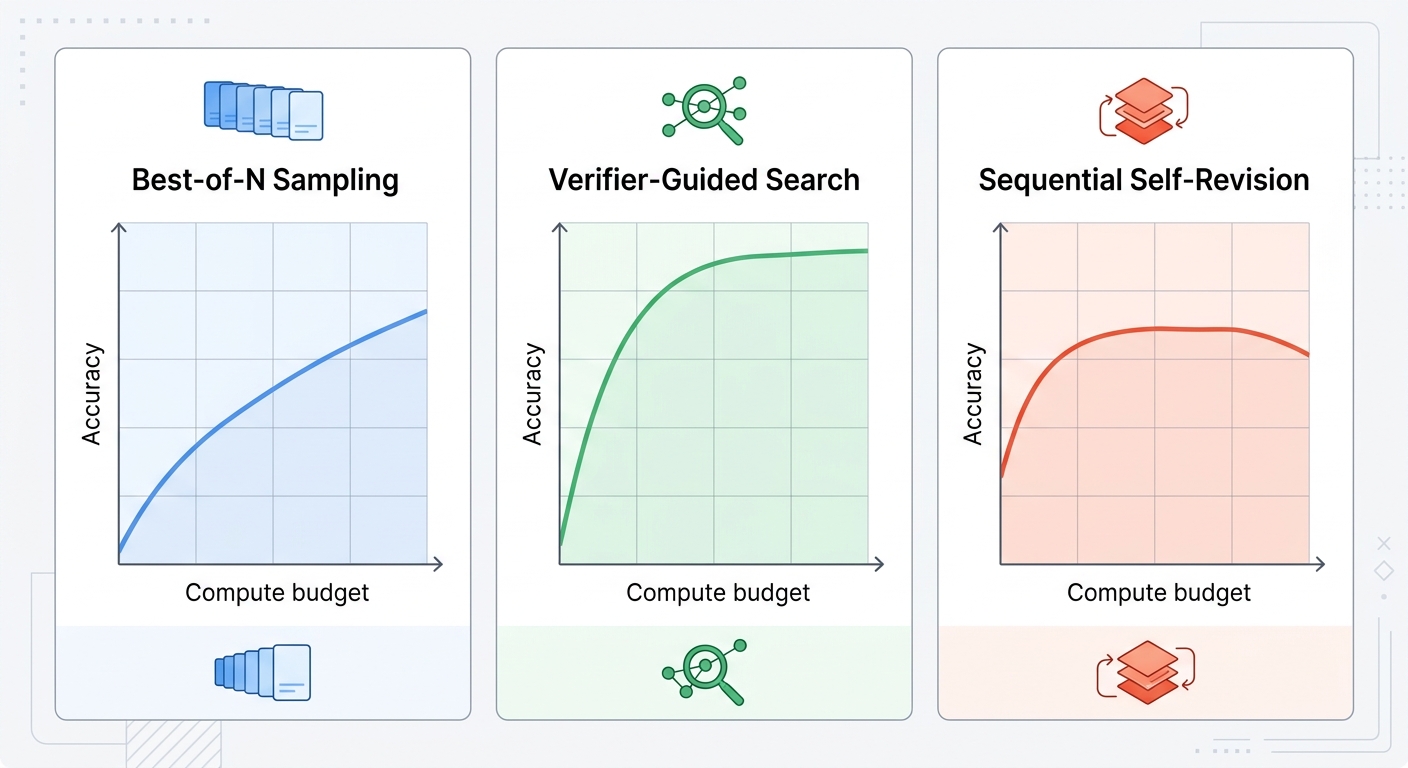
The practical takeaway: the lever matters as much as the budget. Doubling tokens on best-of-N is not the same intervention as doubling tokens on a single chain of thought, and conflating them is a common source of disappointing results. A team that reports "reasoning didn't help" usually means it applied the wrong lever to the wrong task and never isolated which one it was testing.
Where More Thinking Tokens Reliably Help
The pattern across published research is consistent: test-time compute pays off most where there is a reliable correctness signal — something that can tell a good answer from a bad one, whether an external verifier or a well-defined internal check. Where that signal exists, more thinking tokens convert into accuracy. Where it does not, they convert into latency.
Verifiable Domains: Math, Code, and Formal Logic
Competition mathematics, code generation with test execution, and formal proof construction are the showcase domains for inference scaling. The reason is structural, not incidental. A unit test, a proof checker, or an exact-answer match supplies a dense, trustworthy reward signal that lets sampling and search actually discriminate between candidates. Without that signal, generating twenty answers and picking one is close to guessing.
This is why code is often the highest-ROI target for reasoning budgets in production: your existing test suite is a verifier you already own. The model's extra deliberation becomes useful precisely because you can check it. A concrete pattern: generate 8 candidate implementations of a function, run the existing tests against each, and keep the first that passes. If none pass, feed the failure output back for a revision pass. This pipeline routinely lifts pass rates by double-digit percentage points on functions with adequate test coverage, and it costs a fraction of a fine-tuning run. Formal logic follows the same logic — Lean and Coq checkers turn proof search into a verifiable problem, which is why theorem-proving benchmarks respond so strongly to inference scaling. (Related: building a verifier for code generation)
Multi-Step Planning and Tool Use
Gains also appear in decomposable planning tasks — breaking a goal into subtasks, sequencing tool calls, and validating intermediate state. Here the correctness signal is partial: you may not know the final answer is right, but you can often confirm that an intermediate step succeeded (an API returned, a file parsed, a schema validated).
That partial signal is enough to make longer reasoning worthwhile, provided the orchestration layer checks intermediate results rather than trusting the chain end-to-end. The improvement tracks the availability of that check — a recurring theme. An agent that plans a five-step data pipeline and validates each step's output against a schema will catch a malformed query at step two instead of discovering it at step five; an agent that plans the same pipeline and trusts its own chain will propagate the error and burn budget on a doomed trajectory. The difference is not the reasoning budget — it is whether each step is independently checkable. (See: orchestrating tool calls with intermediate validation)
Why Over-Budget Reasoning Degrades
The article's central claim — that more thinking is not always better — needs a mechanism, because teams that skip it over-invest and then blame the model. Three effects drive the decay past an optimal budget:
- Overthinking simple problems. On tasks a model already solves correctly in a short chain, longer deliberation invites second-guessing: the model revisits a correct answer, introduces a spurious consideration, and talks itself out of it. A question like "what is the capital of France" answered in one token becomes a paragraph of hedged reasoning that occasionally lands on a wrong caveat. The effect is well documented in models with visible reasoning traces, where the answer flips from correct to incorrect across the trace.
- Error accumulation in long serial chains. Each step in a chain conditions the next. A small early error compounds, and the longer the chain, the more surface area for that compounding — the serial analogue of a bad retry loop. If each step has a 97% chance of being right, a 50-step chain succeeds only about 22% of the time. Serial reasoning budgets multiply that exposure.
- The selector ceiling. In sampling and search, accuracy is capped by the verifier's ability to pick the right candidate. Once the budget exceeds what the verifier can reliably discriminate, additional samples add cost without adding accuracy — and a weak verifier can actively select worse answers. A reward model that prefers verbose answers will systematically pick the longest, not the best, candidate.
The implication is operational: there is an optimal budget per task class, and it is usually lower than the maximum the model allows. Find it empirically rather than assuming the ceiling is the target. In practice, the optimum often sits at a budget the model's provider would consider "medium" — a few thousand reasoning tokens, not tens of thousands — and the curve past that point is flat or negative.
The question is never "does more thinking help?" It is "is there something in this task that can tell a good answer from a bad one?" Where that exists, reasoning budget compounds. Where it does not, it just costs more.
Routing to the Right Budget
The teams winning with test-time compute treat it as a routing problem, not a dial. A workable pattern:
- Classify difficulty cheaply. Use a small model or a lightweight heuristic to estimate whether the request is trivial, moderate, or hard. This pre-screen costs a fraction of the main call. A 1B-parameter classifier or even a keyword-and-length heuristic can separate "reformat this JSON" from "debug this concurrency bug" at a tiny fraction of the cost of the reasoning call it gates.
- Tier the budget. Send trivial requests to a short chain, moderate ones to a single extended chain, and hard, verifiable ones to sampling or search with a real verifier. Do not apply a search budget to a task with no way to score candidates. Three tiers — fast, standard, deep — cover most production workloads; more tiers add routing complexity faster than they add savings.
- Measure cost per solved task, not cost per token. A budget that doubles tokens but raises solve rate from 70% to 90% is cheaper per success than a lean budget that leaves 30% unsolved and triggers human review or retries. The metric that drives decisions is cost per correctly completed request. If a human review costs $3 and a retry costs $0.40, the math almost always favors spending more on the first call.
- A/B the budget, don't trust the chart. Published scaling curves describe a pattern, not your workload. The optimal budget is a property of your task mix and your verifier, so measur