Test-Time Compute in 2026: What the Reasoning Benchmarks Actually Show
Test-time compute is a real capability lever—but only on some tasks. See what 2025–2026 reasoning benchmarks show about accuracy, cost, and where gains plateau.
The Promise vs. the Evidence
Two years ago, test-time compute was a research curiosity—a line on a scaling-law chart suggesting models might get meaningfully smarter if you simply let them think longer. In 2026, it's a procurement question. Most frontier vendors and several mid-tier ones now ship a "reasoning mode" or a configurable thinking budget, and enterprise RFPs increasingly ask some version of the same thing: how much accuracy do we get per dollar of inference?
The answer, according to the benchmark literature, is more nuanced than the marketing decks suggest. The gains are real—sometimes dramatic—but they are task-dependent, budget-sensitive, and unevenly distributed across problem types. Inference scaling that produces a large jump on competition math can produce flat or even negative returns on open-ended drafting, and the compute cost of chasing the last few points of accuracy frequently outpaces the value delivered.
This article examines what the 2025–2026 reasoning benchmarks actually demonstrate: where inference scaling reliably helps, where it plateaus or reverses, how the cost-per-correct-answer math works out, and how to read vendor claims about "reasoning" without getting fooled by single-point accuracy numbers. The short version: test-time compute is a genuine capability lever, but it's one you have to aim.
What Test-Time Compute Actually Is (and Isn't)
Test-time compute is the additional inference-time work a model performs on a single query before emitting a final answer. When a model "thinks for longer," it is spending more FLOPs at inference—not drawing on a bigger model. But "more compute" is an umbrella, not a technique. Four distinct mechanisms get lumped together, and they behave very differently:
| Technique | What it spends compute on | Best suited to | Primary failure mode |
|---|---|---|---|
| Extended chain of thought | More generated reasoning tokens in one pass | Decomposable problems (math, logic, multi-step code) | Looping, redundant restatement, confident elaboration of a wrong premise |
| Self-consistency / majority vote | N independent samples, vote on the answer | Tasks with a discrete answer space | Cost scales linearly with N; correlated errors don't cancel |
| Best-of-N with a verifier | N samples + a scoring/verification pass | Code, math, anything with a cheap checker | Verifier quality caps the gain; verifier can be gamed |
| Search (tree/graph) | Branching + backtracking over partial solutions | Planning, proof search | High variance, complex to productionize |
Most vendor "thinking budget" knobs control only the first row. If your RFP assumes "reasoning mode" means search or verification, you are buying something different from what you think.
Inference Scaling vs. Training Scaling
The distinction matters because the cost structures differ. Training scaling is a fixed cost amortized across every query. Inference scaling is a marginal cost paid on every call—you pay the reasoning-token premium each time, forever, and it scales with your volume. That flips the economics. A model that is somewhat less accurate but dramatically cheaper per query often wins on total cost of ownership for high-volume, error-tolerant workloads, while a reasoning-heavy configuration only makes sense where errors are expensive or volume is low. The break-even is arithmetic, not ideology: if a reasoning configuration costs C more per query and reduces your error rate by Δe, it pays off only when Δe × (cost of an error) > C. Run that number for your workload before you run the benchmark. (See our breakdown of LLM inference cost optimization strategies.)
The failure modes differ too. Training-scaling limits are gradual and well-understood. Inference-scaling failures are spikier: models can loop, second-guess correct answers, or burn thousands of tokens on a problem a smaller budget would have solved cleanly.
The Chain-of-Thought Multiplier
Chain of thought remains the primary mechanism—the model externalizes intermediate steps, which improves performance on problems that decompose into subproblems. But "more thinking tokens" is not the same as "better reasoning." The 2024–2025 literature on "overthinking" documented this directly: on easy problems, longer reasoning traces frequently reduce accuracy, because the model talks itself out of a correct answer or invents complexity that isn't there. Beyond a task-specific threshold, additional tokens produce redundant restatement, circular verification, or confident elaboration of a wrong premise. The multiplier is real; it just isn't monotonic. (Related: chain-of-thought prompting best practices.)
A related distinction practitioners routinely miss: repeated sampling is not the same as longer thinking. Self-consistency (sample N times, take the majority) improves reliability by averaging out variance; it does not make any single reasoning chain better. If your errors are systematic—the model holds a wrong premise consistently—more samples won't fix it, because the errors are correlated. Verifiers and search address that class of error; raw sampling does not.
What test-time compute is not: a universal accuracy lever you can crank on every workload, a free upgrade (the tokens cost real money and latency), or a substitute for task design. A poorly specified task with ambiguous success criteria does not become well-specified because the model ponders it longer.
"The question is no longer whether inference scaling works. It's whether it works on your task, at your volume, for less than the errors cost you."
How the 2025–2026 Reasoning Benchmarks Are Structured
The benchmark landscape has matured in a specific direction: away from single-number leaderboards and toward accuracy reported as a function of compute budget.
The Benchmarks That Matter Now
Practitioners should track three families:
- Verifiable reasoning suites (competition math, formal logic, code-generation-with-tests). These have objective ground truth, which makes them clean to measure—and also the most saturated and most contamination-prone. They are the best evidence that inference scaling can work and the worst evidence that it will work on your task.
- Agentic and multi-step task benchmarks (tool use, multi-turn planning, environment interaction). These better reflect enterprise workloads but carry higher evaluation variance and are expensive to run at scale. (See agentic AI evaluation frameworks.)
- Domain-specific evaluations (clinical reasoning, financial analysis, legal research, structured data extraction). Least standardized, most relevant to buyers, and most often reported selectively.
Compute-Budget Curves: The New Reporting Standard
The most important methodological shift is that serious evaluations now plot accuracy against inference budget—tokens, samples, or wall-clock cost—rather than reporting a single score at a single setting. A compute-budget curve tells you three things a headline number can't: the ceiling, the slope (how fast you approach it), and the knee (where additional spend stops paying).
Cost-adjusted metrics—accuracy per dollar, or dollars per correct answer—are increasingly reported alongside raw accuracy, and they change the rankings substantially. A model that wins on peak accuracy at unlimited budget can lose badly on efficiency at realistic budgets. (More on our LLM cost-per-token comparison methodology.)
Two caveats apply throughout.
Benchmark saturation. When the top models on a suite cluster within the run-to-run noise band, the suite has stopped discriminating. At that point, ranking on it is measuring noise. A practical heuristic: if the gap between the top few entries is smaller than the reported variance across seeds, treat the suite as saturated and stop citing its leaderboard.
Contamination. Test items leaking into training data inflates scores in ways that are hard to detect and rarely disclosed. You cannot fully audit a vendor's training set, but you can probe: run date-shifted or paraphrased variants of public items, check performance on held-out items you wrote yourself, and watch for the tell-tale pattern of near-perfect scores on famous benchmarks alongside weaker performance on private equivalents. Treat any single benchmark number, however impressive, as one data point among several. (See our guide to detecting benchmark contamination.)
Where Inference Scaling Reliably Helps—and Where It Doesn't
The pattern across the 2025–2026 literature is consistent enough to plan around:
Reliable, large gains: competition-style math, formal logic, code that can be checked with tests, and any task with a clean verifiable answer. These are the workloads where the compute-budget curve has a steep slope and a high ceiling—and where a verifier or majority vote compounds the gain.
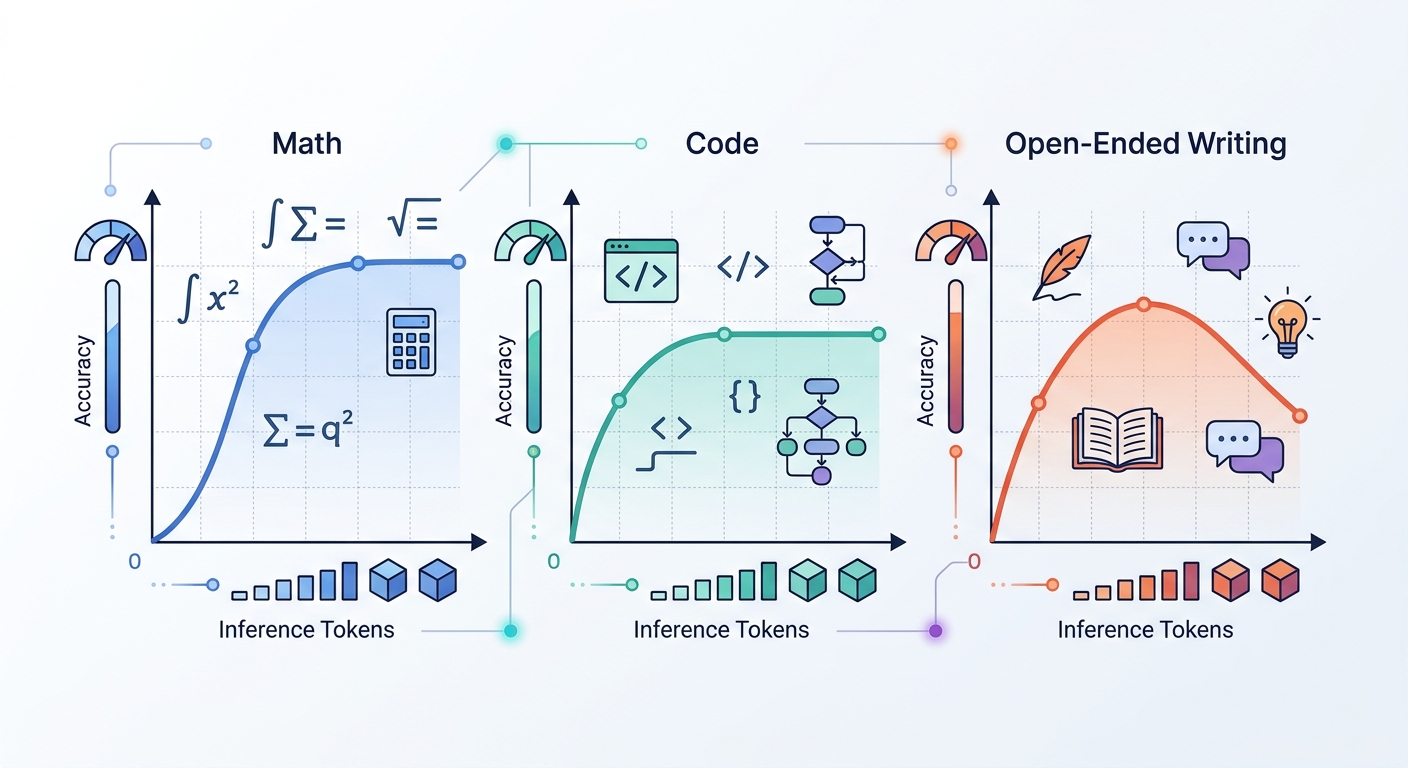
Moderate, budget-sensitive gains: multi-step planning and tool use, structured extraction from messy documents, and analytical tasks with a checkable end state. Gains are real but the knee arrives early; you often get most of the benefit at a fraction of the maximum budget.
Flat or negative returns: open-ended drafting, summarization, conversational tasks, and anything where "more reasoning" invites the model to over-elaborate or hedge. On these, a longer thinking budget buys latency and cost with little accuracy to show for it—and sometimes buys worse output.
The practical implication: do not deploy one reasoning budget across all workloads. Route by task type. Reserve the expensive configuration for the verifiable, high-error-cost cases; run the cheap configuration everywhere else.
Reading Vendor Reasoning Claims
Three questions separate a real capability claim from a marketing number:
- At what budget? A peak-accuracy figure at maximum thinking tokens tells you the ceiling, not the operating point. Ask for the curve, or at least the score at your target budget.
- On what distribution? Public benchmark, private held-out set, or cherry-picked examples? Ask how contamination was controlled.
- At what cost and latency? Accuracy per dollar and p95 latency at your volume. A reasoning mode that triples latency may be unusable regardless of accuracy.
If a vendor can't answer all three, you're looking at a demo, not an evaluation.
Bottom Line
Test-time compute is a real and sometimes large capability lever—but it is a budget you allocate, not a switch you flip. The enterprises that get value from it in 2026 are the ones that (a) route reasoning budget by task type, (b) measure accuracy per dollar on their own distribution rather than trusting leaderboards, and (c) run the break-even arithmetic against the cost of their errors before scaling inference spend. Everyone else is paying a reasoning-token premium for numbers that don't survive contact with their workload.