Structured Output Reliability: Why Your JSON Parsing Still Breaks in Production
Constrained decoding won't stop silent JSON failures. Learn the semantic, schema, and operational failure modes that break structured output in production.
The JSON Parsing Problem You Thought You Solved
Teams adopt structured output and constrained decoding expecting the JSON parsing problem to disappear. Enforce a schema, turn on strict mode, wire up function calling, and the model should hand back clean, machine-readable data every time. That's the pitch. Then production telemetry arrives: parse exceptions at 0.3%, downstream validation failures at 2%, and a slow trickle of records that pass every check and are still wrong.
The uncomfortable truth is that JSON validity is largely a solved problem at the syntax layer. Modern constrained decoding rarely emits unterminated strings or stray commas. The reliability failure has moved. It now lives at the semantic layer (values that are plausible but false), the schema-evolution layer (prompt and validator drifting apart), and the operational layer (truncation, provider quirks, silent coercion).
This piece is for engineering leaders and practitioners who have already shipped structured output and are now debugging why it still breaks. We'll separate what constrained decoding actually guarantees from what your validator assumes, catalog the failure modes that survive syntax enforcement, and lay out a reliability stack you can measure before the next release. (Related: schema design patterns for reliable LLM output)
The Promise vs. the Production Reality
The vendor narrative is seductive and mostly accurate as far as it goes. JSON schema enforcement, grammar-constrained decoding, and function calling all reduce malformed output dramatically. Teams that migrate from free-text prompting to a strict schema typically see parse-failure rates fall sharply — often by an order of magnitude, though the exact improvement depends on the model, the schema, and the provider's enforcement mechanism. That's real progress, and it's worth celebrating.
But "dramatically fewer parse failures" is not "reliable structured output." A persistent floor of errors remains that no amount of schema strictness removes. The failures cluster into three distinct layers, and conflating them is why teams keep misdiagnosing the problem:
- Syntactic failures — unterminated JSON, invalid escapes, truncated objects. Now rare, and constrained decoding addresses most of them.
- Structural/schema failures — wrong types, missing required fields, unexpected keys, enum violations. Common, and only partially addressed by strict modes.
- Semantic failures — structurally perfect records containing wrong values, hallucinated IDs, or plausible-but-false facts. The dominant residual failure class in most production reports, and completely invisible to JSON Schema.
The dangerous failure isn't the one that throws a parse exception. It's the one that validates cleanly and corrupts your warehouse.
Most teams instrument for layer one, spot-check layer two, and have no systematic coverage for layer three. That gap is where production incidents are born. (See also: instrumenting LLM pipelines for silent data corruption)
The arithmetic is worth sitting with. Suppose you process 10 million structured records a month. A 0.3% parse-exception rate is 30,000 failures — noisy, visible, and almost certainly already triaged. A 2% downstream validation failure rate is 200,000 records that need rework or quarantine. But the silent semantic failure rate is the one nobody measures, and even a conservative 0.1% error rate means 10,000 records a month entering a warehouse or a billing system with values that are wrong but perfectly well-formed. Those don't page anyone. They surface weeks later as a reconciliation discrepancy, a customer complaint, or a model retraining run that learns from its own corrupted labels.
The pattern repeats across stacks: teams over-invest in layer one because it's the layer the vendor promised to solve, under-invest in layer three because it requires domain knowledge to define what "correct" even means, and leave layer two in a default configuration that quietly coerces instead of rejecting. The reliability work is moving validation upward in the stack, not making the grammar stricter.
Why Constrained Decoding Doesn't Guarantee Valid JSON
To understand the residual error rate, you need to know what constrained decoding actually does — and what it doesn't. At each generation step, the model produces a probability distribution over its vocabulary. Constrained decoding applies a hard mask to that distribution: logits for tokens that would violate the active grammar are set to negative infinity, so they cannot be sampled. This is distinct from logit biasing, which is a soft technique — it up-weights likely-valid tokens without excluding invalid ones, and therefore provides no formal guarantee. Grammar-guided sampling tracks a formal parser (typically a finite-state machine or pushdown automaton) alongside generation so the mask is always computed against the current parser state; some implementations "fast-forward" through deterministic grammar regions, emitting multiple tokens per forward pass.
The critical distinction: constrained decoding guarantees conformance to the grammar you gave it, not to the schema you have in mind. If the grammar is a generic "any valid JSON" matcher, you get syntactically valid JSON of arbitrary shape. If the grammar encodes your full schema — required fields, types, enums, nesting — you get much closer. But enforcement depth varies by provider and by API surface. Some providers enforce the full schema at the decoding layer; others enforce at the API layer via post-hoc validation and retry (for example, OpenAI's strict: true structured outputs reject non-conforming generations server-side rather than masking tokens); still others expose only a generic JSON grammar. Streaming modes and partial-grammar support are the most common places where guarantees weaken. Test the specific endpoint and model version you ship against — do not assume the guarantee transfers.
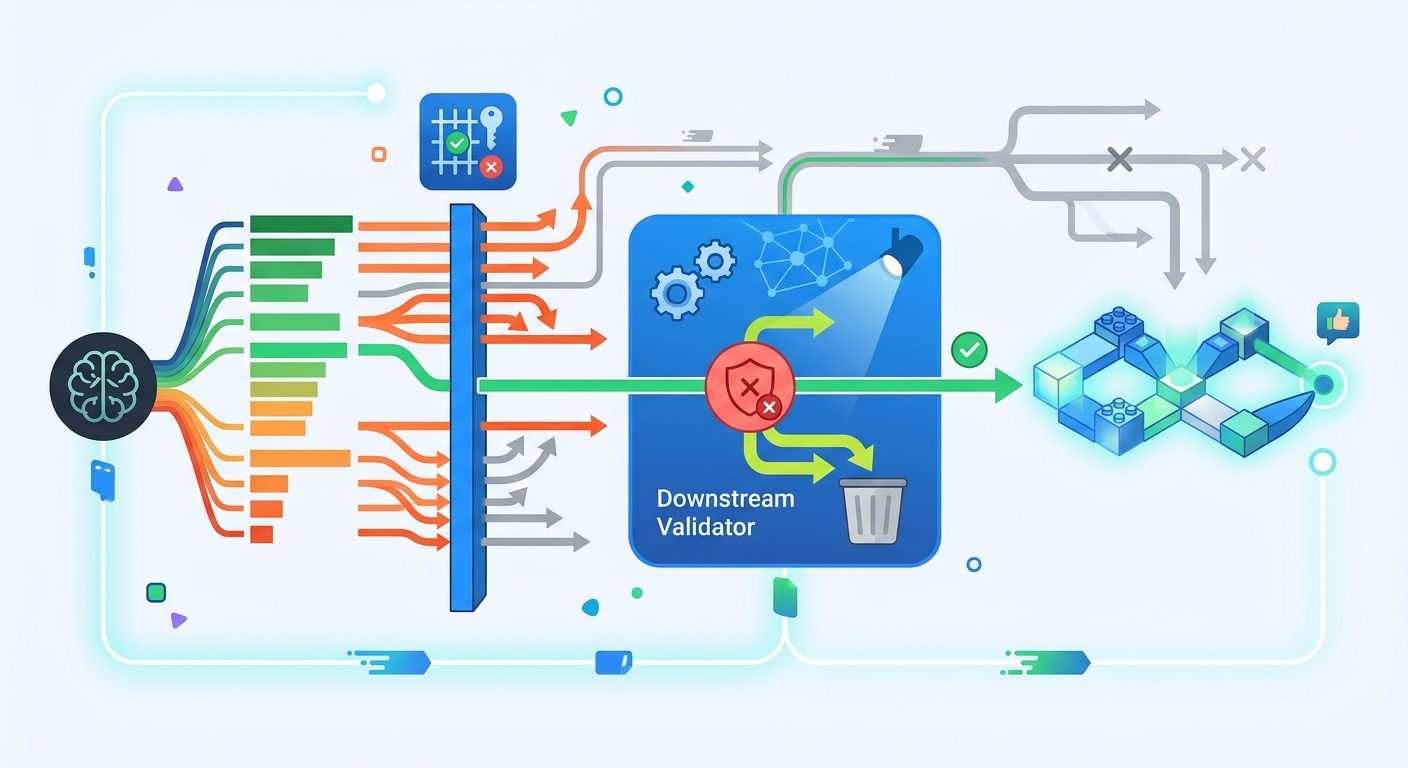
There are also practical constraints that push teams toward weaker grammars. Full-schema grammars can be expensive to compile and maintain, and some inference servers cap grammar complexity or fail closed on pathological schemas (deeply recursive definitions, large enums). Fast-forwarding through deterministic regions is an optimization, not a guarantee — implementations differ in how completely they apply it, and the performance cost of a strict grammar can be material at high throughput. And because the mask operates on tokens, not on meaning, a grammar that correctly permits the token sequence "status": "cancelled" cannot know whether cancellation is the right value for this record. The mask enforces form; it is blind to truth.
So the guarantee is narrower than the marketing implies. It's a strong prior toward well-formed output, not a proof of schema conformance, and certainly not a proof of correctness. (Deep dive: how grammar-constrained decoding works under the hood)
Schema Compliance ≠ Semantic Correctness
A record can pass every JSON Schema check and still be garbage. Schema validation confirms shape: this field is a string, that field is an integer, this enum value is in the allowed set. It says nothing about whether the string is a real customer name, whether the integer reflects the actual quantity, or whether the enum value was chosen for the right reason.
Common semantic failures that sail through validation:
- Hallucinated enum values that happen to exist in your allowed set but are wrong for the context.
- Plausible-but-false values — a fabricated order ID in the correct format, a made-up date within a valid range.
- Null where required semantically — the field is optional in the schema but downstream logic assumed it was present.
- Type coercion — the model emits
"5"where you expected5, and your validator coerces it silently.
A related trap: JSON Schema's format keyword (e.g., "format": "email", "date-time", "uuid") is annotation-only by default in most validators, including the widely used jsonschema Python library unless a format checker is explicitly enabled. Teams routinely assume format is enforced and discover in production that it isn't.
The hallucinated-enum case deserves elaboration because it's the most insidious. If your schema constrains status to ["pending", "shipped", "delivered", "cancelled"], the grammar guarantees one of those four tokens appears. It does not guarantee the model picked the one that matches the underlying reality. A support-ticket classifier that emits "delivered" for a shipment still in transit passes every structural check and silently corrupts your fulfillment metrics. The fix is not a tighter grammar — it's a cross-check against an authoritative source: does the order's actual state in your system agree with the model's claim? That's a semantic validation, and it lives outside JSON Schema entirely.
The same logic applies to identifiers. A generated order_id of "ORD-2024-88431" is format-valid and almost certainly fabricated unless the model had that ID in its context. Referential integrity — confirming the ID exists in your database before acting on it — is the only reliable defense, and it's a database lookup, not a schema check.
JSON Schema validates shape, not truth. Treat it as a gate, not a guarantee. (Related: adding semantic validation layers to structured output)
The Tokenizer and Context-Window Edge Cases
Even perfect grammars break at the edges. Truncation mid-object is the classic: the model hits max_tokens and stops with an unterminated JSON object. Constrained decoding can't help because generation was cut off, not misdirected. Streaming consumers that parse incrementally see partial objects and either throw or, worse, accept a fragment. Mitigation is operational, not grammatical: set max_tokens with headroom for your largest expected object, detect finish_reason == "length" explicitly, and never treat a streamed partial parse as authoritative until the object closes.
Other edge cases that bite:
- Unicode and escaping — emoji, RTL text, or control characters that the model escapes inconsistently across providers; byte-level BPE tokenizers can split multi-byte characters in ways that produce valid-but-mangled strings.
- Schema drift — the prompt says one thing, the validator enforces another, and the model splits the difference. This is the most common cause of "it worked in staging."
- Silent coercion — the validator accepts and mutates values rather than rejecting them. Pydantic's
coerce_numbers_to_strwill happily turn5into"5"; many validators accept5.0for an"integer"field;additionalProperties: falsebehaves differently across JSON Schema drafts. Each coercion hides a model error that should have surfaced as a failure.
Schema drift is worth a concrete example because it accounts for a disproportionate share of staging-to-production surprises. A prompt template says "return the price in dollars," the schema field is named price_cents, and the validator accepts any positive integer. In staging, with a handful of hand-picked examples, the model happens to return cents and the numbers look right. In production, a meaningful fraction of responses return dollars, the validator passes them because they're positive integers, and you've just under-billed or over-billed by a factor of 100. The schema was never the source of truth — the prompt was — and nobody reconciled them. The discipline is to generate the prompt's field descriptions from the schema itself, or to fail the build when the two diverge, so there is exactly one definition of what a field means.
Truncation has a subtler cousin: partial-object acceptance in streaming pipelines. If your consumer parses each SSE chunk independently rather than accumulating until a brace-balanced object closes, it will occasionally emit a record assembled from a fragment. The failure is intermittent and load-dependent — more likely under high concurrency when generation is slower relative to your read loop — which makes it maddening to reproduce. The fix is a buffered parser that only emits on a complete, grammar-balanced value, plus an explicit check that the stream terminated with a normal finish reason rather than a length cut.
The Reliability Stack You Can Measure
Syntax enforcement alone will not get you to production-grade reliability. What does is a layered stack where each layer has an explicit contract and a metric:
- Generation constraints — schema-encoded grammar or API-level strict mode, tested against your actual endpoint. Metric: raw parse-failure rate.
- Structural validation — a strict validator with format checking enabled,
additionalPropertiesbehavior pinned to a draft, and coercion disabled. Metric: structural rejection rate. - Semantic validation — referential checks (does this ID exist?), range and cross-field invariants, and where feasible a second-model or rule-based verifier. Metric: semantic rejection rate, samp