Tokenizer Design for Multilingual LLMs: Vocabulary Choices That Compound
Optimize multilingual LLM tokenizer design. Learn how vocabulary size, fertility, and BPE choices compound into token efficiency, compute savings, and capability.
Why Tokenizer Design Is a Compounding Decision
The tokenizer is the one component of an LLM stack that teams choose in a single afternoon and then live with for years. It sits upstream of every training run, every fine-tune, and every inference call. When it is right, no one notices. When it is wrong for a language or domain, the cost shows up in sequence lengths, GPU bills, and quietly degraded quality for users who are not writing in English.
The reason tokenizer decisions compound is that they are effectively frozen at the moment of pretraining. Changing a tokenizer after the fact invalidates the embedding matrix, the output head, and every artifact trained against the original vocabulary. In practice, this means a vocabulary chosen in week one of a project becomes load-bearing infrastructure for the entire product lifecycle. Teams that treat it as a preprocessing detail rather than an architecture decision inherit that choice for years.
That is why tokenizer design deserves more scrutiny than it typically gets. Vocabulary choices do not just affect how text is chopped up; they determine how much compute each request consumes, how efficiently context windows are used, and how well a model transfers knowledge between languages. A vocabulary that produces 30% more tokens for a target language means 30% longer sequences on every request — and that penalty is paid on every request, forever. Prefill compute and KV-cache memory scale roughly with token count, so the inefficiency compounds across your entire serving footprint. At scale, a 30% token inflation on a language that represents a quarter of your traffic becomes a 7.5% surcharge on total inference spend, paid indefinitely, with no path to remediation short of retraining.
The compounding runs in both directions. A tokenizer that allocates merges well to your target languages shortens sequences, frees context window for actual content, and reduces the per-token cost of serving those users. Those gains also compound — quietly, in the right direction — across every request the model ever handles. The asymmetry is that bad tokenizer decisions are visible in the bill and invisible in the quality metrics, while good ones are invisible everywhere except the bill.
This article is written for the practitioners and engineering leaders who have to make this call and defend it. We will trace the through-line from token efficiency to compute to capability, and lay out the vocabulary decisions that compound in your favor versus the ones that quietly compound against you. (See also: LLM inference cost optimization.)
How Vocabulary Size Shapes Multilingual Performance
Vocabulary size is the most visible knob, and it is a genuine trade-off rather than a "bigger is better" setting. A larger vocabulary compresses text into fewer tokens, which shortens sequences, reduces prefill compute and KV-cache footprint, and lets you fit more content into a fixed context window. But every additional token adds an embedding row and a softmax output unit, and those parameters scale with the full vocabulary across every layer that touches them.
The arithmetic matters. With a 100k-token vocabulary and a 4,096-dimension model, the input embedding matrix is roughly 410M parameters; if input and output embeddings are tied, that is ~820M parameters before you train a single transformer block. For a sub-1B or distilled model, that is a material share of the parameter budget. For a 70B model, it is a rounding error. The cost of vocabulary is not absolute — it is relative to model size.
The practical consequence is a coverage-versus-parameter-budget tension. You can spend parameters on script coverage for dozens of languages, or you can keep the vocabulary lean and accept longer sequences. There is no setting that maximizes both. The right answer depends on your language mix, your latency targets, model size, and whether you are training from scratch or adapting an existing model. (Related: multilingual LLM architecture decisions.)
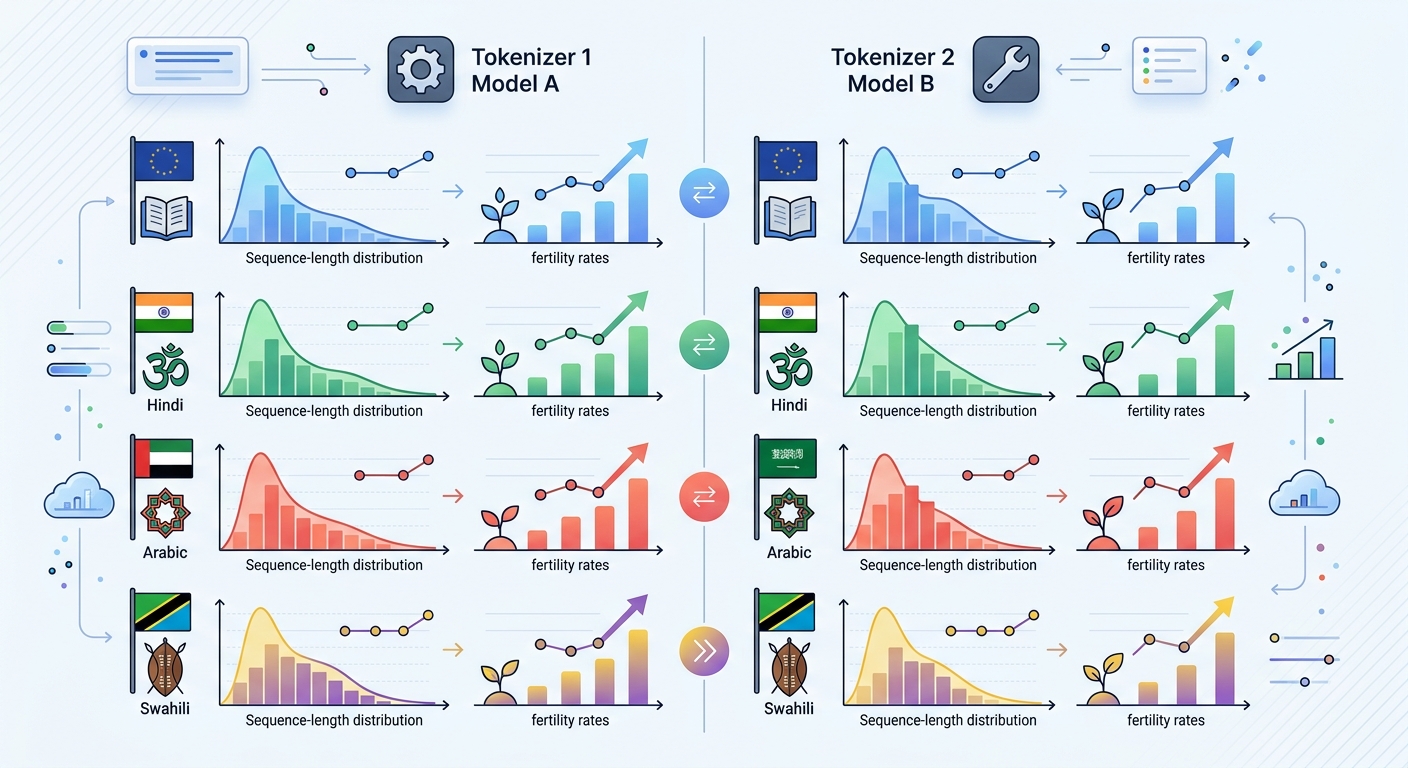
The Fertility Problem: Tokens per Word Across Languages
The standard metric here is fertility, the average number of tokens a tokenizer produces per word (or per character, for scripts without whitespace). Fertility is where multilingual tokenizers reveal their bias. English-centric BPE vocabularies typically land around 1.2–1.4 tokens per English word, while languages such as Hindi, Arabic, Amharic, or Swahili routinely run two to three times higher depending on the tokenizer and script — a gap documented systematically in Petrov et al. (2023), "Language Model Tokenizers Introduce Unfairness Between Languages," and visible across the XLM-R and mGPT tokenizer families. Treat any single fertility number as tokenizer- and corpus-specific; compare tokenizers on your own language mix rather than trusting published averages.
That gap is not cosmetic. Higher fertility means longer sequences, more compute per document, and a smaller effective context window for those users. A model with a 128k-token context might offer the practical equivalent of a third of that to a language whose text tokenizes three times less efficiently. (See: token fertility benchmarks across languages.)
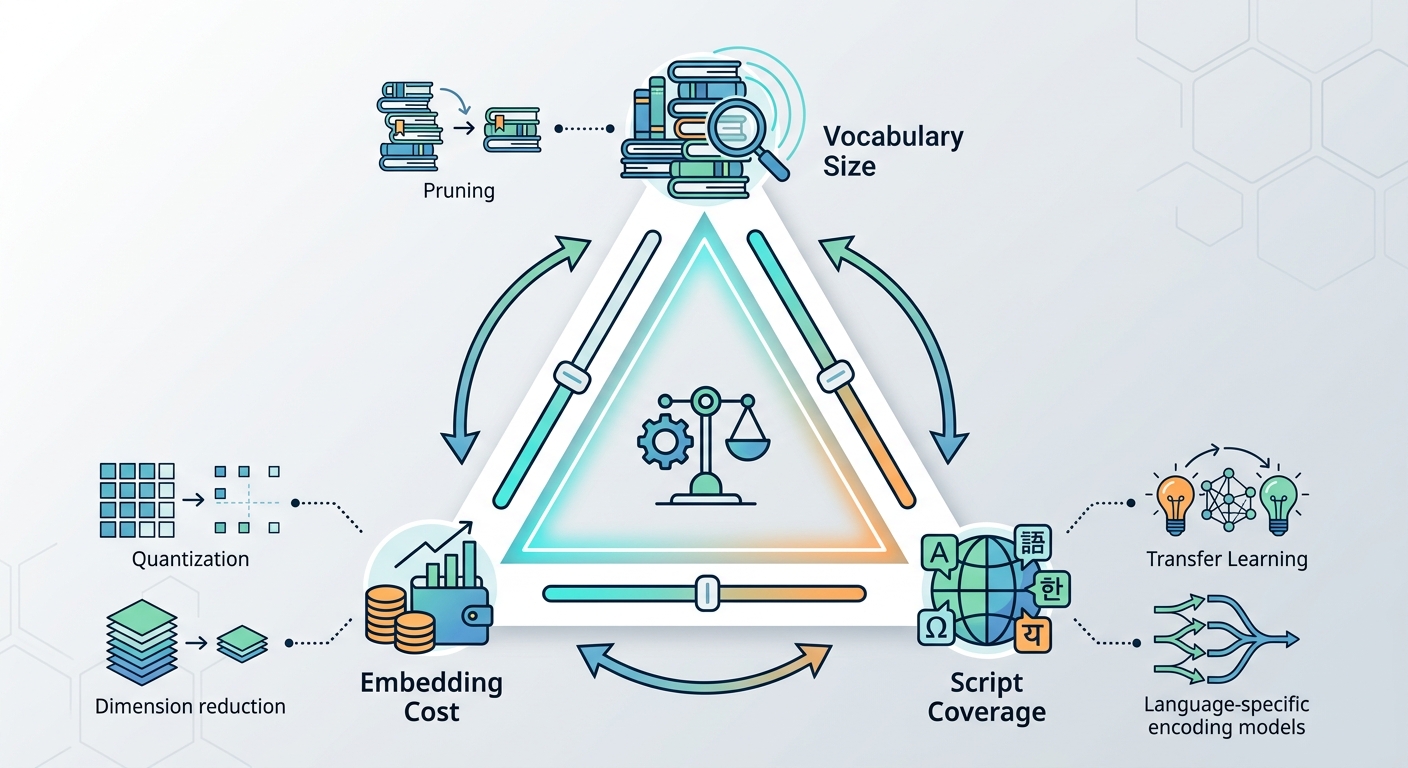
The Trade-off Triangle: Vocab Size, Embedding Cost, Coverage
Think of tokenizer design as a triangle with three corners: vocabulary size, embedding cost, and script coverage. Push toward broad coverage and you grow the vocabulary; grow the vocabulary and you inflate embedding parameters; constrain parameters and you sacrifice coverage or accept fragmentation. Every real tokenizer sits somewhere inside that triangle, and the design question is which corner your workload can least afford to give up.
Byte Pair Encoding and Its Multilingual Blind Spots
Byte pair encoding (BPE) remains the default for most production LLMs, and for good reason: it is simple, deterministic, and effective on the data it was trained on. BPE starts from individual bytes or characters and iteratively merges the most frequent adjacent pairs until it hits a target vocabulary size. The merges that survive are, by construction, the ones that appear most often in the training corpus.
That is also the problem. BPE's merge frequency is a direct function of corpus composition, so a tokenizer trained on a predominantly English corpus will allocate the overwhelming majority of its merges to English subwords. Languages with fewer tokens in the training data get fewer merges, which means their words get split more aggressively. (Related: BPE vs. SentencePiece tokenization.)
Why BPE Underserves Low-Resource Languages
For a low-resource language, the tokenizer often has no merge that spans a full common word, so it falls back to character- or byte-level pieces. A single word may become five, eight, or a dozen tokens. This has two consequences. First, it is a fairness issue: users of those languages pay more per request for the same content. Second, it is a capability issue: long fragmented sequences make it harder for the model to learn stable representations, and they crowd out useful context.
A tokenizer trained on English-heavy data does not just tokenize other languages inefficiently. It encodes a structural disadvantage into every downstream step, from pretraining loss to per-request cost.
Byte-Level Fallbacks and the Cost of Fragmentation
Byte-level fallback is the safety net that guarantees any input, in any script or encoding, can be represented. That guarantee matters. But fallback is a last resort that produces maximum fragmentation: every unseen character becomes a multi-byte sequence of tokens. When fallback rates are high for a language, sequences bloat, throughput drops, and the model spends capacity reconstructing characters rather than reasoning over meaning. Coverage without efficiency is a partial win at best — the tokenizer can represent the text, but at a cost that erodes both quality and margin.
Design Levers That Compound in Your Favor
Diagnosis is cheap; the value is in the levers. These are the decisions that move fertility and cost in the right direction, in rough order of leverage.
1. Set vocabulary size against your model size and language mix. A single-language English model at 7B is well served by a 32k–50k vocabulary. A model that must serve a broad multilingual mix benefits from 100k–250k, but only if the parameter budget can absorb the embedding cost. Rule of thumb: the smaller the model and the broader the language mix, the more carefully you must justify each additional token.
2. Rebalance merge allocation with subword regularization. SentencePiece's character_coverage and its sampling-based training (BPE-dropout, unigram with subword regularization) let you weight underrepresented scripts so they receive a fairer share of merges. Training on a language-balanced or temperature-sampled corpus — rather than the raw web frequency distribution — is often the single highest-leverage fix.
3. Use script-aware pretokenization. Whitespace-based pretokenization breaks down for scripts that do not delimit words (Chinese, Japanese, Thai) and mis-handles combining marks and right-to-left text. A pretokenizer that respects Unicode script boundaries and normalization (NFC) prevents pathological splits before BPE ever runs.
4. Extend an existing vocabulary rather than retrain. For adapting a base model to a new language, vocabulary extension via embedding surgery — adding merges for high-frequency target-language subwords and initializing their embeddings (e.g., as the mean of their component tokens) — preserves the base model's English competence while cutting fertility for the new language. This is usually cheaper and less risky than a from-scratch tokenizer, which invalidates every downstream artifact.
5. Evaluate on fertility and downstream tasks. Fertility is a proxy. A tokenizer with lower fertility can still hurt if it destroys morphological structure the model needs. Measure tokens-per-character and tokens-per-word o