Data Provenance Audits for LLM Training: What Model Teams Actually Check
See what auditors actually check in LLM data provenance reviews—lineage records, licensing evidence, PII removal trails, and the artifacts model teams must produce.
The Provenance Reckoning
Two years ago, a data provenance question might have surfaced in a security questionnaire and died in a spreadsheet. Today it arrives as a formal audit request from a customer's legal team, a procurement clause with a 30-day response window, and a regulator's transparency inquiry — often in the same week. For model teams, the question has shifted from "where did the data come from?" to "can you prove it, on demand, tied to a specific model checkpoint?"
That shift changes the job. Provenance is no longer a documentation afterthought; it is a control that either exists at ingestion or cannot be reconstructed later. This article covers what auditors, enterprise buyers, and internal review teams actually examine when they assess an LLM training corpus — the evidence types, the artifacts, the interview questions, and the red flags — and what it takes to be audit-ready before the request lands. (See also: [LLM data lineage and traceability best practices].)
Why Data Provenance Audits Became a Gate, Not a Formality
Regulatory and contractual pressure
The EU AI Act's transparency obligations for general-purpose models require providers to publish a sufficiently detailed summary of training content. Specifically, Article 53(1)(d) obliges providers of general-purpose AI models placed on the market from 2 August 2025 to draw up and make available such a summary, following the template issued by the European AI Office in July 2025; providers of models released under a free and open-source license may be partially exempt under Article 53(2). In the US there is no federal AI-provenance mandate, but two pressures are real: state comprehensive privacy laws grant data-subject rights (access, deletion) that reach personal data in training corpora, and FTC Section 5 unfairness exposure applies to undisclosed or deceptive data practices. In practice, though, enterprise procurement is moving faster than regulation. Large buyers now write provenance warranties into master agreements: representations about licensed data, indemnification for copyright claims, and audit rights that let the customer inspect records. Legal, security, and procurement teams ask the same question in three different vocabularies, and all three expect an answer with evidence attached.
The cost asymmetry of bad provenance
The economics are lopsided. Capturing a license at ingestion adds near-zero marginal cost to a pipeline that is already logging every document; reconstructing one after a takedown notice can take weeks of engineering time across data, legal, and infra teams. The downside is not just legal fees — it is retraining a model, re-certifying it, and renegotiating contracts. A single undocumented corpus can trigger a model rollback months after launch. Teams that treat provenance as insurance usually do so after seeing the alternative.
"The audit request rarely comes with a quarter's notice. It comes with a deadline, a data-room link, and a list of models the customer already depends on."
What a Provenance Audit Actually Examines
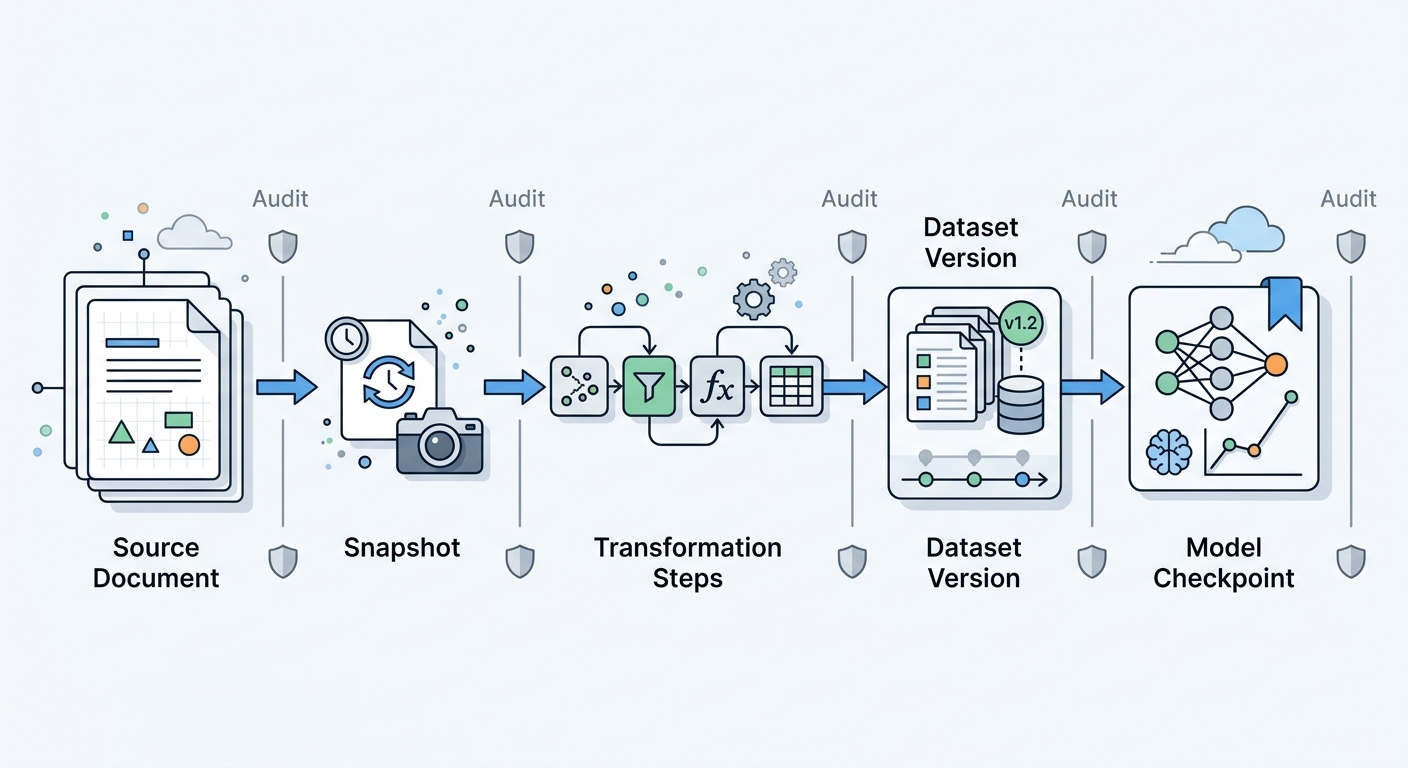
A credible audit traces a specific model version back to individual source documents and forward through every transformation. It examines four evidence domains.
Source inventory and lineage records
Auditors want a per-document record of origin: the URL or API endpoint, the collection method (crawler, licensed feed, partner transfer, user contribution), the collection timestamp, and the full transformation history — deduplication, filtering, redaction, and any synthetic augmentation. The unit of evidence is the document, not the dataset. A statement that "the corpus came from Common Crawl and three licensed providers" is a narrative, not a record. What passes is a machine-readable inventory where any training example can be resolved to a source, a snapshot date, and a processing step. Gaps here are the most common finding: teams can name their sources but cannot enumerate them at document level. (Related: [building a document-level source inventory for training data].)
Licensing and rights documentation
The second domain is rights. Auditors check whether license text was captured at ingestion — the actual terms in force on the date of collection — rather than reconstructed from memory or a current website. They look for commercial-use flags per source, snapshots of terms of service, and records of robots.txt and opt-out compliance at crawl time. For licensed corpora, they want the contract, the delivery manifest, and confirmation that the license permits training use, derivative models, and the intended distribution.
Post-hoc license inference is a red flag — but the finding is "no contemporaneous record," not "a record was reconstructed." Distinguish two cases. If no evidence exists and the license was inferred from a current website after the fact, the audit cannot distinguish compliance from coincidence, and that is a finding. If contemporaneous capture was impossible (a pre-existing corpus, a partner transfer), a reconstruction from an authoritative archive — a Wayback Machine snapshot, a contract archive, a signed delivery manifest — with a documented method and timestamp can be acceptable, provided the caveat is disclosed. The failure mode is silent inference presented as fact.
Consent, PII, and removal trails
Where personal data or user-generated content is involved, auditors trace the removal trail. If a data subject exercised a deletion right, or a site owner opted out, can the team show that the removal propagated across every snapshot and derived dataset — including filtered copies, deduplicated shards, and any synthetic data generated from the removed content? They check data subject request handling, retention schedules, and whether opt-out lists were applied at each pipeline run.
The hard question is the derived-data question, and it needs a mechanism, not a promise. Three controls make propagation checkable: (1) a removal registry of content hashes and fuzzy-match signatures for removed documents, consulted at every pipeline stage including synthetic generation; (2) provenance tags carried on synthetic examples that record the source documents they were generated from, so a removal can be resolved to the synthetic records it implicates; and (3) a re-derivation rule that marks or regenerates synthetic data whose source set intersects the registry. Removal from the raw corpus is table stakes; removal from downstream artifacts is where teams fail.
Corpus quality and contamination checks
The fourth domain is less about rights and more about integrity. Auditors examine deduplication logs, benchmark-contamination scans, and quality-filter definitions, and they ask whether filter decisions are reproducible — can you rerun the pipeline and get the same corpus? Contamination is a provenance problem because it is a traceability problem: if you cannot show which documents were screened against which benchmarks, you cannot defend your evaluation numbers.
Reproducibility is a concrete artifact set, not a claim: the filter code at a pinned commit SHA, the container image digest, the config file with thresholds and random seeds, and the hash of the input snapshot the run consumed. With those four, an auditor can re-execute the run and compare output hashes. Without them, "we filtered for quality" is unauditable.
The Artifacts Auditors Ask For
The audit is largely an artifact review. Three categories carry most of the weight.
Data cards and dataset documentation
Data cards describe the corpus: composition, collection window, known limitations, language and domain distribution, and preprocessing steps applied. Auditors read them less for completeness than for consistency — does the card's described composition match the document-level inventory and the dataset version actually used in training? A card that says "web crawl, English-dominant, 2023 collection window" while the inventory shows multilingual sources through 2024 is a finding, because it means at least one of the two records is wrong. Version the card alongside the dataset and link it to the specific snapshot hash.
Model and system cards
Model documentation must connect the checkpoint to the corpus. The model card should name the dataset version(s) trained on, the evaluation methodology, and known limitations traceable to data. The audit question is a join: can you walk from the model version in production to the exact dataset snapshot and from there to the document-level inventory? If the model card references "our proprietary corpus" without a version identifier, the chain breaks at the first hop.
Audit logs and access records
Finally, auditors want evidence that the controls ran. That means pipeline run logs with timestamps, the identity of who changed filter definitions or opt-out lists, and access records for the source inventory itself. Immutable, append-only logs carry disproportionate weight: a log that can be edited after the fact is treated as a narrative, not a record.
The Interview Questions Behind the Artifacts
Artifacts can be staged; interviews expose gaps. Expect questions like: Who approved this source, and when? Show me the license as it read on the collection date. If I gave you a document ID, how long would it take you to find every dataset and model it touched? When a deletion request came in, what did you do, and how do you know it worked? The teams that pass answer in minutes because the answers are queries against a system, not recollections from a person.
Red Flags
- Document-level enumeration is impossible. The team can name sources but cannot resolve a training example to a document.
- Licenses determined after the fact with no contemporaneous capture and no documented reconstruction method.
- Removal stops at the raw corpus. No propagation to filtered copies, deduplicated shards, or synthetic data.
- Non-reproducible filters. No pinned code, seeds, or input hashes; the corpus cannot be regenerated.
- Mutable logs. Run records can be edited, so they prove nothing.
- Card/inventory mismatch. Documentation contradicts the actual dataset version.
Becoming Audit-Ready Before the Request
Audit-readiness is an ingestion-time discipline, and it compounds. Capture license text and terms-of-service snapshots at collection. Assign every document a stable ID and carry it through every transformation. Maintain a removal registry and tag synthetic data to its sources. Pin and log every pipeline run. Version data cards and model cards against snapshot hashes. None of this is exotic; the failure is almost always that it was deferred until the first audit request, at which point the evidence that would have been free at ingestion is expensive — or impossible — to reconstruct.
[Related: LLM data lineage and traceability best practices; building a document-level source inventory for training data.]