Document AI in 2026: When Vision-Language Models Actually Beat OCR Pipelines
See when vision-language models beat OCR pipelines in 2026—costs, failure modes, and where hybrid document AI wins for US teams.
The 2026 Document AI Stack in Brief
Vision-language models are no longer experimental in document processing. They are in production at banks, insurers, logistics firms, and healthcare payers. But the prediction that VLMs would simply replace OCR stacks has not come true—and it probably won't. Three forces keep OCR in the loop: per-page economics at volume, the auditability that regulated industries require, and the validation burden that comes with any probabilistic extractor.
The reality in 2026 is more interesting. The right architecture depends on the workload, and most mature document AI teams run hybrid pipelines: deterministic OCR where it wins, VLMs where they win, and routing logic that decides per document which path to take. This article is a decision guide for practitioners and buyers who need to choose, not a vendor pitch for either approach.
How the Modern Document AI Pipeline Is Built
A modern document AI pipeline has five stages: ingestion, a text/OCR layer, layout analysis, extraction (rules, NER, or LLM-based), and validation. Historically each stage was a separate model or service, stitched together with glue code and human review queues.
VLMs collapse several of those stages. A single multimodal model can ingest a page image and emit structured JSON directly—no separate OCR engine, no layout model, no regex layer. That consolidation is the defining architectural shift of the past two years. The market is moving toward fewer moving parts, with OCR, layout, and extraction increasingly absorbed into one multimodal endpoint.
But consolidation isn't free. It trades transparency and predictability for flexibility and reasoning. Understanding that trade is the whole game.
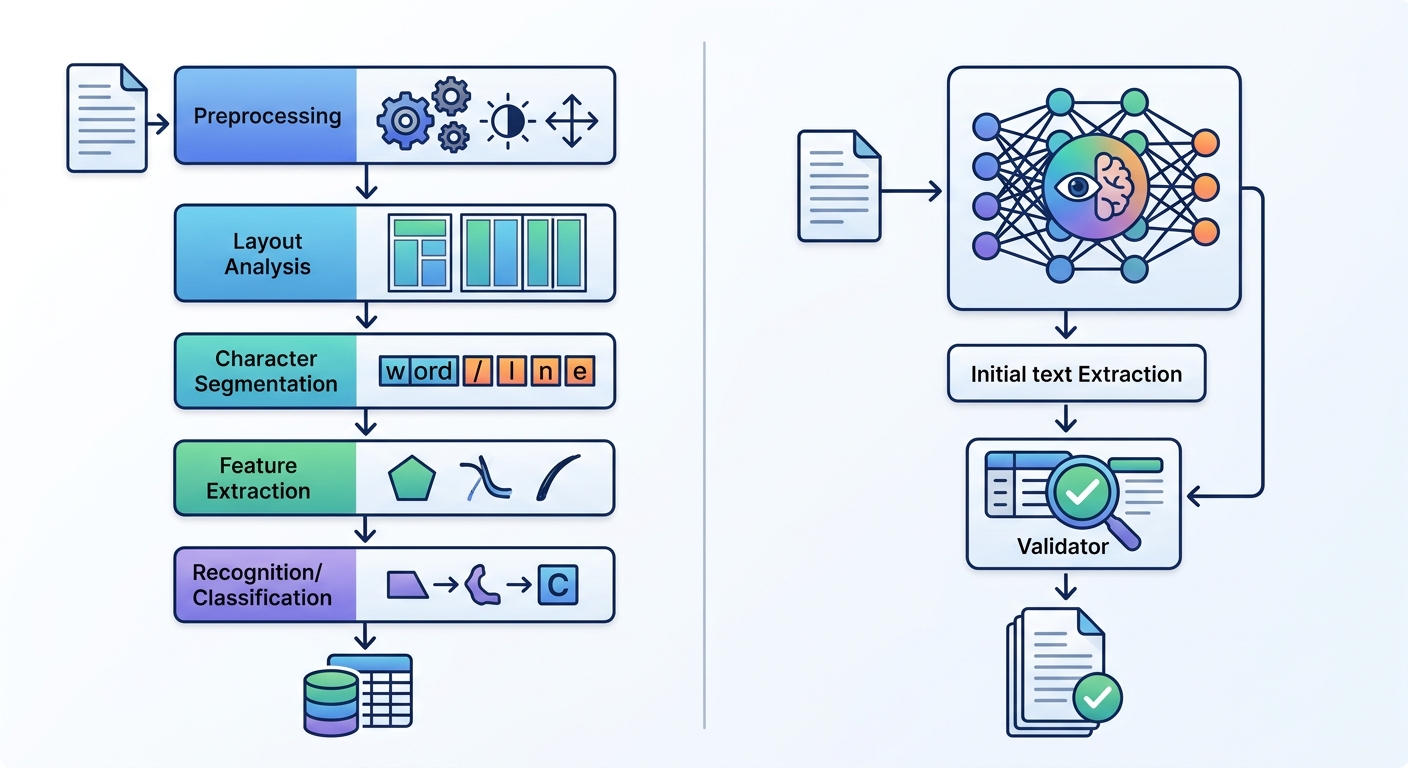
The consolidation is visible in the tooling itself. On the OCR side, the incumbent stack is mature: Tesseract for open-source batch work, ABBYY FineReader for high-fidelity commercial OCR, and cloud APIs (Amazon Textract, Google Document AI, Azure Document Intelligence) that bundle OCR with layout and table extraction. On the VLM side, the field now spans general-purpose frontier models (GPT-class, Claude-class, Gemini-class multimodal endpoints) and document-specialized models trained or fine-tuned for page understanding. The practical difference for buyers is that the OCR vendors sell a pipeline with predictable per-page pricing, while the VLM vendors sell a token-metered endpoint whose cost scales with input image resolution and output length.
That pricing structure is not a footnote—it drives architecture. At typical 2025–2026 list prices, a 1–2 page invoice processed at moderate DPI costs on the order of $1–2 per thousand pages on a mature OCR pipeline. The same page through a frontier multimodal endpoint typically lands in the $10–$150 per thousand range, driven mostly by image tokens (which scale with resolution) and secondarily by output schema length. At ten million pages a month, that spread decides the budget—and it is why "run everything through the biggest model" is rarely the right call. (See our breakdown of [document AI cost modeling per thousand pages].)
How OCR Pipelines and VLMs Actually Differ
The OCR Pipeline Model
Traditional pipelines are deterministic and staged. An OCR engine (Tesseract, ABBYY, cloud OCR APIs) converts pixels to characters with confidence scores. A separate layout model identifies regions—tables, headers, checkboxes. Extraction then runs rules, regex, or NER over the text layer.
The strengths are real: per-page cost is predictable and low, every stage is independently auditable, and failures are diagnosable. If OCR confidence drops on a field, you know exactly where the problem is. The weakness is brittleness—every new document variant needs new rules, and reasoning across ambiguous content is essentially impossible without bolting on an LLM anyway.
The brittleness compounds quietly. A rules layer that works on 40 invoice templates fails on the 41st, and the failure is not a crash—it's a wrong value silently written to a downstream system. Teams accumulate rule debt: hundreds of regex patterns, each patched for a specific vendor's layout, none of them documented well enough to safely delete. The pipeline becomes a museum of every document variant the business has ever seen.
The Vision-Language Model Model
A VLM takes the page image and a prompt (often with a JSON schema) and returns structured output directly. It reads the page the way a human does—holistically, with context. There's no text layer to debug, but confidence signals are also coarser: field-level confidence, where available, is less calibrated than OCR character confidence and can't be thresholded the same way.
Fewer moving parts, less transparency. When a VLM misreads a total, the failure is diffuse: was it the image quality, the prompt, the schema, or the model's reasoning? Debugging requires eval sets and error taxonomy rather than log inspection. That's a real operational cost that benchmarks don't capture.
There are also failure modes unique to VLMs that practitioners learn the hard way. Hallucination on missing fields is the most dangerous: asked for a purchase order number that isn't on the page, a model may invent a plausible-looking one rather than return null. The defense is structural, not aspirational—define every field in the schema as required-or-explicitly-null, use constrained/structured decoding so the model can only emit valid values or null, and run a post-extraction check that flags any field the model "found" with no corroborating text region. Schema drift appears when a provider updates the model and output formatting subtly changes, breaking downstream parsers. Resolution limits bite on dense pages—downsampling a legal-sized page to fit a token budget can erase the fine print the extraction depends on. And prompt sensitivity means a small wording change can shift accuracy by several points, which makes prompt versioning a production discipline rather than an afterthought. (For mitigation patterns, see [VLM hallucination guardrails for structured extraction].)
Where Vision-Language Models Genuinely Beat OCR
Degraded and Low-Quality Scans
This is the clearest VLM win. OCR engines fail on skew, noise, stamps, coffee stains, fax artifacts, and handwriting—and they fail silently, emitting garbage text with low confidence that downstream rules mishandle.
VLMs infer from context. A smudged date field next to "Invoice Date:" is recoverable because the model understands what the field should contain. Handwritten annotations, overlaid stamps, and photocopied pages that defeat character segmentation are handled far better by a model that reads the page as an image rather than a grid of glyphs. The counterpoint matters: a VLM can also confidently misread degraded text, so degraded-scan routing should still pass through a validation layer—cross-field consistency checks, value-range checks, and a human review queue for low-corroboration fields.
Unstructured and Semi-Structured Documents
When the document type is known but the layout is not—varying contract clauses, free-form correspondence, mixed-language forms—VLM extraction avoids the template treadmill. You define the output schema once and let the model find the fields, rather than writing a new rule set per vendor.
Cross-Field Reasoning
Totals that must reconcile (line items against subtotal, subtotal against tax, tax against grand total), dates that must be ordered, and identifiers that must match across sections are where a single model reading the whole page outperforms stage-by-stage extraction. This is reasoning, not transcription, and it's the capability OCR pipelines structurally lack.
Where OCR Still Wins
- High-volume, templated documents. Clean, consistent forms at scale are cheaper and more predictable on a staged pipeline.
- Auditability requirements. Regulated workflows that demand per-stage confidence, reproducible outputs, and a defensible audit trail favor deterministic stages.
- Character-exact extraction. Serial numbers, account numbers, and codes where a single wrong character is costly benefit from OCR confidence plus checksum validation.
- Latency and cost ceilings. When per-page budget is tight, OCR remains the floor.
How to Route Between Them
The hybrid architecture only works if routing is measured, not guessed. Build it in three layers:
- A labeled eval set first. Before any VLM goes to production, assemble a few hundred to a few thousand representative pages with ground-truth fields. This is the precondition for every other decision—routing thresholds, model choice, and prompt changes are all unmeasurable without it.
- A routing gate. Send documents to OCR or VLM based on signals you can compute cheaply: OCR confidence distribution per page, page-quality heuristics (skew, noise, resolution), and a document-type classifier. Low-confidence or degraded pages route to the VLM; clean templated pages stay on OCR.
- A validation layer on both paths. Schema conformance, cross-field consistency, and explicit-null enforcement apply regardless of which path produced the output. The validation layer is where trust is earned.
Re-evaluate routing quarterly. Model prices fall and capabilities shift; a routing rule that was correct in Q1 may be leaving money or accuracy on the table by Q3.
Compliance and Lock-In
For the banks, insurers, and healthcare payers named at the top of this article, sending page images to a third-party multimodal endpoint is a compliance decision before it is a cost decision. Confirm data residency and retention terms, whether on-prem or VPC deployment is available, and how PII in page images is handled in logs and eval sets. Separately, treat prompt and schema dependence on a single provider as a lock-in risk: keep the extraction schema provider-agnostic and maintain a fallback model so a pricing change or deprecation doesn't strand the pipeline.
Bottom Line
In 2026 the question is not "OCR or VLM." It is "which pages go to which path, and how do we prove the output is right." Teams that win build a labeled eval set, route on measurable signals, and put a validation layer behind both paths. Teams that lose either over-pay for frontier inference on clean templated pages or under-serve degraded documents with a pipeline that silently writes wrong values downstream.