Beyond Text: How Multimodal LLMs Are Redefining Human-AI Interaction in 2026
Multimodal AI has moved past novelty into default-interface territory. This article explains the paradigm shift from text-only AI to perceptual partner and what it means for products, enterprises, and the humans who use them.
Meta description: In 2026, AI that sees, hears, and reasons across modalities is the new default. Here's what the shift from text-only AI means for products, enterprises, and the humans who use them.
A field technician in a manufacturing plant photographs a failing pump motor. An AI analyzes the image, cross-references the repair manual stored in the company's knowledge base, identifies the specific fault from 14 similar cases, generates a step-by-step repair procedure, and narrates it through the technician's earbuds — all in under 30 seconds. In 2023, this interaction would have required a senior engineer, a diagnostic tool subscription, and a support ticket. In 2026, it's routine.
That gap — between what would have required specialized human expertise three years ago and what a well-designed AI now handles directly — is the story of multimodal large language models in 2026. Text-only AI was a necessary constraint. Multimodal AI is the key that unlocks AI's real-world utility at scale.
This article is about the paradigm shift that represents: from AI as a text interlocutor to AI as a perceptual partner, and what that means for product teams, enterprises, and the humans who build and use AI-powered systems.
The End of the Text-Only AI Era
The history of AI interaction is largely a history of constraint. GPT-2 and GPT-3 demonstrated that scale could produce startling language capability, but the interface remained stubbornly textual. Users translated intent into prompts; AI translated output back into text. Every problem had to be squeezed through a text-shaped aperture.
This constraint was practical, not philosophical. Text is easy to collect, easy to label, and easy to compute over. Getting AI systems to see the world required solving computer vision, training separate specialized models, and stitching those outputs into language model pipelines through brittle integration code.
By 2026, that integration problem has been largely solved at the foundation model level. GPT-4o, Google's Gemini 2.0, Claude 3.5 Sonnet, and the open-source Llama 4 Vision variants have crossed a capability threshold that makes vision-language understanding — and increasingly audio-language understanding — a default feature rather than an add-on.
What multimodal unlocks that text alone cannot replicate: spatial reasoning from photographs, visual diagnosis of physical systems, document-to-workflow pipelines that understand both the text and the layout of a scanned form, real-time guidance augmented by what a camera sees. These are not incremental improvements to text AI. They are categorically new capabilities with categorically new product possibilities.
How Multimodal LLMs Actually Work
Understanding why multimodal AI behaves the way it does requires a brief look at how it is built — without descending into a full ML graduate seminar.
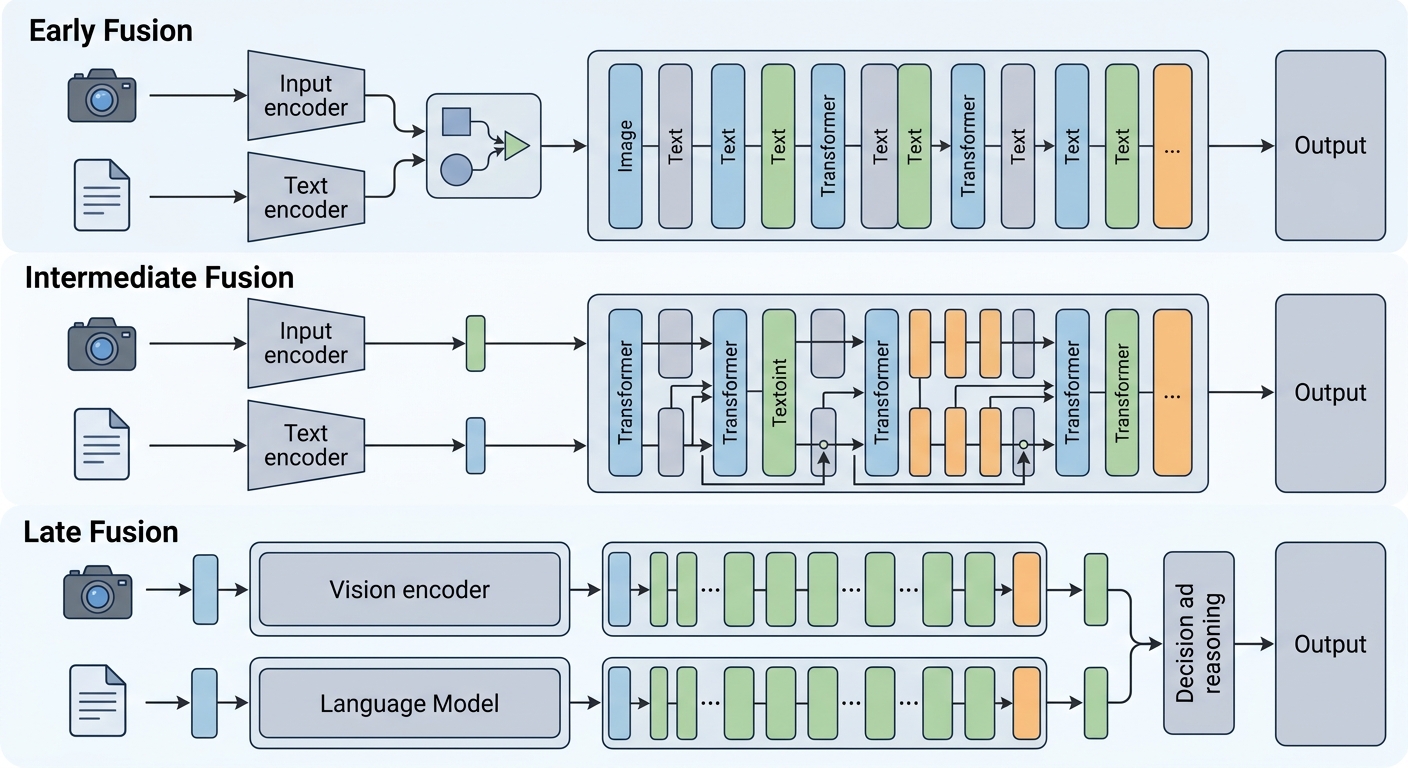
Fusion strategies determine how a model combines information from different modalities. In early fusion, vision and language signals are mixed before processing, at the token-embedding level. The model learns joint representations from the start. Late fusion processes each modality separately and combines outputs at a decision or reasoning layer. Intermediate fusion — the approach most frontier models use in 2026 — learns joint representations at multiple processing layers, giving the model more flexible paths to integrate visual and linguistic information depending on the task.
The practical implication for product teams is significant: vision is not "added on" to a language model like a plugin. Vision becomes a first-class token stream that the underlying language model processes as part of its regular inference. The same attention mechanisms that allow an LLM to reason across paragraphs also allow it to reason across an image and a paragraph together.
This architectural reality explains why multimodal models don't suffer the kind of modal blindness that early hybrid systems did. A separately trained OCR system feeding into a separately trained language model could miss the relationship between a chart's visual structure and its text labels. A natively multimodal model processes them as a unified input, which is why it catches things the pipeline approach misses — the anomaly in the graph's Y-axis, the footnote that contradicts the main claim, the context that lives only in the image's layout.
The architectural insight that matters most for product teams: one model, one unified context window, coherent cross-modal reasoning. You are not integrating a vision API with a language API. You are building on a single model that happens to perceive the world in multiple modalities.
The New Interaction Paradigm
The most important change multimodal AI introduces is not a capability improvement — it is a change in the interaction vocabulary available to users.
From Prompting to Showing
In a text-only world, users must translate what they perceive into language. Describing a broken machine, a confusing interface, a chart with an unexpected spike — all of these require the user to do interpretive work before they can interact with AI. That translation step introduces friction, introduces error, and filters out information that is hard to describe verbally.
Multimodal AI eliminates that translation step for many use cases. Users share a screenshot, photograph, PDF, or diagram. The AI reasons across all of it in a single context window. The user did not need to describe the layout, the visual hierarchy, or the specific anomaly in the data — they just showed it.
This changes the design of AI-powered products fundamentally. The input affordance is no longer a text box with a placeholder that says "Ask me anything." It is a full multimodal interface that accepts text, images, files, and audio — and understands the relationships between them.
Conversational Continuity Across Media
A secondary consequence of unified multimodal context is that conversation history becomes richer. A thread that begins with a user sharing a product requirements document, then a screenshot of a competing product, then a sketch of their proposed UI — all of these are available to the AI as a coherent multimodal workspace. The AI can reason about the relationship between the requirements, the competitive landscape, and the design proposal without the user manually re-explaining context.
This is qualitatively different from pasting text into a chat. The AI has access to visual and spatial information that would be cumbersome or impossible to fully capture in text.
Audio as a First-Class Channel
Voice capability — present in GPT-4o and Gemini 2.0 natively — closes the loop on the multimodal interaction model. Vision gives the AI eyes; audio gives it ears and a voice. The combination enables interactions that would feel natural to a human but were impossible for AI just a few years ago: real-time AI coaching during a live sales call, accessibility applications where an AI narrates visual environments to a blind user, hands-free troubleshooting while a technician's hands are occupied.
In 2026, products that treat audio as a separate feature from vision are working with an outdated mental model. The major frontier models treat audio as another modality processed through the same underlying reasoning stack, and product teams that architect around this principle build more coherent experiences than those that bolt voice onto a text-first system.
The Physical-World Handoff
The most ambitious extension of the multimodal paradigm is AI that perceives and acts in physical environments — both digital UIs and, increasingly, physical spaces.
Multimodal agents that can observe a web interface, reason about what buttons to click, and execute actions are already in production at leading technology companies. The same architectural pattern — vision + language + action tokens — extends naturally to physical robot control in research settings, though commercial deployment in unstructured environments remains limited by hardware and safety constraints.
The enterprise implication is significant: the boundary between "AI that answers questions" and "AI that does tasks" is dissolving. Multimodal perception gives AI agents situational awareness to operate in environments designed for humans — visual interfaces, physical spaces, mixed-document workflows — rather than requiring those environments to be rebuilt as API-accessible systems.
What This Means for Product Design
The paradigm shift from text-only to multimodal AI creates a set of new design challenges that most product teams have not had to solve before.
Designing for Mixed-Media Input
The first new challenge is handling input that contains multiple modalities simultaneously — and the edge cases that creates. What does a product do when a user provides a screenshot and a text description that appear to contradict each other? When an image is too large or too complex for the model to process quickly in a real-time interaction? When a user shares an image that contains personally identifiable information the product has not been designed to handle?
Text-only interfaces sidestep most of these questions. Multimodal interfaces require product teams to think through input validation, user guidance, and graceful degradation in ways that did not exist before.
Explainability as a Design Requirement
When an AI model reasons across a complex document — a 50-page contract, a dense financial chart, a radiology scan — users need to understand where the model looked and what it concluded from each visual element. In a text-only system, the model cites its sources from text. In a multimodal system, the model needs to be able to point to a region of an image, explain what it observed there, and show how that observation contributed to its conclusion.
This is technically hard and ergonomically new. Products that build strong multimodal explainability into their interface — visual highlighting, structured reasoning traces, clickable citations that map to image regions — will earn user trust in ways that text-only explanation cannot replicate.
The Input Affordance Problem
Perhaps the subtlest design challenge is that most existing products were designed for text input. The AI chat widget is a text box. The onboarding flow explains how to type questions. The help documentation assumes users will describe their problems in writing.
Multimodal AI requires rethinking these assumptions at the product level. What does a share button do in a multimodal AI context? How do you design the input area so users intuitively know they can drag and drop an image, share a voice note, or paste a document? The interaction vocabulary of AI-powered products is expanding faster than design systems are adapting.
Enterprise Adoption: The Real Story
Enterprise interest in multimodal AI is high, but adoption is uneven. The gap between pilot enthusiasm and production deployment is significant, and it breaks down along predictable lines.
Where Multimodal AI Is Working in the Enterprise
Document processing is the clearest win. Contracts, invoices, purchase orders, and regulatory filings routinely combine text, tables, signatures, and scanned images in ways that defeated text-only extraction pipelines. Multimodal models that understand layout, visual context, and text simultaneously have dramatically reduced the error rates in enterprise document processing workflows.
Manufacturing quality assurance is another strong use case. AI systems that can compare a live image of a product against a specification, flag visual defects, and route exceptions to human reviewers are deployed at scale in electronics assembly, pharmaceutical packaging, and automotive component manufacturing.
Medical imaging triage is further along than many outsiders realize. Multimodal AI systems that can prioritize radiology workloads by identifying studies with potential abnormalities have received FDA clearance and are in use at a significant number of US health systems as of early 2026.
Customer support is the most visible consumer-facing application. Support interactions that accept screenshots, photographs, or screen recordings from users — and use those to ground AI responses in what the user is actually seeing — show meaningfully higher resolution rates than text-only chat.
Where Enterprise Adoption Is Struggling
Latency is the primary technical barrier for real-time multimodal applications. Processing a high-resolution image through a frontier vision-language model adds meaningful latency to any interaction. For applications where users expect near-instantaneous responses — real-time sales assistance, live technical support, interactive educational tools — this latency is a product problem that quantization, speculative decoding, and model distillation are gradually reducing but not yet solving.
Cost at scale is a persistent enterprise concern. Multimodal inference is more expensive than text-only inference, and organizations processing millions of daily interactions find that the cost arithmetic only works when multimodal capability genuinely changes the outcome — not just when it improves the experience slightly.
The integration challenge is organizational as much as technical. Most enterprise data environments are not multimodal-ready. Scanned PDFs live in different systems than native digital documents. Image archives sit in S3 buckets without structured metadata. Audio call logs are stored separately from the CRM records they relate to. Building multimodal RAG pipelines that can retrieve across this mixed-modality data estate is a data engineering problem that most enterprises are only beginning to solve.
The Competitive Landscape in 2026
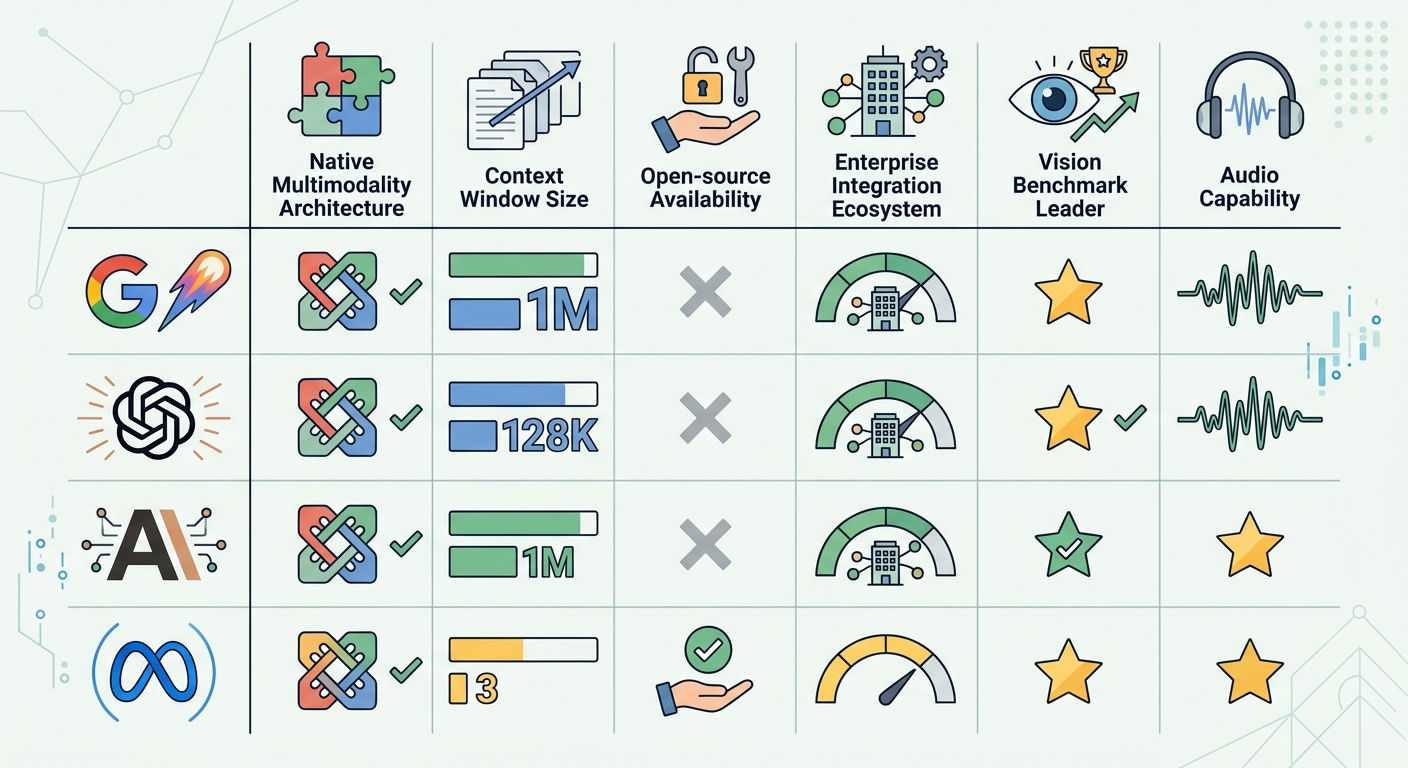
The multimodal frontier model market in 2026 is dominated by three proprietary players — OpenAI, Google, and Anthropic — with open-source rapidly closing the gap.
OpenAI's GPT-4o set the benchmark for natively multimodal reasoning at launch and has maintained a leading position in developer experience, benchmark performance, and ecosystem tooling. Its vision + audio native architecture means it handles modality switching more gracefully than models that added these capabilities post-hoc.
Google's Gemini 2.0 is the strongest competitor at the foundation model level, with native multimodality baked into its architecture from the ground up — not layered onto a language model. Gemini's context window size remains a significant differentiator for document-heavy enterprise workflows where processing a 500-page multimodal document in a single context matters.
Anthropic's Claude 3.5 Sonnet leads in document understanding and extended reasoning tasks — particularly where the user needs analysis that spans hundreds of pages of mixed text and images. Claude's Constitutional AI training approach gives it a meaningful edge in safety-critical enterprise deployments where the alternative is extensive prompt-based safety engineering.
Open-source — particularly Llama 4 Vision models and Qwen 2.5 VL — has closed much of the capability gap with proprietary models for organizations with the ML engineering capacity to fine-tune and self-host. The data sovereignty advantage is significant: for enterprises in regulated industries or jurisdictions where sending visual data to US-based API endpoints raises compliance concerns, self-hosted open-source multimodal models are the only viable option.
The key competitive question for 2026 is not which model wins the benchmark race — as raw model capabilities standardize, the data flywheel and developer experience become the differentiators.
Risks, Limits, and What Multimodal LLMs Still Can't Do
An honest accounting of multimodal AI capabilities in 2026 requires acknowledging significant limitations that benchmark scores obscure.
What Benchmarks Miss
Current multimodal benchmarks — MMMU, MMBench, SeedBench — test models on curated datasets that do not fully represent the distribution of images and documents models encounter in production. Real-world spatial reasoning failures are common: models that ace chart interpretation tasks systematically misread diagrams with unconventional layouts. Visual hallucination on chart data — seeing data patterns in parts of an image that contain no chart — remains a persistent problem.
Models also struggle with adversarial images: photographs with subtle perturbations, or images with text rendered at angles or resolutions that are legible to humans but confuse vision encoders. These failure modes are not exotic edge cases — they appear regularly in enterprise document processing at scale.
The Security Surface
Multimodal AI systems present a broader attack surface than text-only systems. Prompt injection via images — embedding hidden text in images that is processed by the model but invisible to users — has been demonstrated in research settings and represents a real-world threat for any system that processes user-uploaded images. Steganographic data exfiltration (encoding sensitive data in image pixels in ways that bypass content filtering) is a theoretical risk that organizations handling sensitive information need to take seriously.
Biometric data is a specific concern. Vision models that process images containing faces, license plates, or other identifiable features are subject to biometric privacy regulations that vary significantly across jurisdictions. Many enterprise deployments have not adequately addressed whether their use of visual input complies with GDPR Article 9, the EU AI Act, or state-level biometric privacy laws in the US.
The Over-Reliance Risk
Enterprise organizations are increasingly deploying multimodal AI in high-stakes decision contexts: medical imaging triage, legal document review, safety inspection. In each of these domains, the "good enough" threshold for model performance is much higher than it is for casual consumer applications — and the organizational tendency to lower human oversight as AI accuracy improves creates risk concentration that is difficult to reverse.
What's Coming Next
The multimodal frontier in 2026 is not the ceiling. Several directions are advancing rapidly.
Improved audio-native models are the near-term unlock. Current frontier models handle audio, but audio-native reasoning — where the model processes speech for tone, hesitation, emotion, and acoustic context, not just transcribed text — is an active research area with clear product applications in sales coaching, interview analysis, and accessibility.
3D spatial reasoning is emerging as the next capability frontier. Vision-language models trained on 2D images show surprising zero-shot performance on 3D spatial tasks, but models trained natively on point clouds, depth maps, and spatial data will unlock applications in architecture, manufacturing, robotics, and gaming that 2D perception cannot reach.
Multimodal agents are the product frontier. The foundation being built — perception across modalities, unified reasoning, action output — converges toward AI agents that operate in both digital environments (navigating UIs, executing multi-step workflows) and physical environments (robot manipulation, autonomous inspection) with minimal human intermediation.
The organizations that design their products and data infrastructure around multimodal interaction principles today will define the human-AI interface vocabulary of the 2030s. The text-only era of AI interaction is ending. What replaces it is still being written.
Expert Q&A
Q: What is the single biggest misconception product teams have about adding multimodal capabilities to their AI products?
A: Most teams treat multimodal as an input format upgrade — they add an image upload button to an existing text chat and call it multimodal. The deeper shift is architectural: a genuinely multimodal product needs to be designed around cross-modal reasoning, which means the AI layer, the data pipeline, and the interface all need to evolve together. Adding a camera icon to a text interface rarely produces a product users experience as multimodal.
Q: For an enterprise starting to experiment with multimodal AI, what is the highest-leverage first use case?
A: Document processing is almost always the right starting point. Every enterprise has a document problem — contracts, forms, reports, specifications — that involves both text and visual layout. The data is structured enough to evaluate performance rigorously, the ROI calculation is straightforward, and the operational risk of early errors is manageable. It also builds the organizational familiarity with multimodal evaluation that more ambitious use cases require.
Q: How should enterprises think about the data privacy implications of sending images through commercial multimodal APIs?
A: The question is not whether the API provider is trustworthy — it is whether your data handling is defensible under the regulations that apply to your jurisdiction and industry. For EU-based organizations, sending images containing personal data through US-based APIs requires careful analysis under GDPR Chapter V. For US healthcare organizations, HIPAA business associate agreements are non-negotiable. Treat multimodal API integration like any other data processing decision: document the data flows, identify the legal bases, and implement data minimization measures where feasible.