LLM Reasoning Chains: Chain-of-Thought vs Tree-of-Thought in 2026
When a large language model faces a hard problem, how it "thinks" matters enormously. The difference between a correct answer and a confidently wrong output often comes down to the structure of the reasoning process behind it. Two prompting techniques have come to define how developers guide that process: Chain-of-Thought (CoT) prompting, introduced in 2022, and Tree-of-Thought (ToT) prompting, introduced in 2023. Both remain central to LLM reasoning in 2026 — but they serve fundamentally different problem types, and reaching for the wrong one wastes compute, increases latency, and degrades results.
This article breaks down how each technique works, where each excels, and how the landscape has evolved in 2025–2026 with new variants like Chain of Draft, Graph-of-Thought, and Matrix-of-Thought.
1. Chain-of-Thought: The Linear Foundation
Chain-of-Thought prompting instructs an LLM to break a complex problem into sequential, intermediate steps before producing a final answer. Rather than jumping directly from problem to solution, the model generates a visible "chain" of reasoning — each step building on the last until the conclusion emerges.
The canonical example is arithmetic. A chain of thought prompting example might look like this:
Problem: If a train travels 120 km in 2 hours, then stops for 30 minutes,
and then travels another 80 km in 1.5 hours, what is its average speed?

Chain-of-Thought reasoning:
1. First leg: 120 km in 2 hours → speed = 120/2 = 60 km/h
2. Stop duration: 30 minutes = 0.5 hours (no distance covered)
3. Second leg: 80 km in 1.5 hours → speed = 80/1.5 ≈ 53.3 km/h
4. Total distance: 120 + 80 = 200 km
5. Total time (excluding stop): 2 + 1.5 = 3.5 hours
6. Average speed: 200 / 3.5 ≈ 57.1 km/h

Answer: Approximately 57.1 km/h

CoT works by making the model's reasoning process explicit. This helps in several ways: it surfaces errors mid-chain where they can be caught, it gives humans a traceable audit path, and it often improves accuracy simply because articulating reasoning forces more disciplined problem-solving.
Evolution: From Basic CoT to Chain of Draft
The basic CoT paradigm has spawned numerous variants targeting efficiency and structure:
-
Chain of Draft (CoD), introduced in February 2025, optimizes the reasoning trace itself — instead of verbose explanations, the model produces minimal "draft" steps, often capped at 5 words each. CoD matches or exceeds CoT accuracy on benchmarks while dramatically reducing reasoning token counts, cutting both cost and latency. This efficiency-focused variant is one of the most interesting developments in the chain of draft vs chain of thought debate.
-
Hierarchical Chain-of-Thought (Hi-CoT), published in March 2026, decomposes complex problems into a hierarchy of substeps, alternating between high-level planning and granular execution. This reduces flat chain length while improving accuracy on multi-level problems.
-
Focused Chain-of-Thought (F-CoT), proposed in November 2025, separates information extraction from reasoning — the model first isolates relevant facts from the input, then reasons over the distilled set. This input-centric approach improves efficiency on information-dense problems.
-
Self-Consistency with CoT: Rather than relying on a single reasoning chain, this technique generates multiple CoT paths for the same problem and selects the most frequently reached answer via a voting mechanism. It consistently improves reliability on complex reasoning benchmarks.
CoT in 2026: Increasingly Internalized
A significant shift in 2026 is that leading models — GPT-5, Claude 4.7, Gemini 3 Pro, DeepSeek R1, and OpenAI's o-series — have increasingly incorporated CoT-style reasoning internally, controlled through API parameters like reasoning_effort (OpenAI), reasoning_budget, or equivalent provider-specific controls rather than explicit "think step by step" prompts. For these models, explicit CoT prompting is often redundant: the model performs equivalent reasoning in latent space and may even generate explicit traces that don't fully correspond to its internal decision process — a phenomenon some researchers call reasoning theater.
CoT remains most valuable for:
- Smaller or non-reasoning-optimized models
- Tasks requiring auditable, human-interpretable reasoning traces
- Complex multi-step problems in math, code, and logical deduction
- Situations where the API doesn't expose reasoning effort controls
- Tasks where the reasoning trace itself is the deliverable (e.g., educational explanations)
Explicit CoT still adds value even for frontier models when:
- You need the reasoning trace to be auditable by a third party (regulatory, debugging)
- Tasks require structured output matching the CoT format
- The model's reasoning parameters are not accessible via your API tier
2. Tree-of-Thought: Branching for Complex Problems
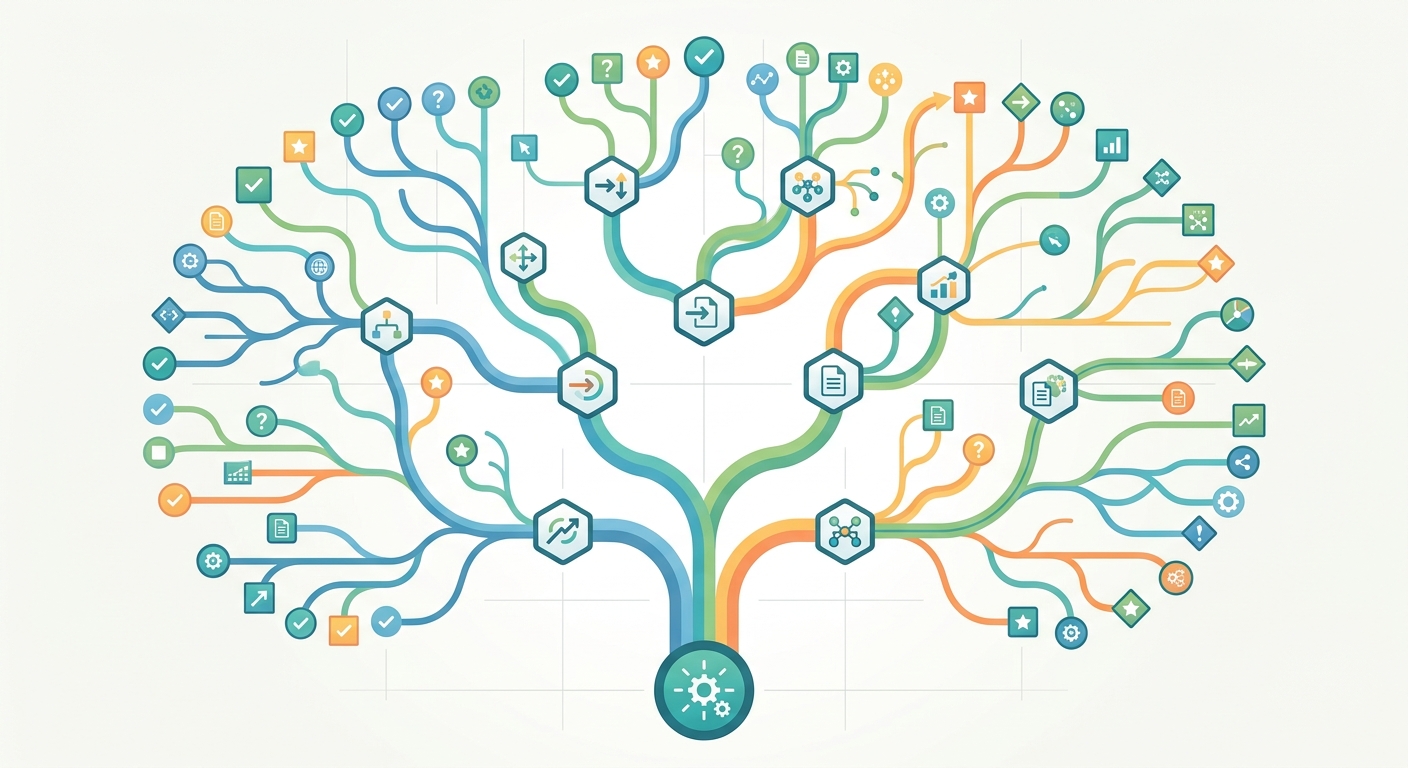
Where CoT follows a single path, Tree-of-Thought prompting explores multiple reasoning branches simultaneously. At each step, the model generates several possible next steps, evaluates their promise, prunes the least promising, and continues from the best candidates. This creates a branching tree rather than a single chain — and enables something CoT structurally cannot: self-correction through backtracking.
Important note: ToT is not a native API feature on most LLM platforms — it requires custom orchestration in your application code, typically using a loop that generates candidate thoughts, evaluates them, and manages the tree state.
The ToT loop works as follows:
- Generate: Produce multiple candidate "thoughts" at the current state
- Evaluate: Score each branch for likelihood of leading to a correct solution
- Select: Prune weak branches; keep the most promising ones
- Expand: Continue the selected branches to the next level
- Decide: Stop when a satisfactory solution is found, or backtrack if all paths fail
This approach mirrors how humans tackle ill-defined problems — trying a strategy, evaluating whether it's working, and pivoting if necessary.
Why ToT Excels Where CoT Fails
CoT's linear structure is a liability for problems with multiple viable approaches or where early decisions constrain the solution space. ToT handles these cases far better:
- Creative writing: Generating multiple plot outlines, evaluating narrative coherence, backtracking to earlier branches when a thread collapses
- Strategic planning: Exploring multiple business scenarios simultaneously, evaluating risks and trade-offs
- Game of 24: Finding a mathematical expression using four numbers that equals 24 — requires exploring many expression trees
- Crossword puzzles: Testing candidate word fits, backtracking when cross-references conflict
On the Game of 24 benchmark, ToT achieves success rates dramatically higher than CoT — approaching human-level performance on this task — precisely because it explores multiple expression trees rather than committing to a single approach.
The Computational Cost Trade-off
ToT's advantage comes at a price: generating and evaluating multiple branches per step multiplies token usage and latency. A three-level ToT with four branches per node generates roughly 4× more tokens per level than a single CoT chain.
In 2026, researchers have responded with novelty-based pruning — using lightweight heuristics to discard branches that are too similar to already-explored paths before running full evaluation. In practice, novelty-based pruning can significantly reduce branch redundancy, though exact token savings vary by problem type and branching factor.
Implementing ToT in Practice
A practical tree of thought prompting example for a problem like Game of 24 might look like:
For each number set below, explore multiple expression trees.
At each step, generate 3-4 candidate next steps, evaluate which
look most promising, and only expand the best 2. Report back
with your best solution and the reasoning tree you explored.

Number set: [3, 3, 8, 8]
Target: 24
Frameworks like LangChain and DSPy have built-in abstractions for ToT-style exploration, making it easier to implement without custom orchestration code.
3. Head-to-Head: CoT vs ToT
The CoT vs ToT choice is fundamentally about problem structure:
| Criteria | Chain-of-Thought | Tree-of-Thought |
|---|---|---|
| Problem type | Linear, sequential | Exploratory, multi-path |
| Error recovery | Limited (must restart) | Native (backtrack) |
| Token cost | Low | High |
| Latency | Low | High |
| Best for | Math, logic, QA | Creative tasks, strategy, puzzles |
| Interpretability | High (single trace) | Medium (multiple branches) |
| Implementation | Simple prompt addition | Custom orchestration required |
Use CoT when:
- The problem has a clear, predictable solution path
- You need an auditable reasoning trace
- Token efficiency and latency are constraints
- You can use provider reasoning effort controls (for frontier models)
Use ToT when:
- The problem requires exploring multiple viable approaches
- Early decisions can constrain or eliminate viable solutions
- Self-correction during reasoning is valuable
- You can afford higher token usage for better outcomes
- You have the engineering capacity for custom orchestration
The Diminishing Returns Problem
By mid-2025, research confirmed what many practitioners suspected: for the most capable reasoning models (GPT-5 class and above, o-series, DeepSeek R1), explicit CoT prompting offers diminishing returns. These models already perform equivalent reasoning internally, and explicit CoT traces may not reflect actual internal computation — making them more theater than truth. For these models, tuning the reasoning_effort parameter (where available) often delivers better results than crafting elaborate CoT prompts. As always, test both techniques on your specific problem — the optimal approach depends on your model, your task, and your constraints.
4. Beyond CoT and ToT: The New Wave
The reasoning chain paradigm has continued to evolve beyond the linear-vs-branching binary:
Graph-of-Thought (GoT)
Graph-of-Thought (GoT) generalizes both CoT and ToT by modeling reasoning as an arbitrary graph rather than a chain or tree. This enables merging different reasoning paths, cyclical refinement, and more flexible structure than ToT's strict branching hierarchy. GoT is particularly suited for highly complex problems where reasoning isn't a simple tree — such as multi-document synthesis or systems design. Early benchmarks suggest GoT outperforms ToT on complex reasoning tasks requiring path merging, though the evidence base is still growing.
Matrix-of-Thought (MoT)
Proposed in late 2025, Matrix-of-Thought (MoT) introduces both horizontal and vertical reasoning dimensions — horizontal exploration of multiple approaches (like ToT) combined with vertical depth-building within each approach (like deep CoT). It also incorporates a built-in fact-correction mechanism that checks intermediate reasoning against known facts, reducing hallucination risk during exploration. Initial results show promise on multi-hop question answering, though more rigorous comparison studies are needed.
Hybrid Approaches
The most powerful implementations in 2026 often combine techniques: a ToT framework where each node contains a CoT — combining the exploration power of branching with the depth of sequential reasoning. Self-consistency voting can then be applied at the leaves. These hybrid architectures represent the state of the art for complex production systems.
The Graph of Thought LLM Landscape
The emergence of graph of thought LLM reasoning represents a maturation of the field — moving beyond rigid structures (chains, trees) toward flexible graph-based reasoning that can handle real-world complexity.
5. Practical Implementation Guide
Getting started with reasoning chain prompting today:
Implementing CoT
- For basic CoT: Append "Let's think step by step" to your prompt, or provide one or two examples of the reasoning format in a few-shot setup
- For self-consistency: Generate 5–10 CoT paths, tally the most common final answer
- For efficiency: Consider Chain of Draft if token usage is a concern — the accuracy trade-off is often minimal
- For advanced models: Use
reasoning_effort=high(or your provider's equivalent) rather than writing explicit CoT prompts
Implementing ToT
- Define your tree depth and breadth: Typically 3–5 levels with 3–5 branches per node
- Write evaluation criteria: Explicitly tell the model how to score each branch (e.g., "Does this lead toward the target? Rate 1-5")
- Set a cutoff: Define when to stop exploring (e.g., "Stop when you find an expression that equals 24")
- Budget for backtracking: Allow the model to return to earlier nodes and explore alternative paths
- Use framework abstractions: LangChain's branching logic, or DSPy's operators, reduce boilerplate
Common Pitfalls
- Using ToT when CoT would suffice: Expensive and slow for simple problems
- Too many branches: More than 5 per node rarely helps; diminishing returns kick in fast
- No clear evaluation criteria: Without scoring guidance, the model can't meaningfully prune
- Ignoring reasoning internalization: For cutting-edge models, explicit CoT prompts may add noise rather than signal
- Test both on your specific problem — the optimal technique depends on model capability, task structure, and your constraints
6. Conclusion
Chain-of-Thought and Tree-of-Thought represent two fundamentally different philosophies of LLM reasoning: linear depth versus exploratory breadth. CoT remains the workhorse for sequential problems where a clear path exists — and with variants like Chain of Draft and Hierarchical CoT, it continues to evolve toward efficiency. ToT is the tool of choice when problems demand exploration, backtracking, and multi-path strategy.
In 2026, both techniques sit within a rapidly expanding taxonomy: Graph-of-Thought, Matrix-of-Thought, and hybrid architectures are pushing the boundaries of what structured reasoning can achieve. The most capable models are increasingly internalizing these reasoning processes — making explicit prompting less necessary for frontier models, even as the underlying concepts grow more important for understanding how LLM reasoning actually works.
The practical guidance is straightforward: match your reasoning structure to your problem type. Linear problems get CoT. Complex, exploratory problems get ToT. And as the field matures, keep one eye on the emerging graph-based paradigms that may subsume both.
[related-article-link]
Sources:
- Wei et al. (2022). "Chain-of-Thought Prompting Elicits Reasoning in Large Language Models." NeurIPS.
- Yao et al. (2023). "Tree of Thoughts: Deliberate Problem Solving with Large Language Models." NeurIPS.
- "Chain of Draft: Efficient Reasoning with Minimal Tokens." arXiv:2604.00130 (February 2025).
- "Hierarchical Chain-of-Thought." arXiv (March 2026).
- "Focused Chain-of-Thought." arXiv (November 2025).
- "Matrix-of-Thought." arXiv (late 2025).