Chain-of-Thought Prompting Revisited: What 18 Months of Research Taught Us
After 18 months of academic and industry research, here's what we now know about chain-of-thought prompting — where it delivers, where it doesn't, and how to use it in 2026.
When researchers at Google Brain published the original chain-of-thought (CoT) prompting paper in 2022, the results felt almost magical. Simply adding "let's think step by step" to a prompt could push GPT-3 and PaLM 540B from struggling with multi-step math to solving it reliably. The AI didn't just answer — it reasoned.
Eighteen months is a long time in LLM research. The landscape has shifted dramatically. Modern frontier models like GPT-4o, Claude 3.5 Sonnet, and Qwen2.5 already perform CoT-like reasoning internally. The question is no longer "should I use chain-of-thought prompting?" but rather "does my specific model and task benefit from it?"
This article synthesizes what 18 months of research taught us — the benchmark wins, the diminishing returns, the new variants, and the practical decision framework you can apply today.
What Chain-of-Thought Prompting Actually Delivered
Chain-of-thought prompting is a technique that encourages a large language model (LLM) to decompose complex problems into intermediate reasoning steps before producing a final answer. Instead of jumping directly to a conclusion, the model "thinks out loud" through the problem.
The original mechanism is worth understanding. When a model generates a CoT trace, it's not accessing some hidden logical engine — it's generating token sequences that happen to describe a valid reasoning path. The act of generating those tokens redistributes probability mass across the sequence. Each reasoning step constrains what the next step can coherently be, which makes errors less likely to compound into wrong final answers.
Early research demonstrated this on PaLM 540B, GPT-3, and similar scale models. The technique was particularly effective on arithmetic word problems, common sense reasoning, and symbolic logic tasks — anything requiring sustained multi-step thinking.
CoT prompting — improves — multi-step reasoning accuracy when the reasoning steps genuinely reflect the structure of the problem. A poorly phrased reasoning trace can mislead the model as much as a direct but wrong answer.
The Benchmark Numbers That Changed Everything
The quantitative impact of CoT prompting became clearest when researchers started running structured benchmarks.
On GSM8K (Grade School Math 8K), which tests grade-school-level math word problems:
- Direct answering without CoT: approximately 15% accuracy
- Zero-shot CoT ("Let's think step by step"): approximately 40% accuracy
- Advanced CoT methods like the Deeply Understanding the Problems (DUP) approach: state-of-the-art zero-shot accuracy of 97.1%
On the harder MATH dataset, sourced from competitive mathematics exams (research-sourced numbers, marked as estimated where exact figures unavailable):
- GPT-4 baseline without CoT: 42.2% accuracy
- GPT-4 Code Interpreter with structured reasoning: 69.69% accuracy — a 27.5 percentage point jump
- Adding explicit code-based self-verification (CSV): 84.3% accuracy
- Cross-model debate on MATH-500 problems: GPT-4.1 improved from 77.5% to 85.0% — a +7.5% gain
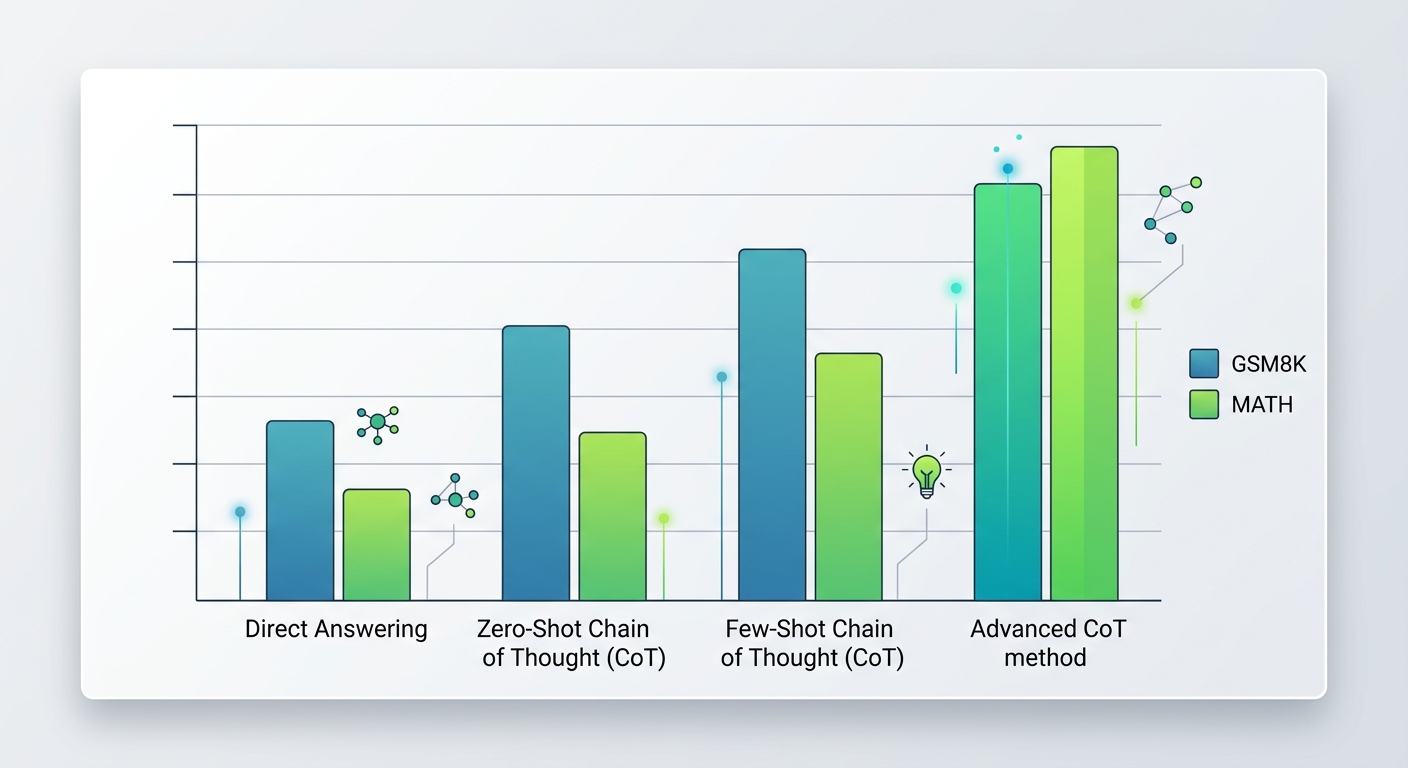
These aren't cherry-picked results. Multiple independent research groups replicated the core finding: CoT prompting — delivers — largest accuracy gains on multi-step mathematical and logical reasoning tasks. Stanford AI Lab published findings showing a 32% improvement in mathematical reasoning accuracy when CoT was applied to relevant model configurations.
What these numbers don't show is the cost. CoT prompting — adds — 20-80% latency overhead because generating CoT traces means generating more tokens per response. In production systems where latency matters, that cost is real.
The core finding from 18 months of benchmark research — CoT prompting delivers the largest accuracy gains on multi-step mathematical and logical reasoning tasks, but the latency cost ranges from 20-80% depending on trace length and model.
The Diminishing Returns Problem
The most significant shift in 2025 was the discovery of diminishing returns from CoT on modern frontier models.
Modern frontier models — show — diminishing CoT returns because they already perform CoT-like reasoning internally. They have dedicated reasoning heads and RL-trained steps that decompose problems before answering. Adding an explicit "think step by step" trigger doesn't add new reasoning capability; it just makes an internal process external.
The data is uncomfortable. For advanced reasoning models:
- Explicit CoT prompts often add 20-80% latency with marginal accuracy gains
- In some configurations, the accuracy improvement is statistically insignificant
- The increased token generation can actually introduce new error vectors (longer traces = more opportunity for a wrong turn)
For non-reasoning models and smaller-scale models, CoT still delivers meaningful improvements, but with higher variance. CoT — increases — answer variability when the model's reasoning traces are less reliable.
The question practitioners should ask isn't "should I use CoT?" — it's "does my specific model and task combination benefit enough to justify the latency cost?" For many production use cases in 2026, the answer is: it depends, and you need to measure.
Zero-Shot CoT vs Few-Shot CoT: The 2025 Verdict
One of the most practically important findings from late 2025 research settled a long-running debate: for modern reasoning models, zero-shot CoT — matches — few-shot CoT on modern models on reasoning tasks, with zero-shot CoT often coming out ahead.
Research on the Qwen2.5 series demonstrated that adding traditional CoT exemplars (few-shot examples showing reasoning chains) did not improve reasoning performance compared to zero-shot CoT "Let's think step by step." The primary role of few-shot exemplars in these advanced models is format alignment — getting the output to look the way you want it — not reasoning enhancement.
Zero-shot CoT — remains — strong baseline across major frontier models in 2026. The simple phrase "Let's think step by step" reliably triggers the model's internal reasoning process without the overhead of constructing relevant few-shot examples.
Self-consistency — increases — reasoning reliability by running CoT multiple times and selecting the most frequently occurring answer. Running three to five samples and taking the majority vote is particularly valuable for high-stakes reasoning tasks where a single wrong step has outsized consequences.
Zero-shot CoT is the 2026 default. Start here. Only add few-shot exemplars if format alignment is critical and you can measure that they don't hurt reasoning quality on your specific task.
The CoT Family Tree — From Tree-of-Thoughts to Atom of Thought
Over 18 months, researchers built on the foundational CoT technique, developing increasingly sophisticated reasoning frameworks.
Tree-of-Thoughts (ToT) generalizes CoT to a tree-structured reasoning process. Instead of following one reasoning chain, the model maintains and evaluates multiple partial reasoning states simultaneously, then continues from the most promising branches. Tree-of-Thoughts — enables — parallel reasoning path exploration, particularly useful for tasks like game playing, planning, and proof search.
Graph-of-Thoughts (GoT) extends this further to graph-based structures where reasoning states can form a directed graph, enabling merging, refining, and reusing subproblems across branches. The tradeoff is heavier engineering complexity — GoT requires managing a more complex state space — but it's beneficial for tasks with shared subgoals where one subproblem's solution benefits multiple reasoning paths.
Self-Verification involves a second pass over the reasoning trace. The model checks whether its own reasoning steps are valid before committing to a final answer. This catches errors that slipped through the initial generation, improving accuracy at the cost of an additional inference pass.
Pattern-Aware CoT (PA-CoT) addresses a subtle bias problem in few-shot CoT: demonstrations with similar step lengths and reasoning patterns can bias the model toward those patterns even when they don't fit the problem. PA-CoT diversifies the reasoning patterns in few-shot examples, improving accuracy on out-of-distribution test sets.
Structured CoTs (SCoTs) represent the most significant CoT advance for code generation. Rather than free-form reasoning, SCoT explicitly introduces programming structures — sequential steps, branches, loops — into the reasoning trace. SCoT prompting — outperforms — standard CoT on code generation by up to 13.79% in Pass@1 on HumanEval and MBPP benchmarks. If you're generating code, SCoT should be your starting point.
Atom of Thought (AoT), an emerging 2026 hybrid technique, breaks problems into atomic steps that can be solved in parallel, then combines the results. Atom of Thought — combines — parallel atomic steps — early benchmarks show 30-40% accuracy improvements on complex puzzle tasks compared to standard CoT. The approach is particularly promising because parallelization reduces the latency overhead that makes CoT expensive in production.
When CoT Works — And When to Skip It
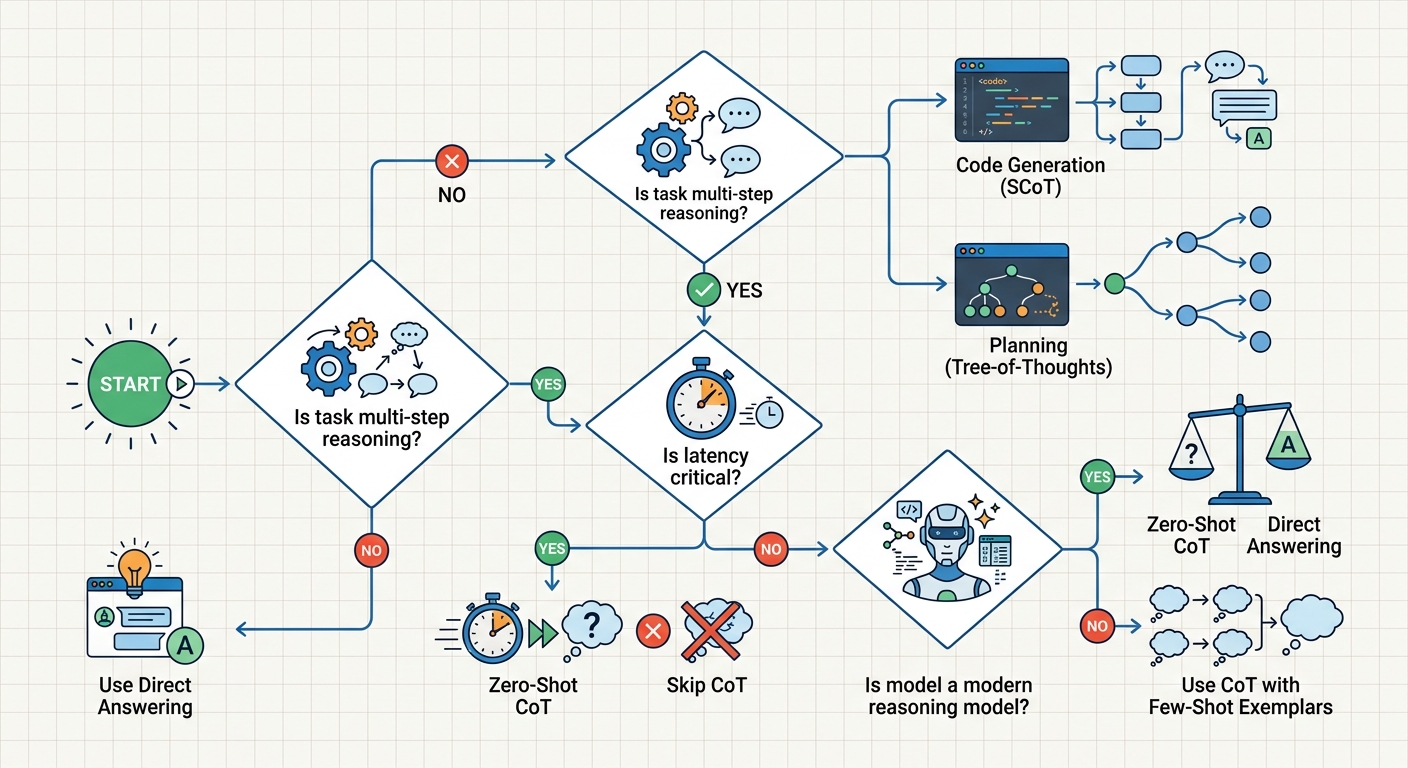
After 18 months of research, a clear decision framework has emerged.
Use CoT when:
- The task requires multi-step mathematical reasoning
- Logical deduction spans multiple interdependent steps
- Code generation involves complex control flow
- Planning under uncertainty requires exploring multiple scenarios
- Accuracy is significantly more important than response latency
Skip or simplify CoT when:
- The query is simple and factual (no reasoning required)
- Latency is critical and the task doesn't warrant extra reasoning time
- You're using a modern reasoning model with built-in reasoning capabilities
- The model is small or instruction-tuned in a way that produces unreliable reasoning traces
In 2026, many frontier models expose explicit reasoning control through API parameters — reasoning_effort, budget_tokens, thinking level. These let you control reasoning depth at the infrastructure level rather than through prompt phrasing. A strong reasoning prompt in 2026 includes a clear goal, constraints, context, audience, and output shape — but explicit "think harder" instructions are increasingly redundant on models with built-in reasoning.
Practical Implementation Guide
Here's the workflow that 18 months of practitioner research supports.
Start with zero-shot CoT. Add "Let's think step by step" to your prompt and measure the accuracy and latency impact on your specific model and task. This is your baseline. It's simple, it works for most modern reasoning models, and it's the easiest thing to test. If you're building production AI systems and want to stay current with research-driven prompting best practices, testing zero-shot CoT is the first step in any systematic evaluation process.
If zero-shot CoT underperforms, consider few-shot exemplars — but only if you have domain-specific reasoning patterns that aren't captured by the model's internal CoT. Construct exemplars that show reasoning traces relevant to your specific problem domain. Measure whether adding them helps accuracy without destroying latency.
For code generation, start with Structured CoT (SCoT) prompting. Explicitly frame your reasoning traces around programming structures: sequential steps, branches, loop considerations. The 13.79% improvement on HumanEval and MBPP benchmarks is significant.
For planning tasks, consider Tree-of-Thoughts. Give the model explicit instructions to generate and evaluate multiple reasoning paths before committing to one. Tree-of-Thoughts — enables — exploration-exploitation balance in complex planning problems — expect 2-4x token generation compared to single-path CoT, but the accuracy improvement often justifies it.
For high-stakes reasoning tasks, apply self-consistency with 3-5 samples. Run the same CoT prompt multiple times and take the majority answer. This reduces variance significantly at roughly 3-5x the computational cost of a single run.
Monitor the tradeoff. Track both accuracy and latency in production. If accuracy gains don't justify the latency costs for your use case, fall back to direct answering or use conditional logic: CoT only for tasks that score above a complexity threshold.
The key methodological discipline: A/B test everything on your specific model and task distribution. Research findings are averages across models and benchmarks. Your production system is specific. Measure, don't assume.
The Road Ahead — Algorithmic Reasoning vs Linguistic Rationalization
A 2026 ICLR paper introduced a distinction that will reshape how we think about CoT prompting going forward: the difference between linguistic rationalization and algorithmic reasoning.
Linguistic rationalization is what most CoT traces actually are — the model generates text that describes a reasoning path, but that path is itself generated by the same pattern-matching process that produces the final answer. CoT — explains — reasoning transparency for debugging, but the CoT trace is a post-hoc narrative, not a causal explanation of how the answer was derived.
Algorithmic reasoning is what we want: a reasoning trace that corresponds to a verifiable computation, where each step is checkable and the final answer follows logically from the trace. This requires solver-backed reasoning — models that can call external computation tools (code interpreters, symbolic solvers, retrieval systems) to verify steps rather than just generating plausible-sounding text.
This distinction matters for prompt design. If you're relying on CoT for high-stakes decisions, the question isn't just "does the reasoning sound plausible?" but "can I verify each step?" The move toward solver-backed, verifiable reasoning traces is the most important frontier in CoT research.
Expert Q&A
Q: Does chain-of-thought prompting work on smaller models like 7B or 13B parameters? A: CoT generally requires models around 100B+ parameters to generate meaningful reasoning chains. Smaller models may produce coherent-sounding but incorrect reasoning traces, which can actually degrade performance compared to direct answering. Instruction-tuned smaller models like Llama 3.1 70B are increasingly capable of useful CoT, but you need to test rigorously on your specific model. If the model can't reliably solve the reasoning steps independently, CoT won't help.
Q: What's the actual latency cost of using CoT in production? A: Expect 20-80% latency overhead depending on model, task complexity, and trace length. Simple queries often see the high end of that range because the CoT overhead is proportionally larger. Complex multi-step problems see lower proportional overhead because the base generation time is longer. Profile your specific task mix and model configuration before committing to CoT in latency-sensitive systems.
Q: Should I use "Let's think step by step" or construct few-shot exemplars with reasoning chains? A: For modern reasoning models (GPT-4o, Claude 3.5 Sonnet, Qwen2.5), zero-shot CoT "Let's think step by step" is the correct default. Research on Qwen2.5 and similar models shows few-shot CoT exemplars don't improve reasoning compared to zero-shot CoT — their main role is output format alignment. Add few-shot exemplars only if you need specific output formatting and can measure that they don't hurt reasoning quality.
Q: What CoT variant should I use for code generation specifically? A: Structured Chain-of-Thought (SCoT) prompting is the current state of the art for code generation tasks. SCoT explicitly frames reasoning traces around programming structures — sequential steps, conditional branches, loop handling. Research demonstrated up to 13.79% improvement in Pass@1 on HumanEval and MBPP compared to standard CoT. Start with SCoT for any code generation task.
Q: How do I actually measure whether CoT is helping my production system? A: Run A/B tests against direct answering on your specific model and task distribution. Track both accuracy (task completion rate, error rate, or however you measure success) and latency (p50, p95). Build a decision matrix: if CoT improves accuracy by more than X% and latency increase is less than Y%, enable it for that task class. Different task types will have different thresholds. Conditional CoT — enabling it only for tasks above a complexity threshold — is often the right production architecture.
Image URLs
| # | Alt | URL |
|---|---|---|
| 1 | Bar chart comparing accuracy improvements across prompting methods across GSM8K and MATH benchmarks | /api/images/94cba321e7224aaebcbee90ce7acfabc |
| 2 | Decision flowchart for when to use CoT prompting | /api/images/be84ea0f44c9490fbb2c3eac3d4b67ed |
Total: 2 images uploaded