Boston Dynamics Atlas Goes Electric: The Next Generation of AI Robots
Boston Dynamics retired its hydraulic Atlas in 2024 and replaced it with a fully electric humanoid robot. Here's what changed, what's new, and what it means for industrial automation.
The End of an Era: Hydraulic Atlas Retired
For over a decade, Boston Dynamics' Atlas robot was the most recognizable humanoid in the world. It ran, jumped, flipped, danced, and performed parkour courses that seemed to violate the laws of physics. That hydraulic Atlas became a symbol of how far robotics had come — and a recurring star of viral videos that made millions of people both amazed and slightly uneasy.
In April 2024, Boston Dynamics officially retired that hydraulic version. The company didn't frame it as a setback. It called it an evolution. The day after the retirement announcement, Boston Dynamics unveiled its replacement: a fully electric Atlas built from the ground up for commercial, industrial work.
The hydraulic era served its purpose. Those earlier generations proved what a humanoid robot could do in a lab environment. But hydraulic systems have inherent limitations for real-world deployment. They are complex, require high-pressure pumps and fluid lines, tend to be noisy, and demand significant maintenance. For a robot meant to work alongside humans in factories and warehouses, those tradeoffs were no longer acceptable.
The pivot to electric was not simply a hardware swap. It represented a change in mission — from "what is possible" to "what is useful."
Meet Electric Atlas: The Technical Leap
The new Atlas is a fundamentally different machine, even if it keeps the same basic humanoid robot shape. Here is what changed.
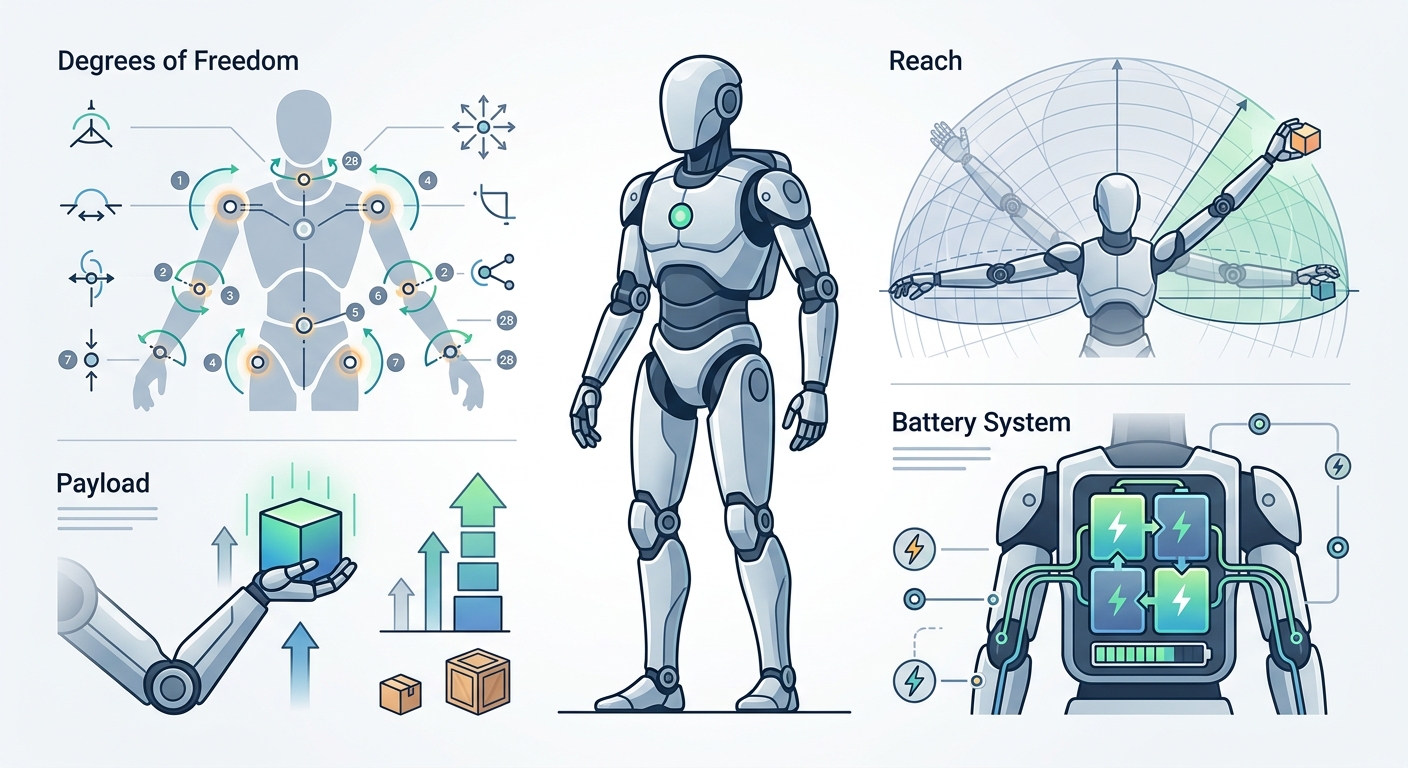
Degrees of freedom. The electric Atlas has 56 degrees of freedom — 56 individual joints it can control independently. That gives it extraordinary range of motion, including flexibility that exceeds what a typical human body can achieve in some axes.
Reach and payload. The robot stands at a height built for human environments, with a reach of up to 2.3 meters (7.5 feet) and the ability to lift objects weighing up to 50 kg (110 lbs). That payload capacity matters for industrial robot automation tasks like moving heavy assemblies, loading containers, or handling bulky components.
Power and endurance. Atlas runs on a self-swapping battery system. When power runs low, the robot can exchange its depleted battery for a fresh one with minimal downtime. This is a practical design choice for continuous commercial operation — no waiting hours for a recharge.
Perception and sensing. The robot has 360-degree vision through an integrated camera suite, plus advanced tactile sensors in its hands and body. It knows where it is in space, how its limbs are positioned, and what it is touching.
AI-driven full-body control. This is the biggest upgrade. Electric Atlas is not running pre-scripted choreography. It uses AI models to process sensor data in real time and generate coordinated whole-body movements dynamically. The robot adapts to changes in its environment, adjusts to objects it didn't explicitly pre-program for, and learns from experience rather than relying solely on engineered responses.
Quiet operation. Electric motors are far quieter than hydraulic pumps. A robot that works alongside humans in a factory needs to communicate with its environment without drowning it in noise. Electric Atlas is designed for that.
How Atlas Learns: AI and the Factory Floor
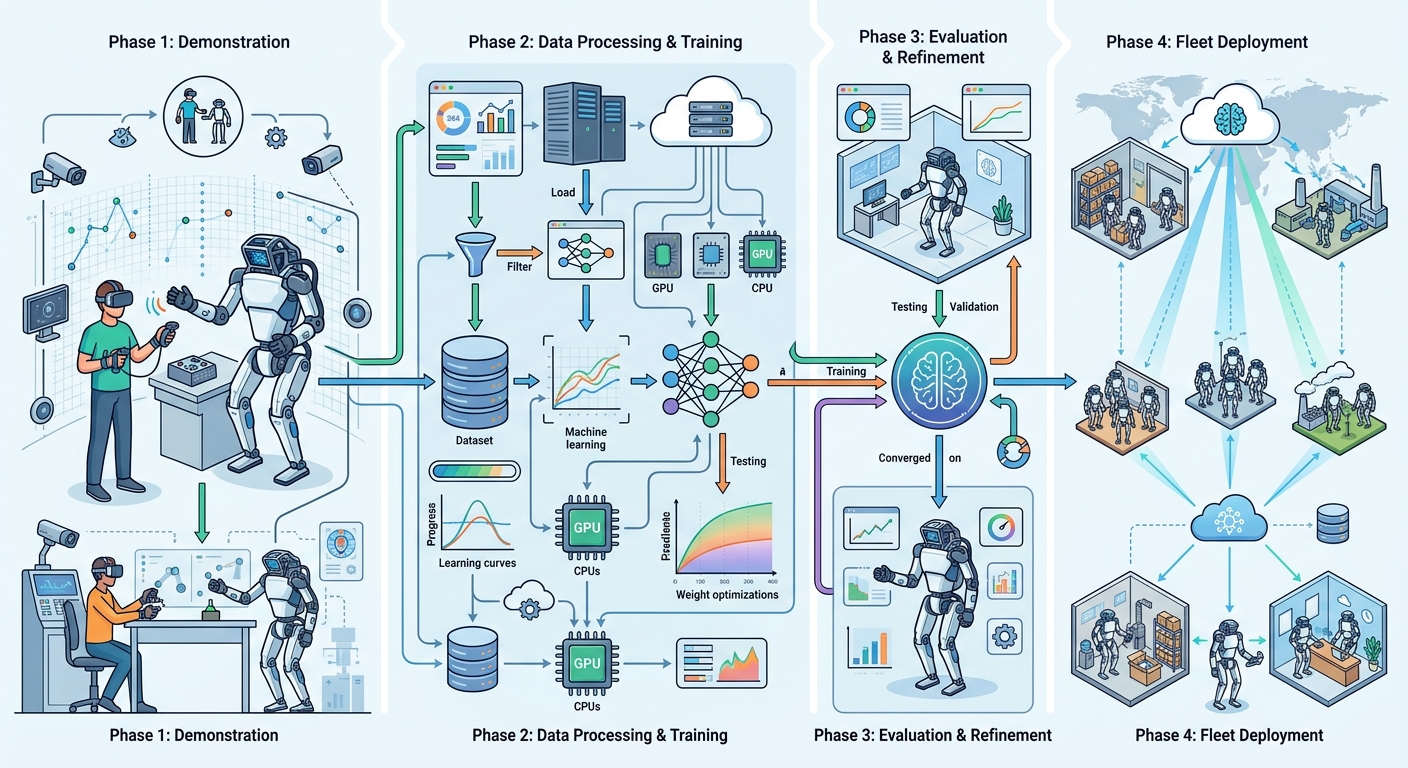
One of the most significant advances in the electric Atlas is not hardware — it is the learning pipeline. Boston Dynamics has built a system where a task learned by one robot can be deployed across an entire fleet in less than a day.
The 2025 development focus was labeled "Learning in the Factory and the Lab." The goal was to teach Atlas real industrial tasks in real environments, not just controlled demos. This involved three main areas.
Perception refinement. Atlas needed to make sense of complex, cluttered, changing factory floors. That required better AI robot vision models and sensor fusion — combining camera data, tactile feedback, and internal state information to build a reliable picture of the world.
Advanced gripper designs. Industrial tasks vary widely — picking up a small electronic component is very different from lifting a heavy metal stamping. Boston Dynamics developed multiple gripper designs tailored to different use cases, allowing Atlas to handle a broader range of objects and surfaces.
Full-body AI control models. Rather than controlling each joint separately, Atlas uses learned models that coordinate the entire body at once. When the robot reaches for something, the system accounts for balance, torso position, arm trajectory, and gripper orientation as a unified problem. This is what enables the robot to adapt to novel situations rather than failing when conditions deviate from a script.
The collaboration with Google DeepMind brings additional reinforcement learning and large model expertise to the project. DeepMind's experience training systems that interact with physical environments — from games to protein folding — translates into better real-world generalization for Atlas.
The fleet learning architecture means that as one Atlas learns a new task, that knowledge can be transferred to other units. A factory deploying ten Atlas robots doesn't need to program each one individually. Once the behavior is validated on one machine, the rest of the fleet can receive the update and begin performing the same task.
From Lab to Factory: Real-World Deployment
The electric Atlas has moved quickly from concept to commercial deployment.
2024: Redefining Atlas. After the retirement of hydraulic Atlas, Boston Dynamics unveiled the electric successor. Early testing focused on basic locomotion, manipulation, and integration with existing factory infrastructure.
2025: Learning in real environments. Throughout 2025, Atlas worked in actual facilities — including Hyundai Motor Group's US manufacturing plants. The goal was not just to demonstrate capability but to discover the edge cases, failure modes, and integration challenges that only appear in real industrial settings. Trial operations ran, feedback was collected, and the AI models were refined continuously.
CES January 2026: Production-ready. At CES 2026, Boston Dynamics and Hyundai unveiled the production version of Atlas. Manufacturing was already underway. The robot shown at CES was not a prototype — it was a product.
2026 deployments. Initial deployments for 2026 are fully allocated. Hyundai Motor Group received the first production units for deployment in its US manufacturing facilities. Google DeepMind also received units, focusing on research applications and continued AI development. Additional customers will be accommodated starting in 2027.
The pace of deployment is notable. From retirement announcement in April 2024 to production shipment in 2026 is roughly two years — a compressed timeline for such a complex machine. Boston Dynamics leveraged everything it learned from commercializing Spot and Stretch to accelerate Atlas's path to market.
What Electric Means for the Robotics Industry
Boston Dynamics is not alone in the electric humanoid robot race. Tesla's Optimus, Figure's Figure 01, 1X Technologies' NEO, and Agility Robotics' Digit are all electric humanoids aimed at similar industrial applications. Each company is taking a different approach to the same fundamental challenge: building a robot that can operate in human environments at a cost that makes commercial sense.
Atlas's advantage is experience. No other company has a track record comparable to Boston Dynamics in full-body humanoid control. The parkour videos, the dance routines, the balance and agility demonstrations — all of that work accumulated years of knowledge about how to make a humanoid body move reliably. The electric Atlas inherits that expertise and redirects it toward practical tasks.
The shift from hydraulic to electric is also a broader industry signal. Hydraulic systems offer raw power and precision that electric motors historically struggled to match. But the gap has narrowed significantly. Modern electric actuators, combined with better control algorithms, can deliver enough force and accuracy for most industrial manipulation tasks. The tradeoffs — quieter operation, simpler maintenance, easier manufacturing at scale — favor electric for commercial products.
For the manufacturing sector, Atlas represents a new kind of industrial robot automation. Traditional industrial robots are fixed in place, performing one pre-programmed task on a production line. Atlas is mobile, adaptable, and trainable by demonstration. A factory that needs to reconfigure a workflow does not need to physically reprogram and recalibrate a bank of fixed arms. They can show Atlas the new task and let the AI figure out how to replicate it across the fleet.
Robots like Atlas are not going to replace human workers wholesale in the near term. They are going to handle the dull, dirty, and dangerous tasks — lifting heavy components, working in loud environments, performing repetitive handling jobs — that make other automation hard to justify. Over time, as the learning pipeline matures and costs decrease, the scope of what these robots can do will expand.
Conclusion
The electric Atlas marks a turning point in the story of Boston Dynamics — and in the broader commercialization of humanoid robotics. By retiring hydraulic Atlas and starting fresh with an electric platform, the company made a clear statement: the future of industrial humanoids is electric, AI-driven, and built for real work.
With 56 degrees of freedom, a 2.3-meter reach, 50 kg payload capacity, fleet learning capabilities, and committed commercial deployments starting in 2026, the electric Atlas has moved decisively from viral video star to industrial product. The robotics industry is watching. The factories are next.
Expert Q&A
Q: What happened to the old hydraulic Atlas?
In April 2024, Boston Dynamics officially retired its hydraulic Atlas robot. The hydraulic version had been in development since around 2013 and became famous through viral videos showing it running, jumping, doing parkour, and even dancing. Hydraulic systems generate high force through pressurized fluid, which gives excellent power and precision — but they are also noisy, mechanically complex, and require regular maintenance. For a commercial product meant to operate in real factories alongside people, those drawbacks became harder to justify. Boston Dynamics replaced it with a fully electric version built specifically for industrial deployment.
Q: What are the key technical specifications of the electric Atlas?
The electric Atlas has 56 degrees of freedom — meaning 56 individually controllable joints across its body, giving it a range of motion that in some axes exceeds typical human flexibility. Its reach extends to 2.3 meters (7.5 feet), and it can lift objects weighing up to 50 kg (110 lbs). The robot uses a self-swapping battery system: when power runs low, it exchanges its depleted battery for a fresh one with minimal downtime, enabling near-continuous operation in industrial settings. Its perception system includes 360-degree vision through an integrated camera suite and advanced tactile sensors in its hands and body. Crucially, it runs AI-driven full-body control models rather than pre-scripted movement sequences, allowing it to adapt to novel situations in real time.
Q: How does the electric Atlas learn new tasks?
Boston Dynamics built a fleet learning system where a task demonstrated to one Atlas robot can be transferred to an entire fleet of units. Rather than programming each robot individually, a factory operator shows the robot the task by guiding it through the motions or performing the task nearby while the robot observes. The robot's AI models process that demonstration and generate a generalized behavior policy that can be deployed across all connected units. According to Boston Dynamics, a new task can go from demonstration to fleet-wide deployment in under a day. The 2025 development focus — "Learning in the Factory and the Lab" — prioritized three areas: better perception for complex factory environments, specialized gripper designs for varied manipulation tasks, and full-body AI control models that coordinate all joints simultaneously for natural, adaptive movement.
Q: Where is the electric Atlas being deployed?
The first confirmed commercial customer is Hyundai Motor Group, which received production units for deployment in its US manufacturing facilities starting in 2026. Google DeepMind also received units for research applications, continuing the collaboration on AI development for Atlas. At CES in January 2026, Boston Dynamics and Hyundai officially unveiled the production-ready version of the robot. Initial deployments for 2026 are fully allocated to Hyundai and DeepMind. Boston Dynamics has indicated that additional customers beyond those two organizations will be accommodated starting in 2027. The company moved quickly from the April 2024 retirement announcement to production shipment in roughly two years, drawing on its prior commercial experience with Spot and Stretch to accelerate the path to market.
Q: How does the electric Atlas compare to other humanoid robots?
The electric Atlas competes in a growing field of electric humanoid robots targeting industrial applications, including Tesla's Optimus, Figure's Figure 01, 1X Technologies' NEO, and Agility Robotics' Digit. Each takes a different approach, but all share the same core thesis: an electric-powered, AI-controlled humanoid can operate safely in human environments at a cost that makes commercial sense. Atlas's main competitive advantage is Boston Dynamics' depth of experience in full-body humanoid control. The company's decade-plus of work on balance, agility, and coordinated whole-body movement — shown in everything from parkour videos to dance sequences — translates into a more mature control stack for the electric version. The shift from hydraulic to electric also reflects a broader industry trend. While hydraulic systems historically offered superior power and precision, modern electric actuators combined with advanced control algorithms have narrowed the gap enough that the other benefits — quieter operation, simpler maintenance, easier manufacturing at scale — make electric the preferred choice for commercial products.
Image URLs
| # | Alt | URL |
|---|---|---|
| 1 | Electric Atlas robot key specifications — 56 degrees of freedom, 2.3m reach, 50kg payload, self-swapping battery system | /api/images/42e65216fa4940daa72ed95310016c16 |
| 2 | Atlas AI learning pipeline infographic — from task demonstration to fleet-wide deployment in under a day | /api/images/6be98ade3e0646159f7069e136e2aa30 |
Total: 2 images uploaded