Boston Dynamics' Atlas Goes Electric: What the New Generation of Commercial Humanoids Means for Warehouse Automation
Boston Dynamics' fully electric Atlas robot brings 56-DOF dexterity, 110lb lift capacity, and fleet learning to warehouses. Here's what the 2026 deployment data actually shows about ROI, reliability, and integration reality.
Boston Dynamics spent over a decade building hydraulic robots that could run, jump, and backflip for viral videos. The company has now quietly shipped that same engineering discipline into something far more practical: a warehouse worker.
The fully electric Atlas—production began at Boston Dynamics' Massachusetts headquarters in 2026—is the first generation of the company's flagship humanoid designed specifically for commercial industrial deployment. Unlike the hydraulic predecessor, which required heavy external power units and operated largely in controlled research environments, the electric Atlas is built to function inside real warehouses, next to human workers, doing real work.
Initial deployments are underway at Hyundai's Robotics Metaplant Application Center and Google DeepMind facilities, with broader enterprise rollouts expected in 2027. Hyundai has committed to deploying tens of thousands of Boston Dynamics robots across its facilities over the coming years. The robot won "Best Robot" at CES 2026, an award that functions partly as market validation and partly as a signal that humanoid robotics has crossed from laboratory curiosity into product territory.
This article examines what the electric Atlas actually delivers, where the financial case holds up, where it falls short, and how it compares to the warehouse automation options operators already have.
The Electric Shift: Why Boston Dynamics Abandoned Hydraulics
The hydraulic Atlas that preceded it was an engineering marvel constrained by physics. Hydraulic actuators require high-pressure fluid systems, external pumps, and significant mass—the kind of infrastructure that works in a lab or an outdoor environment but creates problems inside a fulfillment center. Hydraulics are loud. They leak. They require maintenance intervals that don't align with 24/7 warehouse operations.
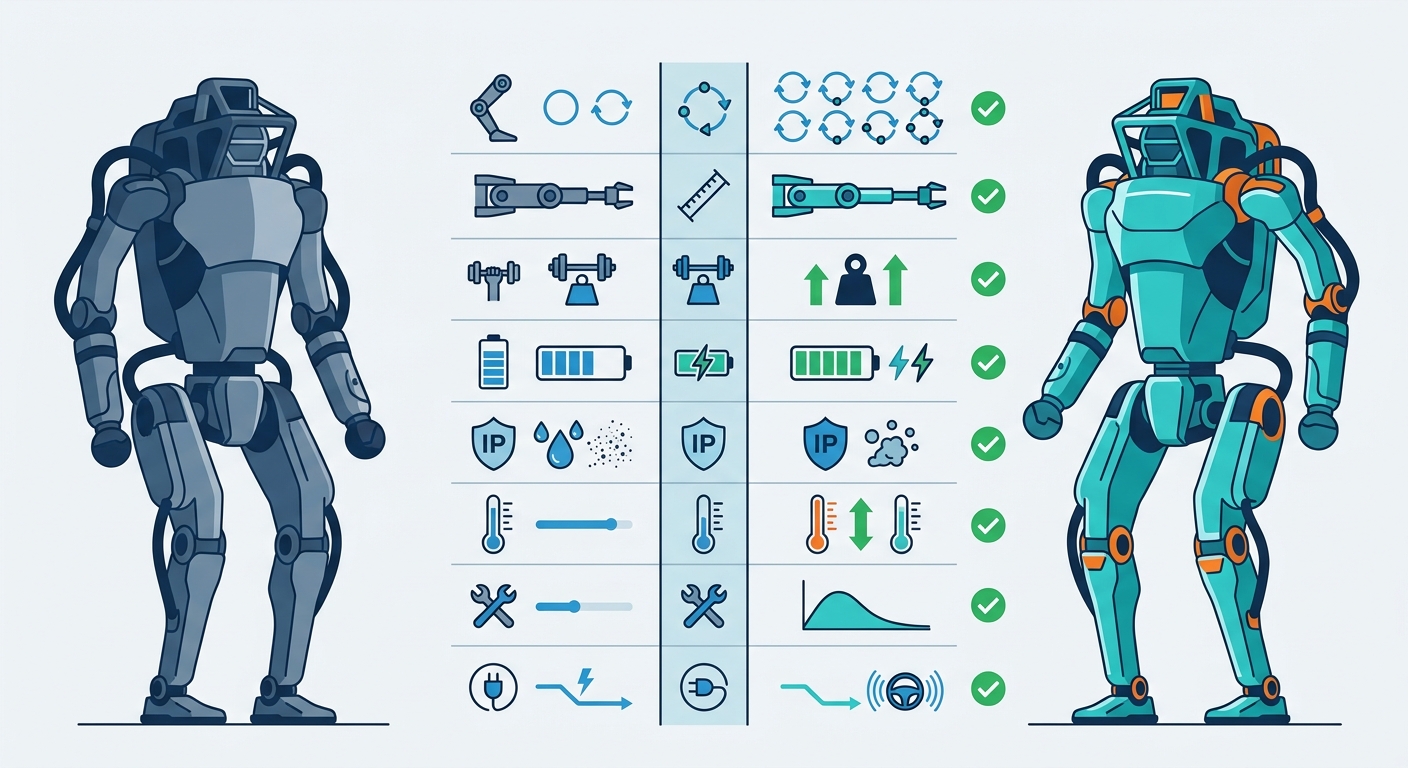
The fully electric Atlas eliminates those constraints. Electric actuators are quieter, more compact, and more reliable at the component level. The robot's 56 degrees of freedom—compared to earlier generations—gives it manipulation capability that roughly matches human range of motion across all major joints. This is not a gimmick: a robot that can move like a person can operate in spaces designed for people, without facility redesign.
The performance specs are substantial. The electric Atlas can lift up to 110 pounds (50 kg) repetitively, with momentary capacity reaching 55 kg. Its 7.5-foot reach covers standard warehouse racking heights. The IP67 rating means it operates in dusty environments and can withstand high-pressure washdowns—important for food and beverage or pharmaceutical applications. The operating temperature range of -4°F to 104°F (-20°C to 40°C) covers most indoor warehouse environments, including freezer-adjacent zones.
These specs matter because they define what Atlas can actually do on a warehouse floor. The combination of humanoid form factor, industrial durability, and electric actuation creates a robot that can slot into existing operations rather than requiring operations to slot around it.
By the Numbers: What the Electric Atlas Actually Delivers
The headline specs answer the question of what Atlas is physically capable of. The operational metrics answer the question of what that actually means for a warehouse.
Battery and runtime is the first constraint operators encounter. The electric Atlas delivers approximately 4 hours of continuous operation on a single charge. For context, a standard warehouse shift runs 8 hours. Boston Dynamics addresses this gap with an autonomous battery swap system that completes a swap in under 3 minutes. In practice, a warehouse would need multiple battery packs per robot unit and would schedule swap intervals around throughput windows—typically during natural breaks in workflow rather than waiting for complete discharge.
The 4-hour runtime is a real limitation that shapes deployment architecture. A facility running two full shifts would need either multiple robots per zone, significant battery inventory, or some combination of human coverage during swap transitions. This is manageable but not trivial, and vendors who imply seamless full-shift coverage without discussing swap logistics are oversimplifying.
Fleet learning is where the DeepMind partnership becomes operationally significant. When one Atlas unit learns a new task—say, handling a specific packaging format or navigating a particular zone configuration—fleet learning deploys across entire robot units without individual unit training. This dramatically changes the economics of deploying multiple units: the marginal cost of teaching the second, third, or hundredth robot the same task approaches zero once the first unit has mastered it.
This has implications for ramp-up timelines. A single-robot pilot that takes three months to reach full productivity suggests a twelve-robot deployment might take significantly less than twelve times that duration—potentially reaching full fleet productivity in four to six months total. Fleet learning doesn't just reduce per-unit training cost; it compresses deployment timelines in ways that materially affect humanoid ROI.
The ROI Reality: When Humanoid Robots Pay for Themselves
ROI analysis for warehouse humanoid robots requires separating the genuinely compelling from the currently speculative.
Under optimal conditions, the financial case is strong. A humanoid robot operating 20 hours per day in a U.S. warehouse—accounting for battery swaps and brief charging pauses—replaces roughly two shift workers when you factor in continuous operation, absence of benefits, and no required breaks. At current industrial humanoid pricing of approximately $80,000 to $250,000 (estimated), a $150,000 unit replacing two workers at $30/hour each (fully loaded) could achieve payback in approximately 12 to 18 months.
The optimal conditions caveat is important. The calculation above assumes high utilization—robots running nearly continuous shifts rather than sitting idle between tasks. It assumes the facility has the throughput volume to keep the robot productively engaged. It assumes the task profile matches what the robot can actually do reliably. Violate any of those assumptions and the humanoid payback period extends.
The math is most favorable when utilization is high and labor costs are high. At $25/hour fully loaded, the payback on a $150,000 robot running 20 hours daily stretches to roughly 24 months. At $15/hour, it extends further—and at that labor cost, the case for humanoid automation weakens considerably.
Most industry analysis places typical ROI timelines at 2 to 3 years under standard operating conditions, with best-case scenarios reaching 6 to 18 months. Hardware cost trajectory will likely compress these timelines: average selling prices are projected to decline from approximately $114,700 in 2024 to around $37,000 by 2030 (all estimated). A robot that costs $50,000 instead of $150,000 changes the warehouse automation ROI calculation fundamentally.
Annual maintenance runs approximately 10–15% of purchase price. For a $150,000 unit, that's $15,000 to $22,500 per year—a cost that must be factored into any multi-year financial model. Software licensing and fleet management subscriptions add an additional 10–20% annually to operating costs, which operators frequently overlook when building initial robot TCO models.
The comparison that matters is not "humanoid vs. no automation" but "humanoid vs. the next-best alternative." Goods-to-Person systems and Autonomous Mobile Robots often deliver better throughput economics for repetitive, high-volume tasks at current price points. The humanoid advantage is flexibility—handling irregular items, adapting to changing workflows, operating in spaces that can't accommodate fixed infrastructure.
Why 2026 Is Still Early: The Reliability Gap
The honest assessment of warehouse humanoid robotics in 2026 requires acknowledging a significant gap between capability and commercial readiness at scale.
The industrial standard for automated warehouse equipment is 95–99% uptime. A conveyor system or automated storage and retrieval system that fails more than 5% of the time gets replaced. Current generation humanoid robots fall well short of that threshold: most operate for 30 to 90 minutes before requiring human intervention for battery issues, navigation problems, or task failures.
This isn't a criticism of Boston Dynamics specifically—it's the state of the technology across the industry. The gap between "robot can do the task in controlled testing" and "robot can do the task continuously for 8 hours without intervention" remains substantial. For 2026 deployments, this means operators should plan for significant human oversight. Each robot zone likely requires at least part-time human supervision—a robot supervisor who handles intervention calls, troubleshoots failures, and manages the handoff between autonomous operation and exception handling.
The AI limitations compound the reliability issue. Current models still struggle with unstructured environments: oddly shaped packages, items that are stuck together, unexpected obstacles, lighting variations, and the thousand edge cases that occur naturally in real warehouses but rarely appear in training data. High-level task planning, error recovery, and seamless human-robot collaboration in non-engineered environments all require further development.
Network latency in metal-dense warehouse environments affects AI performance in ways that don't show up in clean lab testing. Navigation drift—gradual accumulated error in the robot's internal model of its position—remains a practical problem in cluttered, dynamic warehouse settings. These issues are solvable; they simply aren't solved yet at the level required for lights-out autonomous operation.
The current reality for 2026 is that most warehouse operators should pursue selective pilot programs rather than large-scale rollouts. A focused pilot on a specific task—say, inbound decanting or returns processing—generates real operational data without betting the facility's throughput on unproven technology.
Humanoid vs. The Alternatives: Making the Right Automation Choice
Humanoid robots are not always the right answer. Understanding when they excel relative to established alternatives is essential for making sound investment decisions.
Goods-to-Person (G2P) systems—automated storage and retrieval with human pickers—remain the throughput champion for high-volume, repetitive picking tasks. G2P can achieve 200–400 picks per hour per worker, significantly exceeding what current humanoid robots deliver for standardized item handling. The capital cost per pick is lower, and reliability is higher for tasks that don't require handling irregular items.
Autonomous Mobile Robots (AMRs) handle intra-warehouse transport efficiently and at lower cost than humanoid robots for pure movement tasks. They navigate dynamically, integrate with WMS for order routing, and have reached commercial maturity that humanoids haven't matched. For facilities primarily constrained by transport rather than picking, AMRs deliver faster ROI.
Humanoid robots gain advantage in three specific scenarios: handling irregular items that can't be processed by G2P or AMR systems, operating in existing human-centric layouts that can't accommodate fixed infrastructure, and performing multiple task types within a single zone without requiring separate specialized systems.
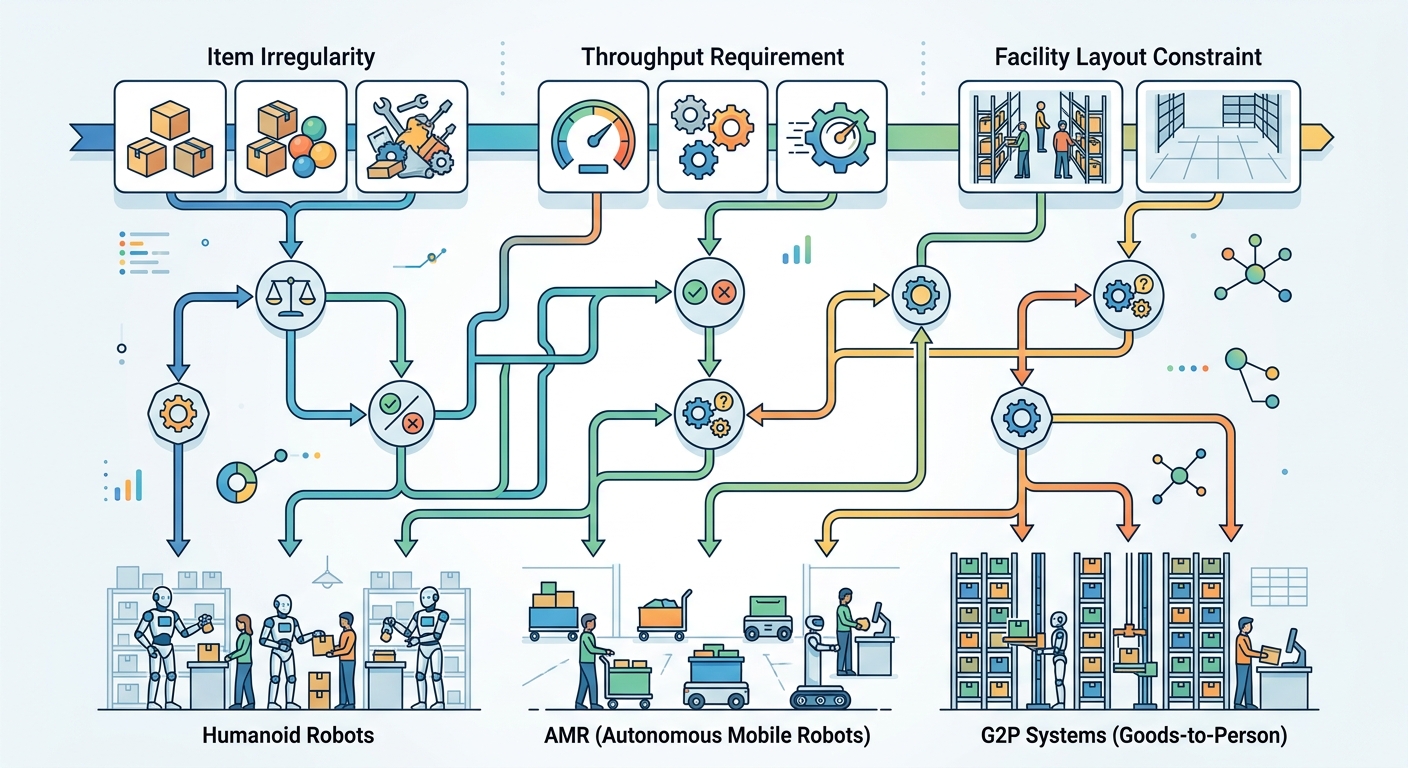
The decision framework for most warehouse operators in 2026 is: start with G2P or AMR for high-volume, standardized tasks where the ROI is proven; add humanoid robots selectively for task types that those systems can't handle—irregular items, variable workflows, or facilities with human-centric layouts that limit fixed infrastructure.
Integration Realities: Connecting Atlas to Your Warehouse
Technical integration is where many humanoid deployments stumble, and where the industry provides less guidance than operators need.
WMS integration requires advanced APIs and standardized data formats. Boston Dynamics and other vendors are converging toward common protocols, but in 2026, expect integration to require custom work. The robot needs to receive task assignments, report completion status, handle exception cases, and synchronize with warehouse execution systems—all in real time. For facilities running older WMS platforms, this integration work can represent a significant portion of total deployment cost.
Network infrastructure may require upgrades. Warehouse environments with dense metal shelving create network coverage gaps and latency variations that affect robot AI performance. Some operators are investing in private 5G networks specifically to support robot deployments, an infrastructure cost that appears in the TCO but often gets missed in initial ROI models.
Workforce transition is arguably the most underappreciated integration challenge. Deploying humanoid robots doesn't eliminate operator jobs—it transforms them. Human workers shift from performing picking and handling tasks to supervising robot fleets, handling exceptions, and managing the boundary between autonomous operation and human intervention. This requires investment in training, new hiring profiles (robot supervisors, fleet managers), and change management processes that most automation projects underfund.
The phased approach recommended by most experienced operators: begin with a narrow pilot on a specific, well-defined task; measure actual uptime, throughput, and intervention rates; expand only after the pilot demonstrates metrics that validate the ROI model; scale gradually as fleet learning accumulates and robot uptime improves.
What's Next: The 2026–2028 Deployment Roadmap
The timeline for warehouse humanoid deployment is not a single inflection point but a gradual ramp.
In 2026, the deployed base consists almost entirely of pilot programs at facilities willing to absorb early-stage technology risk in exchange for operational learning. Hyundai's RMAC and Google DeepMind are the highest-profile examples, but multiple large operators are running internal pilots. The purpose of these programs is generating real-world reliability data, refining integration processes, and building internal expertise.
In 2027, the first wave of broader enterprise deployment begins. Operators who completed pilots and validated ROI models will expand from single-zone to multi-zone deployments. Hardware reliability should improve as vendors incorporate lessons from early deployments. The software stack—fleet learning, exception handling, WMS integration—will mature.
In 2028–2030, the economics shift materially as hardware costs decline toward the $30,000–$50,000 range. At those price points, the ROI case strengthens significantly even for facilities with moderate labor costs. The humanoid advantage in flexibility becomes decisive at scale: a robot that costs $40,000 and handles multiple task types becomes competitive with specialized automation that costs less per unit but handles only one task type.
Hyundai—deploying tens of thousands of units—signals supply chain confidence that the demand exists and that manufacturing scale will follow. Fleet learning improvements compound this: once a task type is learned, deploying it across 1,000 robots costs essentially the same as deploying it across 10.
The practical advice for operators evaluating humanoid adoption in 2026: pilot now, plan for scale in 2027–2028, and build the internal expertise to evaluate and integrate the technology before the cost curve makes it an obvious yes.
Expert Q&A
Q: How does the electric Atlas differ from the hydraulic version, and why does it matter for warehouse deployment? A: The electric Atlas uses fully electric actuators instead of hydraulic systems, which eliminates the external pumps, high-pressure fluid lines, and significant mass that made the hydraulic version impractical for indoor collaborative environments. Electric actuation delivers three practical advantages: the robot operates quietly enough to work alongside humans without safety cages, the smaller form factor fits standard warehouse aisle dimensions, and the component reliability profile is better suited to 24/7 operations. The 56 degrees of freedom represents a meaningful increase in manipulation capability, enabling the robot to perform tasks that require human-equivalent range of motion rather than being constrained by mechanical limitations of earlier designs.
Q: What's the realistic ROI timeline for deploying humanoid robots in a warehouse? A: Most warehouse humanoid programs achieve positive ROI in 2–3 years under standard operating conditions. Under optimal conditions—high utilization rates around 20 hours per day, U.S. labor costs around $30/hour fully loaded, and tasks well-suited to the robot's capabilities—the payback period can reach 6–18 months. The critical variable is utilization: a robot that runs 20 hours per day generates roughly twice the economic value of one running 10 hours per day. At lower labor cost markets ($15–20/hour), the math weakens considerably and the payback extends beyond three years. Hardware cost trajectory will compress these timelines—by 2028–2030, as prices decline toward $30,000–50,000, ROI cases that don't work today will become compelling.
Q: Can Atlas work a full 8-hour warehouse shift without human intervention? A: Not yet on a single charge. The current 4-hour battery life requires autonomous battery swapping to maintain continuous operation across a full shift. The swap takes under 3 minutes, but facilities need multiple battery packs per robot and must integrate swap scheduling into workflow design. A two-shift operation needs either multiple robots per zone, significant battery inventory, or human coverage during transitions. This is manageable engineering, but operators should not expect seamless lights-out operation in 2026. The industry is heading toward full-shift capability as battery energy density improves, but current-generation humanoids require operational design that accounts for swap intervals.
Q: How does Atlas compare to AMR and G2P warehouse automation systems? A: AMRs (Autonomous Mobile Robots) and G2P (Goods-to-Person) systems each beat humanoids on specific dimensions. G2P achieves 200–400 picks per hour—significantly higher throughput than current humanoid robots for standardized item handling—and at lower capital cost per pick for that specific task. AMRs handle intra-warehouse transport efficiently and at lower cost than humanoids for movement-only tasks. Humanoids win on flexibility: handling irregularly shaped items that can't be processed by G2P or AMR systems, operating in existing human-centric layouts that can't accommodate fixed infrastructure, and performing multiple task types within a zone without separate specialized systems. The decision depends on your item profile, throughput requirements, and facility constraints—there's no universal answer.
Q: What are the main barriers to scaled humanoid deployment in 2026? A: Three barriers dominate. First, reliability: most current humanoid robots operate 30–90 minutes before requiring human intervention, well below the industrial 95–99% uptime standard. This means every robot zone needs human oversight, which partially offsets labor cost savings. Second, AI limitations in unstructured environments: current models struggle with edge cases like oddly shaped packages, items stuck together, or unexpected obstacles that occur naturally in real warehouses. Third, capital cost versus throughput: at $80,000–$250,000 per unit, ROI must be justified against established alternatives that often deliver better economics for specific task types. None of these barriers are permanent—reliability is improving with each generation, AI capabilities are advancing rapidly, and hardware costs are declining—but operators should plan for 2026 as an investment year rather than an optimization year.
Q: How does the DeepMind partnership improve Atlas's warehouse capabilities? A: The partnership primarily enables fleet learning at operational scale. When one Atlas unit learns a new task or acquires a new skill—say, handling a specific packaging format or navigating a particular zone—knowledge deploys across an entire robot fleet without individual unit training. This has two significant implications. First, it dramatically reduces the marginal cost of deploying additional robots once the first units have been trained. Second, it compresses deployment timelines: a multi-robot deployment that might take 12 times as long as a single-robot pilot (by linear extrapolation) might instead reach full fleet productivity in 4–6 months total. Fleet learning doesn't eliminate the need for initial training but transforms the economics of scaling once training is complete.
Q: What does maintenance actually cost for an industrial humanoid robot? A: Annual maintenance typically runs 10–15% of the purchase price. For a $150,000 unit, that's $15,000–$22,500 per year, covering actuator servicing, sensor calibration, software updates, gripper replacement, and predictive maintenance. Beyond hardware maintenance, software licensing and fleet management subscriptions add 10–20% annually to operating costs—costs that frequently get omitted from initial ROI models. A complete TCO analysis must include: initial purchase, annual maintenance, annual software licensing, integration costs (often 20–30% of hardware cost), network infrastructure upgrades if needed, and the cost of human oversight during the reliability ramp-up period.
Q: What should a warehouse operator do today to prepare for humanoid deployment? A: Three concrete steps. First, run a narrow pilot on a specific, well-defined task—returns processing, inbound decanting, or a particular picking zone—before committing to broader deployment. Measure actual uptime, throughput, intervention rates, and cost per task unit. Second, invest in workforce transition planning: identify which roles will transform, what new roles (robot supervisors, fleet managers) you'll need, and what training program will prepare your team. Third, build internal technical expertise now—understanding the integration requirements, API landscape, and operational design principles—before the technology is mature enough for large-scale deployment. Operators who start learning in 2026 will be positioned to scale in 2027–2028 when the economics become compelling.
Q: How does network infrastructure affect humanoid robot performance in warehouse environments? A: Metal-dense warehouse environments create network challenges that don't appear in clean lab testing. Signal attenuation through racking, multipath interference from reflective surfaces, and latency variations across large facilities all affect robot AI performance. Current humanoid systems that rely on cloud-based AI inference or fleet coordination are particularly sensitive to network quality. In practice, this manifests as navigation drift (accumulated positional error), delayed task assignment responses, and degraded perception in areas with poor coverage. Some operators are deploying private 5G networks specifically to support robot operations—a significant infrastructure investment that needs to appear in TCO models. Until network infrastructure is purpose-built for robotics, operators should expect integration challenges and plan accordingly.
Q: When will humanoid robots achieve the 95–99% uptime standard for industrial equipment? A: The timeline depends on which barriers you prioritize. Hardware reliability is improving with each generation and will likely reach industrial thresholds within 2–3 years for specific task types. AI reliability—specifically, the ability to handle unstructured edge cases autonomously—is further out, perhaps 3–5 years for general warehouse environments. The 2026–2028 period will likely see selective task types achieve 95%+ uptime in well-scoped deployments, while general-purpose autonomous operation across all warehouse task types remains a 2028–2030+ target. Operators should treat uptime targets as task-specific rather than system-wide: a robot that handles a narrow, well-defined task with consistent item profiles may reach industrial reliability sooner than one handling variable returns processing.
Want to stay ahead of warehouse automation trends as they develop? Subscribe to the Algorithmine portal for detailed technical analysis of industrial robotics, AI, and supply chain automation—without the vendor marketing.
This article is for informational purposes only. Specifications and pricing are based on publicly available information as of 2026 and may not reflect current offerings. Operators evaluating humanoid robotics should request detailed ROI analyses from vendors based on their specific operational parameters.