The 2026 Enterprise AI Spend Report: Where Companies Are Really Putting Their LLM Budgets
Enterprise AI spend nears $407B in 2026. Where budgets really go: inference, agents, talent, and the hidden costs that break plans — with an allocation template.
Enterprise AI spend is no longer experimental. Companies now treat LLMs as core operating expenses. The budgets prove it.
Global enterprise AI spending is projected to reach roughly $407 billion in 2026, per IDC. Gartner puts total AI-influenced technology spend even higher, near $2.59 trillion. Both numbers mark a year of fast, real investment.
AI now consumes about 18% of the average IT budget. That is up from 11% in 2024. In tech-forward firms, the share climbs to 25–30%.
The real shift — pure innovation experiments fell from 25% of AI budgets to just 7%. The rest is now tied to production workloads and measurable outcomes.
This report breaks down where the money goes. It covers infrastructure, inference, agents, talent, and governance. It also names the hidden costs that quietly inflate every plan.
Where the money actually goes
The allocation is no longer mysterious. Surveys of enterprise CIOs give a consistent split.
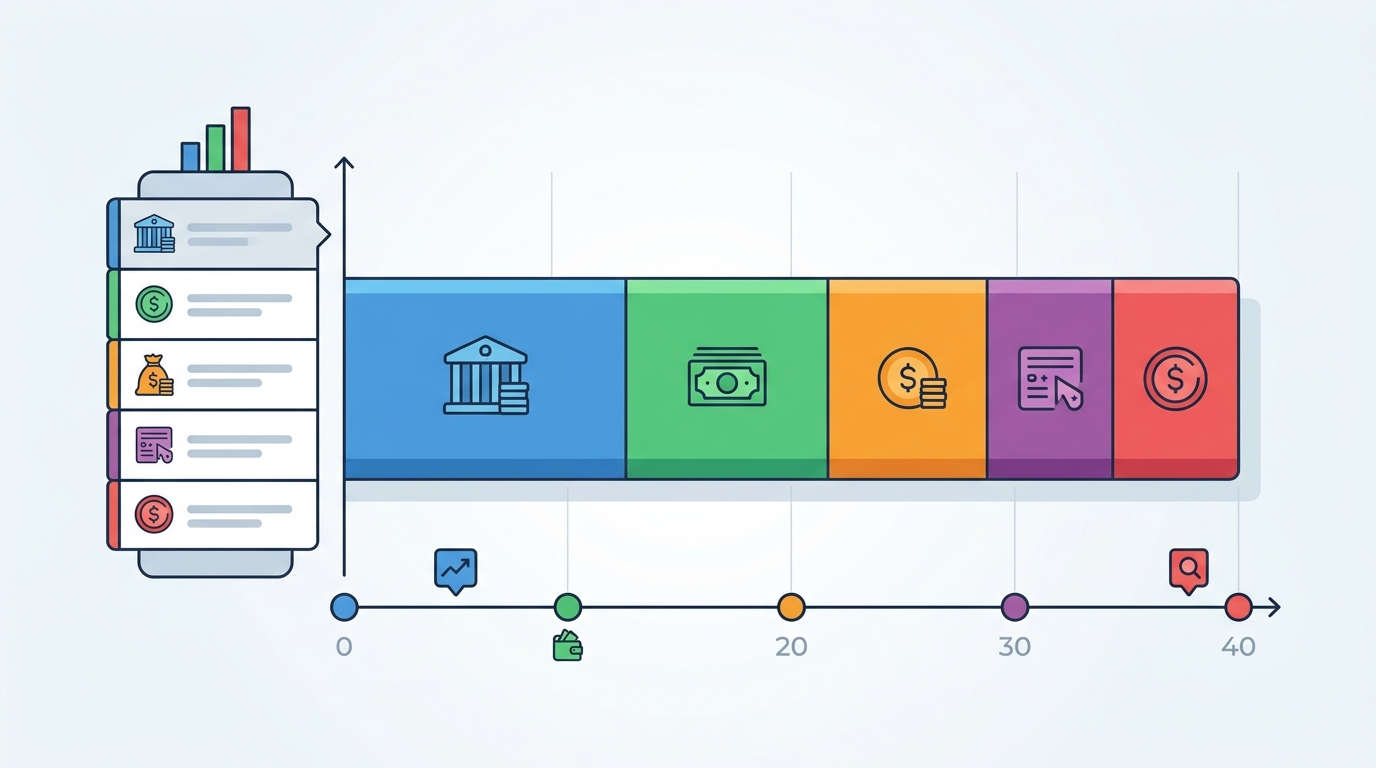
Roughly 35% of AI budgets go to software and SaaS AI tools. About 22% funds cloud infrastructure. Around 17% pays for internal AI talent. The remainder covers data platforms, implementation, and governance.
The software slice is the fastest mover. Enterprises lean on vendor platforms rather than build in-house. This keeps per-seat pricing and subscription fees front of mind.
Infrastructure is the biggest hard-cost line. AI-optimized infrastructure now exceeds 45% of all AI spending. Spending on AI-optimized IaaS is growing 96% this year, reaching $42 billion.
A useful way to read the split is by ownership. Software and talent are decisions you control. Infrastructure and data are decisions your cloud and tooling vendors shape. Understanding who owns each line helps you negotiate better.
A practical frame — the 35/22/17 split is a starting point, not a law. Low-maturity teams skew toward software. High-maturity teams shift spend toward inference and governance.
Renting infrastructure beats buying for most firms. Cloud IaaS lets teams scale inference without long capex cycles. That flexibility is why infrastructure spend stays high.
Inference overtakes training
The biggest structural change is here. Companies now spend more on running models than building them.
Inference spending now exceeds training spending in 2026. Global inference reaches $23.3 billion. Training trails at $19 billion. Inference now accounts for about two-thirds of all AI compute.
Why it matters — running AI is continuous; training is periodic. Every production prediction burns tokens, power, and compute all day, every day.
This is not a small effect. Over the first two years of a deployment, inference can cost three to ten times more than training and fine-tuning combined.
Training still matters. Frontier model runs cost $100 million to over $1 billion each. But for most enterprises, training is a modest opex. Inference is the bill that recurs.
Budget teams must treat inference as operating cost. It behaves like a monthly utility, not a one-time build.
Buy, build, or partner
Where the money goes depends on how teams build. The build-versus-buy decision drives most allocation.
Vendor-led and partnered AI projects show a 67% success rate. Purely in-house builds succeed about 33% of the time. That gap shapes where budgets land.
Why do in-house builds fail more often? Integration is slow. Legacy systems resist change. Governance and workforce redesign add drag.
A useful rule — buy commodity capabilities, build only niche workflows, and partner when you need domain expertise fast.
Buy-first is now the default. Teams customize vendor platforms instead of training from scratch. This lowers time-to-value and shifts spend toward software line items.
The choice still matters per use case. High-value, differentiated workflows justify in-house work. Everything else belongs on a proven platform.
Agentic AI: the newest line item
Agents are the fastest-growing part of the budget. They also carry hidden costs.
AI agent software spending is forecast to reach $206.5 billion in 2026, per Gartner. That could reach $376.3 billion in 2027. Adoption is already broad: 86% of IT decision-makers deploy copilots or agents.
Cause for caution — 57% of professionals have agents in production, yet 32% still cite quality as the top barrier.
The real cost is per action, not per license. Each agent step triggers model calls, tool APIs, and orchestration. Multi-step workflows multiply those calls quickly.
Consider a simple support agent. It reads a ticket, queries a database, drafts a reply, and self-checks. That is four or more model calls for one outcome. A complex workflow can demand dozens.
Observability and human review add more. Agents that take actions across systems need monitoring and intervention points. Security controls against prompt injection and tool poisoning raise the running cost further.
Retry loops are the silent killer. An agent that fails and retries doubles or triples its token bill. Teams should track retries as a first-class cost metric.
Finance teams should model agents as cost-per-transaction. A single autonomous flow can generate dozens of inference calls. That stacks up fast at scale. Set explicit budgets per agent run before rollout.
The ROI gap
Big budgets have not yet produced big returns for most firms. The numbers are sobering.
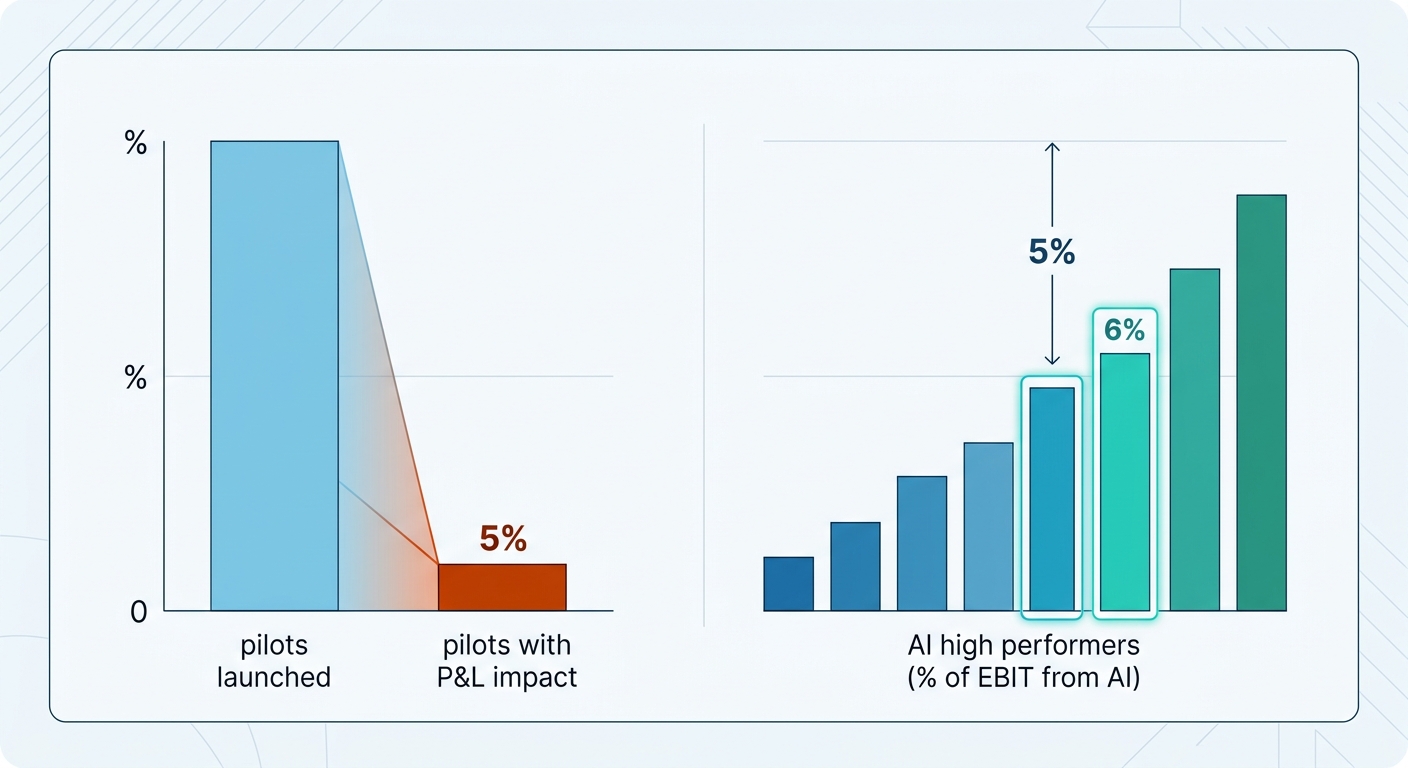
Only 5–8% of companies report measurable, at-scale AI ROI. MIT finds that 95% of generative AI pilots show zero P&L impact. McKinsey reports that just 37% attribute any EBIT impact to AI.
Only 6% qualify as "AI high performers." Those firms attribute 5% or more of EBIT to AI. The rest are still spending without proof.
The blocker is not the model. It is organizational. Workflow integration, data quality, and governance hold back value more than any technical limit.
Improving AI ROI often starts with technical debt. Fixing legacy systems can lift AI returns by up to 29%. Teams that redesign workflows see the biggest gains.
Match the metric to the project. Revenue growth suits customer-facing tools. Efficiency gains suit back-office automation. Picking the wrong metric makes good work look like a failure.
Set a baseline before launch. Measure the workflow without AI, then with AI. The delta is the real ROI, and it is measurable in weeks.
Teams that master this measurement edge stay ahead. If you want ongoing analysis of what works in enterprise AI, subscribe to the portal for fresh benchmarks and playbooks.
The hidden cost stack
Budgets overrun because of costs nobody planned for. These are real and recurring.
Hidden AI costs typically add 35–50% to the original budget. That includes process redesign, scaling compute, and change management. Integration alone routinely blows past estimates.
Annual maintenance adds another 15–30% of the build cost. This line recurs every year but rarely appears in the first plan.
Watch the leaks — shadow AI and tool sprawl lead to abandonment in one of every four AI projects.
Shadow AI means unsanctioned tools used without approval. Overlapping subscriptions and usage-based pricing hide spend across departments. Governance gaps make it worse.
Oversight has a price tag too. AI governance platforms cost $30,000 to $100,000 per year. Legal and ethics reviews run 5–15% of total AI program spend. Few teams budget for either.
Ownership is the first governance gap. Only 14% of companies have clear leadership responsibility for AI. Without an owner, decisions lag and risk grows.
Plan for these lines before committing. A realistic budget includes integration, maintenance, governance, and change management from day one. Treat them as investments, not waste.
The talent bill inside the budget
People are a bigger line than most plans admit. The 17% talent share hides real complexity.
Teams need data scientists and machine learning engineers. They also need AI product managers and platform owners. Hiring these specialists competes against the same shallow talent pool every company faces.
Upskilling is the cheaper lever. Workforce AI training runs $500 to $5,000 per employee per year. That spreads capability across existing staff instead of fighting for new hires.
People also appear as hidden labor. When you automate a routine task, someone must oversee, validate, and handle exceptions. Those roles cost money and rarely appear in the model budget.
A common miss — firms budget for the model but not for the humans who run it. Oversight and validation can double the real cost of a deployment.
Redesign roles alongside automation. Plan for the new supervision work before you cut the old manual work. That keeps the human cost visible and controlled.
Industry benchmarks
Spending varies sharply by sector. Benchmarks help firms calibrate their own plans.
Financial services leads AI spending by sector at about $68 billion. That is roughly 16.7% of all enterprise AI spend. These firms dedicate 25–30% of IT budgets to AI.
Healthcare follows at $45 billion, about 11% of the total. The sector is moving from experimentation to mission-critical systems. Retail spends $38 billion, or about 9.3%, and 90% of retailers plan to raise budgets.
The 18% average IT-budget share is just a floor for leaders. SaaS and fintech run higher, at 25–30%.
These numbers are planning anchors, not targets. Match the benchmark to your industry and maturity level.
Use the split to ask sharper questions. If your financial-services peers spend 25–30% of IT on AI and you sit at 10%, decide why. The gap may be an opportunity or a warning.
Benchmarks also reveal where leaders focus. Financial services pours money into fraud detection and client automation. Healthcare funds diagnostics and clinical support. Retail builds personalization and supply-chain tools.
Your mix should reflect your own value drivers, not a copy of the sector average.
Build your own budget
A concrete template turns these insights into next year's plan. Start with a tested split.
Reserve about 35% for software and SaaS platforms. Set 22% for infrastructure and compute. Keep 17% for internal AI talent. Allocate 13% to data platforms and 13% to implementation plus governance.
Always reserve a governance and observability line of 5–15%. This is the part teams cut first and regret most. Treat inference as recurring opex, not a one-time build.
The closing rule — tie every budget line to a measurable outcome before committing. If you cannot state the metric, the line is a bet, not a plan.
Plan for the inference shift early. Model maintenance and hidden costs from the start. Use industry benchmarks to sanity-check your numbers.
Enterprise AI is entering its operational era. The winners will be the teams that budget for reality, not hype. That means planning for inference, agents, governance, and the hidden stack — and tying every dollar to a result.
For the latest on enterprise AI budgets and what is working, subscribe to the portal. New reports, benchmarks, and field guides arrive every week.
Expert Q&A
Q: What is the single biggest line item in an enterprise LLM budget in 2026, and why does it keep growing? A: The biggest single line is AI infrastructure and compute, driven by inference. AI-optimized infrastructure now exceeds 45% of all AI spend, and AI-optimized IaaS is growing 96% this year to $42 billion. The growth is structural: production workloads run continuously, so compute is a recurring bill rather than a one-time purchase. Teams that plan transport to inferencing early control this line; teams that budget it as a project cost get surprised every month.
Q: Why does inference cost more than training now, and how should a team plan for it? A: Inference is a continuous cost while training is periodic. Once a model is in production, every prediction burns tokens, power, and compute around the clock. That is why inference can cost three to ten times more than training and fine-tuning over the first two years. Plan inference as recurring opex — like a utility bill — and monitor token spend and retry loops, which are the two hidden multipliers that blow budgets.
Q: My team keeps debating buy, build, or partner. What actually wins? A: The data favors buy-first. Vendor-led and partnered AI projects succeed about 67% of the time, versus roughly 33% for in-house builds. Integration, legacy systems, and governance drag down custom builds. A practical filter: buy commodity capabilities, build only the niche workflows that give you a real edge, and partner when you need domain expertise quickly. Match the path to the value, not to engineering pride.
Q: Where do the hidden costs of enterprise AI actually hide, and how do I stop them? A: They hide in integration, maintenance, governance, and change management. Hidden operational costs typically add 35–50% to the original budget, and annual maintenance adds another 15–30% of build cost. Shadow AI and tool sprawl push one in four projects to abandonment. Budget these lines from day one, assign clear ownership (only 14% of firms have it), and track cost per team and per workflow. Visibility is the cheapest fix in the whole budget.
Q: How do agentic AI costs scale as I move from pilots to production? A: Agent costs scale per action, not per license. A simple support agent can make four or more model calls for one outcome, plus tool fees, orchestration, observability, and human review. A complex flow can demand dozens of calls, and retry loops can double or triple the bill. Model agents as cost-per-transaction, set explicit per-run budgets before rollout, and treat retries and observability as first-class cost metrics. This keeps agent spend predictable as you scale.