The Great Enterprise AI Land Grab: What 2026 Adoption Waves Mean for Vendors and Buyers
How the 2026 enterprise AI land grab is reshaping vendor strategy and buyer decisions — adoption waves, consolidation, p
Introduction
The enterprise AI land grab is the 2026 competition between vendors to own enterprise AI platforms, data, and workflows, and between buyers to lock in strategic AI partnerships before consolidation narrows their options.
There is a moment in every technology cycle when the hype curve meets the budget cycle, and the conversation stops being about potential and starts being about ownership. For enterprise AI, that moment is 2026.
I have spent the last few years watching teams across financial services, healthcare, manufacturing, and the software industry turn AI experiments into line items. What I am seeing now is different in kind, not just degree. Vendors are no longer competing to sell you a clever model or a demo. Vendors compete to own enterprise relationships in the land grab — the platform, the data position, the workflow, and ultimately the multi-year contract that comes with it. And buyers, for their part, are racing to lock in partners, platforms, and talent before the good options disappear or get absorbed into something bigger.
This is the great enterprise AI land grab, and it will define who wins and who loses for the rest of the decade. This article breaks 2026 down into three distinct adoption waves, explains how vendors are fighting for enterprise share, and gives buyers a concrete playbook — including a due-diligence checklist — for navigating a market that rewards speed but punishes carelessness.
Why 2026 Is the Tipping Point for Enterprise AI
Every land grab needs a catalyst. For enterprise AI, 2026 is the year that several forces finally aligned.
First is the maturity of the vendor side. The massive investment wave of 2024 and 2025 — hundreds of billions estimated in raised and deployed capital across models, GPUs, and infrastructure — has consolidated into actual platforms you can buy and deploy. Capability is no longer the bottleneck. The hard questions in 2026 are about operations: how to secure it, govern it, measure it, and scale it.
Second is the capital intensity of the market. Building frontier models can cost tens of millions per training run. Running them in production at enterprise scale means compute, orchestration, and data plumbing that most organizations can't build alone. That capital intensity pushes many enterprises toward strategic vendor relationships rather than point purchases.
Third is the shift in boardroom expectations. After years of pilot projects, executive teams are under real pressure to move from "prove the value" to "show the adoption." Leadership teams that talked enthusiastically about AI are now being asked — at annual planning, at board reviews, at investor updates — to report specific, measurable deployments. This is the pressure that turns a pilot culture into a procurement race.
The shift: in 2025 the question was "can this work?" In 2026 the question is "who do we build this with, and how fast can we scale?"
None of this is to say every enterprise is racing at the same speed. But the direction is unmistakable, and it is why framing 2026 as a land grab — rather than an incremental rollout — is the most useful way to understand the market.
The Three 2026 Adoption Waves Reshaping the Market
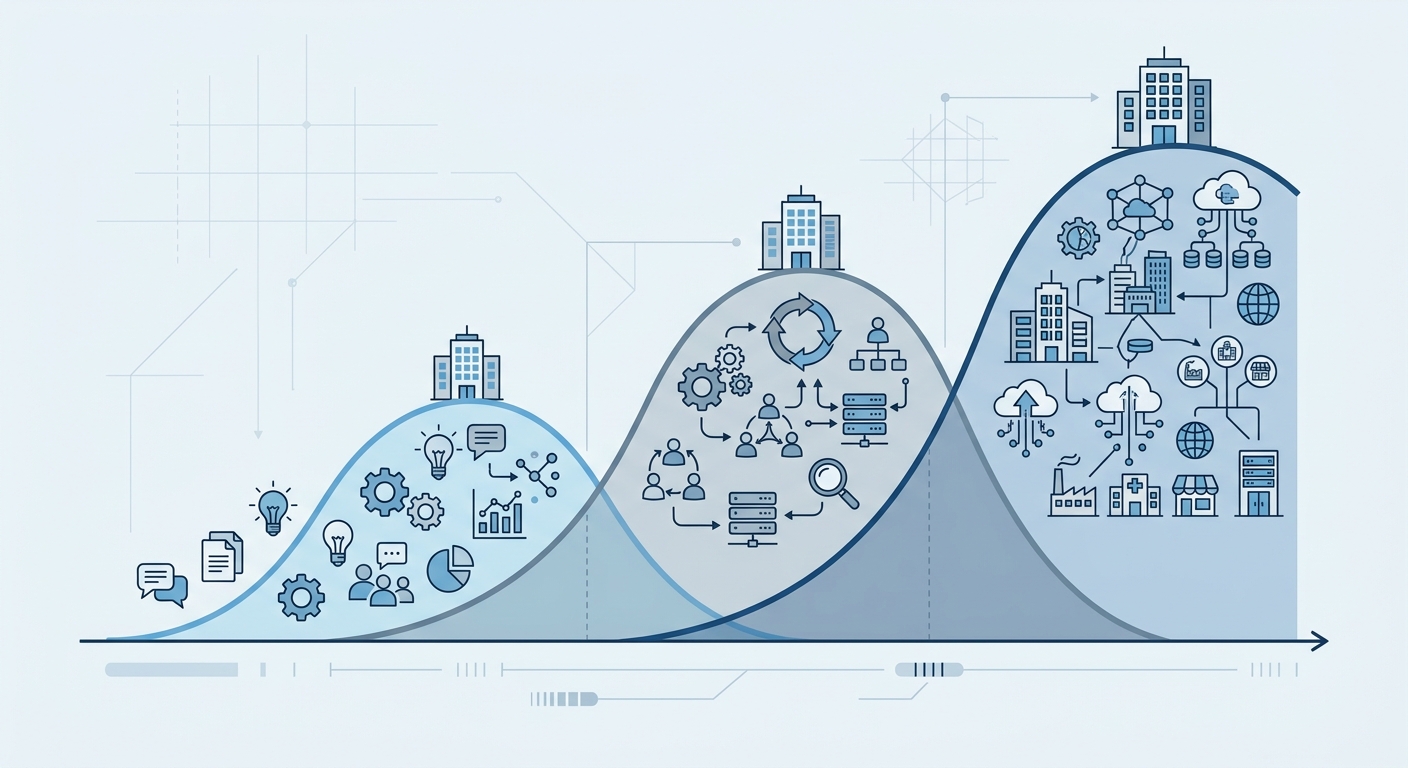
When I map out what enterprises are actually buying and deploying in 2026, the activity sorts into three distinct waves. They overlap, but they are meaningfully different in what they require from buyers and what they mean for vendor strategy. Enterprise AI adoption is happening in three 2026 waves, each with a different buying motion and risk profile.
| Wave | Focus | Buyer | Buying motion | Risk |
|---|---|---|---|---|
| Wave 1 — Copilots & Assistants | Productivity | Individuals/teams | Fast, self-service | Low |
| Wave 2 — Agentic Workflows | Systems that act | Ops/platform teams | Structured, piloted | Medium-high |
| Wave 3 — Vertical Platforms | Industry-specific | Executive/C-suite | Long, reviewed | Highest commitment |
Wave 1: Copilots and Assistants
The first wave is the one most organizations have already touched: copilots and AI assistants. These are tools that sit alongside knowledge workers and help them write, summarize, search, generate code, and handle routine tasks. Copilots and assistants deliver broad but shallow productivity.
This wave is unmistakably real. Adoption is broad because the barrier to entry is low and the value is immediate. A developer who gets a code assistant, a support team that gets a summarization tool, an analyst who gets a query assistant — these are wins you can feel in the first week. Procurement is fast, often self-service, and the risk is contained.
But the shallow dimension of Wave 1 is the catch. Copilots make individuals more productive without necessarily changing the underlying business process. They are additive, not transformative. That is exactly why they are the easiest land-grab entry point for vendors: low friction, broad surface area, and a natural upsell path into deeper workflow automation.
Wave 2: Agentic Workflows
The second wave is where 2026 gets interesting: agentic workflows — systems that don't just suggest but act. Instead of a copilot drafting a response that a human approves, an agent takes actions across your tooling: opening tickets, updating records, reconciling invoices, handling claims, and orchestrating multi-step processes. Agentic workflows let AI take real business actions.
Wave 2 is the differentiator this year because it is where the ROI gets real. An agent that closes a ticket end-to-end, or resolves a claim without human intervention, produces measurable cost reductions and throughput gains that a copilot simply cannot.
But it is also where the risk multiplies. Agents have real side effects. They write to databases, trigger workflows, and spend money. That means guardrails, observability, human-in-the-loop controls, and evaluation become non-negotiable. The buyers winning at Wave 2 are the ones who treat deployment as an engineering discipline, not a feature rollout. And the vendors winning are the ones who can offer not just a capable model but a trustworthy operational shell around it.
Wave 3: Vertical and Full-Stack Platforms
The third wave is the deepest and the slowest: vertical and full-stack platforms built for specific industries. Think AI-native stacks for legal document lifecycle, underwriting and claims, diagnostics, supply-chain planning, or front-office operations. Vertical platforms serve deep, industry-specific needs.
These platforms combine models with industry-specific data, workflows, compliance, and integrations. They command the largest contracts and the longest buying cycles — measured in quarters, not weeks — because the procurement involves legal, security, compliance, and often regulatory review.
Wave 3 is where the land grab becomes strategically permanent. When an enterprise commits to a vertical platform, it is not buying a tool; it is restructuring how a core function operates. That is the deepest lock-in, and for vendors, it is the prize.
The key insight: the three waves are not competing with each other. They are layered. A vendor that lands Wave 1 seat expansion, earns a Wave 2 workflow deployment, and reaches a Wave 3 platform commitment has effectively won the enterprise.
How Vendors Are Fighting for Enterprise Share
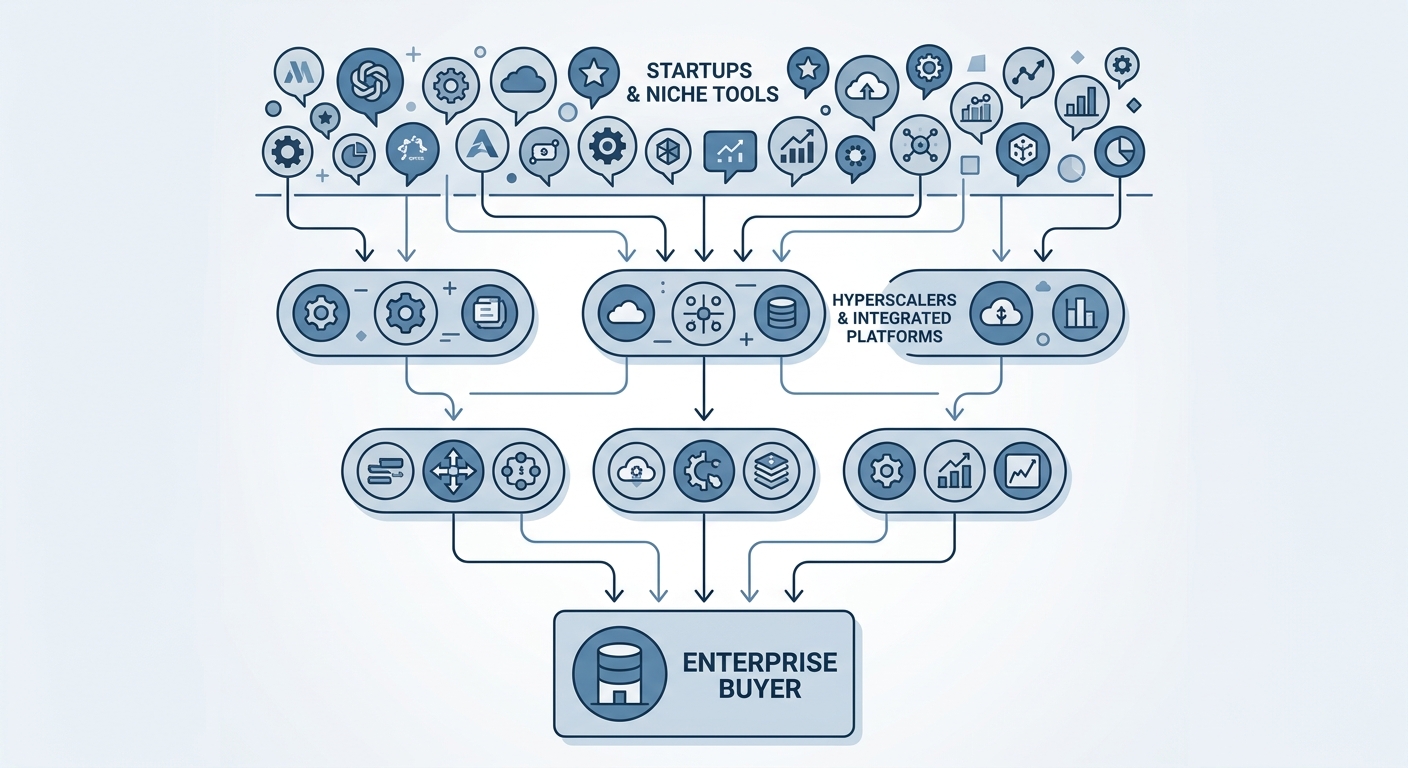
Understanding the waves tells you what buyers want. Understanding the vendor strategy tells you how the market is actually being won — and where the battlegrounds are. Vendors compete to own enterprise share through bundling, consolidation, and compute leverage.
Platform Bundling and the Consolidation Wave
The defining commercial move of the land grab is bundling. Rather than sell a point capability, the major vendors are packaging model, orchestration, security, data, and integration into a single platform and pricing it as the enterprise standard. Platform bundling drives the enterprise AI consolidation wave.
Bundling creates a powerful land-and-expand dynamic. A vendor wins a small, contained workflow — say, an internal knowledge assistant — and then expands from that beachhead into adjacent workflows, agentic automation, and eventually the whole platform. Each expansion raises the switching cost and deepens the relationship.
Consolidation is the market-level version of this. Throughout 2025 and into 2026, we have watched smaller vendors and point tools get acquired or absorbed by hyperscalers and integrated platforms at a rapid clip. For buyers, this consolidation cuts both ways: it promises more integrated, better-resourced tooling, but it also means the vendor you sign with this quarter may not be the same company — or product strategy — next year.
Foundry Deals and Compute Leverage
A structural advantage few enterprises appreciate is compute. The vendors that control frontier model training, GPU supply, and inference infrastructure hold enormous leverage in enterprise negotiations. Foundry agreements — where a customer commits to a cloud provider's AI stack in exchange for model access, credits, and preferred pricing — have become a central sales motion. AI foundry deals and cloud credits reshape vendor leverage.
This creates a subtle strategic reality for buyers: the AI vendor decision is often inseparable from the cloud decision. If you are already running your workloads on a hyperscaler, the path of least resistance — and often the best commercial terms — is to buy that ecosystem's AI platform. That inertia is itself part of the land grab.
Pricing: From Seats to Tokens to Outcomes
The pricing evolution reveals how vendors are trying to align with enterprise value — and where the risk lies. AI pricing models are shifting from seats to tokens to measured outcomes.
Wave 1 copilots are typically priced per seat. That is simple and predictable, but it caps what a vendor can earn from real value created. Wave 2 agentic systems increasingly move to usage-based pricing — per token, per task, per successful action. And the frontier of 2026 is outcome-based pricing, where the vendor shares in measured business results.
Outcome pricing is attractive in principle but treacherous in practice. Defining, measuring, and agreeing on "the outcome" — and apportioning credit when multiple systems contribute — is fiendishly hard. I have watched more than one enterprise negotiate an outcome-based contract only to spend the next two quarters arguing about attribution. Buyers should treat any outcome-pricing promise with healthy skepticism and insist on clear, auditable definitions.
What Buyers Should Do in the Land Grab
The land grab is a vendors' game, but buyers have more leverage than the framing suggests — if they use it deliberately. Here is the practical guidance I give to enterprise leaders. Buyers must avoid the AI pilot graveyard and act deliberately.
Escape the Pilot Graveyard
The single most common failure I see is what I call the pilot graveyard: dozens of proof-of-concept projects, endless demos, and very little production adoption. Pilots are cheap and non-threatening, which is why they proliferate. But a pilot that never becomes a production deployment is not progress; it is deferred cost.
The fix is to force the question of production from day one. Before any vendor demo, ask: what does the production path look like, what does it cost, who owns it operationally, and how do we measure success in production? If a vendor can't answer those questions, it is not ready for your land grab decision.
Treat Vendors as Partners, Not Point Tools
Because the land grab is about long-term relationships, buying on price or on a single capability in isolation is a strategic mistake. Evaluate the vendor as you would a strategic supplier: its roadmap, its ecosystem, its financial stability, and its willingness to co-design around your constraints. The cheapest point tool that isn't part of a durable platform can become an expensive stranded asset within a year.
Evaluate Data Portability and Security Early
In a consolidating market, the ability to leave is your strongest negotiating asset. Data portability, open standards, export APIs, and a clean exit path are not afterthoughts — they are core procurement criteria. The vendor that makes it easy to stay on its own merits, rather than hard to leave, is the vendor worth betting on.
Security and compliance are equally foundational. In a 2026 landscape where AI systems touch sensitive data, run regulated workflows, and take real actions, a vendor's security posture is a first-class requirement, not a check-box on a marketing page.
Build, Buy, or Hybrid: A 2026 Decision Framework
One of the most consequential choices in the land grab is whether to build your own AI stack, buy from vendors, or run a hybrid of both. Build vs buy depends on differentiation and data moats. The answer depends on a few honest questions.
Differentiation and data moats. If the AI capability is core to your differentiation — if it relies on proprietary data, bespoke workflows, or a customer experience you can't outsource — build. The most durable enterprise AI advantages in 2026 come from unique data and workflow integration, not from the model itself, which is increasingly a commodity.
Speed and focus. If the capability is a commodity — summarization, search, standard copiloting — buy. Building a foundation-model layer you could purchase is a fast way to burn budget and talent on undifferentiated work. Buy the commodity so you can concentrate your best engineers where it actually matters.
Compute and capital. Building always carries a capital expense: GPUs, data engineering, MLOps, and ongoing maintenance. If your organization can't sustain that, a managed platform is the realistic path — even if you'd rather own it.
The hybrid is increasingly the 2026 answer. Enterprises pair open or commercially available models with their own data, orchestration, and guardrails, using vendors for managed infrastructure while retaining control over the differentiating layers. This gives you the flexibility to avoid lock-in while still moving fast.
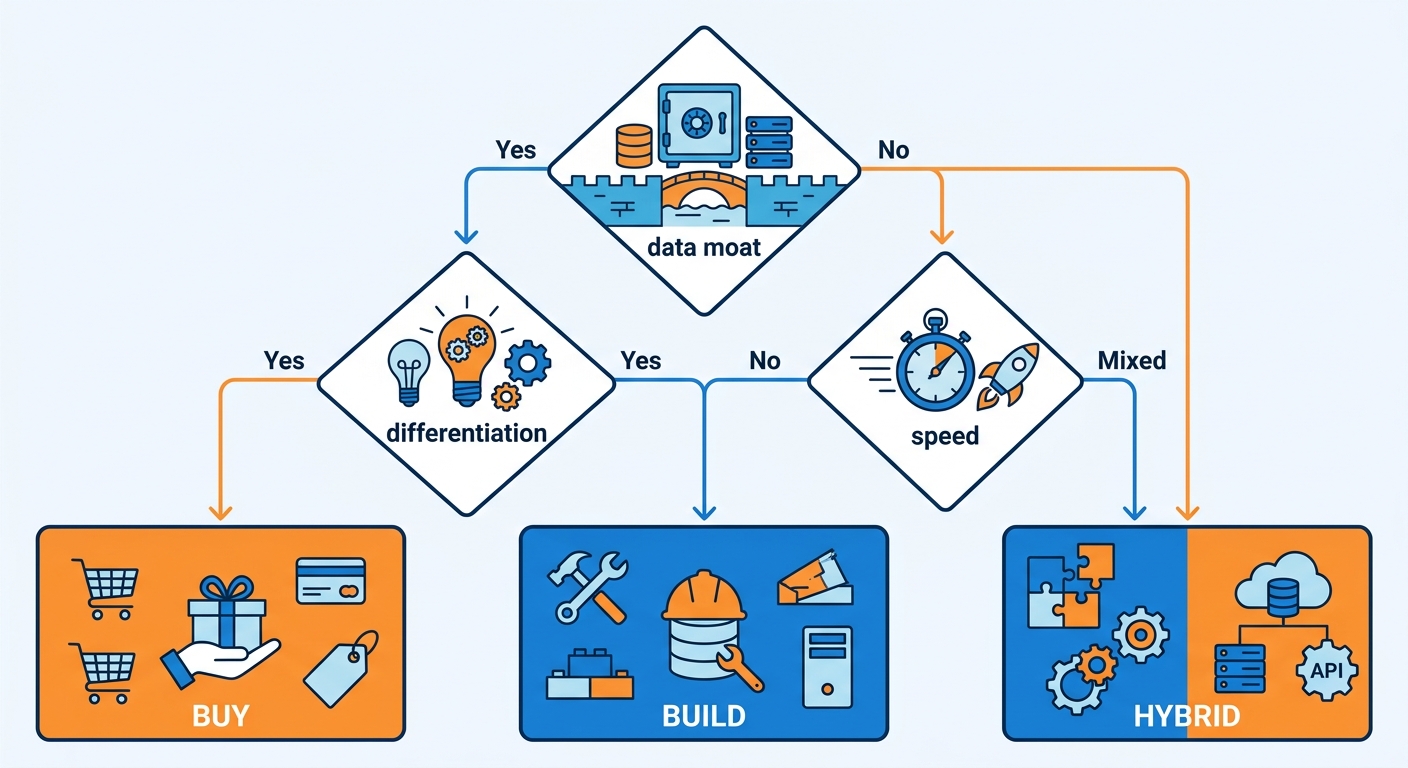
The rule of thumb: buy the commodity, build the moat, and negotiate the exit.
Vendor Selection: The 2026 Due-Diligence Checklist
When you sit down to evaluate a shortlist, work through this checklist discipline. It will save you from the traps that a hype-driven land grab sets. Procurement teams evaluate vendors with a disciplined due-diligence checklist.
- Capability vs. roadmap — Separate what the vendor does today from what it promises next quarter. Discount roadmapped features heavily.
- Reference production deployments — Ask for cases where the product runs in production at your scale and in your industry, not just glowing case studies.
- Data security and compliance — Verify security posture, certifications, data residency, and how your data is used for training. Get it in the contract.
- Pricing transparency — Model the total cost at scale: seats, tokens, actions, and any surge pricing. Ask what happens to price as usage grows 10x.
- Vendor stability and ownership — Check funding, profitability, and ownership. In a consolidating market, a struggling vendor is an acquisition risk.
- Integration and operational effort — Estimate real integration cost and who owns the day-to-day operations. An elegant demo that's hard to run is not a win.
- The exit/switching path — Confirm data export, open standards, and contract terms for leaving. The best negotiating leverage is your ability to walk.
Cross-Industry Signals: Where Adoption Concentrates in 2026
Adoption is not uniform. The 2026 land grab is most intense in industries where the ROI is highest and the data is richest. Enterprise AI adoption trends concentrate in regulated, data-rich industries.
Financial services are leading, driven by quantifiable ROI in risk, fraud, underwriting, and customer operations — and by the willingness to invest heavily in compliant, auditable AI. Healthcare is accelerating in diagnostics, claims, and clinical documentation, though regulatory caution tempers speed. Manufacturing is adopting AI for predictive maintenance, quality, and supply-chain optimization, often with a strong preference for hybrid on-premise stacks. Legal is consolidating around document lifecycle and due-diligence platforms.
The pattern: regulated industries move deliberately but commit deeply once they sign; customer-facing and operations-heavy industries adopt faster and spread AI across more of the enterprise. Understanding where your industry sits on that spectrum helps you calibrate your urgency — and your risk tolerance.
Risks, Lock-In, and the Consolidation Reckoning
It would be a disservice to describe the land grab without its downside. The same dynamics that make it exciting for vendors create real hazards for buyers. Vendor lock-in is the central buyer risk in 2026.
Lock-in is the central risk. The deeper you integrate a vendor's platform — the more workflows, data, and agents you run on it — the harder and more expensive it becomes to leave. When a vendor raises prices, changes its roadmap, or gets acquired, you are exposed. Mitigate with portability requirements and a conscious, documented exit strategy.
Consolidation risk is real. The vendor you sign with this year could be absorbed into a hyperscaler, have its product merged, or see its roadmap change direction. Before signing a multi-year commitment, assess the vendor's likely trajectory and build in contractual protections.
Integration debt and overspending are quieter dangers. In the rush to adopt, enterprises sign overlapping tools, duplicate capabilities, and pay for unused capacity. The land grab rewards motion, but successful buyers are the ones who move with a plan — consolidating spend, measuring value, and retiring what doesn't work.
The 2026 Playbook for Vendors and Buyers
If there is a single lesson from the 2026 land grab, it is this: the winners will be the ones who own measurable value, not the ones who collect the most logos.
For vendors, that means winning enterprise share by delivering production outcomes, embedding into real workflows, and making it easy — not hard — for customers to trust and scale you. The platform, the bundling, and the consolidation are means; durable customer value is the end.
For buyers, it means being deliberate. Resist the hype, move past the pilot graveyard, adopt the three waves in the order that makes sense for your business, buy the commodity, build the moat, and negotiate the exit as hard as you negotiate the entry. The land grab rewards speed, but it punishes carelessness.
The next few years will separate the platforms that matter from the ones that fade. Whether you're a vendor staking a claim or a buyer choosing whom to bet on, the moves you make in 2026 will echo for the rest of the decade. Choose carefully.
Want to stay ahead of the enterprise AI market as it evolves? Subscribe to stay informed on the adoption waves, vendor shifts, and buying playbooks that matter in 2026 and beyond.
Frequently Asked Questions
What is the enterprise AI land grab?
The enterprise AI land grab is the 2026 competition between vendors to own enterprise AI platforms, data, and workflows, and between buyers to lock in strategic AI partnerships before market consolidation narrows their options. It represents the shift from experimental AI pilots to systematic, strategic adoption.
What are the 2026 enterprise AI adoption waves?
The three main 2026 waves are: Wave 1 (copilots and assistants — broad, shallow productivity), Wave 2 (agentic workflows — systems that take real business actions), and Wave 3 (vertical and full-stack platforms — deep, industry-specific commitments). They overlap and layer on top of each other.
Which AI vendors are winning enterprise deals in 2026?
The vendors winning in 2026 are those combining capable models with trusted operational shells — orchestration, security, governance, and integration. Hyperscalers and integrated platforms with bundling and compute leverage are winning the largest contracts, while vertical platforms win deep industry commitments.
How should enterprises evaluate AI vendors in a crowded market?
Use a due-diligence checklist covering capability vs. roadmap, production references, data security and compliance, pricing transparency, vendor stability, integration effort, and the exit/switching path. Treat vendors as strategic partners rather than point tools.
Should my company build or buy AI in 2026?
Buy when the capability is a commodity and speed matters; build when the capability is core to your differentiation and relies on proprietary data or workflows; and consider a hybrid — open or commercially available models plus your own orchestration — as the balanced 2026 default.
What are the biggest risks of the AI land grab for buyers?
The biggest risks are vendor lock-in and switching costs, consolidation risk (a signed vendor being acquired or changing direction), integration debt and overspending, and over-committing before production value is proven. Mitigate with portability requirements and a documented exit strategy.