The Great AI Platform Consolidation: What It Means for Enterprise Buyers
Enterprise AI is consolidating from many point tools to fewer, deeper platforms. What it means for vendor sprawl, lock-in risk, budgets, and your 2026 AI roadmap.
The Consolidation Wave Is Here
If your team is drowning in AI tools, you are not alone. After a few years of running dozens of pilots, enterprise buyers have started to pick winners. The result is a broad push toward fewer, deeper AI platforms rather than more point solutions.
This is not a minor procurement shift. It changes how budgets flow, how teams work, and which vendors survive. The question for enterprise buyers is no longer "which new tool should we add?" It is "which platform do we consolidate around, and how do we protect ourselves while we do?"
AI platform consolidation reduces enterprise vendor sprawl. That is the core mechanical reality behind the headlines. Analyst guidance suggests a large share of enterprises will rationalize their AI vendor portfolios in 2026, though the exact figure varies by source. The same forecasts point to task-specific AI agents becoming embedded in a significant portion of enterprise applications by the end of the year — industry projections commonly cite around 40%. Meanwhile, acquisition activity across mid-market software is projected to reach hundreds of billions of dollars in deal value in 2026, reshaping which platforms remain on the market at all. These figures are estimates, not audited outcomes.
From Pilots to Production
The era of the AI pilot is ending. For a while, it was enough to prove a model could work in a test environment. That is no longer true.
Chief financial officers now demand returns, not demos. Teams must show measurable business value before renewing a subscription. This shift from exploration to production has changed what "good AI" means. A model that impresses in a lab but cannot survive a production load, a security review, and a compliance audit is no longer worth the seats.
Key insight — The shift from experimentation to production is the single biggest driver of consolidation. When CFOs tie AI spend to measurable ROI, teams consolidate around platforms that can deliver it.
Why Vendor Sprawl Became a Cost Problem
Vendor sprawl sounds like an abstract problem. In practice, it is a very concrete one.
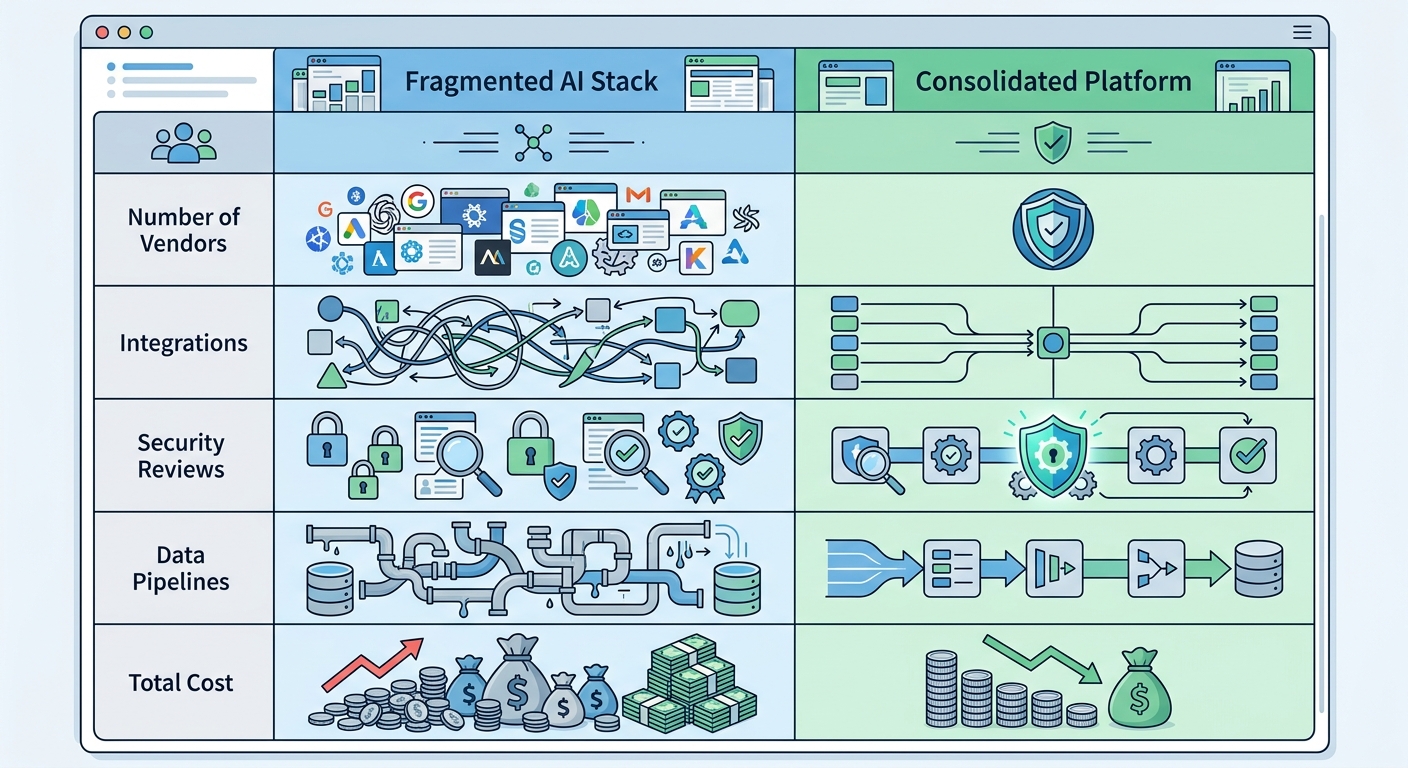
Every AI tool your team adopts adds a new API to manage. Every API adds a security review. Every security review adds engineering time. Then the data begins to fragment. Each tool wants its own pipeline, its own storage, and often its own copy of your data. Before long, the integrations become a full-time job.
We call this "integration fatigue." It is a silent tax on your whole stack. It shows up in slower release cycles, duplicated subscriptions, and engineering hours spent wiring tools together instead of building features.
Integration fatigue raises total cost of ownership in ways that rarely appear on a single invoice. The cost compounds. Fragmented data undermines model quality because retrieval is only as good as its grounding. A chatbot that cannot reach the right dataset gives confident, wrong answers. You then spend more money trying to fix the symptoms instead of the root cause.
The Security and Compliance Load
Sprawl also multiplies risk. Each vendor is another attack surface, another data residency question, and another box to tick in an audit.
AI governance becomes a mandatory procurement criterion. Governance is no longer an afterthought. Enterprises need to see where data lives, how it is encrypted, who can access it, and what is logged. Managing that across dozens of small vendors in parallel is expensive and brittle. Consolidating onto platforms with a single governance layer simplifies the whole burden.
What Consolidation Looks Like in Practice
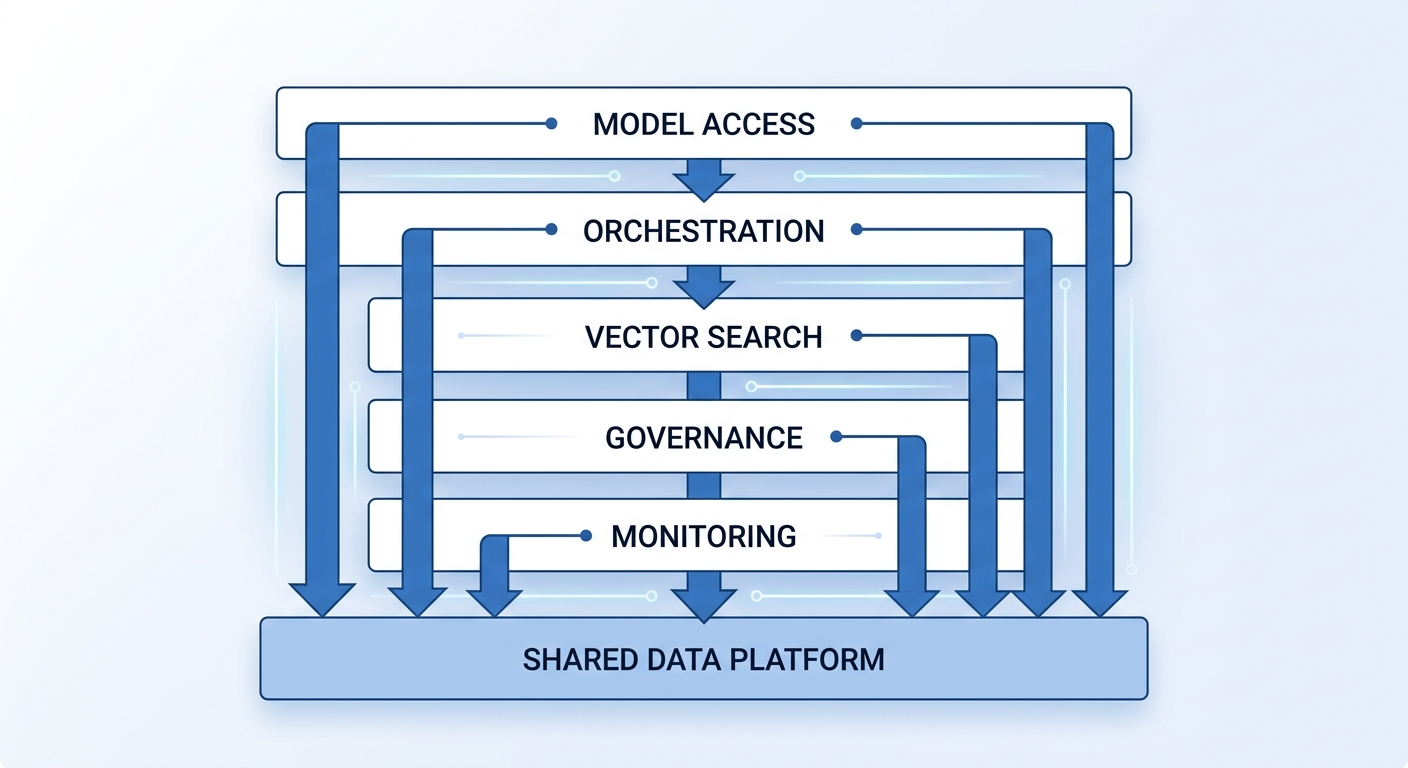
A consolidated AI platform is not just a bigger vendor. It is a different architecture.
Instead of stitching together a model provider, an orchestration tool, a vector database, a governance layer, and a monitoring dashboard, buyers increasingly favor one platform that bundles these capabilities. Vendors have responded by offering AI as a single SKU: model access, orchestration, vector search, and governance packaged together.
Platform breadth beats fragmented point solutions for most enterprises. Data gravity pulls workloads toward established data platforms. Once a platform already holds your data, moving workloads onto it becomes easier than keeping them elsewhere. That creates a self-reinforcing pull. Teams do not actively choose to deepen a relationship. They simply find it increasingly impractical to leave.
Hybrid architectures fit into this picture too. Enterprises rarely put everything in one place. They mix local models for latency and sovereignty with cloud models for scale. A good consolidated platform makes that mix manageable under one governance and orchestration layer.
Preventing Vendor and Orchestration Lock-In
Consolidation brings a real risk: lock-in. Buying fewer platforms means depending more on each one. So how do you deepen a relationship without trapping yourself?
The first step is a multi-model strategy. Standardizing on a single model provider is risky because models change fast and pricing shifts. Running multiple models behind one abstraction layer keeps your options open. The abstraction layer talks to whichever model you need today, and you can swap models without rewriting your application.
The harder risk is orchestration lock-in. It is easy to change model APIs. It is much harder to leave a proprietary orchestration platform once your workflows, agents, and pipelines are built on top of it. Orchestration lock-in exceeds model API lock-in risk in practice.
The fix is to design portability from the start. Use model-agnostic abstraction layers. Prefer open standards where you can. Keep your workflows decoupled from any single vendor's proprietary format, so you always have a credible exit path. A multi-model strategy prevents AI vendor lock-in because it keeps any one vendor replaceable.
Contract Terms That Protect You
Your contract is your first line of defense. In a consolidating market, buyers should demand terms that protect portability.
Ask for data export rights that are genuinely usable, not just legal. Negotiate migration support if you leave. Look for price caps or clear price-change rules so a platform maturing into a monopoly cannot surprise you. And require commitments to open standards, so your orchestration logic does not become proprietary by accident.
How Buyers Should Approach Rationalization
Consolidation works best when you do it deliberately. A rationalization project is essentially an audit followed by a series of removal decisions.
Start by inventorying your current stack. List every AI tool, what it does, who uses it, and what it costs. You will be surprised how much overlap you find. Two teams often run equivalent tools they did not know the other had.
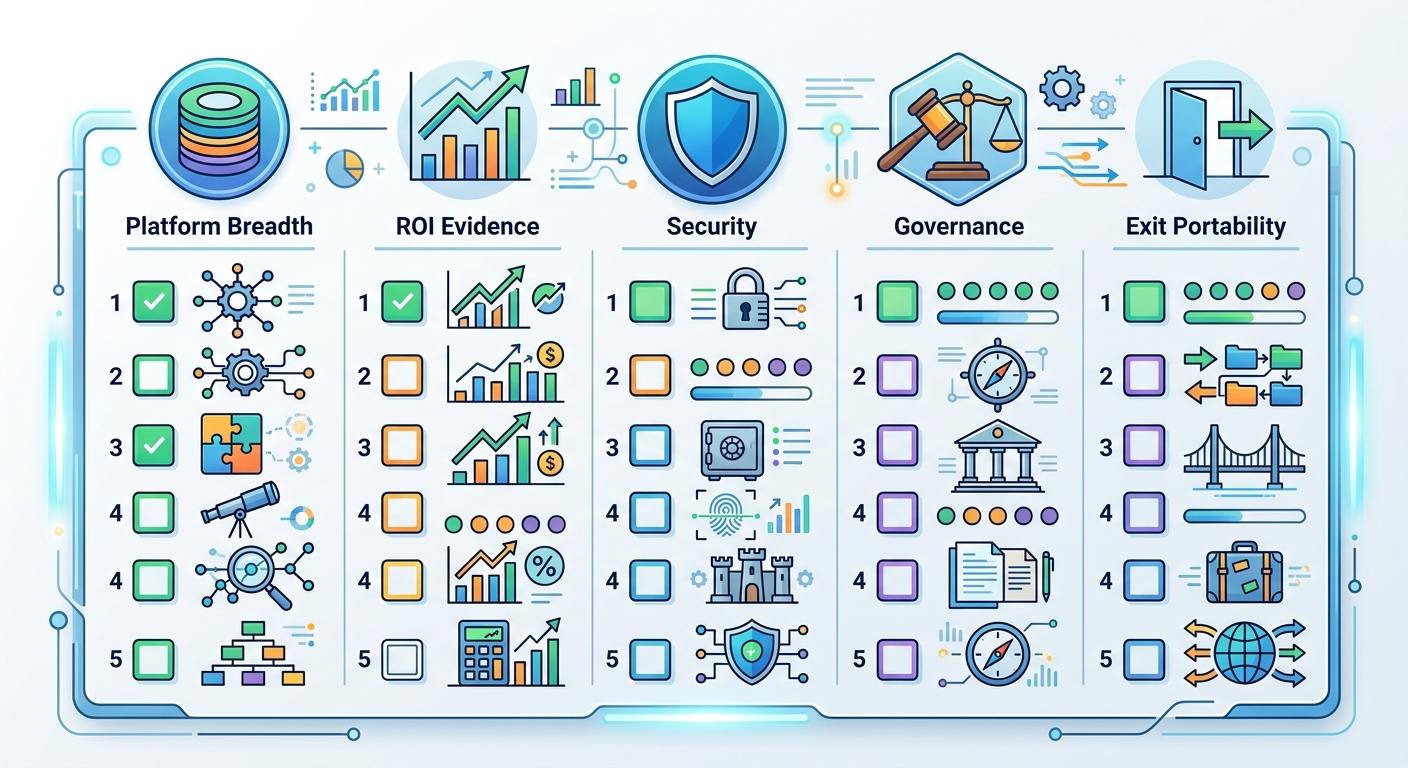
Next, score each vendor against the criteria that matter. Evaluate platform breadth, evidence of production ROI, security posture, governance maturity, and how easy it would be to exit. Each of these deserves a score, not a gut feeling. Vendor rationalization requires a transparent scorecard to make the call defensible.
Then retire the duplicates. Protect essential capabilities, but cut tools that overlap and add no unique value. Stage the migration so you do not disrupt running workloads. Move one workflow at a time, validate it, and then move the next.
Key insight — Rationalization is not about cutting for its own sake. It is about concentrating spend on platforms that can deliver breadth, governance, and a credible exit path — then removing everything that does not earn its place.
What It Means for Your Roadmap
The consolidation wave is not something to wait out. It is the new normal for enterprise AI.
Budget for fewer, deeper platform relationships rather than a growing list of point tools. Measure ROI per workload, not per vendor. Make governance a first-class requirement from day one rather than an afterthought. And keep portability in every architecture decision. Enterprise buyers demand production-grade ROI, and consolidation is the mechanism they use to get it.
If you are building an AI strategy for 2026, the question of which platform to consolidate around is central. The good news is that the criteria are clearer now than they were two years ago: breadth, proven ROI, governance, and a credible exit path.
The market will keep moving. Vendor roadmaps will change. Acquisitions will happen. The way to stay ahead is to keep learning as the landscape shifts — which is exactly what we cover as the story unfolds. Subscribe to the portal to get ongoing analysis of platform consolidation, vendor strategy, and the practical side of building AI on a consolidating market.
Expert Q&A
Q: How do I know if my AI stack has actually reached "too many vendors" versus a healthy mix? A: There is no fixed magic number, but there are reliable warning signs. Look for duplicated capabilities across teams — two groups paying for equivalent tools neither one knew the other had. Track how much engineering time goes to wiring and maintaining integrations versus building features. If you hold regular security reviews for new AI tools, count how many you ran in the last quarter. A stack starts to be unhealthy when the operational overhead of coordination begins to outweigh the marginal value any single tool adds. A practical threshold: if retiring any one of your bottom five tools would free up engineering time and cause no measurable business impact, you are already past the point of healthy diversity.
Q: What is the most common mistake companies make when they try to consolidate? A: Treating consolidation as a pure cost-cutting exercise and ripping out tools too aggressively. It is tempting to cancel subscriptions fast to show a quick win to the CFO. The mistake is doing this before you understand what each tool actually does for its users and without staging the migration. The safer path is audit first, score vendors against a consistent criteria set, protect genuinely differentiated capabilities, and migrate one workload at a time. Careless consolidation just recreates sprawl inside a single platform, because teams start bolting on workarounds to regain what they lost. Cost savings that evaporate into shadow IT are not savings at all.
Q: Should I standardize on one model provider, or is a multi-model approach really worth the complexity? A: For most enterprises, a multi-model strategy is worth it, but only when it is deliberate. The argument for multi-model is resilience and leverage: models improve fast, pricing shifts, and no single provider stays best-in-class for every task forever. A model-agnostic abstraction layer lets you route each workload to the model that fits it. The argument against is complexity, so do not run five providers for the sake of it. A pragmatic default is two to three providers behind one abstraction layer, plus a credible on-prem or local option for sensitive workloads and latency-critical tasks. That is enough leverage to keep any single vendor honest without drowning in orchestration complexity. What you want to avoid at all costs is orchestration lock-in — that is far harder to escape than swapping a model API.