The 2026 Agent Economy: Who's Winning the Race to Monetize AI Workforces
The 2026 agent economy is shifting from software to outcome payments. Here's who captures the margin and how to monetize AI agents profitably.
The Agent Economy Is No Longer a Forecast
Talk to an enterprise AI team in 2025 and you heard about pilots. Talk to the same team in 2026 and you hear about revenue. Autonomous AI agents — programs that perceive, decide, and act to complete a goal with minimal human input — moved from demonstrations to the income statement.
The size of the shift is real. Third-party analysts place the agentic AI market between roughly $9 billion and $19 billion in 2026, depending on how they draw the boundary. These are estimates, not certainties, but the direction is consistent across sources: adoption is compounding year over year. Some estimates put North America at roughly 40% of the market in 2026.
The agent economy shifts software payments toward outcome payments. Instead of paying for software licenses or human labor, organizations increasingly pay for results delivered by digital workers. An agent might resolve a support ticket, reconcile an invoice, or draft and route a contract. The buyer pays for the finished result, not for the hours or the platform underneath.
This is a meaningful change. For decades the software industry sold capability. Now a fast-growing segment sells completed work. The question that matters for every leader is simple: who captures the margin? The answer is not obvious, and it decides which companies win.
Key insight — the agent economy is not about building smarter models. It's about who owns the workflow, the data, and the measurement that turn model output into paid outcomes.
The Four Business Models Competing Right Now
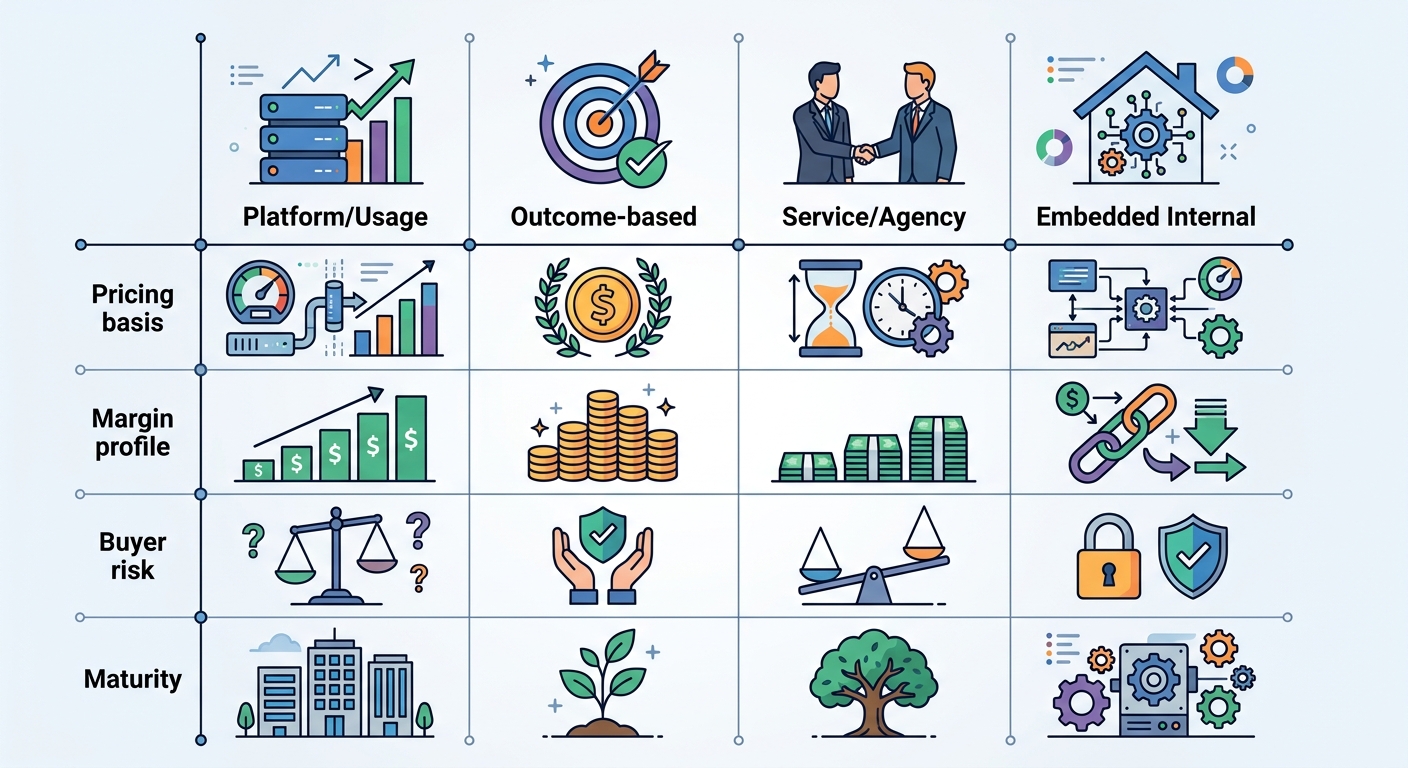
Four monetization models dominate the 2026 landscape. Each has a different margin profile and a different buyer relationship.
Platform and usage-based. The provider charges per action, per token, or per agent-hour. Revenue scales with volume. The buyer retains control over which tasks run. This is the closest model to traditional software, which makes it the easiest to adopt.
Outcome-based. The provider is paid only when work completes successfully. This is the most aggressive model. It shifts risk from buyer to seller, but it also rewards providers who can genuinely deliver. Priced well, it can command premium margins.
Service and agency. A firm sells agent-delivered services to clients — research, content, back-office work. The firm owns the relationship and the margin, and treats agents as the production cost. This model looks like a services business with unusually high leverage.
Embedded internal. The enterprise deploys agents internally to cut cost and free human capacity. The "revenue" is margin recovered or reallocated. This is the least flashy model and often the most reliable.
These models are not mutually exclusive. Many successful operators mix them. But clarity about which model you run matters, because it determines pricing, risk, and where you invest in governance.
Who Is Actually Capturing the Value
The value chain of the agent economy has three main layers. Understanding each explains where the money lands.
Model providers sit at the base. They earn revenue from inference — the computation an agent runs on every call. As agents grow more autonomous and handle longer reasoning tasks, they consume more tokens. That makes the model layer a volume play. Margins are real but competition is intense.
The platform layer sits in the middle. This includes orchestration, observability, and cost-control tooling that makes agents reliable at scale. This is the contested battleground. The firm that controls how agents are built, monitored, and governed can capture recurring platform margin on top of every task that runs.
Enterprises sit at the top. When an enterprise owns the workflow, the proprietary data, and the measurement of outcomes, it captures the largest share of value. The model and platform are inputs. The relationship with the customer — and the process IP — belong to the enterprise.
Enterprises capture the largest margin when they own the workflow. The winners in 2026 are rarely the ones with the flashiest demo. They are the ones who control the layer closest to the paying customer and the outcomes that customer values.
The Unit Economics That Decide the Race
The race to monetize AI agents is ultimately a unit economics race. Compute the cost of one completed task and you know whether a business model survives.
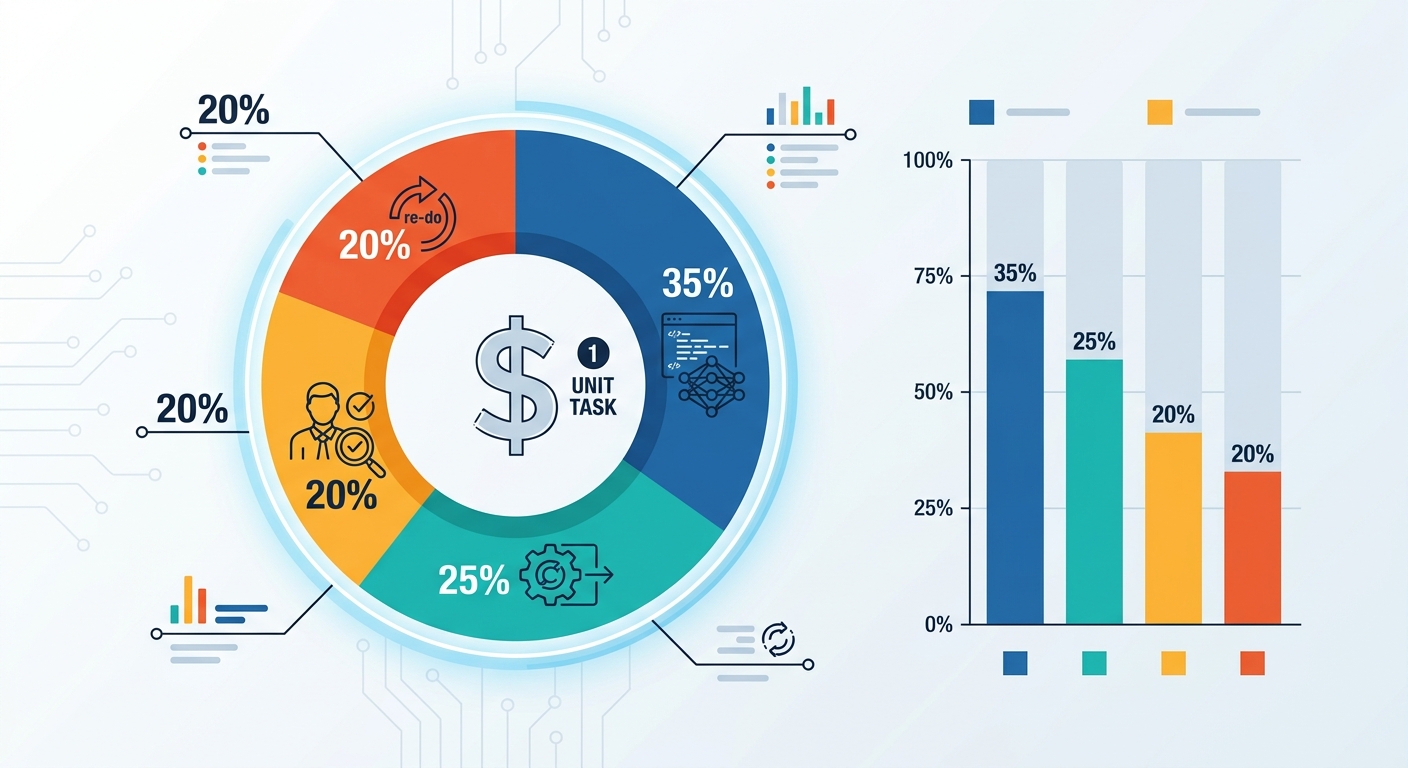
The cost of a single agent task includes four components:
- Model inference. Tokens consumed across reasoning and tool calls.
- Tool execution. APIs, databases, and external services invoked along the way.
- Human oversight. Review effort when a human must approve or correct output.
- Fallback and rework. Failed attempts, error handling, and re-runs.
The cost per task includes inference, tooling, and supervision. Reasoning-heavy agents — the ones that plan and verify — cost more per task. But they replace higher-value work, which changes the comparison. A low-cost agent that hides failures can be far more expensive than a pricier agent that rarely needs rework.
The most important lever is supervision. Autonomous agents cut oversight cost dramatically. But autonomy is only sensible when the cost of an error is low relative to the value of the task. That trade-off is the heart of profitable deployment.
The Maturity Curve: From Automation to Autonomy
Enterprises do not jump straight to fully autonomous agents. They climb a maturity curve.
- Stage 1 — Rule-based automation. Scripts and deterministic logic. Low value, low risk, low cost.
- Stage 2 — Assisted agents. The agent proposes, a human approves. Safe and easy to introduce.
- Stage 3 — Supervised autonomous agents. The agent acts, and a human reviews exceptions only. This is where margin improves most.
- Stage 4 — Fully autonomous systems. Multiple agents collaborate with no routine human oversight. High value, high risk, high governance burden.
The maturity curve maps automation to full autonomy. Winning means matching autonomy to task. Running a high-risk, high-value task at Stage 4 without controls invites expensive failures. Keeping low-risk, high-volume work at Stage 2 wastes the margin advantage. The winning organizations deliberately calibrate autonomy per task, not per platform.
Governance Is the Silent Differentiator
Buyers will not pay for outcomes they cannot audit. This single fact makes governance a monetization lever, not a compliance chore.
Audit trails let a buyer verify what an agent did and why. Guardrails prevent an agent from acting outside defined boundaries. Accountability defines who answers when an agent errs. Together, these determine how much autonomy a customer will accept — and therefore how much margin a provider can earn.
Governance determines which agents can scale. Compliance and liability also filter the field. Providers that can demonstrate controlled, auditable agent behavior can offer outcome-based pricing with confidence. Providers that cannot are pushed toward low-margin usage models. Control, in the agent economy, is a source of profit.
Who Wins in 2026 and Beyond
Put the pieces together and a clear thesis emerges. The platform layer is fighting to commoditize the model layer. But the enduring winners are the enterprises and specialists who own the workflow, the data, and the measurement of outcomes.
Unit economics decide who profits from AI agents. Practical steps for decision-makers:
- Measure cost per task. Build the unit economics early, before scaling.
- Match autonomy to risk. Move to autonomy only where error costs are low.
- Invest in governance. Audit, guardrails, and accountability unlock the highest-margin models.
The agent economy rewards operators, not spectators. The organizations that treat agents as measurable digital workers — with real cost, real quality, and real controls — are the ones capturing the margin. The race is far from over, but the playbook is becoming clear. Want to track how this landscape evolves as the quarter progresses? Subscribe to the Algorithmine portal for ongoing analysis of the agent economy and the business models winning it.
Expert Q&A
Q: How should I estimate the actual cost of an agent task before scaling, when numbers vary wildly between providers? A: Build a cost model from real usage, not vendor benchmarks. Instrument a pilot for two to three weeks and measure the four components directly: inference tokens, tool-call volume, human oversight minutes, and rework rate. The biggest trap is treating "cost per token" as the true cost. Supervision and rework often dominate, especially in high-accuracy domains. Once you have real numbers per task type, you can price or budget with confidence.
Q: What is the most common mistake teams make when trying to monetize AI agents? A: Pushing autonomy too fast without measuring failures. Teams skip straight to fully autonomous agents on high-value tasks, hit an expensive correctness problem, and lose stakeholder trust. The result is a retreat to heavy supervision that erases the margin advantage. The fix is to advance your maturity curve per task: keep error costs low before removing the human loop, and log every failure to prove reliability before scaling.
Q: Should we buy an agent platform or build our own orchestration in-house? A: It depends on where your margin lives. If your differentiator is the workflow, data, and customer relationship, you can often start on a platform and gradually take control of orchestration as your volumes justify it. If you try to build everything from scratch up front, you spend your budget on plumbing instead of outcomes. A common winning pattern is platform-first to validate, then selective in-house control of the layers that drive your margin — orchestration, telemetry, and cost control.
Q: Which monetization model gives the best margin: usage-based or outcome-based? A: Outcome-based carries the highest margin potential because you capture the value of the completed result rather than the cost of the effort. But it is only viable when your agent quality is dependable and you can audit outcomes. If you cannot reliably deliver, outcome pricing will eat your margin through rework and failed tasks. Most successful operators start usage-based to gather reliability data, then layer outcome pricing on the tasks they have proven. Matching the model to proven reliability, not ambition, is what protects margin.