The 2026 Enterprise Agent Funding Race: What New Money and Product Launches Mean for Buyers
Agentic AI funding tripled year-over-year to $8.64B in 2026 as a wave of agent product launches reshaped the enterprise vendor landscape. For B2B buyers, this is a market-maturation signal with direct procurement consequences — from pricing shifts to vendor consolidation and agent-washing risk.
Meta Description: Enterprise agent funding hit a record in 2026 — $8.64B across 112 rounds. Here's what the capital supercycle and agent product launches mean for B2B buyers, pricing, and procurement.
SEO Title: The 2026 Enterprise Agent Funding Race: New Money & Product Launches & What They Mean for Buyers
Excerpt: Agentic AI funding tripled year-over-year to $8.64B in 2026 as a wave of agent product launches reshaped the enterprise vendor landscape. For B2B buyers, this is a market-maturation signal with direct procurement consequences — from pricing shifts to vendor consolidation and "agent-washing" risk.
Author: Algorithmine Team | Published: 2026-09-19 | Section: news | Category: Startups & Funding (19)
The 2026 Enterprise Agent Funding Race: What New Money and Product Launches Mean for Buyers
For enterprise technology buyers, the venture funding that flows into a market is rarely just noise from the financial press. It is one of the most reliable early signals of where the industry is headed — and, just as importantly, who is financially equipped to survive the journey. Right now, the agentic AI market is sending a signal loud enough to reset procurement strategies across the Fortune 2000.
Agentic AI — software that doesn't just answer questions but takes multi-step, goal-directed action across your systems — is in the middle of a genuine capital supercycle. Enterprise agent funding for the sector has roughly tripled year-over-year, and a wave of product launches from Microsoft, Salesforce, ServiceNow, and a swarm of well-funded startups is reshaping the competitive landscape at the exact moment enterprises are moving pilots to production.
This is a funding story, but it is fundamentally a buying story. Here is what the money means, what the launches signal, and how enterprise buyers should respond.
The Capital Supercycle, in Numbers
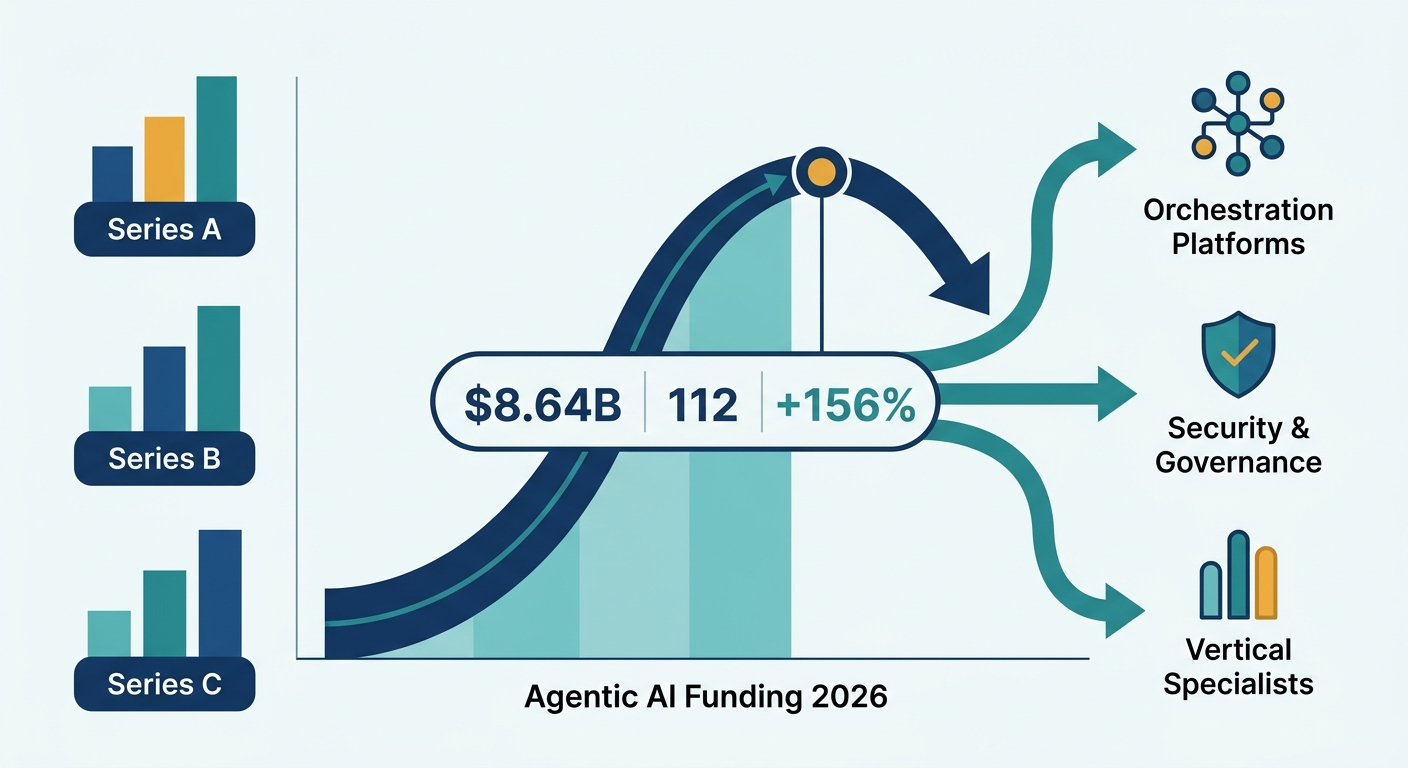
The scale of the 2026 enterprise agent funding race is hard to overstate. By early July, year-to-date agentic AI funding had already reached approximately $2.51 billion — nearly triple the comparable period in 2025. By August, the total had climbed to $8.64 billion across 112 rounds, a 156.34% increase over the same stretch of the previous year.
The market itself is expanding to match. Industry estimates size the global AI agents market between $10.9 billion and $12.1 billion in 2026, and the Gartner projection that 40% of business applications will embed autonomous-capable AI agents by year-end is acting as both forecast and catalyst.
Yet the aggregate numbers hide a crucial structural detail: the money is not flowing evenly. Early-stage companies represent 43.1% of year-to-date deals but captured only 12.4% of total capital. Series B rounds for enterprise AI agent startups are clustering in a $100 million to $500 million range. In other words, the market is funding scale-up winners, not a broad base of experiments — a tell that consolidation is coming and that buyers will soon face fewer, stronger vendors.
From Model to Infrastructure: The Money's New Direction
Perhaps the most consequential shift in 2026 is where investors are placing their bets. A year ago, capital chased the frontier models themselves. Today, the emphasis has rotated decisively to the "infrastructure layer" — the tooling that lets enterprises deploy, orchestrate, secure, govern, and monitor agents inside complex, messy, regulated environments.
This is a strong signal for buyers. It means the industry recognizes that the hard part of agentic AI is no longer raw intelligence; it is operationalization. Vendors that can demonstrate defensible workflow depth, robust agentic evaluation infrastructure, and a clear edge against incumbent AI agent platforms are drawing the largest checks. It also reflects the emerging "agents-replace-SaaS" thesis — the idea that outcome-priced agents will displace traditional per-seat software, which is changing how enterprise software is bought, priced, and renewed.
Pull quote: "The hard part of agentic AI is no longer raw intelligence — it is operationalization: deployment, orchestration, security, governance, and scale."
Key Rounds as Market Signals
Behind the macro numbers are individual rounds that tell specific stories about where the market is going — and what buyers should expect.
- Wonderful raised a $150 million Series B in March, led by Insight Partners with participation from Index, IVP, Bessemer, and Vine. The Amsterdam-based enterprise agent platform plans to roughly triple headcount to ~900 and expand across 30+ markets. Its thesis — operationalizing agents inside complex organizational structures — is a textbook example of the infrastructure-first shift.
- Mintlify closed a $45 million Series B at a $500 million valuation in April, led by a16z and Salesforce Ventures, cementing the "knowledge layer" for AI agents as a distinct and fundable category.
- MIND, an AI-native data-loss-prevention cybersecurity platform, landed a $72 million Series B in September led by Crosspoint Capital, tripling its valuation to $300 million. Security tooling for agents is becoming a must-have line item.
- Lyzr completed a $100 million Series B in July at roughly a $500 million valuation — and used its own agent, SivaClaw, to help close the deal. Eat your own dog food, indeed.
- Adaptive, an agentic accounting platform purpose-built for construction, announced a $30 million Series B in September. Vertical, domain-specific agents are commanding serious attention.
Read together, these rounds point to three durable themes: orchestration and deployment platforms, security and governance, and deep vertical specialization. Buyers evaluating vendors should look for exactly these attributes — not generic "AI assistant" pitches.
The Product-Launch Landscape
The funding race has been matched by an equally intense product-launch cycle, and the two are mutually reinforcing. Well-capitalized startups now compete directly with enterprise incumbents that are pouring billions into agentic capabilities.
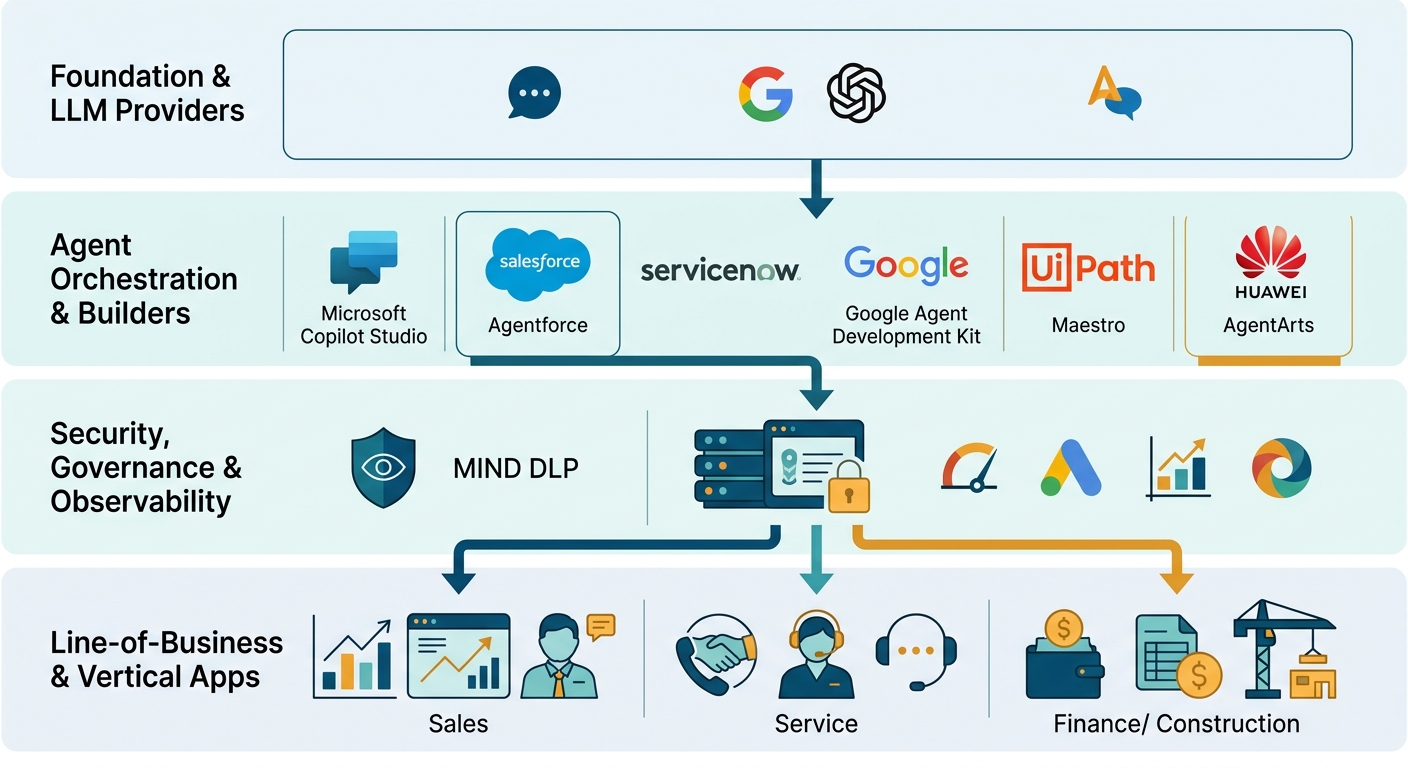
- Microsoft has repositioned Copilot as a full enterprise agent platform. Via Copilot Studio, organizations design custom agents that execute workflows across Microsoft 365, Power Platform, and Azure — automating approvals, consolidating data, and coordinating cross-team work. Microsoft reports 160,000 organizations running over 400,000 custom agents on the platform.
- Salesforce Agentforce lets autonomous agents act across Sales, Service, and Marketing clouds, qualifying leads and handling queries without human step-by-step guidance. Salesforce says it has closed 29,000 Agentforce deals since launch.
- ServiceNow has restructured its commercial model around autonomous AI tiers, signaling that agentic capability is becoming a core packaging decision.
- Google bundles its Gemini Enterprise Agent Platform with the Agent Development Kit (ADK), emphasizing hierarchical agent models and cross-vendor interoperability.
- UiPath has evolved from RPA to full agentic orchestration with Maestro, coordinating AI agents, automation robots, and people — and shipped native agentic capability for government agencies in May.
- Huawei Cloud AgentArts, launched in September with 100+ enterprise customers, shows the race is global. IBM Watson Orchestrate, SAP Joule, GitHub Copilot, and Cursor round out a packed field.
For buyers, the practical takeaway is that the agent market is now multi-vendor and best-of-breed by design. Enterprises are commonly running four to eight AI platforms in parallel — an LLM provider, an agent builder, search, and observability — rather than committing to a single monolithic stack.
What This Means for Buyers: A Procurement Playbook
All this capital and competition is, on balance, good news for enterprise buyers — but only for those who approach it with discipline. Here are the concrete moves that separate informed buyers from those who end up with shelfware.
1. Diligence funding depth, not just revenue. A large round is a durability signal, but it can also precede a burn-rate crisis. Assess runway, path to profitability, and whether the vendor's capital is aligned with the markets and workflows you depend on. In a consolidating market, "eventually acquired" is a real outcome — plan for it.
2. Understand the pricing shift. The "agents-replace-SaaS" thesis is changing how software is priced, from per-seat subscriptions (Microsoft Copilot) to outcome- or usage-based models (AWS Bedrock, Google Vertex). Model the total cost of outcomes, not seats, and build in implementation cost — data prep, integration, training — which often exceeds license fees.
3. Beware "agent-washing." Use-cases and RFPs are now full of products rebranded as "agents" that are, in practice, scripted chatbots or RPA macros. Insist on demonstrations that prove autonomous multi-step reasoning, dynamic error handling, and real tool use within defined boundaries.
4. Plan for a multi-vendor stack. Given the 4–8 platform reality, evaluate interoperability as a first-class requirement: how does the agent platform plug into your identity, data, and orchestration layer? Proprietary lock-in is a strategic liability.
5. Treat security and governance as non-negotiable. Agents act autonomously, which means your exposure moves from static data to actions taken on your behalf. Require SOC 2, ISO 27001, HIPAA/GDPR alignment as appropriate, and — given the EU AI Act took effect in August 2026 — map agent workflows against evolving compliance obligations.
6. Sequence use cases for early ROI. Internal operational wins (support deflection, back-office automation, approvals) typically materialize before supplier-facing commercial benefits. Sequence high-impact, low-risk workflows first to build internal confidence and a defensible ROI case.
The Bottom Line
The 2026 enterprise agent funding race is not a Silicon Valley sideshow — it is a market-maturation signal with direct procurement consequences. Record capital is concentrating in well-funded scale-up winners, rotating decisively toward the infrastructure layer, and being matched by an unprecedented wave of agent product launches from both startups and hyperscale incumbents.
For buyers, the window is favorable: competition is high, prices are being redefined, and choice is real. But the same dynamics that create opportunity also create risk — from vendor consolidation and "agent-washing" to autonomous-action security exposure and lock-in. Evaluate on durable funding, provable workflow depth, open interoperability, and governance readiness. The vendors that survive this race will reward careful buyers; the buyers who do the diligence now will be the ones standing when the market consolidates.
Want the agentic AI market tracked for your stack? Subscribe to the Algorithmine newsletter for weekly intelligence on agent platforms, funding moves, and procurement — delivered to your inbox.
Algorithmine Team — independent analysis of the AI market for enterprise decision-makers. The views expressed are editorial and reflect independent research as of 2026-09-19.