The 2026 AI Startup M&A Wave: Acqui-hires, Consolidation, and Unicorn Exits
Record AI funding is meeting a wall of acqui-hires, consolidation, and long-awaited unicorn IPOs. Here is what the 2026 M&A wave means for founders and investors.
The AI M&A Wave Is Here
Something structural is happening in the startup market. It is not a single headline deal. It is a wave.
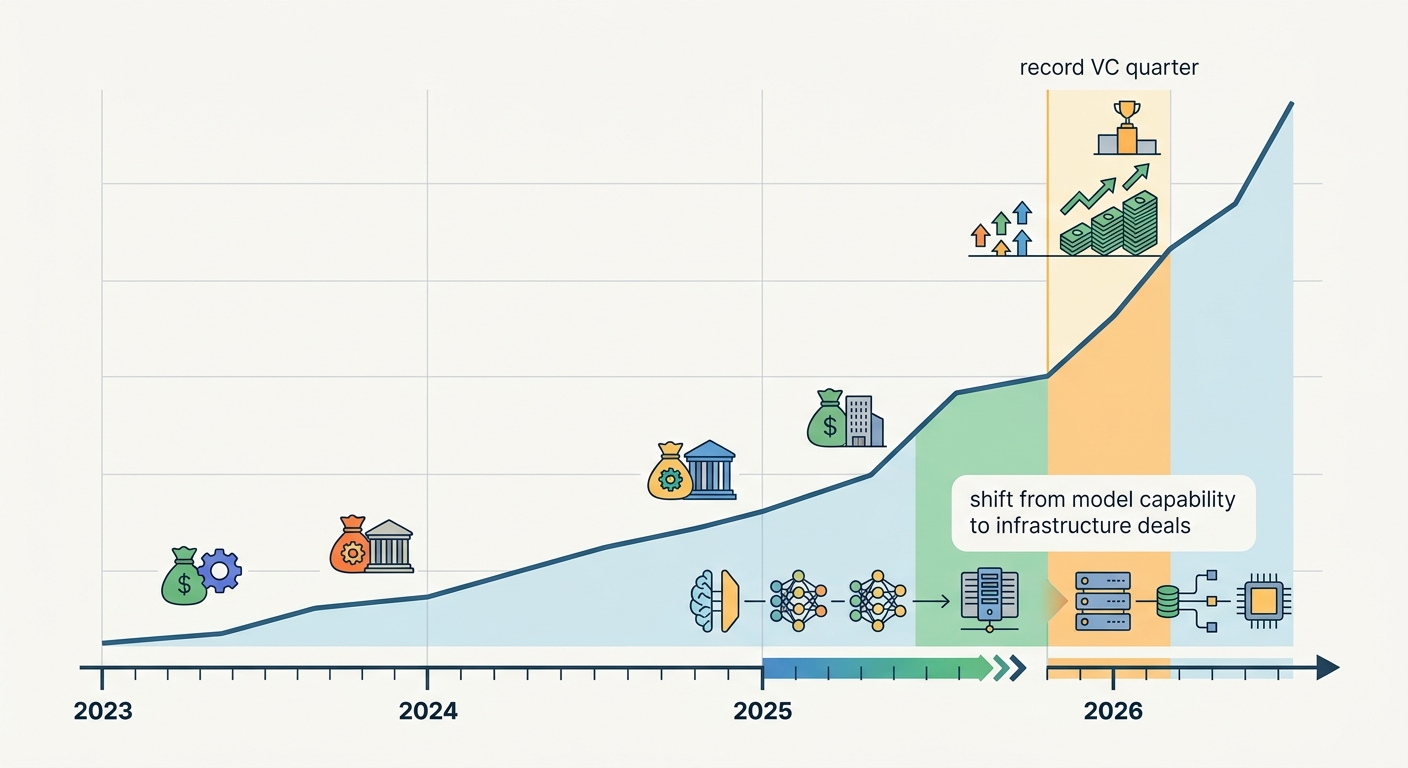
Global venture capital reached a record $510 billion in the first half of 2026, with AI-related companies accounting for roughly 86% of all US venture capital by dollar volume (all figures estimated). The numbers keep compounding at the top. In Q1 2026, the market saw $267.2 billion in VC deal volume, and 88% of it was tied to AI and machine learning.
The striking part is where that capital lands. OpenAI, Anthropic, xAI, and Waymo absorbed roughly 65% of every venture dollar deployed in Q1 2026. By mid-year, foundation model companies alone took 43% of all H1 funding.
Key insight — Nearly half of all strategic tech deal value above $500 million now comes from AI-native companies. That single fact is reshaping the entire startup landscape.
AI-native companies are now driving nearly half of all large strategic tech deals. Foundation model companies absorbed 43% of H1 2026 venture funding. The result is a barbell market that is squeezing the mid-stage.
The result is a barbell market. A few enormous frontier companies sit at one end. A long tail of small startups sits at the other. In between, mid-stage AI companies are running out of room — and increasingly running out of time. This article breaks down the three exit paths available, who is buying and why, and what founders should actually do.
The Three Exit Paths for AI Startups in 2026
Every AI founder now faces the same strategic question: how does this company end? In 2026, there are three realistic answers — and each comes with its own math. Acqui-hires, strategic acquisitions, and unicorn IPOs each serve different founder profiles.
Acqui-hires: The New Default Exit
An acqui-hire is a deal where a larger company acquires a startup primarily for its team and technology, not for its revenue. In AI, these increasingly take the form of licensing deals structured to hire the engineering team while bypassing standard antitrust review.
Between 2024 and 2026, the major tech companies spent over $20 billion on this exact model. Major tech companies have spent over $20 billion hiring AI startup teams and licensing their technology. A well-known example: a major platform paid $2.4 billion to hire the founders of an AI coding startup and license its technology, while a separate acquirer bought the rest of the company.
This has become the default outcome for founders without a revenue story. When a capability play cannot stand on its own business model, the talent acquisition is often the best available exit — and increasingly the only one.
Strategic Acquisition: Where Real Multiples Live
Applied-AI companies are a different story. When a startup has real revenue and defensible data, strategic buyers pay strong multiples for it. Applied-AI companies command strong valuation multiples when they can prove recurring revenue.
The difference matters. Pure capability plays — remarkable technology without revenue — tend to resolve as talent acquisitions. Applied-AI companies with a working business model trade on conventional M&A terms. The gap between these two profiles is one of the defining splits in the 2026 market.
If you can answer "who pays us, and will they keep paying next quarter?" you sit in the fast lane. If you cannot, you need to understand what an acqui-hire realistically values.
Unicorn Exits and the IPO Pipeline
For the largest private AI companies, 2026 is the year the IPO bottleneck finally breaks. A record backlog of AI unicorns is now moving toward public markets. The IPO bottleneck is breaking in 2026 as private AI unicorns reach public markets.
The scale is dramatic. One robotics-and-space company filed confidentially targeting a $1.75 trillion valuation — potentially the largest public debut in history. Two foundation model companies filed confidential IPO paperwork after reaching valuations of roughly $965 billion and $852 billion. A chip maker already went public in May at a $56.4 billion valuation.
The market is picky, though. Public investors are demanding a clear path to profitability and proven scale. For the handful of giants, the door is open. For the thousands of AI startups behind them, acquisition — not IPO — remains the realistic endgame.
Who Is Buying and Why
The acquirer map in 2026 is concentrated and deliberately targeted. One model lab has been the most prolific single buyer, completing eight acquisitions this year. Acquirers increasingly prioritize talent, infrastructure, and data provenance. The hyperscalers and frontier labs are buying three things: talent, infrastructure, and provenance.
The reasoning has shifted. The industry is moving from a race over who builds the better model to a land grab over the power, data, and infrastructure that make models actually work at scale. Billion-dollar buyers are pursuing infrastructure and talent rather than raw model capability. Applied-AI companies with proprietary data become attractive because their data is defensible. Infrastructure plays become attractive because compute and power are the real constraint.
The scale of that shift is visible in the largest deal of the year. A space company and an AI company merged in a deal that valued the combined entity at $1.25 trillion — a bet driven less by model capability than by the promise of orbital, solar-powered data centers for massive training and inference workloads.
The Consolidation Wave in Software and SaaS
Consolidation is not limited to the frontier labs. It is sweeping through software and SaaS at record pace. The AI software market is consolidating through record M&A volume.
In 2025, software-as-a-service saw 2,698 M&A transactions, up 28% from the prior year. That pace carried into 2026, with more than 620 deals worth over $95 billion closed in Q1 alone.
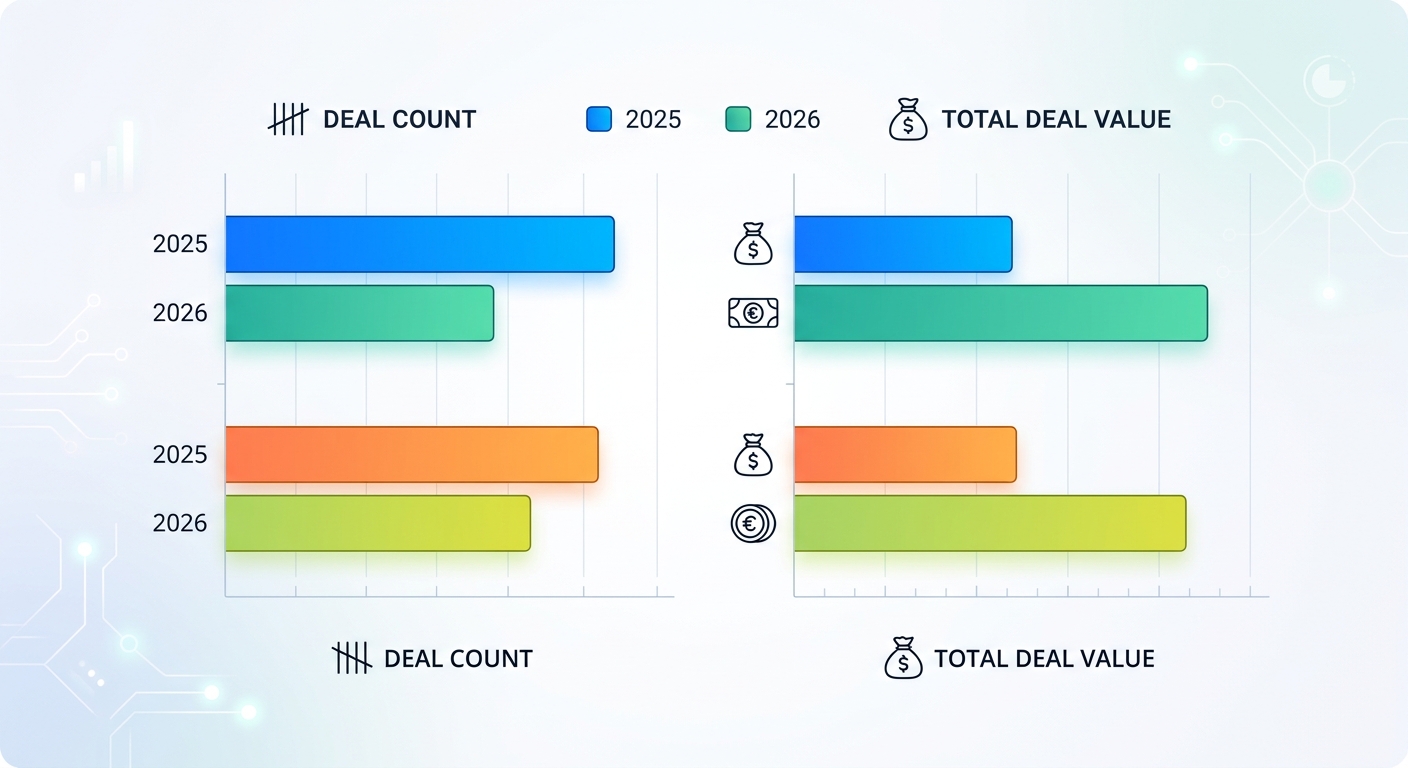
The pattern is what analysts call a K-shaped market. Deal value is rising while deal volume falls. Technology M&A delivered $150.4 billion in value, up 31% year over year, while the overall number of deals dropped about 13%. Megadeals now constitute nearly half of all deal value.
Key insight — Behind the megadeals sits a quieter force: roughly 68% of CIOs plan to consolidate vendors this year, cutting the average number of providers by about 20%. Smaller AI SaaS products are the casualties.
A Practical Playbook for Founders
Reading about the wave is one thing. Deciding what to do is another. Here is a practical framework. The best way to enter an exit conversation is to know your own company profile and your realistic options.
The Decision Framework: Exit Now or Raise
First, be honest about probability. If your startup is running low on capital and the market is not funding companies like yours, a bridge round is a gamble, not a plan. Many early-stage AI agent startups are expected to exhaust their capital reserves by late 2026.
Compare the options with clear-eyed math. A round dilutes you and extends the runway — but only if you have a credible path to the next milestone. An acqui-hire ends the journey but preserves some outcome for founders and employees. A strategic sale pays market multiples for revenue and data you can actually prove.
Revenue per employee has become a decisive valuation signal. Investors and acquirers reward lean, revenue-proven teams. If your headcount is growing faster than your revenue, that works against you in every negotiation.
What Happens to Teams After the Deal
Consolidation has a human dimension that is often ignored. Acqui-hires typically come with earn-outs and retention periods designed to keep key engineers on board. Integration risk is real — a team that built a fast-moving startup can struggle inside a larger organization.
For employees, the practical question is whether the retention package matches their value over the earn-out window. For founders, it is whether the earn-out targets are achievable with the resources the acquirer actually provides. Get both in writing before you sign.
Looking Ahead: What 2027 Brings
The consolidation wave is structural, not cyclical. Capital is concentrating, and mid-stage exits will keep accelerating. Market concentration is accelerating across the AI startup landscape.
For founders, the takeaway is to know your own profile. If you are an applied-AI company with revenue, you have options and leverage. If you are a capability play, the window to build or sell is closing. Either way, the market is rewarding clarity, revenue, and defensible data over promise.
For the industry, the next few years will test what a concentrated AI market looks like. The giants are consolidating control over models, infrastructure, and capital. Yet the long tail of the market remains open — new entrants still have room where applied, vertical, and domain-specific value is real.
If you are building or investing in this market, staying current matters. For the latest analysis on AI startups, funding rounds, and exits, subscribe to the Algorithmine newsletter and get the data that shapes decisions — delivered before it becomes mainstream news.