AI Startup Funding in Mid-2026: Emerging Trends, Largest Rounds, and Sector Hotspots
The first half of 2026 rewrote the rules of venture capital.
The $510 Billion Surge: AI Venture Funding in H1 2026
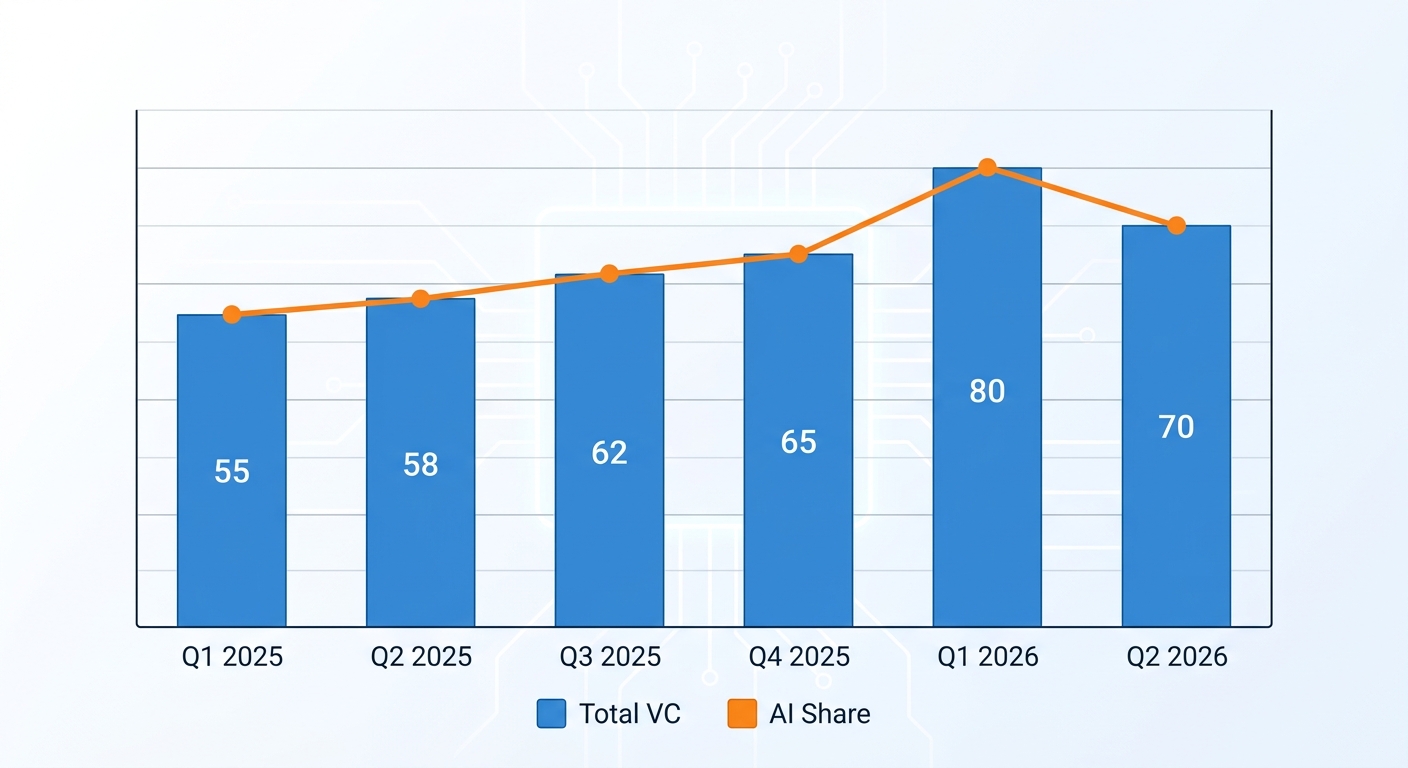
The first half of 2026 rewrote the rules of venture capital. Global VC investment reached $510 billion across six months, a figure that already exceeds the $440 billion deployed throughout the entirety of 2025. The surge arrived in two enormous waves: Q1 2026 delivered the single largest venture quarter in history at $305 billion, followed by Q2 at $205 billion.
But raw totals obscure the most consequential story: artificial intelligence has become the near-exclusive destination for growth capital. AI startups — captured — 80% of global VC in Q1 2026, approximately $242 billion. That share dipped to the low 70s in Q2 but remained dramatically above the ~55% AI share recorded in Q1 2025. The sector's dominance is not a trend — it is a structural reorientation of where capital flows.
Deal count tells a different story. Total venture deal count in North America hit its lowest point since 2018, yet average deal size more than doubled year-over-year. Seed deal count — fell — 31% YoY in Q1 2026, but total seed dollars rose by roughly 30%. Investors are writing fewer checks, but each carries substantially more weight.
The concentration is extraordinary. Four companies — OpenAI, Anthropic, xAI, and Waymo — raised approximately $188 billion in Q1 2026 alone, representing about 65% of all global venture capital deployed that quarter. This is not a diversified ecosystem. It is a winner-take-most structure operating in real time.
The geographic dimension reinforces the US advantage. Approximately 88% of AI capital in H1 2026 flowed to US-based companies, a concentration particularly pronounced in frontier AI labs and AI infrastructure bets. This reflects the compounding advantage of talent density, compute access, and regulatory familiarity that the American ecosystem provides.
The Four Companies That Captured 65% of Q1 Venture Capital
Understanding the first half of 2026 requires understanding a handful of transactions that reshaped the venture landscape permanently.
OpenAI closed the largest private financing in Silicon Valley history on March 31, 2026: OpenAI — raised — $122B in Q1 2026 at $852B valuation. The round drew capital from sovereign wealth funds, major tech corporates, and a syndicate of leading venture firms. The scale of a single company's raise — larger than most countries' annual startup investment — is unprecedented in private markets history.
Anthropic followed a similar trajectory: Anthropic — secured — $95.6B across H1 2026 at $965B valuation. The marquee transaction was a $65 billion Series H in May, led by Altimeter Capital, Dragoneer, Greenoaks, and Sequoia Capital, with $5 billion from Amazon and $10 billion from Google as corporate co-investors. Anthropic filed confidentially for an IPO in June 2026, suggesting the public markets may soon absorb the largest private AI bets.
xAI raised $20 billion in a Series E round during Q1 2026. Waymo — valued at — $126B after $16B round in Q1 2026, validating years of investor patience as autonomous vehicle technology moved from experimental to commercially deployed at scale.
The common thread among these four is not just scale — it is the nature of what they are building. All are operating at the capability frontier, requiring capital at a scale that most venture structures were not designed to provide. The result has been a hybrid investor base: traditional venture firms operating alongside sovereign wealth funds, hyperscalers, and corporate strategic arms.
AI Startup Valuations by Stage: The 2026 Benchmark
For founders and investors navigating fundraises, the 2026 valuation landscape presents a paradox. AI valuations carry a structural premium at every stage. Yet the bar for advancing to the next stage has escalated faster than the premium.
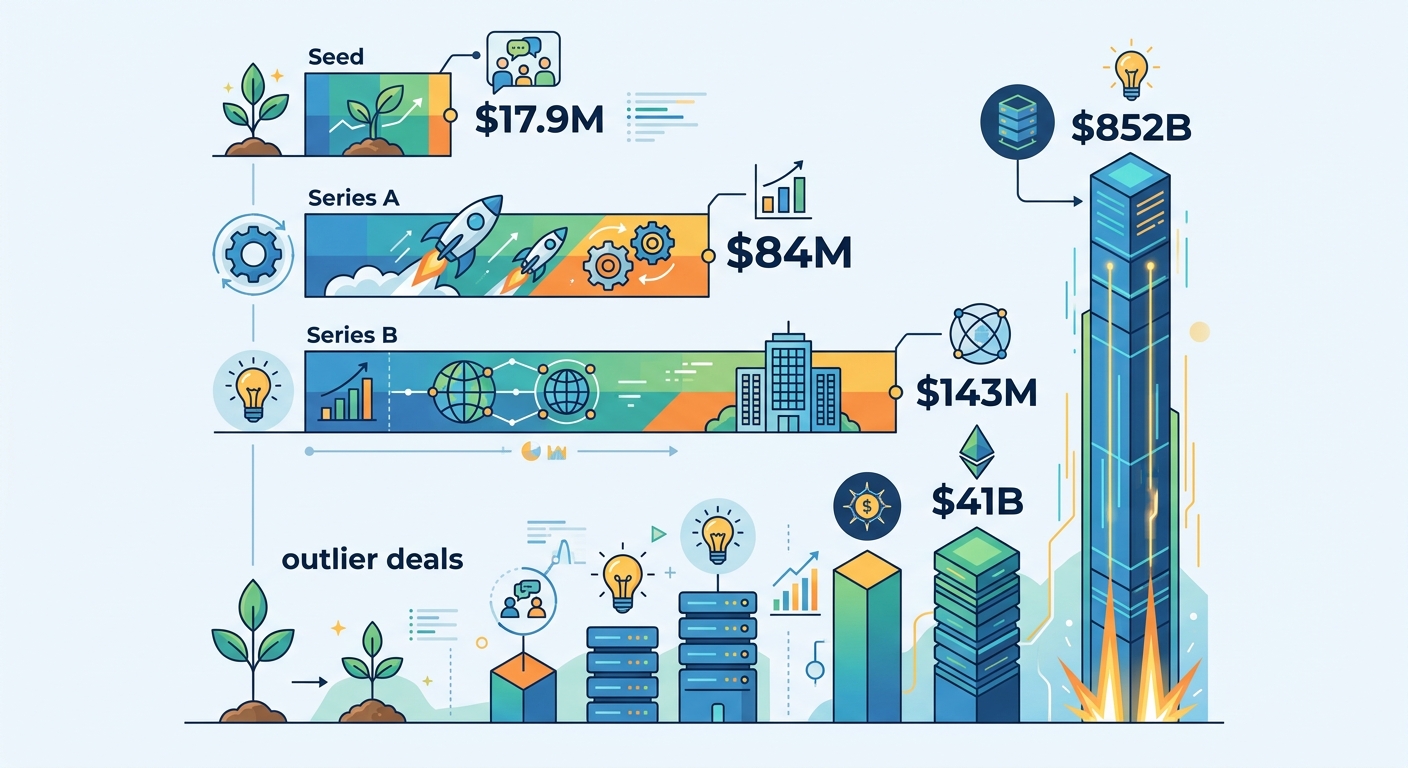
Seed Stage — AI seed rounds now command a median pre-money valuation of approximately $17.9 million: AI seed valuations — are — 42% higher than non-AI counterparts. For repeat founders with prior exits or strong team backgrounds, pre-seed valuations can cluster in the $30–60 million range, with some outliers approaching $50 million before a product ships. Despite the premium: Seed deal count — fell — 31% YoY in Q1 2026, while seed dollars rose 30%. This is the math of consolidation — fewer deals, larger checks.
Mega-seed rounds of $100 million to $2 billion remain rare but are no longer unprecedented. Prometheus — raised — $12B Series B at $41B valuation while still operating at early-commercial stage. In Q2 2026, at least five companies raised seed or angel rounds exceeding $100 million.
To secure seed funding in 2026, AI startups increasingly need validation signals beyond an idea: pilot customers, design partners, or demonstrable early user engagement. The "concept phase" raise is disappearing for all but the most celebrated founding teams — and even for them, the bar has risen to include compute access agreements or evidence of proprietary data.
Series A Stage — AI Series A — commands — $84M median valuation in 2026, nearly double the overall median Series A valuation across all sectors. A "normal" round in 2026 lands between $10–15 million at a $40–60 million pre-money valuation.
The bar for what "Series A ready" means has escalated sharply. Investors now expect $1–3 million in annual recurring revenue (ARR) with consistent 15–20% month-over-month growth over at least six months. In 2023, that benchmark would have qualified as Series B territory.
Less than 40% — of seed AI startups — advance to Series A. This is not a market failure — it reflects the reality that many AI applications struggle to close the gap between product-market resonance and scalable revenue, regardless of technical quality.
Series B Stage — AI Series B — reached — $143M median valuation in 2026, significantly outpacing non-AI equivalents. Series B rounds typically range from $20–60 million, with median around $29–38 million. Investors at this stage look for $5–20 million in ARR, predictable year-over-year growth exceeding 100%, and strong unit economics.
Sector Hotspots: Where the Capital Is Flowing
The AI funding surge is not uniform. Three verticals have captured the majority of applied AI investment in 2026: robotics and embodied AI, healthcare AI, and AI infrastructure. Each has distinct dynamics, investor theses, and risk profiles.
Robotics and Embodied AI
Robotics startups — raised — $18.8B by June 2026, already surpassing the full-year total for 2025 ($15 billion) and the previous peak of $14.1 billion in 2021. The driving force is embodied AI — artificial intelligence with a physical presence that interacts with the real world.
Humanoid robot shipments grew 508% year-over-year in 2025, reaching approximately 18,000 units globally. The commercial pipeline is accelerating. Waymo's $16 billion Q1 round validates autonomous vehicle deployment at scale. Saronic, focused on autonomous sea vessels, raised $1.75 billion in a Series D. Neura Robotics and Skild AI are building the foundational software layer — the "robot brain" — that could make humanoid and general-purpose robots programmable like smartphones.
Industrial automation remains the largest near-term market. The AI-powered industrial robot market is projected at $17.9 billion in 2026, with 72% of manufacturing companies planning to integrate AI-powered robots by year-end. Collaborative robots (cobots) with AI capabilities are growing at a projected CAGR of 41% through 2030.
The investment thesis is clear: generative AI has proven it can handle digital tasks, but the next wave of value creation lies in physical labor replacement and augmentation.
Healthcare AI
Digital health AI — absorbed — $7.4B in H1 2026, an increase of $1 billion compared to the same period in 2025. A striking 45% of this capital went into 19 megadeals — financings of $100 million or more — reflecting investor confidence in AI clinical applications at scale.
Clinical AI is the leading category. Health systems are deploying AI products for predictive analytics (identifying patients at risk of adverse events before they occur) and diagnostic algorithms (spotting abnormalities that human observation might miss). Unlike earlier "AI in healthcare" waves that focused on administrative automation, the 2026 cycle targets direct clinical workflows.
Weight management and GLP-1 therapeutics represent the second-most funded clinical indication, driven by the explosive growth of the semaglutide ecosystem and companies like eMed, Nourish, and Midi. Mental health remains robustly funded, with Talkiatry and Grow Therapy continuing to attract institutional capital.
The critical enabler is healthcare AI data infrastructure. Both AI model labs and application companies are investing heavily in healthcare-specific data pipelines, because clinical AI performance is directly tied to training data quality and domain specificity.
AI Infrastructure
The infrastructure layer — the compute, storage, and networking that powers every AI application — has become the largest single investment category by dollar volume, even though much of it flows through hyperscaler balance sheets rather than startup portfolios.
Hyperscalers — spending — $697B on capex in 2026, with approximately 75% targeting AI-specific capacity. J.P. Morgan estimates total hyperscaler capex will reach $697 billion for the year. AI data centers — projected to reach — $180.6B market in 2026.
AI-optimized IaaS — growing — 96% in 2026, reaching $42 billion. Notably, AI inference spending — to surpass — AI training spending in 2026 — $23.3 billion versus $19 billion — a milestone that signals the market is shifting from model training to model deployment at scale.
The near-term constraint is power. Nearly 100 gigawatts of new data center capacity is expected to be added between 2026 and 2030. However, power availability, supply chain constraints, and permitting timelines mean 30–50% of planned 2026 AI data center capacity will be delayed until 2028. This creates a bottleneck for the entire AI application layer above it.
The AI Chip Boom and Its Supply Chain Strains
AI chip market — expected to hit — $100B in 2026, while Deloitte estimates generative AI chips will generate nearly $500 billion in revenue — roughly half of global chip sales. AI — driving — global semiconductor industry to $975B in 2026.
High-bandwidth memory (HBM), the specialized memory architecture used in AI hardware accelerators, has become the chokepoint of the AI supply chain. HBM memory — consumed by — AI data centers (70% of global production) in 2026, creating a cascading shortage that affects personal computing devices, smartphones, and other memory-dependent products.
North America holds approximately 42% of the global AI chip market share, driven by the presence of major cloud providers, chip designers, and a mature venture capital ecosystem. Meanwhile, China is pursuing aggressive AI chip autonomy — domestic solutions are projected to capture nearly 90% of China's high-end AI chip market in 2026, a dramatic shift from prior dependence on imported accelerators.
The critical question for 2027 and beyond is whether chip supply can scale fast enough to meet the inferred demand trajectory, or whether the HBM constraint will persist and throttle AI deployment timelines.
Defense AI and Autonomy: The $7 Billion Wave
A category that has moved from experimental to essential in 2026 is defense AI and autonomous systems. Across half a dozen significant deals, defense AI startups absorbed over $7 billion in H1 2026.
Anduril Industries — raised — $5B Series H in May 2026, led by Thrive Capital and Andreessen Horowitz. Shield AI — focused on autonomous drone systems for combat environments — raised $2 billion in combined equity and preferred financing in March. Saronic, building autonomous sea vessels for naval operations, closed a $1.75 billion Series D. Safe Superintelligence reportedly received a $5 billion investment from Nvidia in July 2026.
The common thread across these deals is the shift from AI as a software product to AI as a deployed capability with defense contracts, operational deployment, and government relationships as the revenue backbone.
The Investor Landscape: Who Is Writing the $100 Billion Checks
The investor base for frontier AI has structurally changed. Traditional venture capital firms — Sequoia, Andreessen Horowitz, Thrive, Greenoaks — remain active and influential, but they are now joined by capital sources that traditional VC models did not anticipate.
Sovereign wealth funds have entered as anchor LPs and direct investors in AI mega-rounds. Corporate hyperscalers (Amazon, Google, Microsoft) have shifted from passive technology partners to active investment vehicles. In Anthropic's $65 billion round, Amazon and Google participated directly as investors, not just as cloud platform customers. This corporate-as-investor model gives AI startups more than capital — it provides compute access, distribution relationships, and strategic alignment that financial-only investors cannot match.
The result is a two-tier capital market for AI. At the frontier, dominant capital comes from strategic investors who view AI capability as a core business interest. Below the frontier, at Series A and Series B, traditional VC dynamics reassert themselves, with valuation discipline and revenue expectations operating more conventionally.
For founders, this means the fundraising landscape is bifurcating. If you are building at the AI capability frontier, capital is effectively unlimited and comes with strategic value. If you are building applied AI in a vertical, the path requires conventional revenue milestones.
The Cooling Signals: Flight to Quality and Early Consolidation
The AI funding boom carries genuine warning signs. The market is not uniformly heating — it is concentrating.
Seed deal count fell 31% year-over-year in Q1 2026 even as seed dollars rose 30%. This means investors are making fewer bets but investing more in each. The implication is that the long tail of AI startups is being filtered out at the seed stage before they can reach Series A.
The power constraint issue compounds this. If 30–50% of planned AI data center capacity for 2026 is delayed until 2028, the inference capacity bottleneck will constrain AI application deployment timelines.
Less than 40% — of seed AI startups — advance to Series A. This is not a market failure — it reflects the natural selection of a high-variance technology bet. But it means that for every Prometheus or Fireworks AI, there are two or three technically capable teams whose companies will not survive the Series A filter.
The largest M&A signal yet arrived in Q2 2026: SpaceX acquired xAI for approximately $250 billion, the largest AI-related acquisition in history, exceeding the combined value of all AI M&A over the prior three years. This is frontier AI consolidation at civilizational scale.
Revenue-per-employee has emerged as the key efficiency metric replacing growth-at-all-costs logic. As interest rates remain elevated and public market comparables tighten, investors who funded AI companies on pure growth trajectories are now demanding proof that revenue can be generated efficiently.
What Comes Next: Reading the 2026 Funding Landscape
Projections for full-year 2026 AI venture funding range from $650–800 billion, with $797.9 billion as a commonly cited mid-point estimate. Whether or not the year lands at that level, the structural shift is clear: AI has become the dominant destination for venture capital, and this dominance will not reverse.
The inference economy is overtaking the training economy. With AI inference spending — to surpass — AI training spending in 2026 for the first time, the value chain is shifting from "build the model" to "deploy the model." This transition favors companies that can build reliable, cost-effective inference infrastructure at scale.
21 AI startups have confirmed valuations exceeding $10 billion as of mid-2026. The question for 2027 is not whether more will join this list, but whether the current cohort will deliver on valuations that assume continued exponential growth.
For founders, the practical implications are concrete. The $1–3 million ARR benchmark for Series A is no longer aspirational — it is table stakes. The 15–20% month-over-month growth requirement has compressed fundraising timelines. And the investor base has bifurcated between frontier AI labs (where capital is nearly unlimited and strategic) and applied AI verticals (where conventional revenue discipline applies).
The AI funding landscape of mid-2026 is not a bubble in the traditional sense. The technology works. The revenue is real. The use cases are expanding. What it is, is a period of extreme concentration where capital is being deployed at historical scale into a small number of proven bets, leaving the broader ecosystem to compete for the remaining allocation.
Understanding this structure — who is writing the checks, at what stage, and for what type of AI — is the most practical skill for anyone operating in or adjacent to the AI startup ecosystem in 2026 and beyond.
Expert Q&A
Q: The article states that 80% of global VC went to AI in Q1 2026 — but some sources cite 86%. Which figure is more reliable? A: Both figures appear in credible reporting (PitchBook cited the 86% figure; Crunchbase data aligned closer to 80%). The discrepancy stems from whether "AI" is defined narrowly (pure AI model companies) or broadly (any company where AI is a material component of the business). The 80% figure is the more conservative and widely reproducible estimate. For the purposes of this article, the key takeaway — AI's overwhelming dominance over all other sectors combined — holds regardless of which precise figure one adopts.
Q: What does the 31% decline in seed deal count actually mean for early-stage founders? A: It means the market is applying a much stricter quality filter at the seed stage. Investors are not retreating from early-stage AI — they are concentrating seed bets into a smaller number of companies with stronger validation signals. In practice, this means founders need more than a strong technical team and an AI pitch: they need pilot LOIs, signed design partners, or demonstrable early revenue. The "build it and they will come" approach at seed has been effectively replaced by "prove the market exists before we fund the build."
Q: How should founders interpret the $1–3M ARR Series A benchmark given that AI inference costs are still high? A: The benchmark is real and now standard for AI Series A rounds. The implication is that founders need to achieve product-market fit and initial revenue traction faster than previous cohorts. AI inference costs do squeeze margins, but investors are increasingly looking at revenue efficiency metrics (revenue per dollar of compute cost) rather than pure gross margin. The $1–3M ARR range is not arbitrary — it signals that the company has found a repeatable customer acquisition pattern, which is the actual predicate for Series B growth capital.
Q: The article mentions 30–50% of AI data center capacity being delayed to 2028. How material is this constraint? A: It is the most underappreciated risk in the current AI investment thesis. Hyperscalers have announced aggressive capacity expansion, but power grid infrastructure, permitting, and construction timelines are real constraints that announced capacity does not account for. If 30–50% of 2026's planned capacity is delayed, the inference bottleneck will slow application-layer deployment for companies that depend on third-party compute. For companies building their own inference infrastructure, this delay is actually a competitive opportunity — they can move faster than the hyperscalers in specific verticals.
Q: Is the SpaceX/xAI $250B acquisition a signal that AI consolidation has begun in earnest? A: It is the clearest consolidation signal yet, but it reflects a specific dynamic: xAI needed compute scale and distribution that SpaceX (via Starlink and launch infrastructure) could provide, while SpaceX needed frontier AI capability integrated into its operations. This was a strategic merger, not a financial one. The more relevant question for the broader ecosystem is whether more frontier model companies will seek similar strategic partnerships — and whether smaller AI application companies will become acquisition targets as their would-be Series B investors instead choose to acquire rather than fund. The answer to both is likely yes.
Interested in staying ahead of AI infrastructure and investment trends? Subscribe to the Algorithmine portal for weekly analysis on the technologies shaping the AI landscape.
Related Articles: