The Q4 2026 AI Funding Reset: Who Is Still Raising and Who Is Quietly Shutting Down
Q4 2026 AI funding reset: capital is concentrating into infrastructure and vertical AI while thin-wrapper startups quietly wind down. What leaders should do now.
Editor's note: This is an analysis of funding patterns observed through Q4 2026, drawing on public venture data (PitchBook, Crunchbase, NVCA) and operator reporting. Figures are directional and should be verified against the cited sources before use in procurement decisions.
The Q4 2026 AI Funding Picture: An Inflection, Not a Crash
Q4 2026 is being written up as the quarter AI funding "cooled." That framing misses what is actually happening. Capital has not left the category—it has concentrated. Aggregate dollars deployed into AI remain near recent highs, but they are flowing into a shrinking set of companies with defensible economics. The long tail is a different story: a growing number of AI startups have quietly stopped operating, sold their teams, or wound down without a press release.
The result is a split-screen quarter. On one side, infrastructure, vertical, and regulated-market AI companies are closing rounds—often oversubscribed, per operator accounts—at valuations that are flat to modestly up versus their last round. On the other, thin-wrapper application startups that raised in 2024 are running out of runway with no Series B in sight.
The mechanics behind the split are worth spelling out. A 2024-vintage seed company that raised $4M on an 18-month plan is, by Q4 2026, either on a bridge or out of money. The same company in 2025 could have raised a Series A on a compelling demo and a handful of design partners. In Q4 2026, that Series A conversation starts with cohort retention curves, gross margin by customer segment, and a contracted revenue schedule. Founders who cannot produce those artifacts are not negotiating valuation—they are negotiating survival.
For practitioners, this matters more than the headline totals. Every AI vendor in your stack is now a stability question. This article maps who is still raising, who is quietly exiting, and what engineering and procurement leaders should do about it before Q1 2027. (Internal link suggestion: "AI vendor due diligence checklist")
The Q4 2026 AI Funding Picture at a Glance
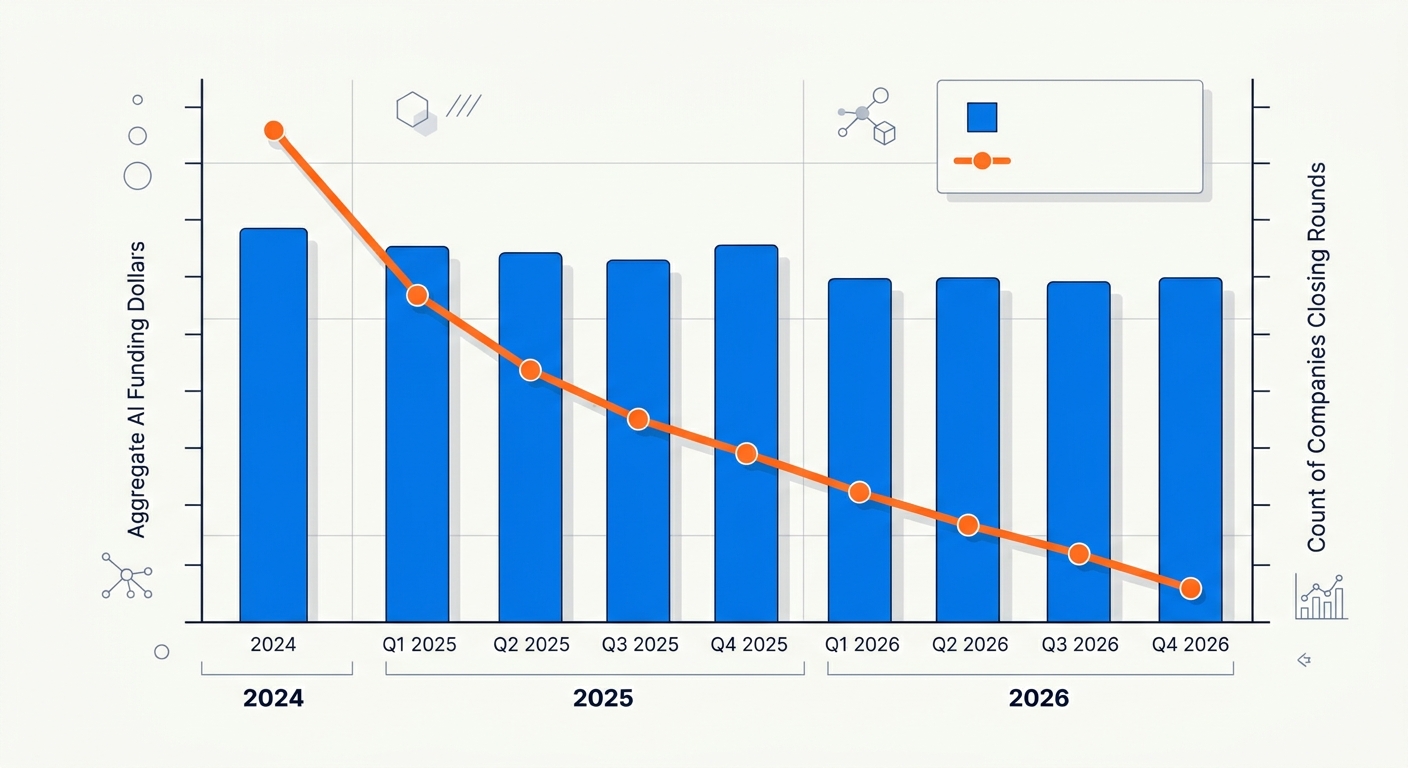
The headline number and the deal count tell opposite stories. Total AI venture dollars are roughly in line with 2025 levels, but the number of companies closing rounds has fallen sharply—a divergence consistent with the "fewer, larger checks" pattern reported across venture data trackers this year.
That divergence is the defining feature of the reset. A handful of mega-rounds into inference infrastructure and enterprise verticals prop up the aggregate, while the median AI startup faces a much harder market than a year ago. (Internal link suggestion: "AI venture funding trends 2026")
What Changed Since the 2024–2025 Peak
The 2024–2025 peak was a broad-based enthusiasm cycle. Capital spread across the application layer, agents, copilots, and every "AI for X" category. Diligence cycles were short and conviction was thematic. A seed round could close in three weeks on the strength of a founder's prior exit and a waitlist.
Q4 2026 is category-specific. Investors now underwrite gross margin, net revenue retention, and contracted revenue before they underwrite a demo. The bar moved from "is this AI?" to "does this AI make money at scale?"
The practical consequence is that the funding funnel has narrowed at every stage. Seed checks are smaller and more often structured as SAFEs with caps that reflect a down round relative to 2025. Series A investors are asking for a paid pilot cohort of at least 10–15 customers with six months of usage data. Series B investors want to see the sales efficiency ratio—net new ARR divided by sales and marketing spend—trending toward 1.0 or better. Companies that cannot show that trajectory are being told to come back in two quarters, which in runway terms is often the same as a no.
The Numbers That Define the Reset
Three structural shifts define the quarter:
- Round size up, round count down. Capital is concentrating into fewer, later, larger financings.
- Longer diligence. Series A and B processes that took weeks in 2025 now take months, with deeper technical and financial review.
- The Series B bridge is harder. Companies that raised seed and Series A on momentum are finding the next stage gated on retention and margin data they may not have.
A fourth shift sits underneath these: the bridge round has replaced the up round for a large share of the 2024 cohort. Insider-led extensions at flat or structured terms are keeping companies alive without appearing in headline funding totals, which means the reported aggregate understates how many companies are actually struggling. When you see a vendor announce a "strategic investment" with no new lead investor named, read it as a bridge.
Who Is Still Raising: The Durable Categories
The companies closing rounds in Q4 2026 share a profile: real margins, contracted revenue, and defensible data or distribution. They are not necessarily the loudest names. They are the ones whose economics survive scrutiny.
Infrastructure, Inference, and Efficiency Players
The clearest winners are companies that make AI cheaper to run. Inference optimization, model routing, GPU efficiency, and cost-reduction infrastructure are attracting capital on a straightforward narrative: every enterprise adopting AI needs to control inference spend.
These companies sell into a real budget line. As model costs fall, the layer that manages and optimizes that spend becomes more valuable, not less. Investors are underwriting them as picks-and-shovels plays with usage-based revenue that scales with customer adoption. (Internal link suggestion: "AI inference cost optimization guide")
The category spans several distinct sub-segments, and the diligence questions differ for each:
- Inference serving and optimization (batching, quantization, speculative decoding, KV-cache management). The trade-off investors probe is accuracy versus throughput: aggressive quantization can degrade output quality on reasoning-heavy tasks, and buyers need per-workload benchmarks, not a single tokens-per-second number.
- Model routing and gateways. These sit between the application and multiple model providers, choosing the cheapest capable model per request. The failure mode to watch is brittleness—routing logic that optimizes cost can silently downgrade quality on edge cases, so ask vendors how they evaluate routing decisions against a held-out quality set.
- GPU scheduling and utilization. Fractional GPU allocation and spot-instance orchestration can cut compute spend materially, but the savings depend on workload tolerance for preemption. A vendor that quotes a headline utilization figure without disclosing preemption rates is telling half the story.
The common thread is that these companies have a cost-of-goods story that improves with scale, which is exactly what the current diligence regime rewards.
Vertical AI With Proven Unit Economics
Vertical AI companies—those selling into specific industries with measurable ROI—are closing rounds where they can show retention. The differentiator is no longer the model; it is the workflow integration and the data moat behind it.
Enterprises buy outcomes, not intelligence. Vertical players that can point to strong net revenue retention—commonly cited by investors as the 110%+ benchmark for a healthy enterprise SaaS cohort—and a clear cost-of-goods story are getting term sheets. Those still selling "AI-powered" without a payback calculation are not.
Concretely, the verticals closing rounds in Q4 2026 tend to share three traits: a regulated or high-friction workflow where generic models underperform without domain data; a customer base that measures ROI in hard dollars (claims processed, denials overturned, hours of clinician documentation removed); and a data feedback loop that compounds with each customer. Legal drafting, medical coding and prior authorization, insurance claims triage, and financial compliance monitoring are the recurring examples. In each, the buyer can compute payback in months, and the vendor can show cohort retention above the 110% benchmark because the product is embedded in a system of record.
The trade-off for buyers is concentration risk in the other direction: vertical vendors are often single-industry businesses, so a downturn in that industry hits the vendor directly. Ask about customer concentration—a vertical AI company where the top three customers are more than 40% of revenue is a stability question even if it is raising.
The Sovereign and Regulated-Market Lane
Defense, health care, and financial services AI are in a lane of their own. Compliance is a moat, and buyers in these markets pay for data residency, auditability, and regulatory fit. Sovereign AI initiatives—national and regional programs to keep AI infrastructure and data in-country—are adding a durable demand signal.
Capital here is patient and strategic, often from corporate and government-adjacent sources rather than traditional venture funds. That insulates these companies from the consumer-facing sentiment swings that hit the application layer. (Internal link suggestion: "sovereign AI and data residency requirements")
The trade-off is procurement friction. These vendors often carry FedRAMP or equivalent authorization work in progress, which means their sales cycles are long and their roadmaps are shaped by compliance milestones rather than product velocity. For a buyer in a regulated industry, that is a feature. For a buyer who needs a capability next quarter, it is a scheduling risk worth pricing in.
"The reset is not a shortage of capital. It is a shortage of patience for companies that cannot show a path to margin."
Who Is Quietly Shutting Down: The Winding-Down Pattern
The other half of Q4 2026 is happening off the front page. Shutdowns in AI are rarely announced as shutdowns. They appear as acqui-hires, asset sales, team absorptions, and unannounced wind-downs where the website stays up while the company quietly stops operating.
The "Thin Wrapper" Cohort
The most exposed category is the thin-wrapper application layer: products built on top of foundation model APIs with little proprietary data or workflow lock-in. When the underlying models absorb their feature set—or when a platform bundles the same capability for free—the wrapper's value proposition erodes fast.
This is not a universal death sentence. Some wrappers survive on distribution, integrations, and support that model providers do not replicate. The ones at risk are those whose only defensibility is the prompt layer. They were viable in 2024 when distribution was cheap and differentiation was assumed. In Q4 2026, the market prices that differentiation at close to zero.
The failure mode is predictable and worth recognizing early. A thin wrapper typically shows three symptoms before it stops operating: feature announcements that track the foundation model release calendar rather than customer requests; a pricing page that changes quarterly as the underlying API costs shift; and a support queue where the most common ticket is "the output got worse after your last update." None of these is fatal alone, but together they describe a company whose product is a configuration of someone else's model.
Why Acqui-Hires Hide the Real Failure Rate
An acqui-hire is not a soft landing for customers. It typically means the product roadmap stops, the engineering team is reassigned, and the acquiring company has no obligation to honor the original service levels. When a vendor is absorbed, your data and contracts become an integration problem you did not plan for.
The tell is in the transaction shape: a team-and-IP deal with no customer continuity plan is a wind-down wearing a press release. Watch for acquisitions announced with no mention of existing customers, or where the acquired product is "sunset" within two quarters.
Three signals distinguish a genuine acquisition from a disguised wind-down. First, does the announcement name a customer migration path and a timeline? Second, does the acquiring company have a product that overlaps enough to absorb your use case, or is it buying the team for a different roadmap? Third, what happens to the data processing agreement—if the acquirer requires you to sign a new contract on short notice, your original terms are effectively gone. A vendor that cannot answer these questions before you ask them is telling you the deal was structured for the team, not the customers.
What Engineering and Procurement Leaders Should Do Before Q1 2027
The reset turns vendor selection into risk management. Five concrete steps:
- Audit API dependency concentration. For each AI vendor, identify how many of its core features are thin calls to a single foundation model provider. High concentration plus no proprietary data is a red flag. A useful test: ask the vendor's solutions engineer what happens to the product if their primary model provider ships the same feature natively. The answer tells you whether you are buying a product or a prompt.
- Check the runway math. Seed and Series A companies from 2024 with no announced Series B are, on typical burn, approaching the end of runway. Ask directly about funding status and expected close dates in renewal conversations. A vendor that answers with a specific date and lead investor is a different risk than one that answers with "we're in active conversations."
- Contract for continuity. Negotiate data export rights, source-code or model escrow where feasible, and termination assistance clauses so an acqui-hire does not strand your integration. Insist on export formats you can actually ingest—a JSON dump of embeddings is not useful if your downstream system expects a structured schema.
- Demand the unit-economics story. Ask vendors for gross margin and net revenue retention (cohort basis, defined). A vendor that cannot answer is a vendor that has not been asked by its own investors.
- Prefer the durable categories where the stakes are high. For regulated workloads, weight toward infrastructure and compliance-moated vendors whose capital base is patient and strategic.
The Q4 2026 reset is not a reason to stop buying AI. It is a reason to buy it the way you buy any critical infrastructure: with diligence, exit terms, and a plan for the vendor that does not make it.