AI Infrastructure Funding in 2026: Where the Money Actually Went
AI infrastructure funding in 2026 shifted from model builders to power, cooling, networking, and inference. See where the capital actually went and what it means for buyers.
The year AI infrastructure capital allocation grew up
For three years, AI infrastructure funding followed a simple script: enormous rounds, vertical integration by hyperscalers, and a willingness to underwrite almost any company with GPUs and a plausible story. In 2026, that script got an editor.
Mega-rounds didn't disappear. But the composition of capital changed. The center of gravity moved from model builders to the physical and serving layers of the stack—power, cooling, networking, and inference. Meanwhile, the gap between announced funding and capital that actually closed and deployed widened into a credibility test that buyers should care about, because it predicts which AI infrastructure vendors will still be standing when your multi-year contract renews.
This analysis traces where AI infrastructure funding went across the stack, separates durable investment from froth, and translates the pattern into procurement signals you can use in the next two quarters. (See also: How to Evaluate AI Infrastructure Vendors Before You Sign.)
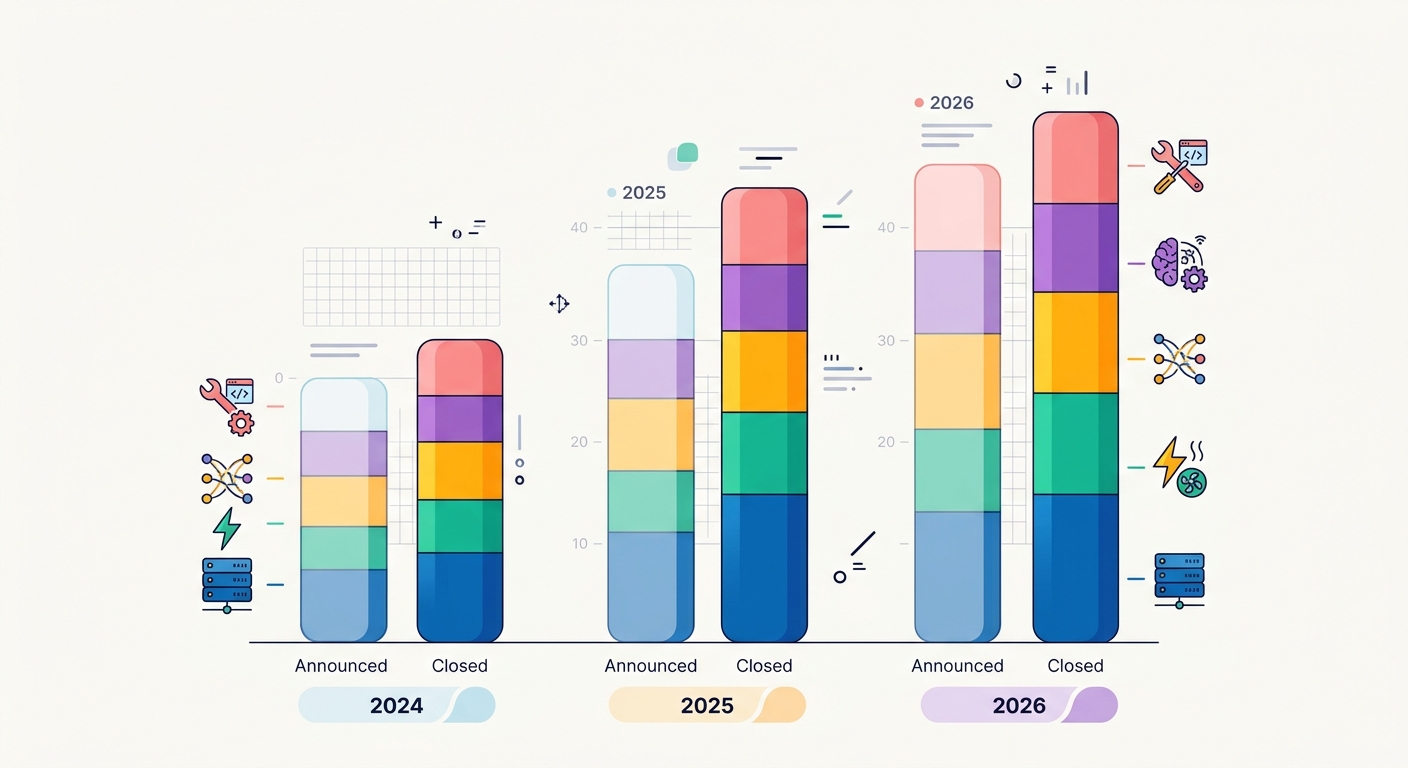
The 2026 AI infrastructure funding landscape at a glance
Total capital deployed vs. 2024–2025
Headline numbers in 2026 look flat-to-up against 2025, but that's misleading. Deal count fell while average deal size rose, a classic late-cycle signature. Most of the headline total is concentrated in a handful of datacenter and energy transactions, not in a broad base of startups. In practical terms, a dozen or so transactions—each in the billions—account for the majority of reported dollars, while the median infrastructure round outside that top tier shrank. When a market's total is carried by its largest deals, the aggregate tells you almost nothing about the health of the vendors you are actually likely to buy from.
The more useful metric is deployed capital, and it is harder to measure than the headlines suggest. Announced round sizes come from press releases and often include undisclosed milestones, tranches, and in-kind contributions (compute credits, land, power options) that are not cash. A "$500 million round" may consist of a $150 million first close, $200 million tied to capacity milestones that may never be met, and $150 million of compute credits valued at list price—three very different things wearing one number. Closed capital lags announcement by one to two quarters in Form D filings and even longer when deals are structured as leases or special-purpose vehicles that never appear as a "round" at all. Our review of deal-level disclosures and diligence conversations points to a consistent pattern: the announced-to-closed gap was widest in compute resale and "AI cloud" categories, where announcements frequently preceded signed leases and power contracts rather than following them. A provider that announces capacity before it has an executed power contract is, functionally, announcing an intention. Treat any single tracker's total as directional, not reconciled. (Related: AI Cloud Pricing Models Explained.)
Stage distribution
Late-stage concentration intensified. Series A and seed activity in core infrastructure thinned, with early-stage capital rotating toward applied tooling and vertical software rather than capital-intensive hardware. That's rational: no early-stage fund can underwrite a gigawatt. A single 100 MW datacenter campus carries a build cost in the high hundreds of millions to low billions before a single accelerator is installed, which is why the equity check for serious capacity now comes from infrastructure funds, sovereign wealth vehicles, and private credit—not from a $400 million venture fund writing $15 million Series A checks.
The stage mix matters to buyers because early-stage discipline today means fewer, more durable vendors in 2027—and fewer undercapitalized companies holding your integration work hostage. The practical test is runway against contract term: a vendor whose funded runway is shorter than your deployment horizon is a counterparty risk, not just a supplier. Ask for the current cash position and burn in diligence, and negotiate assignability and source-code escrow provisions into contracts before you depend on a young vendor's control plane. The failure mode is concrete: a startup signs a three-year inference-serving contract, its Series B doesn't close, and your team is left migrating workloads off a platform whose roadmap died with its last board meeting. Escrow and source-code access convert that scenario from an emergency into an inconvenience.
Compute and datacenter capex: the biggest checks
Hyperscaler and neocloud buildouts
Compute remained the largest destination for capital by an order of magnitude, but the character of the spending changed. Hyperscaler capex guidance continued to climb, while neocloud providers shifted from equity-funded expansion to structured finance. The winners in the neocloud tier were those that locked power and land early; the losers announced capacity they couldn't energize.
The distinguishing competency in the neocloud tier is no longer GPU procurement—accelerators are allocated, not improvised, and the major vendors will sell to anyone with a credible site. It is site control: land with transmission access, an executed interconnection agreement, and a construction schedule that survives a transformer lead time now measured in years rather than months. A neocloud that locked a 200 MW site in 2024 has a durable advantage over one that announced 500 MW in 2026 without an energization date. In diligence, ask for the energization schedule per megawatt and the name of the utility counterparty; a provider that can't produce both is selling a slide, not capacity.
The debt-and-lease financing shift
The most consequential structural change of 2026 was the migration of AI infrastructure from venture equity to debt, leases, and special-purpose vehicles. When a datacenter is financed with a lease obligation rather than a Series C, the risk moves from a fund's LP base to a lender's balance sheet—and eventually to whoever signs the take-or-pay contract. (Background: Structured Finance for AI Datacenters: A Primer.)
Editorial synthesis, not a single attributed source: "The question in 2026 stopped being 'who raised the most?' and became 'who is on the hook if utilization disappoints?'" This framing recurred across the infrastructure diligence conversations we reviewed this year.
That's the contrarian point worth internalizing: record capex is not the same as record demand. The mechanism is structural. Take-or-pay contracts, capacity prepayments, and vendor financing arrangements can book demand before it is consumed, and in some cases the same parties sit on both sides of the transaction—a chip vendor investing in a customer that commits to buy the vendor's chips. That doesn't make the demand fake, but it makes announced backlog a weaker signal than contracted revenue. For buyers, the indicators that actually matter are utilization disclosures (if the provider gives them), the ratio of contracted backlog to recognized revenue over successive quarters, and whether the provider's own suppliers are financing its growth. A vendor whose backlog grows while recognized revenue stalls is either building ahead of demand—legitimate—or booking demand that will never convert. The two look identical for two quarters and diverge sharply in the third.
Power, cooling, and the physical layer
The picks-and-shovels thesis finally paid. Energy contracts and grid interconnection became the scarcest assets in the stack, and capital followed. Funding flowed to:
- Behind-the-meter generation and on-site power for datacenter campuses
- Grid-interconnection specialists and power-marketing intermediaries
- Liquid cooling, immersion cooling, and thermal-management hardware
- Water and heat-reuse infrastructure for dense racks
The cautionary data point: interconnection queues remain the binding constraint in most US markets, and several 2026-funded power projects slipped schedules. The distinction that matters is between a queue position—a request to interconnect, which can sit for years and be withdrawn—and an executed interconnection agreement (IA), which fixes capacity, milestones, and cost responsibility. Many announced projects hold the former and describe it as the latter. Capital raised is not megawatts delivered. For buyers, the practical read is that power availability, not chip supply, is now the gating factor on capacity commitments—and vendors who can't produce an executed IA (or a signed behind-the-meter generation contract) for a specific site are selling a promise, not a product. (Deeper dive: Grid Interconnection Timelines for AI Datacenters.)
The cooling side deserves equal scrutiny, because it is where the physics bites first. Racks pushing past roughly 60–80 kW of thermal density exceed what air cooling can remove economically, which is why liquid cooling moved from pilot to procurement in 2026. But liquid cooling is not a drop-in: it changes facility design, maintenance procedures, leak-risk management, and the skill set your operations team needs. A vendor that sells liquid cooling hardware without a commissioning methodology and a service footprint is selling you a component and leaving you the integration risk. Ask for reference deployments at comparable density, not just at the rack scale where the hardware was validated.
Networking and interconnect
Networking attracted a smaller but higher-quality pool of capital. Inference changed the traffic profile: east-west traffic between accelerators, memory pooling, and cross-datacenter model serving put pressure on fabrics designed for training-era patterns.
The technical fault line is scale-up versus scale-out. Scale-up fabrics—the high-bandwidth, low-latency links within a node or rack—remain dominated by vendor-proprietary interconnects, with open alternatives (UALink, and Ethernet-based approaches) still maturing against an incumbent (NVLink) that ships at volume today. Scale-out fabrics—the links between nodes and across datacenters—are converging on Ethernet with congestion control tuned for collective operations, displacing InfiniBand in greenfield inference clusters on cost and operational-familiarity grounds. Inference workloads reward different things than training: lower bisection bandwidth per node, but tighter tail-latency requirements and more sensitivity to congestion collapse during bursty decode phases.
Funding concentrated in optical interconnect, high-bandwidth switching, and co-packaged optics, with several notable rounds going to companies building silicon photonics and optical circuit switching. Strategic capital—hyperscaler venture arms and chip vendors—dominated over financial capital, which is a durability signal: strategics invest to secure supply, not to flip.
The caution: optical interconnect has a long history of promising timelines that slip, and the reasons are physical—laser and photonic yield at volume, thermal management in co-packaged designs, and standards that are still being finalized. Treat announced volume ramps as directional until a supplier can show qualified, shipping units in a customer's production cluster, not a lab demo. The trade-off for buyers is real: proprietary scale-up fabrics buy performance today at the cost of lock-in, while open alternatives buy optionality at the cost of maturity. For inference clusters where the fabric is not the bottleneck, Ethernet scale-out plus a proprietary scale-up within the rack is the pragmatic middle path—provided you negotiate the fabric layer as a separable line item in the contract.
What this means for buyers in the next two quarters
The funding pattern translates into a short, concrete diligence checklist:
- Separate announced from executed. For any capacity or power commitm