AI Funding Roundup: Top 10 Investments Reshaping the AI Landscape in 2026
The first quarter of 2026 sent a clear signal to markets worldwide: the AI investment supercycle is not slowing down — it is accelerating. In a single quarter, AI companies captured over $188 billion in funding, with the year's largest deals concentrated among a handful of companies that are collectively reshaping what AI means for industries, governments, and the global economy.
From foundational model labs to autonomous vehicle pioneers, from sovereign wealth funds to chip designers, the breadth of 2026's AI investment landscape reveals something important: AI is no longer a vertical — it is the entire investment thesis.
This roundup breaks down the ten deals that defined AI funding in 2026, what they mean individually, and what patterns emerge when you look at them together.
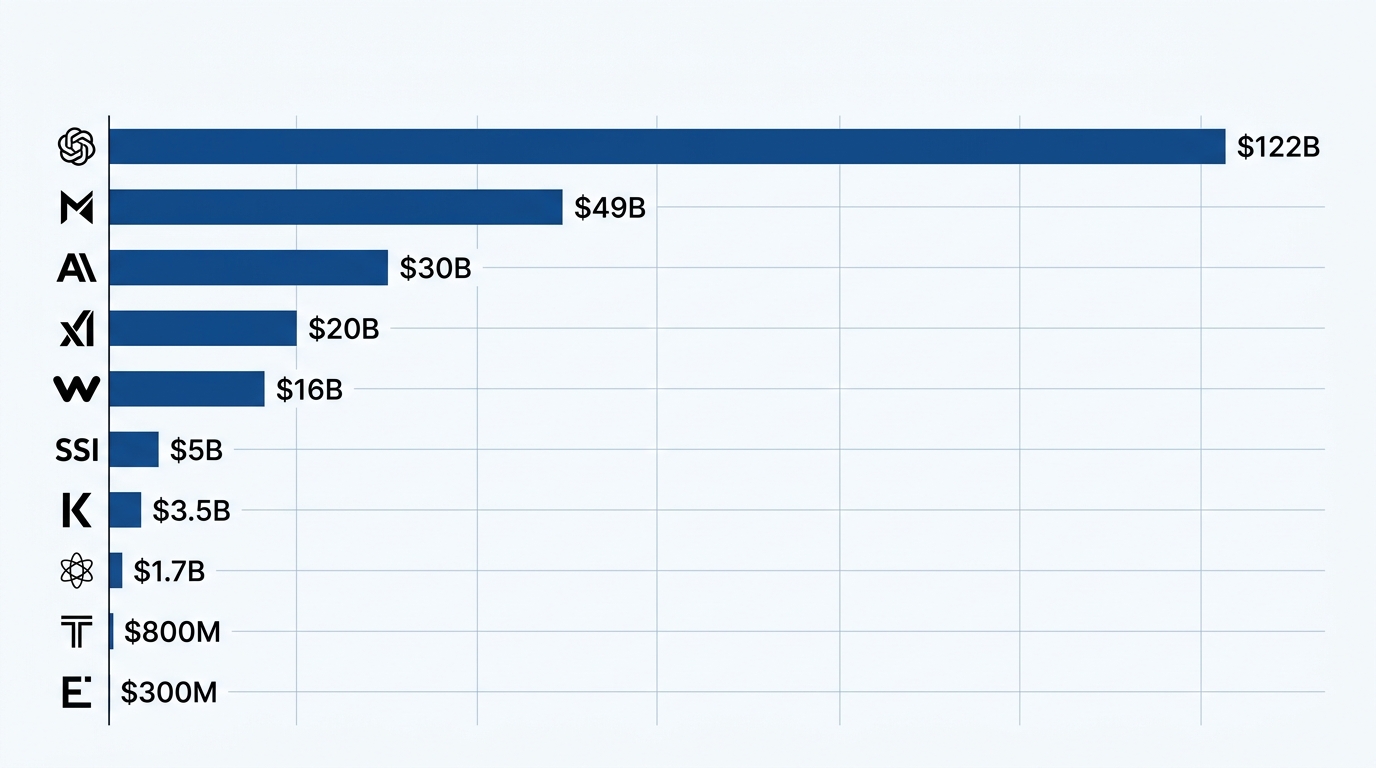
1. OpenAI — $122 Billion (March 31, 2026)
No story captures the scale of 2026's AI investment frenzy better than OpenAI's historic raise. On the last day of Q1 2026, the company closed a $122 billion funding round — the largest private financing deal in Silicon Valley history — at a $852 billion post-money valuation.
The investor lineup reads like a who's who of global technology and capital:
- Amazon — $50 billion
- SoftBank — $30 billion
- Nvidia — $30 billion
- Retail investors — $3 billion (via a structured participation mechanism)
Key insight — Three of the world's most sophisticated technology investors made a coordinated, nine-figure bet on a single company simultaneously. Amazon is buying compute partnerships and distribution. SoftBank is betting on the next phase of the AI internet. Nvidia is securing GPU demand and ecosystem lock-in.
What makes this round remarkable isn't just the size — it's the signal it sends. This single round exceeds the total valuation of most publicly traded companies in any sector outside of technology. It also makes OpenAI more valuable than 95% of the S&P 500 by market cap — as a private company with no traditional public market trading history.
Why it matters: OpenAI's valuation anchors the entire AI ecosystem. When the leading model lab is worth $852 billion, everything downstream — AI applications, infrastructure, tooling, and services — recalibrates upward. It sets the floor for what "AI leadership" is worth.
2. Anthropic — $30 Billion Series G
The second-largest private tech funding round in history (after OpenAI) went to Anthropic, which closed a $30 billion Series G in Q1 2026, valuing the company at $380 billion post-money.
Where OpenAI's valuation is built on product velocity and consumer adoption (ChatGPT, API revenue, Enterprise), Anthropic's valuation rests on a different proposition: enterprise AI with safety baked in. Anthropic's Claude models have become the default choice for regulated industries — financial services, healthcare, legal — where AI safety guarantees and compliance features matter more than raw capability benchmarks.
The $380 billion valuation implies that investors believe the enterprise AI market will generate hundreds of billions in revenue within a decade. At a rough 15-20x revenue multiple common for high-growth SaaS, Anthropic would need to demonstrate $20-25 billion in annual recurring revenue to justify this valuation — a bar that requires the enterprise AI market to grow substantially from today's base.
Anthropic also benefits from Amazon's reported $8 billion investment in the company (part of a broader Amazon-Anthropic partnership), which gives it both capital and cloud distribution advantages.
Why it matters: "Safe AI for enterprise" is a $380 billion thesis. That's a category that didn't exist three years ago. Anthropic proves that the market will pay premium valuations for AI products with demonstrated safety and compliance characteristics.
3. xAI — $20 Billion Series E, Merging with SpaceX
Elon Musk's AI venture xAI closed a $20 billion Series E round in Q1 2026, simultaneously announcing a strategic merger of interests with SpaceX. The combined entity positions xAI as a vertically integrated AI company with access to SpaceX's data centers, Starlink infrastructure, and launch capabilities.
The logic is infrastructure-first: xAI isn't just building AI models — it's building the compute and physical infrastructure to run them at scale. SpaceX's data center ambitions, combined with Starlink's global connectivity, create a distribution and compute advantage that no other AI startup can replicate.
Musk has been transparent about the fact that xAI's primary goal is to build Autonomous AI Agents that can perform complex, multi-step tasks with minimal human oversight. The SpaceX merger gives xAI real-world data streams (launch telemetry, satellite imagery, Starlink network data) that most AI labs can only dream about.
Why it matters: Vertical integration is the new moat in AI. If infrastructure-native AI companies can outperform cloud-dependent ones on cost and latency, expect a wave of compute infrastructure acquisitions by AI labs.
4. Waymo — $16 Billion Series D (February 2026)
Alphabet's autonomous driving company announced a $16 billion Series D in February 2026, reaching a valuation of $126 billion. This wasn't just a bet on self-driving cars — it was a bet on physical AI and real-world deployment at scale.
Waymo has been quietly operating a commercial robotaxi service in San Francisco, Phoenix, and Los Angeles for over a year. Its valuation surge reflects actual revenue generation, not just technology promise. The company reportedly processes hundreds of thousands of paid rides per week, with a unit economics model that improves with scale.
The $126 billion valuation makes Waymo one of the most valuable AI companies in the world — and signals that the decade-long "autonomous vehicles are always five years away" narrative has finally given way to commercial reality.
Why it matters: Physical AI — AI that acts in the real world — is now a proven commercial category. Waymo validates investment in robotics, autonomous systems, and embodied AI more broadly.
5. MGX Fund I — $49 Billion (July 1, 2026)
Abu Dhabi's sovereign wealth fund vehicle MGX closed its debut AI-focused fund at $49 billion on July 1, 2026 — exceeding its original $45 billion target. The fund has already deployed capital across 14 companies in semiconductors, AI infrastructure, and AI platforms.
MGX is not a traditional VC. As a sovereign wealth vehicle, it represents the geopolitical dimension of AI investment: nation-states are now direct participants in AI capital allocation, not just bystanders. The UAE's strategic objective with MGX is to position Abu Dhabi as a global AI financial hub — a bridge between Middle Eastern capital and Silicon Valley AI expertise.
MGX's portfolio includes investments in Nvidia (indirect via fund positions), custom silicon startups, and cloud AI infrastructure plays. The fund has also been active in financing AI data center construction across the Middle East and Southeast Asia.
Why it matters: Sovereign wealth funds are direct AI investors with longer time horizons and strategic objectives. They can sustain valuations through market downturns in ways that traditional VCs cannot.
6. Safe Superintelligence (SSI) — $5 Billion Nvidia Strategic Partnership (July 27, 2026)
Perhaps the most philosophically interesting deal of 2026: Safe Superintelligence (SSI), founded by OpenAI co-founder Ilya Sutskever, secured a $5 billion strategic partnership with Nvidia on July 27, 2026. The deal includes exclusive access to Nvidia's forthcoming Vera Rubin GPU platform and values SSI at $32 billion — despite having zero commercial revenue and no publicly available product.
This is the purest demonstration yet that the market is willing to assign extraordinary value to AI safety research as a strategic asset. Nvidia's investment is partly altruistic (the company has every incentive to be seen as supporting safe AI) and partly strategic (exclusive GPU access gives SSI a compute advantage that could produce the world's most capable safe AI model).
Why it matters: The market prices AI safety as a $32 billion asset class. SSI's valuation challenges every conventional metric for tech investing — safety research without a product is worth more than most software companies' entire market caps.
7. Atoms — $1.7 Billion (July 2026)
Atoms, the physical AI startup founded by Uber co-founder Travis Kalanick, raised $1.7 billion in a round led by Andreessen Horowitz in July 2026. The company is building foundation models for physical world tasks — robotics, manipulation, autonomous movement — an area that has lagged behind pure software AI despite decades of research.
Kalanick's involvement brings a distinctive founder profile to the AI race: a builder who disrupted transportation once and now believes physical AI will be the next platform shift. The $1.7 billion raise — for a company with limited public product details — signals that VCs have moved beyond the "software eating the world" era into "robots eating the world."
Why it matters: Physical AI has arrived as the next major funding category after foundation models. After years of software AI dominance in investment dollars, robotics and embodied AI are getting serious capital.
8. Together AI — $800 Million Series C
Together AI, an open-source AI infrastructure platform that provides compute and tooling for training and running open-source AI models, raised $800 million in Series C funding, reaching an $8.3 billion valuation. The round was led by Aramco Ventures with participation from Nvidia and other investors.
Together AI's value proposition is the open-source AI stack: instead of relying on OpenAI or Anthropic APIs, enterprises can train and run models on Together's distributed infrastructure using open-source model weights (LLaMA, Mistral, Falcon). This is a meaningful bet that the open-source AI model ecosystem will capture significant enterprise workloads.
The involvement of Aramco Ventures (Saudi Aramco's investment arm) is notable — it represents another sovereign-adjacent investor making a large bet on AI infrastructure, with geopolitical overtones given Saudi Arabia's stated ambition to become a global AI hub.
Why it matters: Open-source AI infrastructure is a viable $8.3 billion business. If open-source models continue to close the capability gap with proprietary ones, platforms like Together AI become the "Linux of AI."
9. Etched — $300 Million Series C
Etched, a startup building custom silicon specifically designed for transformer model inference, raised $300 million in Series C funding led by Sequoia Capital, at a $10 billion pre-money valuation. This means Etched is valued at over $10 billion before its chip ships in volume — an extraordinary vote of confidence in the custom AI chip category.
Etched's bet is that general-purpose GPUs (even Nvidia's H100 and B200 series) are architecturally suboptimal for transformer inference workloads. By designing chips specifically for the attention mechanism and matrix multiplications that define transformer models, Etched believes it can achieve 10-100x better performance-per-dollar for inference tasks.
Nvidia's dominance in AI training is unquestioned. But in inference — where models are run, not trained — there may be more room for competition. Etched is betting that the inference market will be enormous and that custom silicon will capture a meaningful share.
Why it matters: Custom silicon is the next AI semiconductor battlefield. After years of "just buy more H100s," investors are betting on silicon diversity for AI inference workloads.
10. Kleiner Perkins $3.5 Billion AI Fund (March 18, 2026)
Rounding out the top 10 is not a company investment but a fund — Kleiner Perkins, one of Silicon Valley's most storied VC firms, launched a $3.5 billion fund dedicated exclusively to AI startups on March 18, 2026.
This is significant for two reasons. First, Kleiner Perkins doesn't raise sector-specific funds lightly; the firm has historically been selective about fund theses. Second, a $3.5 billion vehicle in a single fund represents one of the largest AI-focused VC commitments ever raised by a traditional firm — signaling that the AI investment opportunity is large enough to anchor an entire fund strategy.
Kleiner Perkins has historically been early in platform shifts (Google, Amazon, Salesforce). Their AI fund thesis is reportedly focused on AI application layers — companies that use foundation models as building blocks to solve specific industry problems, rather than investing in foundation model labs themselves.
Why it matters: When tier-1 traditional VCs commit $3.5 billion to AI, it validates that AI is not a thematic trend — it's the defining technology platform for the next decade.
The Bigger Picture: Big Tech's $405 Billion AI Commitment
Individual funding rounds tell part of the story. The other part is the aggregate capital expenditure commitment from the hyperscalers. In 2026, Microsoft, Amazon, Google, and Meta are collectively committing over $405 billion in AI-related capital expenditure — data centers, GPUs, custom silicon, and infrastructure.
Key insight — When you add the Big Tech $405 billion commitment to the $188 billion in startup funding captured in Q1 2026 alone, the total AI investment picture for 2026 is well over half a trillion dollars — before counting secondary market activity, strategic investments, or government AI programs.
This is not venture capital; it's balance sheet capital. Amazon is building AI infrastructure both for its own products (Alexa AI, AWS AI services) and to offer to enterprises via AWS. Microsoft is doing the same via Azure + Copilot. Google's commitment is centered on TPU development and DeepMind research-to-product pipelines. Meta is spending heavily on AI infrastructure to power its recommendation systems and future AI-powered devices.
10 AI Investment Trends to Watch
Based on the funding patterns above, several clear trends emerge:
1. The Mega-Round Stratification
The AI funding market is bifurcating: $10+ billion rounds for a handful of frontier labs, and a growing seed and Series A market for application-layer startups. The middle market (Series B-D) is getting squeezed — too mature for early-stage premium, too small for mega-round attention.
2. Vertical Integration Is the New Moat
OpenAI, xAI, and Anthropic are all building proprietary infrastructure layers. The days of "pure software AI" startups relying entirely on cloud infrastructure may be numbered. Companies that own their compute stack — or have privileged access to it — will have structural cost advantages.
3. Physical AI Has Arrived
Waymo ($126B), Atoms ($1.7B), and robotics-adjacent AI investments signal that the next major AI category is embodied AI: systems that interact with the physical world. After years of "software AI eating everything," the next wave is "robots and autonomous systems."
4. Sovereign Wealth Funds Are Direct AI Investors
MGX ($49B fund), Aramco Ventures, and Saudi government-linked investment vehicles are now significant AI capital allocators. This introduces geopolitical dynamics that traditional VCs don't face — and creates new strategic relationships between Gulf states and Silicon Valley AI labs.
5. AI Safety Has a Market Price: $32 Billion
Safe Superintelligence's valuation — for a company with no product and no revenue — demonstrates that the market is assigning concrete monetary value to AI safety research. This creates a new investment category: pure-play AI safety companies.
6. Open-Source AI Infrastructure Is a Real Business
Together AI's $8.3 billion valuation shows that the open-source AI ecosystem is generating viable businesses. As enterprises seek to avoid model vendor lock-in, platforms that make open-source AI easy to deploy will capture significant value.
7. Custom Silicon Is the Next Battlefield
Etched ($10B pre-money), together with Nvidia's dominant market position and Google's TPU program, signals that the AI chip layer will see increasing competition. Inference-optimized silicon is the next frontier after training-optimized GPUs.
8. Regulated Industries Are AI's Fastest Growing Enterprise Segment
Anthropic's enterprise traction and Taktile's Goldman Sachs-led $110M round show that regulated industries (finance, healthcare, legal) are willing to pay premium prices for AI solutions that come with compliance guarantees.
9. AI Fund-of-Funds Is a New VC Category
Kleiner Perkins' $3.5B AI fund and similar vehicles suggest a new VC strategy: AI sector funds that specialize in AI without being limited to a specific stage or application. Traditional "generalist" VCs are being forced to specialize or cede AI deal flow to AI-native funds.
10. The Valuation Reset Question
With OpenAI at $852B and Anthropic at $380B, the question on every investor's mind is: are these valuations sustainable? The AI investment boom has echoes of the 1999-2000 internet bubble — but proponents argue that unlike early internet companies, AI companies have real revenue and real product-market fit. The 2027-2028 period will test whether the AI investment supercycle is a bubble or a genuine platform shift.
Conclusion
2026 will be remembered as the year AI investment went truly institutional. Not in the sense that VCs started writing AI checks — they did that in 2023 and 2024. Rather, 2026 is the year that sovereign wealth funds, semiconductor companies, aerospace conglomerates, and trillion-dollar tech giants all decided that AI is the defining capital allocation decision of the decade.
The amounts are staggering: $122 billion for one company, $405 billion in Big Tech AI capex, $49 billion in a single sovereign wealth fund. These numbers are large enough to reshape not just individual companies but entire industries — semiconductor supply chains, energy grids, real estate markets for data centers, and the geopolitical balance of technology leadership.
Whether this represents rational, long-term capital formation or an unprecedented asset bubble remains to be seen. But one thing is certain: the AI investment story of 2026 will define the competitive landscape of AI for the next decade. The companies and funds that secured capital in 2026 have the resources to set the agenda for the entire industry — in research, in infrastructure, and in the real-world deployment of AI systems that will touch billions of people.
Data current as of August 2026. Valuations represent reported figures at time of raise; private company valuations are inherently subjective until a public market reference point exists.
Expert Q&A
Q: Why did three of the world's most sophisticated technology investors (Amazon, SoftBank, Nvidia) simultaneously invest $50B, $30B, and $30B respectively in OpenAI? Is this coordinated or coincidental?
A: This level of coordination in a $122B round doesn't happen by accident — it's the product of deep strategic alignment among investors who each have distinct but complementary interests in OpenAI's success. Amazon secures compute partnership and Azure-equivalent positioning for AWS; SoftBank gets access to AI infrastructure for its Masayoshi Son's "AI revolution" thesis; Nvidia ensures continued GPU demand and ecosystem lock-in. The round structure likely involved months of negotiation with synchronized signing dates. For investors, the real question isn't whether $122B is rational for OpenAI — it's whether the AI ecosystem's total addressable market is large enough to justify $852B in aggregate valuation for the leading player.
Q: Anthropic is valued at $380B but is widely seen as "slower" than OpenAI in product velocity. How do investors justify the valuation?
A: Anthropic's valuation isn't built on growth velocity — it's built on revenue quality and stickiness in enterprise accounts. Where OpenAI has massive consumer and developer API revenue (high volume, variable contract sizes), Anthropic's enterprise business is characterized by longer sales cycles but significantly higher average contract values and lower churn. Regulated industries (finance, healthcare, legal, government) are willing to pay a premium for Claude because the compliance and safety features reduce legal and regulatory risk. If Anthropic reaches $20-25B in ARR — a realistic 5-year target given enterprise AI adoption curves — the $380B valuation looks modest by SaaS standards. The bear case is that enterprise AI will face the same compression as generic SaaS when the initial excitement fades.
Q: The xAI-SpaceX merger is described as "vertical integration." What does that actually mean in practice, and is it a real competitive advantage?
A: Vertical integration in xAI's case means controlling the full stack from model training to inference infrastructure to distribution. SpaceX gives xAI access to: (1) real estate for data centers at SpaceX facilities, (2) Starlink's global network for low-latency inference distribution, (3) exclusive data streams from SpaceX operations (launch telemetry, satellite imagery, communications). The advantage is structural cost reduction and data moats that pure cloud-dependent AI companies cannot replicate. The risk is that xAI's model is only as good as SpaceX's willingness to share infrastructure — and Musk has a track record of allocating resources across his portfolio companies in non-market ways. Whether this is a sustainable competitive advantage or an accounting fiction depends on how the merged entity is valued and whether Starlink data actually improves xAI model capabilities in ways customers will pay for.
Q: Waymo at $126B is more valuable than most S&P 500 companies but operates in only three US cities. Is this valuation rational?
A: Waymo's valuation is a forward-looking bet on geographic and vertical expansion, not a current earnings multiple. The company has demonstrated: (1) a working commercial robotaxi service with positive unit economics at current scale, (2) regulatory approval frameworks that are gradually expanding to new jurisdictions, and (3) a technology moat (proprietary sensor fusion, mapping, and driving policy) that competitors have struggled to replicate. The $126B valuation implies investors believe Waymo can expand to 20+ cities globally and capture 10-15% of the urban mobility market — a multi-trillion dollar TAM. The bear case: regulatory barriers in Europe and Asia may be higher, Tesla's FSD progress could catch up, and the capital required for geographic expansion may require additional dilutive funding rounds.
Q: Safe Superintelligence has zero revenue and no product, yet is valued at $32B. Is this the clearest signal of an AI bubble?
A: It's more nuanced than a simple bubble signal. SSI's valuation is an options bet on two things simultaneously: (1) the possibility that AI safety research produces breakthrough alignment techniques that become essential for future AI systems, and (2) the possibility that Ilya Sutskever — who was central to every major OpenAI development — has unique insights that others don't. Nvidia's $5B investment is strategic, not purely financial: if SSI produces the world's safest frontier model and Nvidia has exclusive GPU access, Nvidia's broader GPU ecosystem benefits. The bubble signal would be if SSI's valuation persisted for 3-5 years without any commercial output. As of 2026, it's still an early-stage bet, not a bubble marker.
Q: What does MGX Fund I's $49B tell us about the geopolitics of AI investment?
A: MGX represents the emergence of nation-states as direct AI capital allocators, not just as regulators or customers. The UAE is positioning itself as the bridge between Middle Eastern sovereign capital and Silicon Valley AI expertise — a financial intermediary for AI that sits between the petrodollar and the AI lab. This creates geopolitical complexity: AI labs that take MGX money may face pressure to share technology or data in ways that pure US-based VCs wouldn't require. It also means that the "AI arms race" narrative has a real financial dimension — Gulf states are buying AI exposure the same way they bought US Treasuries in previous decades. The risk for Western AI labs is regulatory: export controls on AI technology may eventually conflict with sovereign fund investments.
Q: The article mentions a "valuation reset question" — what specific metrics would signal that AI valuations are returning to earth?
A: The most reliable signals of an AI valuation reset would be: (1) Failure to grow ARR at current trajectory — if OpenAI or Anthropic report a revenue growth slowdown from 200%+ to 50-60% year-over-year, the re-rating would be severe. (2) A large AI company failing or requiring a distressed bail-out — reminiscent of 2001 for internet companies. (3) A sustained period of GPU surplus — if H100/B200 availability outstrips demand and GPU rental rates fall 50%+, it signals that compute scarcity was partly speculative. (4) Multiple high-profile AI failures in enterprise deployments — if major companies announce they're pulling back from AI investments after seeing poor ROI, enterprise AI revenue forecasts would compress. None of these have happened yet in 2026, which is why the bull case remains intact — but each represents a realistic scenario for 2027-2028.
Note: All valuations are reported figures as of August 2026. Private company valuations do not have public market validation and should be treated as estimates.