AI Agent Startups Raised $4B in Q2 2026: What the Funding Boom Means
Q2 2026 saw AI agent startups collectively raise $4B+ as investors bet on autonomous systems over AI models. Here's what the funding surge means for founders, enterprises, and the AI industry.
AI Agent Startups Raised $4B in Q2 2026: What the Funding Boom Means
By Algorithmine Staff | Published August 4, 2026 | Industry News
Quick Summary
- AI agent startups raised over $4 billion in Q2 2026, representing a deliberate investor shift from foundation models to autonomous AI agents
- The AI agent market is projected to grow from $7.84 billion in 2025 to $12–15 billion in 2026
- Key funded categories include AI infrastructure, healthcare agents, coding agents, and enterprise workflow automation
- Deal count for agentic AI increased 5x year-over-year, from 13 deals (H1 2025) to 65 deals (H1 2026)
- Risks include elevated valuations, regulatory uncertainty, and AI agent security challenges
The second quarter of 2026 will go down as the moment venture capital drew a clear line between AI that talks and AI that acts.
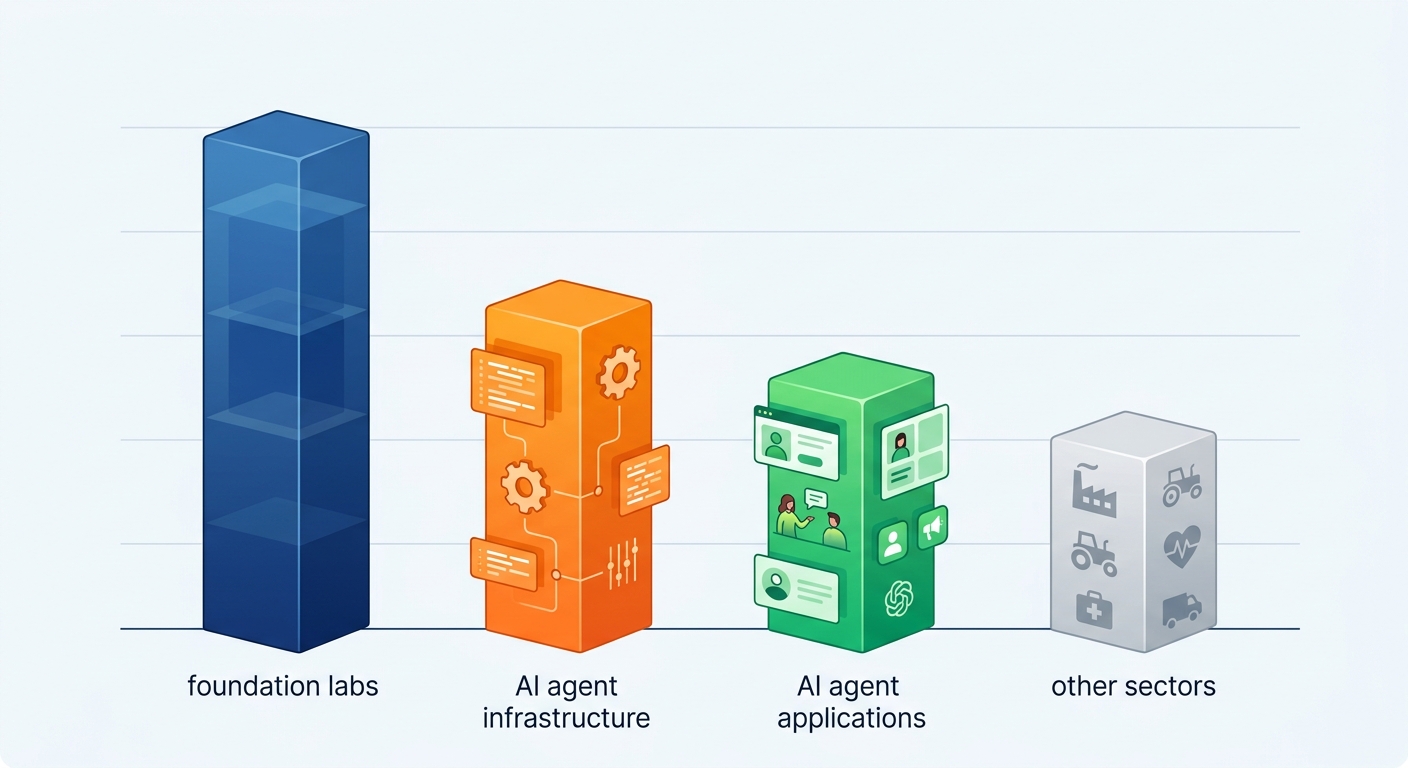
Global venture funding hit $205 billion in Q2, the second-largest quarter ever recorded, according to Crunchbase data. But buried in that figure is a more specific story: a distinct cohort of startups building AI agents — autonomous systems capable of planning, executing, and adapting through complex tasks — collectively raised more than $4 billion in the same period.
That figure is a rounding error against the $65 billion Anthropic raised or the $152 billion OpenAI secured. But for the AI agent ecosystem, it represents something more significant. Investors are no longer simply betting on the models that power AI. They are now betting on the systems that use those models to do real work.
"This is the inflection point," said one partner at a major U.S. venture firm who asked not to be named. "Agents are where mobile apps were in 2009. Everyone knew it was big. Nobody knew exactly how it would shake out."
What $4 Billion Actually Bought
The $4 billion figure is an aggregate approximation of funding rounds where AI agent startups were the primary beneficiary. It spans companies building the infrastructure layer that agents run on, vertical applications in healthcare and professional services, and emerging categories that did not exist two years ago.
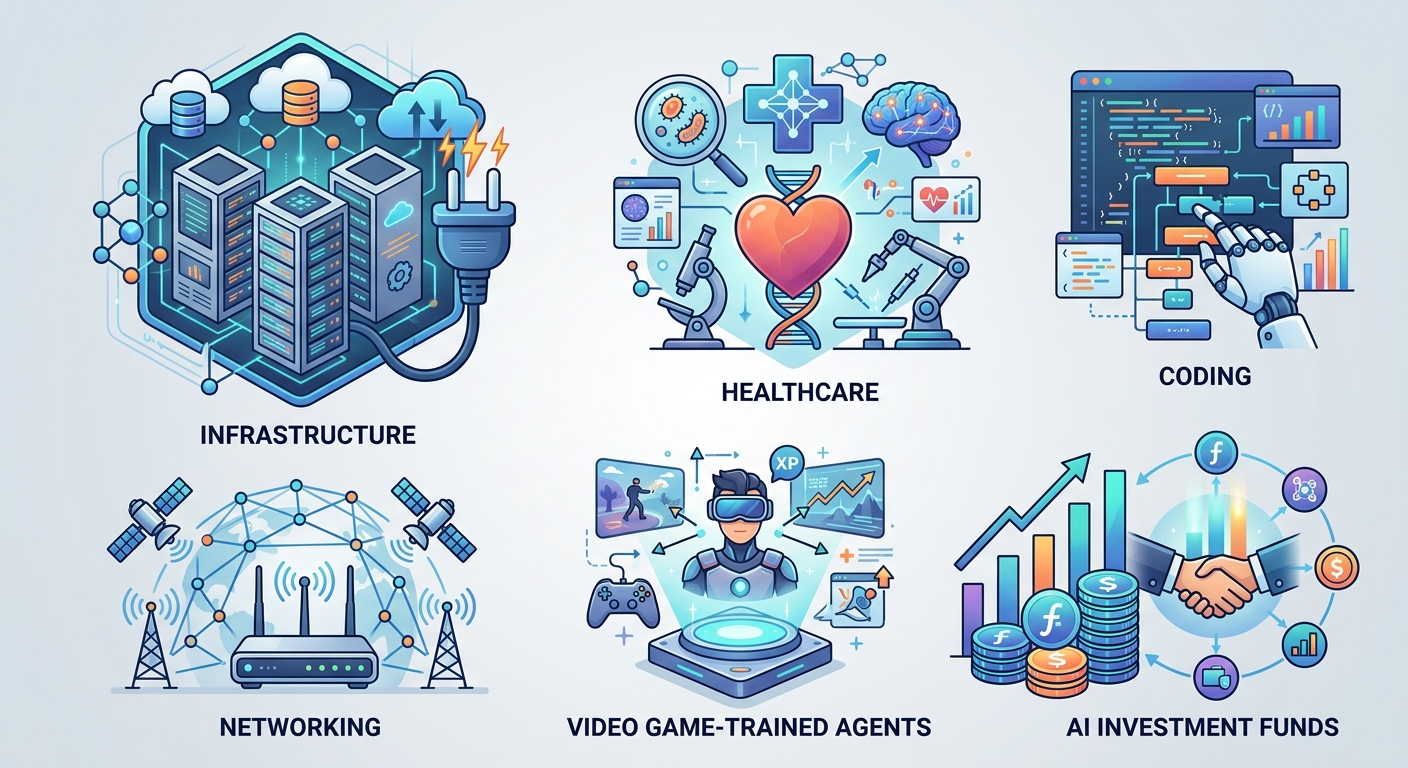
The largest single beneficiary was not a direct agent developer. Together AI, which provides cloud infrastructure optimized for AI inference and agent workloads, raised $800 million in a Series B round. The company's platform is used by agent developers to run large-scale, long-horizon AI tasks that require sustained compute over hours or days — not the seconds-long responses typical of chatbot interactions.
Close behind was Nexthop AI, which secured $500 million to build networking infrastructure specifically designed for AI and cloud data center workloads. As agents increasingly operate in distributed environments and interact with multiple external systems simultaneously, the underlying network layer has become a critical bottleneck. Nexthop's investors agree. The round was led by Sequoia Capital, with participation from Benchmark and Kleiner Perkins.
The healthcare agent segment attracted particular investor enthusiasm. Assort Health raised $120 million in a Series C to expand its patient journey AI agents — systems that guide patients through care scheduling, pre-appointment preparation, and post-discharge follow-up. Trase, which builds controlled AI agents for hospital operations, raised $107 million. Between them, these two companies represent more than $220 million flowing specifically into autonomous healthcare workflows.
General Intuition took a different approach entirely. The company raised $320 million to train AI agents using video game data — a method its founders argue produces agents with better situational awareness and decision-making heuristics than training on text alone. The round was backed by Founders Fund and Andreessen Horowitz.
Also notable: MGX, Abu Dhabi's sovereign AI investment vehicle, closed its first fund at $49 billion, with explicit mandates to invest in semiconductors, agent infrastructure, and AI platforms. While not all of that capital targets AI agents specifically, the fund's positioning signals that national-level investment vehicles view agent infrastructure as a strategic asset class.
The Shift from Chatbots to Agentic AI
The funding numbers reflect a broader pivot in how venture investors evaluate AI companies. For most of the past three years, the dominant question was simple: how good is the model's benchmark performance? Today, the dominant question is becoming: what can the system actually do?
That shift has profound implications for how AI companies are valued. Traditional AI companies — including most large language model providers — are typically valued on metrics like revenue multiples or, more speculatively, on training compute and parameter counts. AI agent companies are increasingly being evaluated on outcome-based pricing: what fraction of a workflow can the agent complete autonomously, and what is that workflow worth?
Outcome-based pricing changes everything. When you charge per task completed rather than per token processed, you align incentives with the customer. That is a much easier sell in the enterprise.
The deal count data underscores the acceleration. Across all funding stages, 65 agentic AI deals closed in the first half of 2026. That is five times the 13 deals recorded in the first half of 2025. Even accounting for increased investor appetite and a broader definition of what counts as an AI agent company, the growth is stark.
Why Now? The Enterprise Adoption Curve
Several factors converged in Q2 2026 to make AI agents suddenly attractive to investors who had previously been cautious.
First, enterprise adoption data started arriving — and it was better than expected. Companies deploying AI agents for sales, customer support, and internal operations reported measurable productivity gains. One large financial services firm told investors that its AI agent deployments had increased sales team productivity by 23 percent in a single quarter.
Second, the technology matured. Agents that could reliably complete multi-step tasks — booking travel, processing insurance claims, conducting preliminary medical triage — crossed a reliability threshold that made them viable for enterprise procurement cycles. Twelve months ago, most enterprise AI agents failed too often for large-scale deployment. That has changed.
Third, the pricing model shift reduced enterprise risk. Outcome-based pricing means the vendor shares downside risk. If an AI agent cannot complete a task, the vendor does not get paid. This has dramatically reduced the internal political friction that often stalls enterprise AI procurement.
"The enterprise buyer used to need six months to get comfortable with an AI tool. With outcome-based pricing, the proof point is built into the contract. You either deliver or you do not get paid."
Andreessen Horowitz led or participated in multiple agent infrastructure rounds. Sequoia Capital backed both Nexthop AI and a handful of undisclosed healthcare agent companies. Thrive Capital made a strategic push into agent-based workflow automation, reflecting its founder's well-known thesis that AI agents represent the next major platform shift in enterprise software.
NVIDIA Ventures continued its infrastructure investing spree, with explicit focus on the compute layer that agents depend on. The logic is straightforward: in a world where millions of AI agents run continuously, demand for GPU compute and networking will grow substantially beyond current projections.
Founders Fund and Kleiner Perkins both made smaller but notable bets on early-stage agent companies, including General Intuition's $320 million round. These rounds reflect a conviction that the agent category is still young enough that differentiated approaches to training and deployment can produce large outcomes.

What Comes Next
The Q2 2026 funding data raises a straightforward question: what does $4 billion buy in terms of actual products?
The honest answer is: it depends. Infrastructure investments like Together AI and Nexthop AI will produce observable results within 12 to 18 months as their platforms scale to meet agent workload demand. Healthcare agents like Assort Health and Trase are already in deployment and should show measurable clinical and operational outcomes within the next two to three quarters.
More speculative bets — General Intuition's video game-trained agents, for example — have longer time horizons. The training methodology is novel and not yet proven at commercial scale.
The broader industry impact is more predictable. As more capital flows into AI agent infrastructure, the cost of building and deploying agents will decline. Lower costs mean more experiments, more startups entering the category, and more enterprise pilots. The flywheel effect should begin to manifest in 2027.
Separately, the SpaceX acquisition of Anysphere — maker of the AI coding agent Cursor — for $60 billion in Q2 offers the most concrete evidence that autonomous coding agents have achieved strategic asset status. The fact that the largest acquisition in startup history involved an AI agent company tells investors that the category has graduated from experiment to core technology.
Risks Worth Naming
No funding boom comes without countervailing risks. Several deserve mention.
Valuation compression is the most obvious concern. Many AI agent startups raised at valuations that assume the market will grow at rates that may not materialize. If enterprise adoption slows or if early agent deployments produce disappointing results, a correction in private market valuations is plausible.
Regulatory uncertainty is a real wildcard. AI agents that make autonomous decisions in healthcare, finance, and legal contexts will face regulatory scrutiny that static AI tools do not. The EU AI Act and emerging U.S. federal guidance on autonomous systems create compliance burdens that could slow enterprise deployment.
AI agent security represents an underappreciated risk. AI agents have broader attack surfaces than traditional software because they interact with external systems, execute multi-step plans, and often operate with elevated permissions. The cybersecurity segment of AI agent startups — companies like Zenity, which raised specifically to secure AI agents — is growing precisely because security has become a blocking item for enterprise procurement.
Finally, capital concentration remains a structural concern. While $4 billion flowing to AI agent startups sounds significant, it represents a small fraction of total AI investment. Most AI agent companies that will exist by 2028 have not yet been founded. The current funding ecosystem still heavily favors a few well-connected startups over the broader long tail.
The Bottom Line
Q2 2026 will be remembered as the quarter that the AI agent thesis became a consensus bet among top-tier venture investors. The $4 billion figure is less important than what it represents: a deliberate, coordinated shift of capital from AI models that generate content to AI systems that plan, act, and deliver outcomes.
Whether that bet pays off in the form of durable companies and transformative products remains to be seen. The infrastructure is building, the enterprise adoption curve is bending upward, and the technology is improving faster than skeptics predicted.
For founders building in the AI agent space, Q2 2026 was a signal: the capital is there, the investors are serious, and the market opportunity is real. For enterprises evaluating AI agent deployments, the same quarter delivered a growing toolkit of specialized providers, improving reliability, and outcome-based pricing models that reduce procurement risk.
The agent economy is not coming. In Q2 2026, it arrived.
Expert Q&A
Q1: Why are VCs suddenly so excited about AI agents specifically, rather than just AI in general?
The excitement comes down to a distinction between AI that generates and AI that executes. Generative AI produces outputs — text, images, code — that humans then use. AI agents plan and act autonomously, completing entire workflows without human intervention at each step. For enterprise buyers, that is the difference between a tool and a workforce supplement. Outcome-based pricing models have made this even more compelling: if an agent can complete 40 percent of a workflow independently, the enterprise can justify headcount reduction or reallocation. That multiplier effect is what investors are betting on.
Q2: Is the $4 billion figure for AI agent startups credible, or is it inflated by broad categorization?
The figure should be treated as directional rather than precise. Many companies that raised in Q2 2026 sit somewhere on a spectrum between "AI infrastructure company" and "AI agent company." Together AI, for instance, provides inference infrastructure that agent developers rely on — it is not itself building agent products. Nexthop AI is a networking company, not an agent company per se. A conservative reading would put direct AI agent application companies at closer to $2–2.5 billion, with the remainder being adjacent infrastructure. Even at that reduced figure, the trend is unmistakable: capital is flowing into the agent ecosystem at a rate that was not present 18 months ago.
Q3: What is "outcome-based pricing" and why does it matter for enterprise AI adoption?
Outcome-based pricing means the AI vendor charges based on a measurable result — a task completed, a workflow resolved, a sale closed — rather than per token or per API call. This matters because it transfers risk from the enterprise buyer to the vendor. If an AI agent fails to complete the task, the vendor does not get paid. This is fundamentally different from the consumption-based pricing that dominates AI APIs today. For enterprise procurement departments, which often require six to twelve months to approve new software, outcome-based pricing dramatically compresses the decision timeline because the proof of value is embedded in the contract structure itself.
Q4: Healthcare AI agents seem to be getting a disproportionate share of funding. Why?
Healthcare has three characteristics that make it exceptionally well suited to AI agent deployment. First, workflows are highly repetitive and rule-structured — scheduling, intake, triage, follow-up — which maps well to current agent capabilities. Second, the cost of errors is quantifiable: a missed follow-up can lead to a readmission, which costs the hospital money under value-based care contracts. Third, healthcare is experiencing a chronic labor shortage, particularly in administrative roles, which creates immediate demand for automation that does not face the political resistance that displacing physicians would face. Assort Health and Trase both focus on administrative and operational workflows, which is deliberate — that is where the ROI is clearest and fastest.
Q5: How concerned should enterprises be about AI agent security?
Very concerned, but not enough to stop deployments. AI agents have fundamentally broader attack surfaces than traditional software or even standard AI models. They interact with multiple external systems, often using elevated permissions. They execute multi-step plans where a compromise at any step can cascade. They handle unstructured data inputs that can be manipulated through prompt injection or data poisoning. The enterprise security community is still developing best practices for AI agent deployments. Companies like Zenity are building dedicated AI agent security tooling, which is a signal that the market recognizes the problem. Enterprises should treat AI agent procurement with the same security review rigor they apply to network access software — and most are not there yet.
Q6: The SpaceX/Anysphere acquisition for $60 billion is the biggest data point in the article. What does it actually tell us?
It tells us two things. First, it tells us that autonomous coding agents have crossed a threshold of reliability and strategic importance where they are now considered core infrastructure by major technology acquirers. Cursor is not an experimental tool — it has reached a penetration level in software development workflows that makes it worth $60 billion to a company that builds rockets and satellites. Second, it tells us that the "agentic" shift is not theoretical. A $60 billion acquisition is the market's way of voting with capital. If autonomous coding agents were a niche curiosity, SpaceX would not have paid that price. The fact that it did suggests that the broader thesis — that AI agents will become a primary way software is built and maintained — has achieved credibility at the highest levels of the technology industry.
Q7: What is the most likely failure mode for the AI agent funding boom?
The most likely failure mode is not technological — it is commercial. AI agents require deep integration into enterprise systems to deliver on their promises. CRM integrations, ERP connections, legacy system access, and organizational change management are all required before an agent can produce meaningful workflow automation. Most AI agent startups are software companies that expect enterprise IT to do the integration work. When that integration work turns out to be expensive, slow, and politically complex, deployment timelines extend and ROI assumptions break down. The result is a wave of enterprise pilots that convert to production at lower rates than investors are projecting. That would trigger a valuation correction in the private market. It would not kill the category — the technology is real and the use cases are genuine — but it would compress valuations and extend timelines significantly.
Key Takeaways
- AI agent startups raised $4B+ in Q2 2026 as investors moved from AI models to AI systems that act autonomously
- Agentic AI deal count surged 5x year-over-year (13 to 65 deals), signaling a structural market shift
- Major rounds included Together AI ($800M), Nexthop AI ($500M), General Intuition ($320M), Assort Health ($120M), and Trase ($107M)
- Outcome-based pricing and improving reliability are driving enterprise AI agent adoption
- Key risks include valuation concerns, regulatory uncertainty, and AI agent security challenges
- The SpaceX/Anysphere ($60B) acquisition proved AI agents have graduated to strategic asset status
Sources: Crunchbase News, Crunchbase Unicorn Board, industry funding trackers, and interviews with venture investors. Specific funding figures are as reported or estimated based on available public data.
Tags: AI agents, agentic AI, AI agent funding, Q2 2026 venture capital, autonomous AI, AI infrastructure, AI agent security, enterprise AI agents, outcome-based pricing, AI startup funding