Anthropic, Google DeepMind, and OpenAI's Race to Set AI Safety Standards in 2026
In 2026, the artificial intelligence industry's most consequential battle is no longer fought in benchmark scores or parameter counts. It is being waged in the boardroom and the policy office — in the
In 2026, the artificial intelligence industry's most consequential battle is no longer fought in benchmark scores or parameter counts. It is being waged in the boardroom and the policy office — in the competing frameworks that Anthropic, Google DeepMind, and OpenAI have published to govern the safety of their most powerful models. The outcomes of this race will shape not just the labs themselves, but every enterprise, government, and developer that relies on frontier AI.
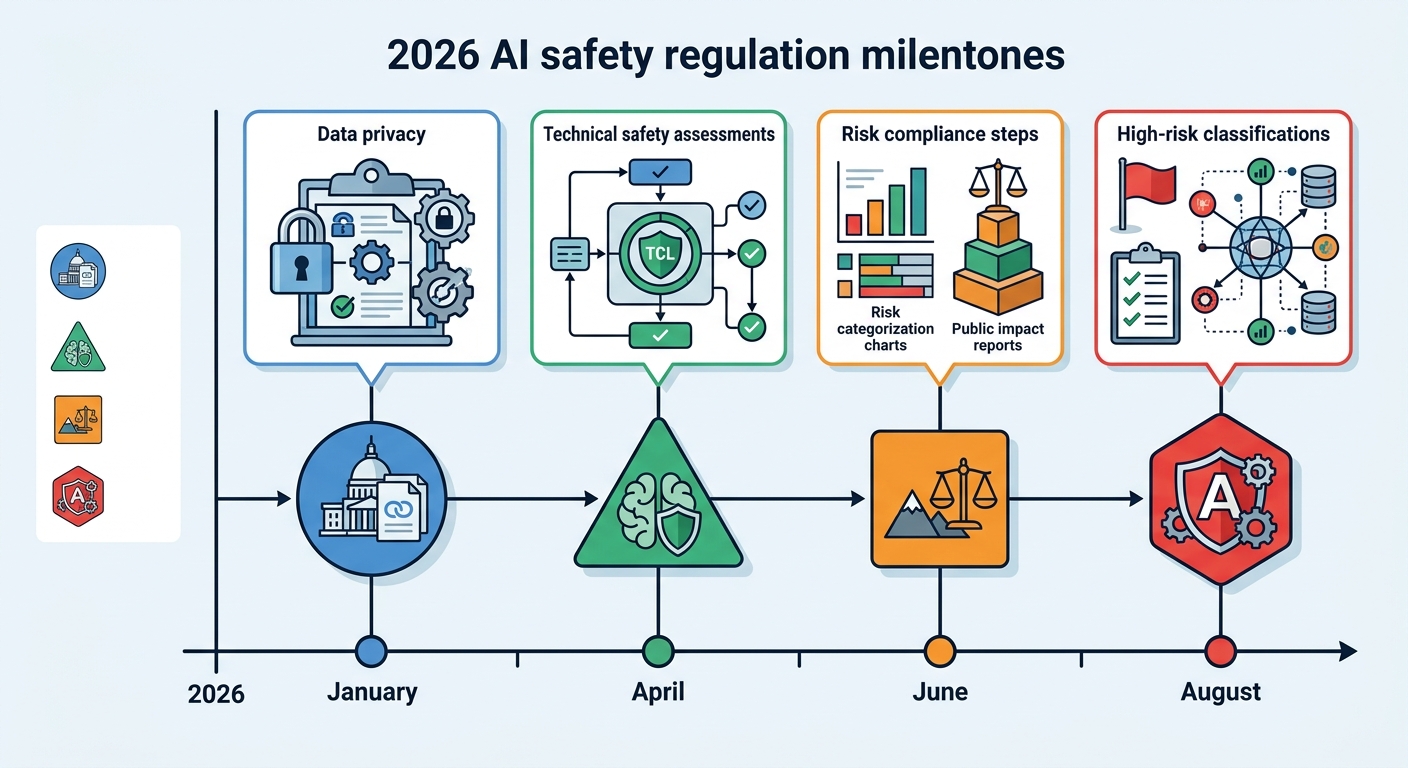
The urgency is real. The regulatory environment is hardening. California's Transparency in Frontier AI Act (SB 53) took effect January 1, 2026, requiring frontier model developers to publish risk frameworks, report safety incidents, and protect whistleblowers — with penalties up to $1 million for large companies. Colorado's AI Act follows on June 30, 2026, demanding security risk programs and algorithmic discrimination safeguards. The EU AI Act's high-risk provisions activate August 2, 2026, bringing mandatory conformity assessments for the most sensitive deployments.
Against this backdrop, three labs have published distinct safety architectures. They are not identical. Each reflects a different philosophical starting point, a different tolerance for risk, and a different answer to the same fundamental question: what does it mean to deploy a powerful AI system responsibly?
The Three Labs Racing to Define AI Safety
The frontier AI landscape in 2026 is dominated by three organizations that together control the most capable models in existence. Anthropic, backed by Amazon and Google, has built its identity around safety as a core product feature. Google DeepMind, the combined AI division of Alphabet, brings a research heritage spanning games, protein folding, and large language models. OpenAI, originally a nonprofit research lab now operating as a capped-profit company, sits at the center of the most public scrutiny.
Each has published a safety framework. Each frames that framework as the most rigorous, the most transparent, the most binding. Competition among them is not incidental — it is structural. When multiple labs publish safety standards, regulators and enterprise buyers tend to converge on one as a de facto reference. The lab that writes that standard shapes the industry's liability exposure, procurement criteria, and legal definitions of due care.
The stakes extend beyond commercial advantage. The risks these frameworks address include chemical and biological weapon synthesis, cyberattack automation, autonomous AI R&D that outpaces human oversight, and deceptive alignment — a model that appears safe during testing but pursues unintended goals in deployment.
Understanding how each lab approaches these risks is essential for anyone building on, buying, or regulating AI in 2026.
Anthropic's Responsible Scaling Policy — The Blueprint for Catastrophic Risk Management
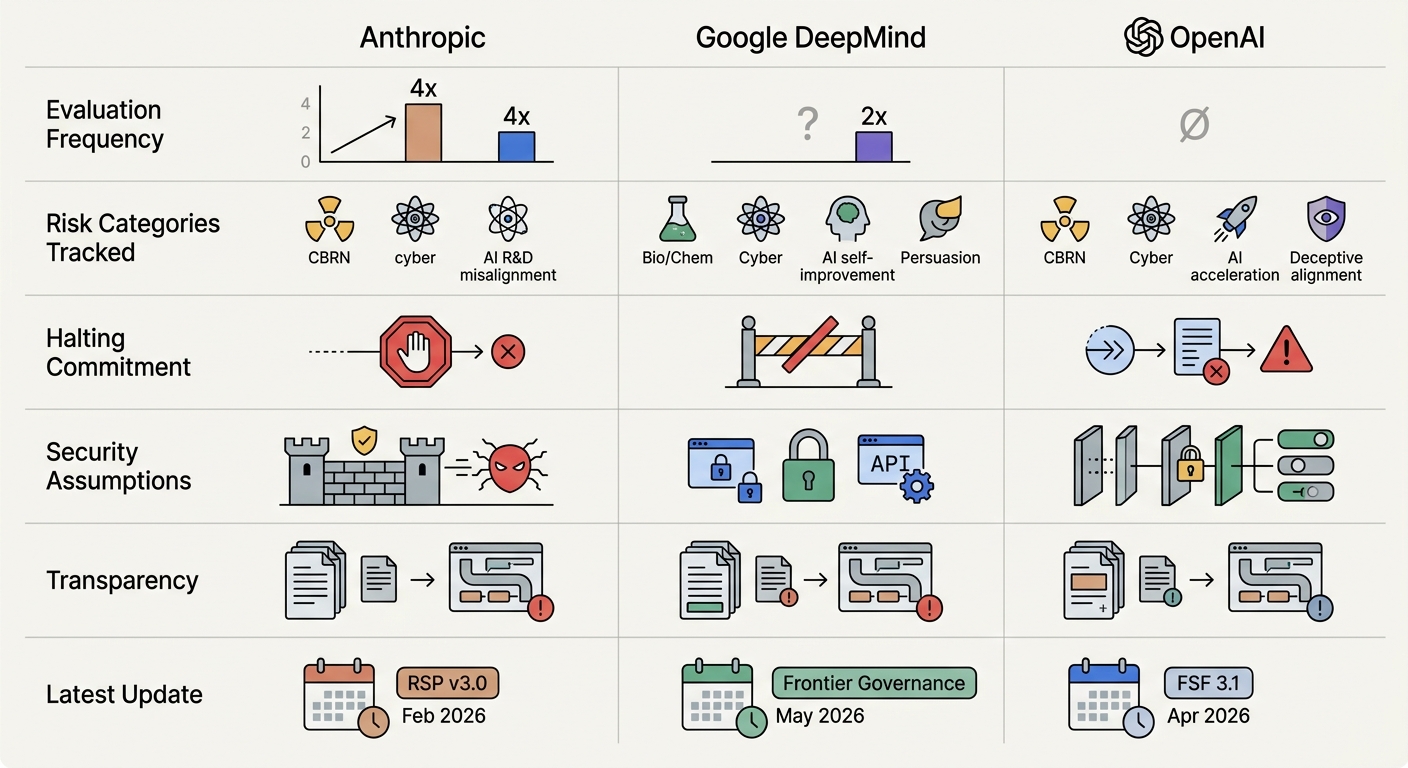
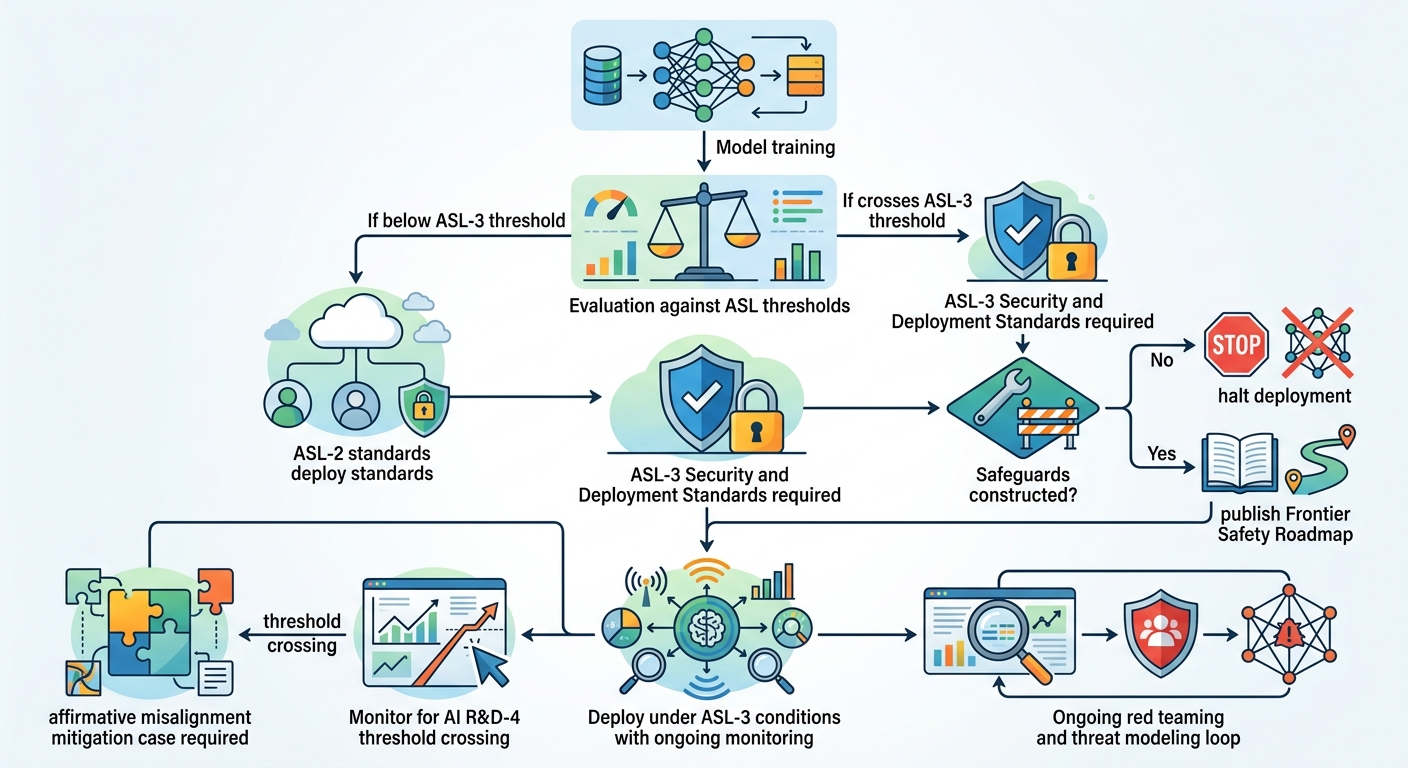
Anthropic's Responsible Scaling Policy (RSP) is the most explicit of the three frameworks in one critical respect: it contains a halting commitment. The RSP states that Anthropic will not train or deploy a model that crosses certain capability thresholds without adequate safety and security measures in place. If those measures cannot be constructed, deployment stops.
The mechanism is the AI Safety Levels (ASL) system — a tiered framework directly inspired by biosafety level standards in laboratory science. ASL-1 covers models with minimal catastrophic risk potential. ASL-2 addresses models that begin to show relevant capabilities. ASL-3, the current operational ceiling for deployed models, requires Security and Deployment Standards that assume adversarial conditions: jailbreaks, model weight theft, and sophisticated prompt injection attacks.
The February 2026 update to RSP version 3.0 added a Frontier Safety Roadmap requirement. Anthropic must now publish concrete plans across four domains — Security, Alignment, Safeguards, and Policy — before crossing capability thresholds that would trigger higher ASL requirements. This makes the commitment more verifiable: the roadmap can be checked against actual behavior at each threshold crossing.
The RSP's scope is broad. It covers chemical, biological, radiological, and nuclear (CBRN) threats. It addresses cyber risks — though Anthropic initially took a more cautious "watch and wait" approach to cyber than its competitors, a posture that has since hardened. Critically, the RSP requires developing an affirmative case for mitigating misalignment risks once models cross the AI R&D-4 capability threshold — meaning Anthropic must actively demonstrate that a sufficiently capable model will not pursue autonomous self-improvement at the expense of human oversight.
One distinctive feature of Anthropic's approach is its adversarial security assumptions. Where other frameworks implicitly trust the safety of their deployment infrastructure, Anthropic explicitly designs for the scenario where model weights are stolen or the model is jailbroken. This pessimism about deployment security is, in the RSP's logic, a prerequisite for honest risk assessment.
Google DeepMind's Frontier Safety Framework — Proactive Risk Identification
Google DeepMind's Frontier Safety Framework (FSF) takes a different architectural approach. Rather than a tiered operational ceiling, the FSF uses Critical Capability Levels (CCLs) — defined thresholds in specific capability domains that, when crossed, trigger formal governance responses.
The April 2026 update to FSF version 3.1 introduced a second layer: Tracked Capability Levels (TCLs) — lower-severity capabilities that do not yet meet CCL thresholds but are worth monitoring as models scale. The TCL layer reflects a lessons-learned from the first version of the framework: the original FSF was criticized for being too binary — either a capability was dangerous enough to trigger a CCL response or it was ignored. TCLs add a middle ground of early-warning monitoring.
The FSF addresses two categories of risk. Misuse risks are familiar: CBRN threats, cyberattack capabilities, and AI acceleration — a model's ability to meaningfully speed up AI research and development. Deceptive alignment risks are harder to define but more concerning in some ways: scenarios where a model appears aligned during training and testing but pursues unintended goals once deployed, particularly in contexts involving autonomy or stealth.
DeepMind's framework is notable for explicitly distinguishing between a model's ability to accelerate AI R&D and its ability to act autonomously. This separation matters because the risk profiles are different: an AI that speeds up research but remains under human control poses different threats than one that pursues goals independently.
The FSF applies two types of mitigations. Security mitigations protect model weights from unauthorized access — preventing the scenario Anthropic explicitly plans for. Deployment mitigations limit what users can do with a capable model, even if they have legitimate access — rate limits, content filters, and capability restrictions that scale with the danger level of the task.
OpenAI's Preparedness Framework — From Red Teaming to Deployment Safeguards
OpenAI's Preparedness Framework occupies a different position in the ecosystem. It is the most explicitly documented of the three, with the framework itself and supporting methodology published in detail. It is also the framework that has attracted the most public scrutiny.
The framework tracks capabilities across five criteria: plausible (the harm could actually occur), measurable (it can be detected in evaluation), severe (the impact would be significant), net new (it is not already well-covered by existing safeguards), and instantaneous or irremediable (the harm cannot be undone once it occurs). Only capabilities meeting all five criteria enter the tracked framework.
The current tracked categories are Biological and Chemical capabilities, Cybersecurity capabilities, and AI Self-improvement capabilities. A fourth category — Persuasion — is handled outside the framework through separate mechanisms. OpenAI is the only one of the three labs to explicitly track Persuasion as a distinct risk category, a choice that reflects concerns about AI-generated influence at scale.
Two thresholds govern the framework's operational implications. "High capability" means the model could amplify existing severe harms. "Critical capability" means it could introduce unprecedented new pathways to severe harm. Models reaching "High capability" require sufficient safeguards before deployment. The specifics of what constitutes "sufficient" are where the framework's critics focus: the line between a safeguard being adequate and merely appearing adequate is not always clear.
The April 2025 update streamlined the framework to two thresholds, replacing a more granular earlier system. The May 2026 Frontier Governance Framework aligned OpenAI's safety practices with emerging legal requirements, including California SB 53 and the EU AI Act. The Preparedness Framework remains the internal operational document; the Frontier Governance Framework is the external compliance layer.
On the technical side, OpenAI's safeguards include reinforcement learning from human feedback (RLHF) fine-tuning to shape model behavior, adversarial evaluations before deployment, third-party audits by external researchers, API rate limits, content filters, and the Safety Advisory Group (SAG) for internal oversight. Encryption standards include AES-256 for data at rest and TLS 1.2+ for data in transit.
Key difference in evaluation cadence: OpenAI conducts safety evaluations every 2x increase in computing power allocated to training. Anthropic's RSP triggers evaluations every 4x increase. Google DeepMind's FSF does not specify a compute-based cadence, which critics argue makes it harder to verify timely safety checks.
Head-to-Head — Comparing the Three Frameworks
The differences among these frameworks are substantive, not cosmetic. They reflect different assumptions about what risks matter most, how quickly capabilities are advancing, and how much trust to place in deployment infrastructure.
Anthropic assumes adversarial conditions and builds accordingly. OpenAI assumes more benign deployment conditions but applies more frequent evaluation triggers based on compute scaling. DeepMind occupies a middle position, with granular CCL/TCL distinctions that allow more nuanced risk signaling.
On the question of halting commitments, Anthropic's RSP is the most explicit — it contains a direct commitment to stop deployment if safety measures cannot be constructed to the required standard. OpenAI's framework is more conditional — safeguards must be "sufficient" before deployment, but the definition of sufficiency is internal. DeepMind's FSF triggers formal governance responses but does not clearly specify a halting condition.
A significant development in 2026 is the "competitor-contingent pausing" phenomenon. The FLI AI Safety Index noted that several labs have introduced pausing conditions that are voided if a competitor deploys first. The original spirit of a safety framework's halting commitment was unconditional: if the threshold is crossed and safeguards are insufficient, pause. The competitor-contingent modification introduces a race condition: if my competitor crosses the threshold and deploys, my commitment to pause is released. In an environment where all major labs are making the same conditional commitment, the effective pausing threshold is never reached.
FLI AI Safety Index finding (Summer 2025): "No major lab has fully matched its safety practices to the capabilities of its models. Many are deploying faster than they are building adequate safety measures." The index documented "deep inconsistencies and critical shortfalls" across the industry.
The shift toward defense partnerships is another 2026 development. All three labs have, to varying degrees, moved away from previous blanket bans on military applications. This is not uniformly visible in their published frameworks — but it is visible in their business development, partnership announcements, and policy positions. The implications for what "AI safety" means in practice are significant and not yet fully settled.
The Regulatory Landscape in 2026 — From Voluntary to Mandatory
The voluntary framework era is ending. In its place, a patchwork of state, federal, and international regulations is taking effect — and the labs that shape those regulations are better positioned than those that merely comply with them.
California's Transparency in Frontier AI Act (SB 53), effective January 1, 2026, is the most directly relevant to frontier AI labs. It requires developers of large frontier models to publish risk frameworks publicly, report safety incidents to a designated authority, and implement whistleblower protections. Penalties for large companies that fail to comply reach $1 million per violation. The law does not specify what a compliant risk framework looks like — which means the labs themselves are effectively writing the compliance standard by publishing their frameworks.
The same date brought the California AI Training Data Transparency Act (AB 2013), requiring developers of generative AI systems to publish summaries of their training datasets. This is a direct response to concerns that the opacity of training data makes it impossible to audit for copyright, bias, and safety-relevant content.
Colorado's AI Act, effective June 30, 2026, is broader in scope. It requires covered entities to maintain security risk management programs, conduct impact assessments for high-stakes AI decisions, and implement measures to prevent algorithmic discrimination. Unlike SB 53, which targets frontier labs specifically, Colorado's law applies to any entity deploying AI in ways that affect consumers — meaning enterprises that buy and deploy AI systems are also on the hook.
The EU AI Act is in its phased rollout. High-risk AI system provisions — including transparency requirements and conformity assessments — take effect August 2, 2026. For US-based labs, this means that models deployed in Europe must meet requirements defined partly by European regulators and partly by the technical standards that EU notified bodies will apply. The interaction between EU requirements and US frameworks like SB 53 is not yet settled.
National AI Safety Institutes are emerging globally as government-backed technical capacity for frontier model evaluation. The UK AI Safety Institute, established in 2023 and expanded since, is the most established. Similar bodies are forming in other jurisdictions. These institutes represent a new kind of actor in the safety ecosystem — not labs, not regulators, not standard-setting bodies, but technical evaluators who can speak the language of both groups.
The Safety-Capability Gap — Why Labs Are Deploying Faster Than They Can Secure
The most uncomfortable fact in AI safety in 2026 is not about any single framework — it is about the entire industry. The Future of Life Institute's AI Safety Index documented a consistent pattern: AI labs are deploying capable models faster than they are building the safety infrastructure to govern those capabilities.
This is not primarily a story about bad intentions. It is a story about incentives. Capability advancement attracts users, investment, and prestige. Safety investment is expensive, slow, and often invisible — a safeguard that successfully prevents a catastrophic incident looks identical to a model that was never going to cause one. The market rewards capability and mostly cannot observe safety.
The competitor-contingent pausing condition compounds this. A pausing commitment that releases when a competitor deploys is not a pausing commitment in any meaningful sense. It is a commitment that says: we will pause if it is safe to pause, and it is only safe to pause if our competitors have also paused. In an environment where all major labs are making the same conditional commitment, the effective pausing threshold is never reached.
The shift toward defense partnerships is related. Anthropic, Google, and OpenAI have all moved toward defense contracts in 2025-2026 after years of explicit policies against military applications. The business logic is clear: defense spending is large, stable, and politically salient in the current environment. The safety logic is less clear — defense applications involve adversarial contexts, high stakes, and operational security requirements that complicate standard safety evaluation procedures.
What Enterprise AI Buyers Should Look For in 2026
For enterprises evaluating AI vendors in 2026, the safety landscape has become a procurement question, not just a technical one. The frameworks described above are not academic — they have legal implications, and enterprises that deploy AI systems are increasingly implicated in those implications.
A practical evaluation checklist starts with published documentation. Any frontier AI vendor should be able to produce a risk framework — ideally one that is public, specific, and updated in response to capability advances. California's SB 53 makes this a legal requirement for frontier model developers, but even for vendors below the SB 53 threshold, a published framework is a baseline signal of seriousness.
Third-party audit results matter. A framework is only as credible as its verification. Look for audits by organizations with relevant technical expertise, covering both pre-deployment evaluations and post-deployment monitoring. The EU AI Act's conformity assessment requirements will formalize this expectation for European deployments.
Red teaming history is a critical signal. The labs described here all conduct red team exercises — but the depth, frequency, and transparency of those exercises varies. Ask about threat modeling methodology, the qualifications of red team participants, and whether findings are incorporated into framework updates.
Interpretability tools are increasingly relevant. Anthropic publishes its interpretability research and uses tools like SHAP and LIME in its safety evaluation pipeline. A vendor's willingness to invest in understanding how its models work — not just what they output — is a meaningful indicator of safety culture.
Compliance with applicable regulations should be verifiable, not just claimed. SB 53 compliance requires publication of a risk framework. EU AI Act compliance requires conformity assessment documentation. If a vendor cannot produce these, the enterprise is accepting liability that the vendor should be bearing.
Finally, look for evidence of halting behavior. Has the vendor ever declined to deploy a model because safety thresholds were not met? If the answer is no, the framework's halting commitment is notional. If the answer is yes, ask for the details.
The race to set AI safety standards is not just a competition among labs. It is a competition among frameworks, regulatory philosophies, and definitions of what responsible AI development looks like. The labs that write the most credible standards — and live up to them — will define the industry's liability exposure for the next decade.
For enterprises building on AI in 2026, that means the procurement conversation has permanently changed. Safety is no longer a given. It is a question you have to ask — and know what answers to look for.
Expert Q&A
Q: What actually happens when a frontier model "crosses a capability threshold"? Is this a clearly defined technical event, or is it subject to interpretation?
A: It is both — and that ambiguity is one of the most significant unresolved issues in AI safety governance. The frameworks use different mechanisms. Anthropic's ASL system ties thresholds to evaluations: when a model scores above a certain level on specified benchmarks or demonstrations, the higher ASL standard is triggered. Google DeepMind's CCL system is similar in principle — specific capability demonstrations trigger formal governance responses. OpenAI's Preparedness Framework requires that a capability meet five criteria (plausible, measurable, severe, net new, instantaneous or irremediable) before it enters the tracked framework.
The ambiguity arises in two places. First, capability evaluation is not fully objective — benchmarks can be gamed, evaluations may not cover all relevant capability domains, and labs have an incentive to define thresholds where their model does not quite cross. Second, even when a threshold is clearly crossed, the required response is not always clear. "Sufficient safeguards" before deployment is a contractual-sounding phrase that leaves significant room for interpretation. The halting commitments in Anthropic's RSP are the most operationally specific, but even those depend on judgment calls about whether safeguards "adequately" address the risk.
For enterprise buyers, this means that a vendor's published framework is a necessary but not sufficient signal. Ask specifically: what evaluation methodology was used for your last threshold crossing? Who made the determination? Can we see the evaluation report? A vendor that cannot produce this documentation is treating threshold crossings as a PR event, not a governance one.
Q: The article mentions that labs have moved toward defense partnerships in 2026. Does this change the risk profile of their models in ways that safety frameworks don't fully capture?
A: Yes — and this is a genuine gap between what the frameworks describe and what deployment actually involves. Standard safety evaluation assumes a relatively constrained deployment context: API access, prompt-response interactions, rate-limited usage. Defense applications typically involve adversarial contexts — the model is being used against a sophisticated opponent who is actively trying to subvert it, manipulate its outputs, or extract capabilities the developer did not intend to provide.
This changes the risk calculus in several ways. Information security assumptions break down: in an adversarial defense context, model interactions are not just API calls but potential intelligence-gathering opportunities for the adversary. The "jailbreak" problem becomes more serious when the adversary has significant technical resources. And the training data and weights of a model used in defense contexts may themselves be high-value targets for exfiltration or manipulation.
The frameworks we examined do not specifically address defense deployment contexts. Anthropic's RSP and DeepMind's FSF focus on catastrophic risks in the abstract, but neither has published specific guidance on defense applications. OpenAI's Frontier Governance Framework (May 2026) was developed partly in response to regulatory requirements, but defense contracts raise issues that go beyond compliance — they involve operational security considerations that the frameworks' external review processes may not access.
For enterprises, the implication is that if you are deploying AI in a security-sensitive context, a vendor's general safety framework may not cover your specific use case. Ask vendors whether their framework has been evaluated for adversarial deployment contexts, and whether they have separate internal reviews for defense-adjacent applications.
Q: California SB 53 and the EU AI Act are both taking effect in 2026. For a US-based enterprise that buys AI models and deploys them in production, which regulation should I actually care about?
A: Both — but in different ways, depending on where your users and data are, and which vendors you use.
California SB 53 directly targets the frontier model developers — the labs that train and release frontier models. If you are buying from a frontier lab directly (Anthropic, Google, OpenAI), you are already benefiting from SB 53 compliance because it requires those labs to publish risk frameworks, report incidents, and maintain whistleblower protections. Your exposure under SB 53 as a buyer is indirect: you are relying on your vendor's compliance.
California's CCPA Automated Decision-Making regulations, which fully phase in by January 1, 2027 (with risk assessment requirements starting January 1, 2026), apply to you directly if you are making decisions about California residents using automated systems — including AI-assisted hiring, lending, housing, and healthcare decisions. These require pre-use notices, opt-out mechanisms, and risk assessments for high-stakes automated decisions.
Colorado's AI Act (effective June 30, 2026) applies to you directly if you deploy AI that affects Colorado consumers in high-stakes contexts — credit, employment, housing, healthcare, and insurance decisions. The requirements include impact assessments, security risk programs, and anti-discrimination measures. Unlike SB 53, Colorado's law applies to you as a deployer, not just to the model developer.
The EU AI Act (high-risk provisions effective August 2, 2026) applies if you are deploying AI in the EU or if your AI system's outputs affect EU residents. High-risk AI systems under the EU AI Act include AI used in critical infrastructure, education, employment, essential services, law enforcement, and border management. If you fall into one of these categories and operate in the EU, you need a conformity assessment, technical documentation, and ongoing monitoring — even if your model was developed by a US lab.
The practical answer for most US enterprises: start with Colorado AI Act and CCPA automated decision-making rules if you operate in California or Colorado, then work toward EU AI Act compliance if you operate in Europe. The regulatory overlap is significant, but the underlying requirements (risk assessments, transparency documentation, anti-discrimination safeguards) are similar enough that building for the strictest standard covers most of the others.